Archive for the ‘Politics’ Category

From threats to bomb Assad, Obama bombs Assad’s enemies a year later

September 23, 2014

What a difference a year makes.

In September last year Barack Obama and John Kerry were drawing red lines in the sand and threatening to bomb Bashar al-Assad. They never did.

And Obama – with his coalition against evil – is now bombing Assad’s enemies in Syria.

NYT:

The United States and allies launched airstrikes against Sunni militants in Syria early Tuesday, unleashing a torrent of cruise missiles and precision-guided bombs from the air and sea on the militants’ de facto capital of Raqqa and along the porous Iraq border.

American fighter jets and armed Predator and Reaper drones, flying alongside warplanes from several Arab allies, struck a broad array of targets in territory controlled by the militants, known as the Islamic State. American defense officials said the targets included weapons supplies, depots, barracks and buildings the militants use for command and control. Tomahawk cruise missiles were fired from United States Navy ships in the region.

The strikes are a major turning point in President Obama’s war against the Islamic State and open up a risky new stage of the American military campaign. Until now, the administration had bombed Islamic State targets only in Iraq, and had suggested it would be weeks if not months before the start of a bombing campaign against Islamic State targets in Syria.

Bahrain, Jordan, Qatar, Saudi Arabia and the United Arab Emirates took part in the strikes, American officials said, although the Arab governments were not expected to announce their participation until later Tuesday. The new coalition’s makeup is significant because the United States was able to recruit Sunni governments to take action against the Sunni militants of the Islamic State. The operation also unites the squabbling states of the Persian Gulf. ….. 

Assad will surely spin this as support for his regime. That may not be the primary intention of the air strikes but he will surely be strengthened by the attacks on the most potent of his many enemies

I think ISIS does need eradicating but it needs to be by the Sunni Muslim world in the first instance. I cannot help but wonder which of Obama’s moving red lines was crossed now by ISIS which was not crossed earlier by Assad. The difference of course is that bombing ISIS is – politically – almost risk-free for the US President. Vladimir Putin will not protest and neither will Netanyahu. Even Iran will be quite happy with this attack on Sunni extremists opposed to Assad. Even the EU will support – though the position of the EU is largely irrelevant for the US. But air strikes alone will not eradicate ISIS or bring much greater order to the chaos in Iraq and Syria.There is a real risk of the chaos being extended – geographically and in time – but Obama’s final term has not long left to run.

The entropy of the chaos increases.

Barack Obama will be remembered not  as a leader with any clear principles but merely as the first black President of the US and for whom principles were always subordinated to his fear of risks. Courage will not be associated with his terms in office.

“Yes. We can” will become “Well, I tried..”.

South East Asia vary of Chinese nationalism and a return of the Maritime Silk Road

September 22, 2014

The Chinese vision of a Maritime Silk Road is based on the seven great voyages of Admiral Zheng He in the time of the the Yongle Emperor (1360 – 1424), the third Emperor of the Ming dynasty.

The admiral of all seven fleets was Zheng He, the great-grandson of a Mongol warrior. His original name was Ma Ho, the Chinese version of Muhammad, for his father was a Muslim who had made the pilgrimage to Makkah. In 1404, the emperor conferred on him the honorific Zheng, and he was appointed Grand Eunuch, thenceforth to be known as Zheng He. ….

From the point of view of geographical discovery, the Ming voyages must rank as the earliest state-sponsored effort to seek out new lands, markets and spheres of political influence. That the same idea occurred to the rulers of both the Far East and the “Far West” almost simultaneously is intriguing, and it shows that—long before the emergence of a “global economy” in the late 20th century—East and West were responding to the same rhythms of political and economic change.

Zheng He 7 voyages - National Geographic

Zheng He 7 voyages – National Geographic

The reestablishment of the Chinese Maritime Silk Road is said to be a pet project of President Xi Jinping who is a scholar of Chinese maritime history and an admirer of Admiral Zheng He. Even before the Ming dynasty there was extensive maritime and cultural commerce between South India and China during the Song and Yuan dynasties. But the maritime routes withered after Zheng He and left the area open for the Potuguese in the 16th century and later for the French, Dutch and the British who followed. The Maritime Silk Road was among the items to be discussed by President Xi with Narendra Modi on his recent visit to India.

New Delhi is abuzz with speculation that President Xi Jinping could raise the issue of Maritime Silk Road (MSR) during his visit to India this week and explore business, investments and trade opportunities for China in India. At least three reasons can be identified to uphold the above assumption; first, the issue of MSR was raised during President Hamid Ansari’s visit to China in July this year and the Indian side had indicated that New Delhi would examine the idea. The Chinese would be keen for a response from the Indian side and India may push for the BCIM (Bangladesh, China, India and Myanmar) corridor to which it has offered wholehearted support and it serves the interests of all the partners.

The second reason is that the MSR is a pet project of the Chinese President and is believed to have been driven by his knowledge of ancient Chinese cultural and trade connections with the outside world. Apparently, between 1985 and 2002, Xi had personally taken interest in the Quanzhou Maritime Museum, and according to the curator, Xi had perused through the ancient historical records, artifacts and exhibits at the museum and may have ‘learnt a lot about China’s maritime history’ which could have been the driver for his interest in MSR. Xi even secured substantial government grants for the museum. Incidentally, Quanzhou is home to several ancient shrines and temples built by Tamil communities who had established trading contacts with the Chinese during the Song (960-1279) and Yuan (1279-1368) periods. Given his knowledge of ancient maritime trade and cultural connections between India and China, Xi may recall the cultural and Buddhist connections between the two countries. It is pertinent to mention that China has committed US $1 million for the Nalanda University.

While India is not averse to some parts of the Maritime Silk Road being reestablished, others – and especially Vietnam – are very suspicious of Chinese intentions.

Maritime Silk Route

Maritime Silk Route

Most countries have maritime disputes with China in the South China Sea, but also see a threat to liberty, security and maritime safety at sea.

The restoration of “Silk Road on the Sea” is both an ancient ambition of the leaders in Beijing, and a symbol of Chinese nationalism. So it hides a lot under what seems beneficial to the surrounding neighbors of China. The essence of Chinese intentions in the idea of ​​building “new silk road” at sea are:

Firstly , create a new order in which coastal neighbors follow a trajectory operated and dominated by the Chinese. The “Silk Road on the Sea” is part of the  “string of pearls” master plan to transform China into a maritime power and compete with American superpower.

Secondly , “Silk Road on the Sea” is a diplomatic tool to execute foreign policy with China’s neighbors. Through the use of “Silk Road on the Sea”, the Chinese are trying to create a soft image, useful for the rise and expansion of its influence.

Thirdly , “Silk Road on the Sea” provides an opportunity for China to promote its policy of “setting aside dispute and pursuing joint development” so as to exploit marine resources in the region, especially energy resources of oil and gas. 

Fourth , the initiative “Silk Road on the Sea” is to further the territorial claims on islands by China. Successful implementation of the initiative “Silk Road on the Sea” will create conditions favorable for the presence of the Chinese coast guard  especially the South China Sea, the Strait Malacca, Indian Ocean, and help to expand Chinese maritime influence and enhance the influence of its military on the sea. … As with ancient Zheng He’s voyage the objective is “to establish and enforce sovereignty “over the Paracels and Spratlys (of Vietnam). To justify its claims to sovereignty. China will continue to use the “Silk Road on the Sea” for aggressive actions in the South China Sea make the situation hotter and more physical.

Fifth , China will use initiative “Silk Road on the Sea” to implement a divide and rule policy of the neighboring countries. There may be the possibility that some countries will be attracted to the immediate economic benefits, are willing to overlook the problem rules and norms of international law to support the initiative “Silk Road of the Sea ​​”of China that will harm the interests of the country which has sovereignty disputes with China over some island. On the other hand, this does not exclude the possibility that China will increase the pressure and aggression with countries that do not support the initiative “Silk Road on the Sea”.

Sixth , the initiative “Silk Road on the Sea” also aims to push the United States and the Western countries out of the area. This initiative is important in order for the policy to “rebalancing strategy in Asia – Pacific region” of America. On the economic front, “Silk Road on the Sea” is to fight Agreement Trans-Pacific economy (TPP) of the United States. Thus, one can see “Silk Road on the Sea” China will make competition between the United States and China increasingly fierce.

Once the “Silk Road on the Sea” is formed China will set out new rules to force other countries to comply; China will act unilaterally ignore international law. The actual situation in the South China Sea has proven time over this. Seen from this perspective, the “Silk Road on the Sea” is not only a threat to the security and territorial sovereignty of neighboring countries, especially countries with maritime disputes with China in the South East, but also a threat to freedom, security and safety of navigation at sea.

China has officially put the materials to build the concept of “Silk Road on the sea at a meeting of Senior Officials (SOM) ASEAN – China. ASEAN countries have not yet responded. …..

For Vietnam, the initiative “Silk Road on the Sea” is a challenge to the sovereignty of the islands of Vietnam just as Zheng’s ships in ancient times were used as an argument concerning the sovereignty of archipelagos Sa and Truong Sa of Vietnam.

But Malaysia, while still vary, is tempted by the possibilities of development on the relatively under-developed East coast in Kuantan.

More than 600 years ago, the legendary Ming Dynasty diplomat Admiral Zheng He made seven epic journeys to the West via a route known as the maritime Silk Road.

First used in the Qin and Han Dynasties (AD 25-220), the nautical passageway connected the ports of south China to Southeast Asia, India, Arabia and Africa. Silk, china, tea and spices exchanged hands from Guangzhou, the starting point, to the countries around the Gulf. 

Now, China is proposing to rebuild this centuries-old seaway into a 21st century maritime Silk Road. Kuantan, on the east coast of Peninsular Malaysia, is hoping that modern day Chinese vessels will share Zheng’s assessment when he landed here in the 15th century: that this city facing the South China Sea is an ideal gateway to the region and beyond.

Located 250 kilometers from the capital city of Kuala Lumpur, Kuantan is the east coast’s economic hub and its most modern city; although by no means as cosmopolitan as its west coast sisters. The capital of the state of Pahang is being developed into an integrated logistics and industrial hub for the East Coast Economic Region (ECER), a major project by the Malaysian government to decentralize economic activities.

Crucially, it provides fast access to China through its namesake port. The multipurpose, deep-sea port serves the resource-rich hinterland of the east coast and is a leading petrochemical hub port and container terminal for that part of the peninsula.

Sweden votes “against”, but what is Sweden “for”?

September 15, 2014

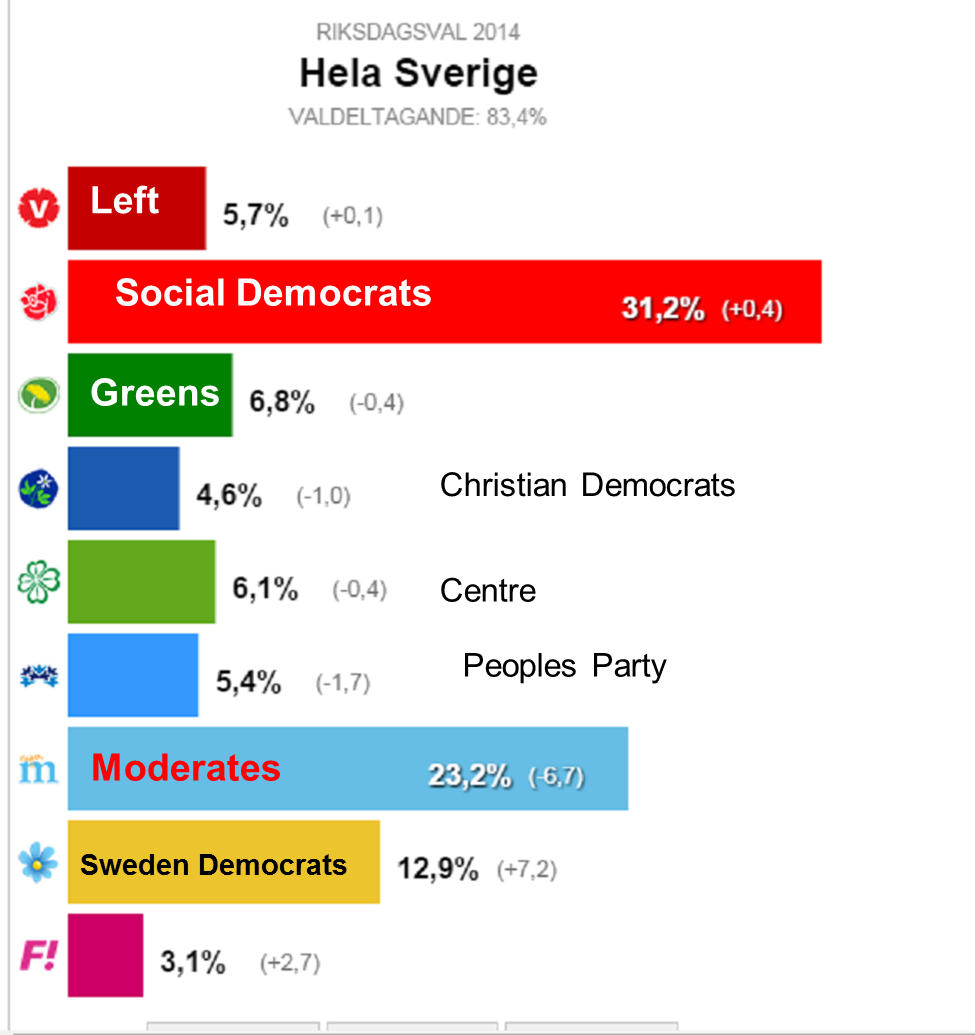
It was quite a high turnout at 83.4% in the general election.

The results show that Sweden has voted “against” many trends but has not really voted “for” anything. The left (red-red-green) will govern while the far-right show the greatest gains. Perhaps this is an indictment of all parties in that none succeeded in presenting any compelling vision of the future. 

After 8 years in power, the free market Alliance have lost power quite decisively, but the Social Democratic block (including the Environment and the Left Party) while clearly the largest grouping, are quite a bit short of an absolute majority. The Moderates lost 6.7% of the vote share. The clear gain is for the anti-Europe, anti-immigration, nationalistic, neo-Nazi party the Sweden Democrats who have more than doubled their vote from 5.7 to 12.9% – a gain of 7.2%. The Social Democrats actually gained virtually nothing (+0.4%). The losers are the small right-of-centre parties supporting the Moderate coalition in government (the Centre Party, Peoples Party and the Christian Democrats). The Environmental Party also lost a bit but will find itself in government anyway. The top 3 parties cover 67% of the vote. As much as 30% of the vote share is split between 6 parties with less than 7% share each. The Left Party (erstwhile communists) are now absolutely necessary to the Social Democrats and may well even be formally in government.

The Feminine Initiative were neither here nor there and ended up as being yet another “spoiler” party.

Sweden election 2014 - graphic from SvD

Sweden election 2014 – graphic from SvD

So a very fractured picture emerges but what strikes me is that voters have generally voted “against” trends they do not like far more than voting “for” anything. Maybe it is simplistic but my reading of the results is that Sweden has expressed strong opposition to:

  1. European meddling in Swedish society
  2. EU bureaucracy
  3. Further immigration (but not necessarily against immigrants)
  4. the Euro
  5. profit – rather than quality – as the basis of health care
  6. profit – rather than quality – as the basis of elderly care
  7. profit – rather than quality – as the basis of schools
  8. ideology in environment

But what Sweden is in favour of is not at all clear.

It will not be easy for the Social Democrats to build a stable government which has any clear direction. The votes “against”  do not allow any block to find a clear way forward – in any direction. Nobody wants to treat – visibly – with the Sweden Democrats. Their votes “for” anything are of little value in themselves and provide neither opportunity or risk to anybody else. They have not the power to get their proposals accepted but they will have the parliamentary votes to stop many things.

I am afraid that we have 4 years of horse-trading and vacillation and drift ahead.

Sweden’s general election – unsatisfactory choices in a quiet campaign

September 11, 2014

Sweden goes to the polls on Sunday for its four-yearly general election (parliamentary, county level and municipal level). Even though there are sporadic efforts to inject some excitement into the proceedings, excitement is notably lacking. But engagement is not and a fairly high turn-out can be expected – thought it will probably be slightly lower than 4 years ago. We shall be voting and I – for one – am quite happy that the noise and the circus of an Indian or a US election will be absent. I am also quite happy that the nastiness (but stupid nastiness) of a UK election will also be missing. I find nastiness in campaigning can be mitigated to some extent if there is some cleverness involved but the campaigns of all the various parties in Sweden are not nasty but neither are they very inspiring or very clever.

The only little “excitement” has been the “shock” disclosures by the Expressen newspaper about the various members of the neo-Nazi, right-wing, nationalistic Swedish Democrats who have been busy making anonymous, nasty, racialist and anti-zionist comments on the internet on a number of “hate” sites. But there has not been much shock involved. Their attempted nastiness is only to be expected. The Swedish Democrats remain largely a party of “junkies and hooligans” but the party leader, Jimmy Åkesson, is actually the most personable of all the party leaders on display and more articulate than most.

Though quiet campaigns are much to be desired they do not necessarily ensure rational discussion. There are some serious issues facing Sweden (schooling, health care, the balance between private profit and quality of service, integration of immigrants, energy policy and – above all – job creation) but the limited coalitions of parties that are available lead only to unsatisfactory choices for the electorate. There has been -unfortunately – little intellectual content in the debates even though there could have been much more. Cliche has been set against cliche. “Political correctness” has been immune to challenge. In fact one of the fundamental problems is that Swedish “political correctness” is well past its “sell-by date”. All the parties talk down to the electorate. They give voters little credit for being able to think and that has been a pity. The Swedish electorate is probably more capable of applying their minds to the many issues than in many other countries. But they have not been given the chance.

The choice is limited to either a coalition of the Moderates, the Christian Democrats, the Centre Party and the Peoples Party (a sort of libertarian, right-leaning, profit oriented, market oriented grouping) or a coalition of the Social Democrats with the Environmental Party and supported by the Left party and the Feminine Initiative (a sort of socialistic, do-gooding, left-leaning, we-know-best, authoritarian grouping with tinges of communistic zeal). These two blocks actually demonstrate the undemocratic nature of party politics. You don’t actually vote for individuals as your representatives or that of a constituency – you vote for people on the party lists. How people are selected to be on the party list has little to do with democratic principles and everything to do with activism within the party. Those elected represent their party first, party members next and the general electorate last. Whichever block wins, a coalition is inevitable. And the evils of all coalition governments will be again on display. The smaller parties will have a disproportionate influence and importance in the policies followed by each block. If the two large political blocks are evenly balanced it will put an undemocratic balance-of-power into the hands of the extremist, but small, Swedish Democrats.

The two major parties (the Moderates and the Social Democrats) have little choice but to put up with the foibles of their smaller partners. Rather than providing a natural check and balance, mollifying the smaller parties leads to fractured and inconsistent policies. The Moderates are forced to adopt some policies to satisfy the fundamentalism of the Christian Democrats and others to satisfy the Big-Nanny tendencies of the Peoples Party (Folkpartiet). The Centre Party is chasing the youth vote but are remarkably superficial about everything. The Social Democratic Party (which is just a straight-forward, if anachronistic, Big Union Party) has to put up with the eco-fascism and intellectual bankruptcy of the Environmental Party. They will have to ignore the job-destructive consequences of all the so-called Green policies. They may have to accept the support and some far-left policy elements of the Left Party (which is just an old-fashioned Communist Party by another name). The Feminist Initiative is neither here nor there.

Not great choices then. I expect the Social Democratic, red-green coalition will probably win – just. But jobs are going to be destroyed mainly by the Green initiatives which will have to be pandered to. And where jobs are created they will be in the public sector and will be wealth consuming rather than wealth creating.

But it will be a quiet election. And I do appreciate that.

Fifty years of counter-productive affirmative action

September 7, 2014

I don’t like “affirmative action” which is merely a euphemism for reverse discrimination. Whether for race or for gender, affirmative action and quotas not only don’t work, they are also counter-productive in that they perpetuate the differences they are supposed to eliminate. Quota systems only create a privileged – and often undeserving – class and reaffirm and enshrine the very differences they try to address. The analogy is with subsidies for non-commercial technologies which only remove all incentive for those technologies ever becoming commercial. The “reservation” system in India – for example – has only ensured that those “scheduled castes” privileged by such “reservation” have no longer any incentive to get their children to come out of the “reserved” category. In fact whole communities now fight to be classified as “backward” or as a “scheduled caste” to enjoy the undeserved privileges that brings. Competence and ability are given no value and – surprise, surprise – are in decline. Five decades after the Civil Rights Act of 1964 and the Voting Rights Act of 1965 in the US, there is no discernible improvement in the position of the home-grown, US, black population.

Jason Riley is black, writes for the Wall Street Journal and has a new book : Please Stop Helping Us: How Liberals Make It Harder for Blacks to Succeed

He addresses “which efforts have facilitated black advancement, and which efforts have impeded it? and makes the case that “Liberalism has also succeeded, tragically, in convincing blacks to see themselves first and foremost as victims. Today there is no greater impediment to black advancement than the self-pitying mindset that permeates black culture.”

He points out that

  • The black-white poverty gap has widened over the last decade and the poverty rate among blacks is no longer declining.
  • The black-white disparity in incarceration rates today is larger than it was in 1960.
  • Black unemployment rate has, on average, been twice as high as the white rate for five decades.
  • Black people from the US still continue to perform worse at school than other blacks, Hispanics, Asians and the white population.
  • Black teenage unemployment has never been as high at any time as with minimum wage laws.
  • Racial preferences in the form of affirmative action show no benefits.

Of course the liberals don’t much care for this book (as with this review in Salon.com by Ian Blair who is a student of journalism and apparently a very politically correct person). But Riley’s language is simple and straightforward and his arguments appear – to me – to be well substantiated.

Of course his arguments also fit what my experience tells me – that quotas don’t work and that subsidies don’t often work and both are usually counter-productive. Reverse discrimination only serves to perpetuate the difference it is supposed to reduce.

As this recent article puts it, affirmative action in the US was just a sop;

Slate, Feb 2014:

Today, the statistics on black and white inequality are so unchanging that they can be recited by rote: The black unemployment rate holds steady at double the white unemployment rate; the median net worth for black households is about 7 percent of white households; annual per capita income for blacks is 62 cents for every dollar of per capita income for whites.* When presented with these figures, supporters of affirmative action typically use them as evidence that conservatives kept affirmative action from working. Others say the statistics are proof that affirmative action didn’t really work that well to begin with. But there’s always the third option to consider: that persistent racial inequality is, at least in part, the result of affirmative action working exactly as it was intended to.

A “society” – to be a society – can be multi-ethnic but not multicultural

September 4, 2014

A “culture” is both the glue that binds any society of humans and lubricates the interactions within that society. It applies as well to a family or an association or a sports club or a company or a geographic area (say a country). The culture of any sub-society – a sub-culture – must be subordinated to that of the larger society it is  – or wants to be – part of.

Of course one can have – if one wishes – many different cultures within different sub-societies in a single geographic area. But if these sub-cultures are not subordinated to a larger culture then the sub-societies cannot – because it becomes a fatal contradiction – make up any larger society. Multiculturalism dooms that geographical area to inevitably be a splintered and fractured “greater” society – if at all.

The politically correct “multiculturalism” followed in Europe in recent times has effectively preserved and maintained each ethnic group in its own cultural silo and – inanely – made a virtue out of preventing the evolution of any overriding, common culture. This has been the fundamental, “do-gooding” blunder of the socialist/liberal “democrats” all through Europe. Creating a society of the future with a common culture as the glue has been sacrificed in a quest for some imagined God of Many Cultures. For an immigrant – anywhere – how could it be more important to keep the language of his past rather than to learn the language of his future? The “do-gooders” have prioritised living in the past to creating and living in a new future.

Hence Rotherham and Bradford or Kreuzberg or Rosengård or Les Bosquets,

Multi-ethnic communities particularly need both a glue and a lubricating medium. And that has to be an overriding common – new – culture and not some mish-mash, immiscible collection of sub-cultures – each within its own silo, insulated and held separate from all others.

  1. Multi-ethnic societies are inevitable around the world.
  2. A single society has a single culture.
  3. To have many cultures in one area – which are not subordinated to a larger culture (values) – is to exclude a single society.
  4. Promoting multiculturalism is to promote the fracturing of that area into many immiscible (inevitably ethnic) societies.

Multi-ethnicity – especially – requires a mono-culture to be a society at all.

Multi-ethnic and multi-cultural is separatism and serves to ensure that a single society will never be established.

Just a conspiracy theory or did the US and Turkey create ISIS?

September 1, 2014

ISIS appeared apparently from nowhere in June this year. For a supposedly splinter group of Al Qaida they were remarkably well armed, generously funded, well trained, completely ruthless, took Mosul without resistance and swept through Iraq to the outskirts of Baghdad.

How could this possibly have happened without the knowledge of the intelligence services and their massive data collection activities?

When something is inexplicable, conspiracy theories come out of the woodwork. But some conspiracy theories do turn out to be true.

Certainly the US did install Saddam Hussain in the 1960s and support him in the 1980s against Iran. Certainly the US helped in drawing the Russians into Afghanistan and then in creating the Taliban. And now come the theories of the connections between the overthrow of Gadaffi, the channeling of weapons and rebels by the US and Turkey to Syria to bring down Assad, the funding of the rebels (later ISIS) by Saudi Arabia and Qatar. Ambassador Chris Stevens who was killed in the attack on the US Embassy in Benghazi was a key figure in setting up the agreement between the CIA, Turkey and the Syrian rebels to set up the “rat line”.

Even Haaretz wrote in February 2014 “Military option against Syria is alive. U.S., Saudi Arabia and Jordan are reportedly helping rebels plan attack starting in south and spreading to Damascus”. Front Line (PBS) reported in May on the training of jihadists by the US in Qatar on “how to finish off soldiers still alive after an ambush”.

A number of articles and a video came out last week on “The covert origins of ISIS” but more compelling is this article by Seymour Hersh from April this year. He exposed a classified agreement between the CIA, Turkey and the Syrian rebels to create what was referred to as a “rat line”. The “rat line” was a covert network used to channel weapons and ammunition from Libya, through southern Turkey and across the Syrian border. Funding was provided by Turkey, Saudi Arabia and Qatar.

The Red Line and the Rat Line

In 2011 Barack Obama led an allied military intervention in Libya without consulting the US Congress. Last August, after the sarin attack on the Damascus suburb of Ghouta, he was ready to launch an allied air strike, this time to punish the Syrian government for allegedly crossing the ‘red line’ he had set in 2012 on the use of chemical weapons. Then with less than two days to go before the planned strike, he announced that he would seek congressional approval for the intervention. The strike was postponed as Congress prepared for hearings, and subsequently cancelled when Obama accepted Assad’s offer to relinquish his chemical arsenal in a deal brokered by Russia. Why did Obama delay and then relent on Syria when he was not shy about rushing into Libya? …….. Obama’s change of mind had its origins at Porton Down, the defence laboratory in Wiltshire. British intelligence had obtained a sample of the sarin used in the 21 August attack and analysis demonstrated that the gas used didn’t match the batches known to exist in the Syrian army’s chemical weapons arsenal. ……

……. The full extent of US co-operation with Turkey, Saudi Arabia and Qatar in assisting the rebel opposition in Syria has yet to come to light. The Obama administration has never publicly admitted to its role in creating what the CIA calls a ‘rat line’, a back channel highway into Syria. The rat line, authorised in early 2012, was used to funnel weapons and ammunition from Libya via southern Turkey and across the Syrian border to the opposition. Many of those in Syria who ultimately received the weapons were jihadists, some of them affiliated with al-Qaida…… 

In January, the Senate Intelligence Committee released a report on the assault by a local militia in September 2012 on the American consulate and a nearby undercover CIA facility in Benghazi, which resulted in the death of the US ambassador, Christopher Stevens, and three others. ……… A highly classified annex to the report, not made public, described a secret agreement reached in early 2012 between the Obama and Erdoğan administrations. It pertained to the rat line. By the terms of the agreement, funding came from Turkey, as well as Saudi Arabia and Qatar; the CIA, with the support of MI6, was responsible for getting arms from Gaddafi’s arsenals into Syria. A number of front companies were set up in Libya, some under the cover of Australian entities. Retired American soldiers, who didn’t always know who was really employing them, were hired to manage procurement and shipping. The operation was run by David Petraeus, the CIA director who would soon resign when it became known he was having an affair with his biographer. (A spokesperson for Petraeus denied the operation ever took place.) ….. 

Read the whole article

ISIS did not come out of nothing and from nowhere. They were created and trained and armed and funded. Quite possibly the creators of ISIS did not fully realise the kind of monster they would spawn – just as they did not know what the Taliban and Al Qaida would become.

As SCG’s report puts it:

This is a tried and true geopolitical strategy.

Step 1: Build up a dictator or extremist group which can then be used to wage proxy wars against opponents. During this stage any crimes committed by these proxies are swept under the rug. [Problem]

Step 2: When these nasty characters have outlived their usefulness, that’s when it’s time to pull out all that dirt from under the rug and start publicizing it 24/7. This obviously works best when the public has no idea how these bad guys came to power.[Reaction]

Step 3: Finally, when the public practically begging for the government to do something, a solution is proposed. Usually the solution involves military intervention, the loss of certain liberties, or both. [Solution]

But under the big picture – conspiracy or not – we have the encouragement and nurturing of the vilest characteristics of gullible, degenerate, European Muslim youth who are enticed by jihadi cool.

And the weapons industry is still showing strong growth.

Narendra Modi needs to dump the Shiv Sena and crack the whip within the BJP

July 24, 2014

The biggest credibility challenge that Narendra Modi faces is to convince Indians – and the outside world – that he represents something much larger, secular and inclusive than the narrow, religiously-bigoted  and exclusive position espoused by the RSS and some even more extreme Hindu nationalist groups. But he has to do this equitably but without giving the perception of appeasing the Muslim fanatics.

And he has to clean his own house first. His ally in Maharashtra, the Shiv Sena, is now an embarrassment and a liability. Within his own party also there is no dearth of intellectually retarded loud-mouths. They are all now a burden and unless he cuts them down to size they have the potential to negate all his efforts to be  inclusive.

The Shiv Sena is a special case and I think Modi can afford to dump them. They have just made utter fools of themselves:

IBNA video has now surfaced showing Shiv Sena Thane MP Rajan Vichare forcing a Maharashtra Sadan Muslim staffer to eat during his Ramzan fast. CNN-IBN has accessed footage which shows Vichare force feeding the staffer.

The video gives credence to the allegations that Shiv Sena MPs abused the employee and forced him to eat, even as the Shiv Sena continues to deny the claims. Shiv Sena MP Anant Geete in the Lok Sabha on Wednesday said that the claims being made by the Opposition are false.

DNATaking law and order into his own hands is not something new for Rajan Vichare, the Shiv Sena MP from Thane who force-fed a Muslim catering supervisor to break his Ramzan fast at Maharashtra Sadan last week. In the last 25 years, around 24 cases have been registered against the senior Sena leader in various police stations of Thane. 

Defending his recent act, Vichare said, “I was protesting against the quality of food at Maharashtra Sadan.” Later, Vichare was forced to apologise and issued a statement saying, “I regret if anyone’s religious sentiments were hurt. I did not know that the employee was a Muslim. I respect all religions and have even attended roza as well as iftar parties.

The Shiv Sena party leader, Uddhav Thackeray, has been engaged in some verbal contortions while apologising – but not seeming to apologise – and has been reduced to mumbling that it was all about the food quality and nothing to do with religion. But Shiv Sena is not the force it was when his father Bal Thackeray was in charge. Neither intellectually nor politically. When no party member dared to deviate from the party line as determined by Bal Thackeray. (I recall when I regularly used to meet the Minister of Power – who was then a Shiv Sena nominee in the coalition government of the time. First it was Suresh Prabhu and later it was Anant Geete. After every substantive meeting, I usually had to go to Bombay to meet Bal Thackeray and reconfirm whatever had been discussed with the Minister). Uddhav Thackeray does not have that sort of iron control over his party members and they are now apparently rushing around – the analogy is headless chickens – all doing their own thing. The Shiv Sena remains a force – if only in Maharashtra – but they are in a declining spiral and my reading is that it would be least damaging for Modi to dump them now – early on in his term – and cap his losses.

With his own party members Modi will just have to lay down the law and get rid of the intellectually challenged. And there are quite a few of them.

The BJP leader in Telegana, a certain K Laxman, of no great intellectual stature (and not to be confused with VVS Laxman), has been stupid enough to attack a leading Indian sports star – because she happens to be Muslim and is married to a Pakistani. He was idiot enough to attack Sania Mirza the tennis player. If there is one thing that unites Indians and transcends politics and religion and caste, it is sport. And cricket and tennis lead all the rest.

FirstPostIn a statement that could almost have been designed to reclaim the ‘pointlessly offensive’ tag from Shiv Sena MP Rajan Vichare, Telangana BJP leader K Laxman on Wednesday slammed the TRS government’s decision to appoint tennis star Sania Mirza as brand ambassador of Telangana, terming her a “daughter-in-law of Pakistan”.

“Sania was born in Maharashtra and settled in Hyderabad only later and, hence, is a non-local”, he told reporters, pointing out that she is married Pakistani cricketer Shoaib Malik. “If 1956 is the criteria for deciding the nativity of Telangana, where was Sania born and when did she come to Hyderabad? And whom she married should also be a criterion for selecting her.”

So much for aman ki asha.

The comment has predictably created an uproar with members of the TRS, the Congress and other opposition figures falling over each other to criticise it, and for good reason. The statement reflects a toxic combination of anti-Muslim bigotry and sexism that is the preserve of rightwing ideologues.

“My goal is a white Ukraine” – Swedish neo-Nazi

July 24, 2014

Whether they admit it or not, the European Union and the United States have helped the growth of the far-right, neo-Nazi Right Sector in Ukraine. My belief is that this was more due to incompetence in applying foreign policy (what else would one expect with John Kerry, William Hague and Catherine Ashton in charge?) than due to any well analysed implementation of foreign policy. The growth of the Right Sector – which makes no secret of its fascist, anti-semitic, anti-black views –  was probably not intended, just as the growth of ISIS and Al Qaida related groups was not intended in Syria. Just as the growth of ISIS in Iraq or the rebirth and growth of the Taliban in Afghanistan were not intended.

Ukraine and the Right Sector have also provided the idiot, neo-Nazi, white supremacists of western Europe with a cause to rally behind and an opportunity to exercise their yearnings for violence. Just as Syria and ISIS have provided young, radicalised, idiot Muslims of western Europe with a cause and an opportunity. (That this was not foreseen by the governments of Europe and the EU is another indicator of incompetence and also that the “common” EU foreign policy is just a “dumbing-down” of the policies of its member countries).

In Ukraine the Azov Batallion  was formed by, and operates under, the authority of the Ukrainian Interior Ministry. It is, ostensibly, a volunteer force, about 300 strong and has provided a home for the more violent, far-right Ukrainian hooligans. It has also provided a home for neo-Nazi “volunteers” from at least Sweden, Finland, Norway and Italy.

Svenska Dagbaldet:“My goal is a white Ukraine. I am a nationalist and I want that white Europeans will remain in Europe” , says Mikael Skillt from Sundsvall. SvD reached him by telephone with the Azov Batallion somewhere outside Donetsk.  

Skillt is a member of the Swedish neo-Nazi, Swedish Party. Since February, he is in Ukraine. Now, he is in the Azov batallion and leads a search party outside Donetsk.

Skillt has also been talking to the BBC:

The appearance of far-right activists, both foreign and home-grown, among the Ukrainian volunteers fighting in east Ukraine is causing unease. Mikael Skillt is a Swedish sniper, with seven years’ experience in the Swedish Army and the Swedish National Guard. He is currently fighting with the Azov Battalion, a pro-Ukrainian volunteer armed group in eastern Ukraine. He is known to be dangerous to the rebels: reportedly there is a bounty of nearly $7,000 (£4,090; 5,150 euros) on his head.

In a telephone conversation from an undisclosed location, Mr Skillt told me more about his duties: “I have at least three purposes in the Azov Battalion: I am a commander of a small reconnaissance unit, I am also a sniper, and sometimes I work as a special coordinator for clearing houses and going into civilian areas.”

…… Mr Skillt believes races should not mix. He says the Jews are not white and should not mix with white people. His next project is to go fight for Syrian President Bashar al-Assad because he believes Mr Assad is standing up to “international Zionism”.

Italians and Finns and Norwegians are also in the Azov Batallion.

YLE

The Russian Foreign Ministry issued a demand on Monday for Finland, Sweden, the Baltic countries and France to investigate claims published in Italy’s Il Giornale newspaper that citizens from these countries have voluntarily left to fight alongside government troops in east Ukraine.

The article in Il Giornale, published over the weekend, said the international fighters had joined the armed volunteer group the Azov Brigade, said to be made up of around 300 far-right extremists fighting against pro-Russian separatists.

Il Giornale featured an interview with one Italian volunteer who had joined the brigade, who says he and his colleagues are there of their own will and for their own ideological reasons.

“Many have joined us from the Nordic countries, like Sweden, Finland and Norway,” the fighter says.

It would seem that the Azov Batallion is the unregulated military arm of the Ukrainian government.


The very model of a modern individual

July 21, 2014

I can never find a political label that fits me or a label that I would like to be fitted to.

(some edits on 24th July to try and improve the scanning)

(With apologies and thanks to Gilbert and Sullivan)

I am the very model of a modern individual,

I am well informed on matters social and political, 

I know the his-tory of Man and of theories philosophical,

Of apes and Denisovans and matters anthropological.

I’m very well acquainted, too, with matters mathematical,

I understand the flow of heat in a manner thermodynamical.

About politics and sociology, I’m up-to-date with all the news,

On any subject under the sun, I have opinions and decided views.


Of science led by politics, I tend to be suspicious,

My views on global warming verge nigh on being scandalous.

On matters social, economical and all that is political,

I am the very model of a modern individual.


I know our myths and legends from time ages immemorial,

I can tell the tales of Duryodana, of Beowulf and Galadriel.

I can quote from the songs of Omar Khayyam and from the sonnets of the Bard,

Verses from the Bible, the Koran or from the Vedas do not come so very hard.

I am familiar with the post-modernists and privy to all the schisms,

Between environmentalism, and feminism and even conservationism.

I could hum you an air from Bach or Mozart or even a Shankar raga, 

And even sing along with you the many hits of Abba.

I am quite familiar with the works of Marx and Paine and Friedman,

I can And debate with you the ins and outs pros and cons of abortion or execution

In short, in matters social and political,

I am the very model of a modern individual.


I don’t know what is meant by “God” and by ridiculous “Religions”,

As if w‘re e are still stuck in the dark depths of the Spanish Inquisition.

I have little time for Islamic jihad or rampant Zionism,

I only have contempt for Christians killing Christians.

I find I’m simultaneously, conservative and socialist,

And when I’m not a fascist, I can even be a communist.

Nationalism and patriotism seem to me quite artificial,

Since Nation States are merely accidents geographical.

As a conglomeration of matters contradictory,

There is no better modern individual than me.


I don’t know what I don’t know, or even all there is to know,

But I will know all that I can know, before it’s time for me to go.

In short, in matters social and political,

I am the very model of a modern individual.