Archive for the ‘Politics’ Category

Bitcoin still soaring

April 9, 2013

Updating my previous post, the Bitcoin value  continues to soar and had reached about $240 today. The Bitcoin hoard of 21 million is now worth about $5 billion.

Three months ago the value of a Bitcoin was less than $10. Simple arithmetic tells us that around an additional $4.8 billion has come into this market and  is now locked up as Bitcoins. Some of this enhanced value may be due to intentional circular trading but if that is the case this bubble will burst and some will make a killing and others are going to take a big hit. Anybody who has entered recently without a well thought out exit strategy is taking a big risk.

Last price:$235.70000, 

High:$240.11100, Low:$180.00000, 

Volume:108657 BTC 

bitcoin value 9th april 2013 in USD

bitcoin value 9th april 2013 in USD

Bitcoin value in US Dollars

Bitcoin value in US Dollars last 6 months to 7th April

Portugal moves closer to a Red Euro

April 7, 2013

The common thread running through the countries which are now in or entering the Red Euro zone  is that they have reached their current positions because they have all been incredibly profligate in their public sector while being incredibly lax in controlling the excesses of a rampant private banking sector. Of course the private sector “cowboys” have made obscene amounts of money and ridden off into the sunset. But a large number of public sector employees also made economically unjustified gains in the form of increased salaries and inflated pensions and reduced working hours. Now the piper has to be paid and of course those doing the paying are not necessarily those who gained the benefits. There is a pervading sense of the unfairness of it all.

It is only to be expected that those bearing the brunt of the consequences will fight to retain what they have. Portugal has been teetering on the brink of falling into the Red Euro zone and has been struggling to implement the austerity measures that are deemed necessary. Most of the austerity measures in Greece and Italy and Portugal postpone the day of reckoning but don’t really correct for the previous profligacy. Now Portugal’s Constitutional Court has rejected some of the measures for public sector salary and pension reductions as being “unfair”. Portugal continues “muddling through”  and Government sources are playing down the impact of the Court’s rejections but Portugal is one step closer to the Red Euro. There is an argument that formally establishing the Red Euro zone with a lower value than the Blue Euro rather than “muddling through” with all the Euro constraints, would be a better way to go.

(Reuters) Portugal’s constitutional court on Friday rejected four out of nine contested austerity measures in this year’s budget in a ruling that deals a blow to government finances but is unlikely to derail reforms two years after the country’s bailout.

The measures rejected by the court should deprive the country of at least 900 million euros ($1.17 billion) in net revenues and savings, according to preliminary estimates by economists.

…  Debt-ridden Portugal agreed to a 78 billion euro bailout in 2011 from the European Union and International Monetary Fund. The entire package of austerity measures introduced by the 2013 budget is worth about 5 billion euros and includes the largest tax hikes in living memory, which were mostly upheld.

“It’s a lesser evil. … Putting it into perspective, a good manager and leader should not have difficulty finding room in a budget to accommodate this cut,” said Joao Cantiga Esteves, economist at the Lisbon Technical University.

…. The government has called a Cabinet meeting on Saturday, and would not provide any immediate comment. It has to cut the budget deficit to 5.5 percent of GDP this year from 6.4 percent in 2012, when it missed the goal but was still lauded by its EU and IMF lenders for its austerity efforts.

Analysts consider the outcome manageable and say the government should be able to cover the shortfall with additional spending cuts it has been working on at the request of lenders. Analysts say the lenders could also give Portugal more leeway in terms of budget targets. 

…… On Wednesday, the government easily defeated a motion of no confidence, but the move united all the opposition in parliament against it. Socialist opposition leader Antonio Seguro said on Friday the court’s ruling “reinforces our position in d..emanding the government’s resignation.”

…… The 13 constitutional court judges have been scrutinizing articles of the 2013 budget since January when opposition parties argued that cuts to pensions and welfare benefits undermined workers’ basic rights.

The court rejected cuts in pensioners’ and public servants’ holiday bonuses, as well as reductions to sickness leave and unemployment benefits. They upheld tougher measures such as a reduction in the number of tax brackets, which alone brings in an estimated revenue of more than 2 billion euros.

Last year, the court also dealt a blow to government plans for more public-sector wage cuts, forcing it to resort to tax hikes instead. The austerity has provoked mass protests, but rallies in Portugal have been much more peaceful than in countries like Greece or Italy.

The return of Eugenics

March 30, 2013

It is the association of the practice of Eugenics with Adolf Hitler and his Nazis and the stigma which that brings which makes it – at least overtly – politically incorrect and tabu. But it was formally practiced by many governments through the 1900’s and as late as 1975 in Sweden.  But Hitler was also a vegetarian, a teetotaler and a non-smoker. So something more than a “Hitler connection” is needed when discussing eugenics. This recent tweet from Richard Dawkins  together with all the recent developments in genetics and IVF and pre-natal screening got me to wondering as to why there is a perception in some quarters that eugenics is “evil”.

Richard Dawkins@RichardDawkins  “Eugenics”: What’s wrong with a nonrandom choice of a gene your child COULD have got from you at random, anyway, by normal genetic lottery? 9:18 AM – 17 Mar 13

Definition oeugenicsnoun [treated as singular]

the science of improving a population by controlled breeding to increase the occurrence of desirable heritable characteristics.

The application of eugenics included genetic screening, birth control, promoting differential birth rates, marriage restrictions, segregation, compulsory sterilization, forced abortions or forced pregnancies and genocide. But the history of the practice of eugenics goes back to infanticide in pre-historic times and we apply it every day without any objections in the management of domestic and wild animals. In the days when we were hunter gatherers – it is thought – infanticide was commonly prevalent:

Joseph Birdsell believed that infanticide rates in prehistoric times were between 15% and 50% of the total number of births, while Laila Williamson estimated a lower rate ranging from 15% to 20%. Both anthropologists believed that these high rates of infanticide persisted until the development of agriculture during the Neolithic Revolution. Comparative anthropologists have calculated that 50% of female newborn babies were killed by their parents during the Paleolithic era. Decapitated skeletons of hominid children have been found with evidence of cannibalism.

The Hitler and the Nazi connotation is certainly part of it but is it primarily the application of coercive measures which today gives eugenics its unsavoury reputation? As practiced in the early 20th century eugenics was applied to humans pretty much as it was for animals – effectively by promoting certain types of matings, preventing others and culling unwanted individuals. I suspect that it is not just the Hitler connection and the coercive treatment of humans which is so objectionable but also that groups of humans were treated en masse as animals for the sake of improvement of the herd.

In today’s world it is perfectly acceptable for couples using IVF to choose – so far as is possible – desirable genetic characteristics of the sperm or egg donor or both. Genetic pre-natal screening can and does lead to abortions if certain criteria are met or others are found wanting. It is effectively culling before birth. Potential surrogate mothers are genetically screened before selection. Genocide and mass rape still take place in conflict situations (Kosovo, Rwanda…) but are universally condemned. We find it perfectly acceptable however that these choices be made by individuals or couples about “their” child. It is taken to be a proper expression of individual rights – though the consequences are mainly borne by the child yet to be born (or not born). But we would find it quite unacceptable today if any government or society would impose these choices on any individual.

It would seem therefore that eugenics is here to stay. As a preventative health measure it is already acceptable if practiced voluntarily by the individuals involved. Selective breeding practiced voluntarily by individuals is also acceptable but is unacceptable if imposed by coercive decree. Enforced sterilisation of those considered mentally or physically defective was a major part of the Eugenics programs in Europe and the US and Australia but the sterilisation of the mentally ill is much rarer now. It seems inevitable that as physical or behavioural or mental characteristics can be connected to specific genes or groups of genes that these characteristics will become part of the criteria for selecting sperm or eggs or for continuing with a pregnancy or not. And even if “voluntary” individual eugenics is already in place today, I am afraid that it is not unthinkable that governments and societies will once again insist on specifying the criteria to be used to improve the common condition. I conclude therefore that it cannot be eugenics which is evil but it is the manner in which it is practiced which can.

Cyprus could be the straw that breaks the Euro’s back

March 26, 2013

The wunderkind of the EU have just established a two-currency Europe and have undermined the trust any depositor can have in a Eurozone bank. The Cyprus solution has effectively created a Cypriot Euro which is – in practice – worth a lot less than a normal Euro. And every depositor holding more than €100,000 will be taking a very large risk if he puts his money in a weak Eurozone bank or in a weak Eurozone country. The depositor will need to demand a risk premium to cover the risk that his money could be stolen by the bank or by the State.

A Cypriot Euro (Κ€) is now worth less than a “normal” Euro (€). What that value is is a little difficult to judge but it lies somewhere between 60% and 90% of a normal Euro. All K€ which are outside of the deposit guarantee are now only worth 80% of a normal €. Moreover currency restrictions apply which are not so different to exchange control regulations for movement outside the country but which apply – in addition – to movement of money within Cyprus. A K€ still has the same buying power as a normal Euro but, on the other hand, it will no longer be possible to get any “outside Euros” to move into Cyprus and risk confiscation!

Jeroen Dijsselbloem, the Dutch chairman of the Eurozone announced (rather idiotically) yesterday that the Cyprus solution was the template to be used in the future.  Cyprus itself does not have an economy large enought to be so significant. But effectively  he was confirming that “Savings accounts in Spain, Italy and other European countries will be raided if needed to preserve Europe’s single currency by propping up failing banks”. But the resulting, ostensibly “single currency” will , de facto, have to distinguish between the currency held in different countries and just calling it a “single” currency will not hide the reality.  Mr. Dijsselbloem later tried to back-pedal on his statement but the truth was out by then. No amount of denials will change the fact that the Cyprus solution now sets the precedent and every weak bank will now be required to try and protect its shareholders by attacking its depositors.

I think the damage has been done and it is already too late for the EU to try and soften the message. I heard today that financial advisers in India and China were already suggesting to clients with Euro holdings to make sure it was in a strong country. This eliminates Greece, Italy, Spain, Ireland and even Hollande’s France. This only leaves Germany. The Russians are probably already shifting their legitimate Euro funds to Germany or the Netherlands and their not-so-legitimate money to the Bahamas or Mauritius or the Seychelles. In the short term Germany is the main beneficiary. Not only are their exports being helped by a weak Euro (kept weak because of the weak countries persisting within the Euro) but their banks are likely to see Euro deposits from the weak countries moving their way. But in the long term a flight from the Euro will not help anyone in Europe. The ideological – and almost dogmatic – attachment to the single Euro is now damaging all of Europe and delaying the recovery. Every single one of the bailed-out countries would recover faster if only they had a currency which could have been devalued.

The Cyprus solution is also a more general attack on Europe’s middle class (admittedly the richer part of the middle class). The population of the EU is about 500 million. With an average of about 2.5 individuals per household this represents about 200 million households. Probably 15-20 million households have a net worth exceeding  €200,000 which implies financial assets (as opposed to property and other non-liquid assets) of about €100,000. So an attack on European deposits of greater than €100,000 could affect some 40 – 50 million individuals.

Cyprus could be the straw that breaks the Euro’s back.

Stealing by the state from depositors in Cyprus is a dangerous precedent for all weak banks in the Euro zone

March 23, 2013

A one off tax is not a regular tax but just confiscation. When done by a State it is Grand Theft. It is some kind of nationalisation where some selected private assets are appropriated. Whatever it is called, it is just plain stealing from bank depositors. When banks are weak or badly managed it is the owners of the bank who should be held both responsible and accountable. But to blatantly and arbitrarily just “confiscate” a part of some of the depositors holdings  is a dangerous precedent.

If this is what happens in Cyprus and seemingly with the acquiescence –  if not the encouragement – of the Euro zone then it bodes ill for all depositors in weak Euro zone banks or banks in weak Euro zone countries. Cyprus can set a precedent of what is acceptable behaviour in the Euro zone. Certainly the banks and the owners will like this. After all it shifts risk from the bank’s equity to the bank’s depositors. And for profligate countries it provides a cover for stealing the money of large depositors.

For depositors having more than €100,000 in Cyprus it is already too late. Robbery by the State has been sanctioned by the European Union including Germany. Rationalising such a move by saying it is to get at black Russian money is disingenuous. If this is acceptable in Cyprus today then it may well be acceptable for banks – and not just the State – to confiscate their customer’s savings whenever an “emergency” arises.

For those with substantial deposits  – and not just over €100,000 – in Greece or Spain or Italy or Ireland it is probably high time to get out.

The shrinking list of triple A credit rated countries

March 23, 2013

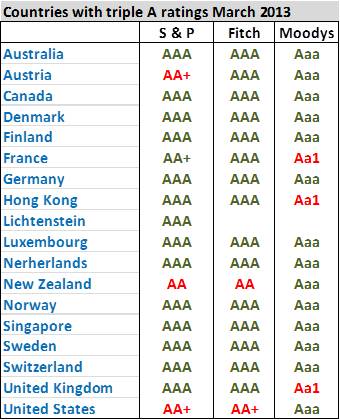
As Fitch puts the Uk’s country rating on negative watch, the number of countries left with triple A ratings has continued to shrink in 2013. Only countries given a triple-A rating by at least one of the big-3 rating agencies are included here.

triple A countries march 2013.emf

Boeing’s PR upsets Japanese Civil Aviation Board – and this will delay the Dreamliner flying again

March 16, 2013

Boeing’s upbeat announcement that the Dreamliner could be flying in a matter of weeks has upset the Japanese Civil Aviation Board. It would seem that Boeing did not clear their PR blitz in Tokyo in advance with the CAB. Their optimistic statements about the Dreamliner flying again “in a matter of weeks” to try and reassure the market place may prove to be a PR blunder and could backfire.

ET: Japanese regulators immediately warned that the timetable was impossible to predict, in part because investigators still do not know what had caused lithium-ion batteries to overheat on two 787s. 

“At this time we are not yet in a position to say when flights will restart,” said Shigeru Takano, the air transport safety director at Japan’s Civil Aviation Board (CAB), which will assess and approve Boeing’sproposed fix. …

…. “If we look at the normal process and the way in which we work with the FAA, and we look at the testing that’s ahead of us, it is reasonable to expect we could be back up and going in weeks, not months,” the 787’s chief engineer, Mike Sinnett, said at an earlier briefing in Tokyo. 

But the CAB, the FAA’s counterpart in Japan, dismissed Sinnett’s prediction, saying it was too early to predict when 787 operations could resume, since regulators in the United States and Japan are still investigating. Takano, the air transport safety director at the CAB, said Sinnett’s comment on the battery probe was “inappropriate.”

To call Boeing’s statement “inappropriate” is tantamount to an outright rejection. I think Boeing has shot itself in the foot since the CAB clearly perceives their role being usurped by Boeing’s PR pronouncements. There is now no way that the CAB can or will allow any “fast-tracking” of approvals.

Reuters: Japan is Boeing’s biggest customer for the fuel-efficient aircraft, which has a list price of $207 million. JAL and ANA combined account for almost half the global Dreamliner fleet. Japanese firms also build 35 of the aircraft.

And until the CAB approves, other countries will also hold off their approvals. It is going to be at least 2 months now before Dreamliners fly again commercially.

Another Clinton, another Bush

March 15, 2013

From across the Atlantic, Hillary Clinton versus Jeb Bush is not only plausible, it now seems to me to be becoming inevitable. It is not so very far away to 2016 in calendar time – though it could be an eternity in political time.

But all those who harbour any pretensions to standing for President of the US in 2016 must already be planning their campaigns – at least in the confines of their own minds. But the crucial need for financing means that they have probably confided their ambitions to a very small and select group who are already sounding out potential donors for a potential campaign.

The energised campaign of 2008 was exciting (to an observer) but it has proven to be extremely divisive for the country. Perhaps campaign energy – if it is at too high a level – actually leads to divisions. But a lack of energy does not correlate with unity or a removal of divisions. This energy of 2008 was certainly missing in 2012 but the parties remain just as far apart and divisions among the electorate are not being bridged. Perhaps there is some optimum level of energy which is desirable for a campaign. It remains to be seen how the legacy of Obama’s Presidency will be seen but I think there is a large risk that the divisiveness during his two terms will mean that he is remembered primarily as the first “black” President. Any other achievements will seem quite mundane. He has proven to very risk-averse and so it is unlikely he will be remembered for any catastrophic blunders either. A Hillary Clinton – Jeb Bush race may actually get the balance right; an energised campaign which captures the imagination of the bulk of the electorate but does not drive them to the extreme positions of the fanatics.

I cannot see Jeb Bush bringing an Obama-style energy into either the Primaries or the Presidential Campaigns but he will not be devoid of energy. From the splinters of the Tea Party and the depths to which the Republicans have sunk, having another Bush scion to call on may seem to provide a “safe”, low-energy, compromise choice for the GOP. But Jeb Bush may actually be the brightest of all the Bushes.

NPR: The former two-term governor of Florida has not run for office since 2002, and has up to now refused to get caught up in public presidential speculation. Widely acknowledged as a power behind the scenes, he is seen as politically savvy and astute. It’s long been thought that had he won his 1994 gubernatorial campaign against Lawton Chiles in Florida, it would have been Jeb — not brother George W. — whom the GOP turned to in 2000. What he says carries great weight, and when he criticized his party last year for its approach to overhauling the nation’s immigration laws, people sat up and paid attention. You’re not going to win over the hearts of Latino voters, Bush said over and over, by talking about self-deportation and blocking paths to citizenship for those who are here illegally.

But in his new book, Immigration Wars: Forging an American Solution (co-authored with Clint Bolick), Bush is no longer focusing on a path to citizenship. Let’s talk instead about residency rights. “A grant of citizenship,” Bush now says, “is an undeserving reward for conduct we cannot afford to encourage.” Pay a fee, he says of those 11 million people here illegally. Pay back taxes. Do community service. Learn English. But the end would be residency, not citizenship. For many, however, the headline was about 2016.

Hillary Clinton is the heir apparent.  She is uniquely qualified of course. If  her health is up to it and she runs, it is unlikely that any other Democratic candidate will challenge her seriously except to get some exposure and her attention. She cannot any longer be held responsible for any blunders the administration now makes. As potentially the first woman President she will arouse much of the same energy that Obama did in 2008 but perhaps without the same divisiveness and with a reach that – unlike Obama’s – could cut across party lines.

Politico: The ranks of Democratic governors are filled with ambitious politicians boasting records that would probably play well with primary voters in 2016.

But even as they eye a move from the statehouse to the White House, there’s broad recognition among the chief executives that the next generation of Democrats may have to wait longer than four more years to take their place as President Barack Obama’s heir.

Nowhere is The Hillary Factor felt more acutely, and painfully, than in the same elite club of policy innovators and budget balancers that vaulted her husband onto the national political scene in the 1980s. ….

“It’s just a very unique situation in which an extremely qualified candidate with a long history of public service who has been fully vetted is considering running for the presidency,” noted Nixon, who easily won reelection last year to his second term in conservative-leaning Missouri. “She’s entitled to her time of analysis. It does, I think, in many ways freeze the field until she more clearly states what she wants to do with the rest of her life”. ….

So Clinton-Bush in 2016 may not be such a bad thing. Bush may actually be able to bring the Republican Party together again and repair the self-inflicted damage wrought by the loony right. Clinton would energise – for or against – every woman in the US and that energy will spread to others. The winner would have a much less divided country to contend with. I think Hillary Clinton would win such a race but with Jeb Bush as her opponent it will not be a walk-over. She will provide the US – at long-last – with a female head of state. And the Democrats will have been in power for 16 years in 2024 when she leaves office after her second term.

Pope Francis (first of that name)

March 13, 2013

An important event even if I have not much of value to add.

Cardinal Jorge Mario Bergoglio, a a 76 year old Jesuit from Argentina and a relative outsider has been elected the 266th Pope and will take the name Pope Francis (1).

Of course he is just “Pope Francis” for now and being the first of that name he will NOT  be “Pope Francis the first” until there is a second.

Francis is a French and English surname of Latin origin.

Famous Francises (first name)

and not forgetting my childhood favourite – FRANCIS the talking mule

My Brazilian friend sounded a little disappointed.

Surprise! 99.8% of Britishers on the Falklands wish to stay British!!

March 12, 2013

While there seems to be very little merit in the Argentine claim to the Falkland Islands (they didn’t discover the islands, they didn’t settle there permanently and they haven’t invested there), the results of the vote by the Falklanders showing that 99.8% wish to remain British is little more than an exercise in packaging.

The numbers for the referendum are interesting:

  • Population – 2841
  • Registered voters – 1649
  • Turnout 92%
  • Votes counted 1517 (excluding 1 spoiled vote)
  • Votes for 1514 (99.8%)
  • Votes against 3

But this reminds me of a Sales Manager I once worked for who managed to convince his new bosses during his annual performance review that he was due a massive bonus because he had achieved a “100% market share of his market”.  He taught me a great deal about what “selling” was all about!

But there is no denying that 99.8% of Britsishers on the Falklands wish to stay British.

I don’t suppose it would be very difficult to identify the 3 people who voted against.

(Alex Salmond should learn his lesson for the referendum on Scottish independence due in the autumn of 2014. As of now only some 20% of the expected electorate are likely to support him in breaking away from the UK and having to reapply to the EU for membership. If he can just make sure that non-permanent residents (say people with less than 3 or 5 generations born in Scotland) and those who have the majority of their assets outside Scotland don’t get to vote, he could  get a much larger market share of his market. He does not stand much chance unless he manages  – more by crook than by hook – to restrict the vote to just his supporters and even if he does – he still won’t win.)

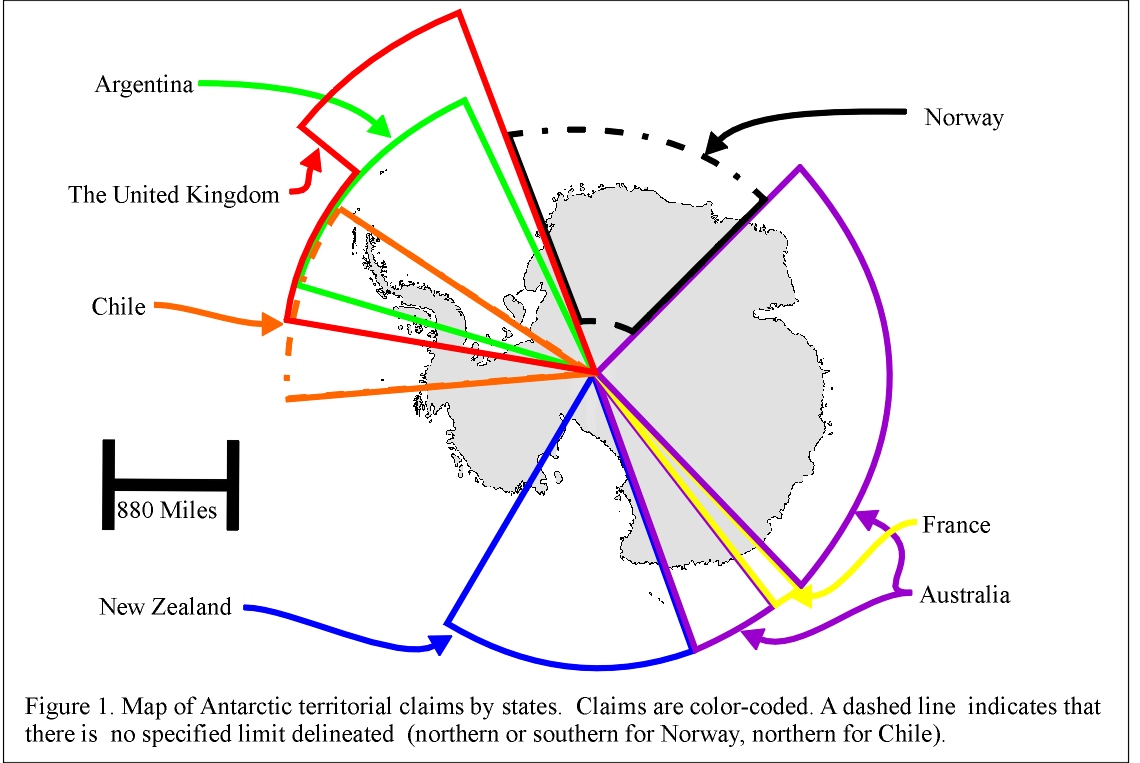
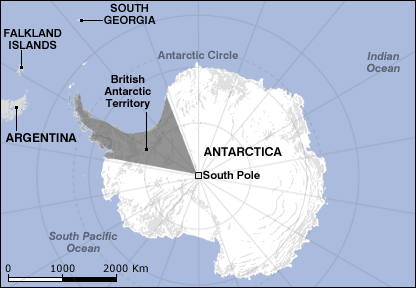
Of course the real interest in “owning” the Falklands – for Argentina and for Britain – is the proximity to Antarctica, the basis it provides for territorial claims and the access it ensures. Territorial claims in  Antarctica have been frozen since 1961 till when 7 nations had registered claims. Currently the entire Argentinian claim falls within the British Antarctic Territory and it must be terribly frustrating for Argentina to find the UK leveraging its ownership of the Falklands all the way to the South Pole.

Antarctic territorial claims(graphic - http://geography.osu.edu/grads/jdavis/fig1.jpg)

Antarctic territorial claims
(graphic – http://geography.osu.edu/grads/jdavis/fig1.jpg)

falklands and antarctica (BBC)

falklands and antarctica (BBC)