Archive for the ‘scientific misconduct’ Category

Upstate Medical University researcher fabricated data to benefit his own company

October 10, 2013

UPDATE!!

Stem cell scientist says data in retracted paper “is not falsified or fabricated”

=========================

Researchers are not angels.

Just normal human behaviour from a man in a white coat.

GeroldFeuer2.jpg

Gerold Feuer, a professor of microbiology and immunology at Upstate Medical University

Syracuse.com:

A scientific journal has retracted a study by an Upstate Medical University researcher accused of using fake data.

The paper was authored by Gerold Feuer, who was found guilty last year of using state money and employees to benefit his private biotechnology company.

The article, first published in 2008, was retracted Oct. 4 by the journal Stem Cells. It focused on a virus that causes cancer in humans.

The retraction notice was published today by Retraction Watch, a blog that reports on retractions of scientific papers. The notice said the article was retracted after an investigation by Upstate’s research misconduct committee showed data used in the study had been “fabricated and/or falsified.”

Feuer, 53, of the town of Onondaga, landed $6.2 million in state grants in 2009 for stem cell research at Upstate. He oversaw a lab that bred mice without immune systems, then “humanized” them with stem cells to mimic the human immune systems. The mice are used in research studies.

Upstate suspended Feuer without pay in late 2010 while investigating his management of a research contract and the way he was operating his lab at Upstate. In 2008 Feuer had started his own private company to develop the same kind of mice for use in testing by universities and companies.

Upstate brought 53 charges of misconduct against Feuer, accusing him of using Upstate’s employees to perform services for his company and charging the cost to a state grant.

An arbitrator reviewed the case and in an Aug. 20, 2012 decision found Feuer guilty of 30 of the 53 misconduct charges. But the arbitrator said Feuer never intended to personally profit from the arrangement and should be reinstated.

Upstate reinstated Feuer, a tenured professor of microbiology and immunology, Feb. 18 at an annual salary of $116,196 and placed him in an undisclosed off-campus assignment.
It’s unknown what effect the latest misconduct finding will have on his employment status, said Darryl Geddes, an Upstate spokesman.

Upstate officials said they completed a separate investigation in April that found Feuer and Prabal Banerjee, a co-author of the paper, guilty of scientific misconduct. Banerjee now works for Feuer’s company, HuMurine Technologies Inc. Upstate officials said two other researchers involved in the study, Michelle Sieburg and Elizabeth Samuelson, did not do anything wrong.

Upstate has requested retractions of two other papers by Feuer published in other journals.

Nature hypes the IPCC

September 24, 2013

It could not have escaped anybody’s notice that the summary of the IPCC’s 5th Assessment Report (AR5) is due out at the end of this week in Stockholm on 27th September. The hype around this release is building up and by all the usual suspects. And the prime suspect is Nature. It has released a special issue on the 25 years of the IPCC. But nearly all these usual outlets are all in a state of denial or cover-up or both.

The IPCC faces a dilemma. Should they mention that while carbon dioxide keeps increasing global temperatures have been at a standstill and their fantasised link between fossil fuel combustion and global temperature seems to be broken. Not likely since the usual suspects have far too much invested in this hypothesis. Should they just ignore that global warming has stalled for the last 17 years and lose even more of their fast evaporating credibility. Or should they mention it and then enter into an orgy of contortion to show that their models are still valid because the missing heat has been swallowed by the Monsters of the Deep. It looks like they will choose the latter since the contortions have already begun.

The simple but inconvenient truth is that the IPCC has misled and wasted the world’s resources for  25 years.

Nature Special Issue

OUTLOOK FOR EARTH: A NATURE SPECIAL ISSUE ON THE IPCC
This Nature special issue explores the Intergovernmental Panel on Climate Change (IPCC) – an international body of hundreds of scientists and policy experts that regularly assesses the state of knowledge about how climate is changing, what impacts that will have, and how nations can mitigate the problem. A graphical introduction chronicles the history of the IPCC and how climate science has evolved over the past 25 years. One news feature examines the latest research on rising sea levels and another profiles Ottmar Edenhofer, a leader of the IPCC’s upcoming report on mitigation. In a Commentary, Elliot Diringer proposes that individual actions by nations to tackle the causes of climate change can set the stage for international action. And K. John Holmes looks at the history of large-scale environmental assessments.
Image credit: Carl De Torres


FEATURES

Outlook for Earth

As the IPCC finalizes its next big climate-science assessment, Nature looks at the past and future of the planet’s watchdog.

25 years of the IPCC

A graphical tour through the history of the Intergovernmental Panel on Climate Change and the science that underlies it.

Rising tide

Researchers struggle to project how fast, how high and how far the oceans will rise.

The climate chairman

Getting hundreds of experts to agree is never easy. Ottmar Edenhofer takes a firm, philosophical approach to the task.

COMMENT

A patchwork of emissions cuts

Home-made national approaches can be effective for climate-change mitigation if countries agree on rules and build trust, says Elliot Diringer.

Pushing the climate frontier

The first large-scale environmental surveys, carried out on the US arid lands, hold scientific lessons for policy-making still relevant today, explains K. John Holmes.


Another fraudster unmasked in Dutch academia: Anthropologist Mart Bax

September 23, 2013

After the unmasking of the massive scientific misconduct committed by Dirk Smeesters, Don Poldermans and Diedrik Stapel, the Netherlands can ill afford yet another scandal. But that would be living in hope. Now comes this scandal involving an anthropologist, Mart Bax, which appears to be just as massive a fraud.

It does seem that Dutch Universities are cleansing their academic stables. And by the amount of excrement being found it seems to be quite a task! I don’t think that attitudes and pressures in Dutch scientific research are much different to those in other parts of Europe. Which only suggests that while the Dutch are cleaning house, there is a great deal of muck waiting to be found in other countries.

(The picture in the earlier posting was not of Mart Bax but of the journalist who exposed him. The picture has been removed. My thanks to thinkerandtinker for pointing out my error and my apologies to Mr. Frank van Kolfschooten).

Bax retired as a Professor from the Free University (Vrije Universiteit) of Amsterdam in 2003. But for 15 years – at least – he has been making up data. He has invented places where he has claimed to have carried out research, he has made up titles for himself along with claims of non-existent teaching at prestigious universities. Some 64 papers of his 161 claimed publications do not exist.

  • Of the 161 publications claimed by Bax, 64 are non-existent.
  • The book Medjugorje: Religion, Politics, and Violence in Rural Bosnia (1995) mentions a blood feud for which there is no evidence at all. None of the inhabitants of the area are aware of anything like this happening.
  • Shortly after the publication of book mentioned above, Bax acknowledged that he misinterpreted some information, but claimed he did not have the chance to make any rectifications.
  • The commission established he did have the opportunity to rectify these errors at various occasions, yet never did.
  • After the publication of Medjugorje: Religion, Politics, and Violence in Rural Bosnia, Bax referred to the blood feud in three other articles, after he already acknowledged to be aware of the misinterpretation, which the commission labeled as “serious scientific misconduct”.

Retraction Watch: Bax, who studied an Irish town he called Patricksville, a Dutch pilgrimage site he called Neerdonk, and Medjugorje, a Bosnian pilgrimage site, retired from the Free University in 2002. The university began investigating Bax’s work last year after science journalist Frank van Kolfschooten published Ontspoorde Wetenschap (“Derailed science”). In that book, van Kolfschooten raised questions about Bax’s work into an alleged massacre at Medjugorje during the Bosnian War.

 NRC Handelsblad: Again fraud in science is exposed by a university inquiry. Former professor of political anthropology Mart Bax from the Free University has invented research, published nonexistent items put on his list of publications and  committed forgery in university documents. That concludes a commission of inquiry headed by historian Prof. Michiel Baud from the University of Amsterdam.

Volkskrant: The retired professor of political anthropology at the Vrije Universiteit Amsterdam Mart Bax has committed at least 15 years of serious scientific misconduct, forgery and plagiarism itself. That is the conclusion of the inquiry led by historian Michiel Baud in a report released today.  ….

The committee also calls it “very likely” that Bax has made up much of his fieldwork in Brabant and the Bosnian pilgrimage site of Medjugorje from his imagination. But the committee can not formally call it science fraud since Bax insists he was misled by informants themselves. Notes have been destroyed and the informants themselves are untraceable or deceased. The Committee therefore holds it as “serious scientific misconduct “,” deception” and “unethical scientific behavior”.

Citation stacking rife in Brazil

September 3, 2013

The impact factor of an academic journal is a measure of the average number of citations for articles in the journal. In the academic world it is always better to have your papers published by a “high impact” journal. For editors and publishing houses, impact factor is directly related to revenues earned. Over the years the methods of increasing the number of citations (not self citations, by articles in other journals and preferably from a different publishing house) and the impact factors of journals have become increasingly sophisticated.

Citation stacking has been the method that has developed where editors of journals – sometimes even from quite different publishing houses – have colluded to see to it that articles in their journals cited articles in the others. This has been going on for some time and a year ago THE reported that Thomson Reuters had suspended 26 journals for citation stacking.

“Anomalous citation patterns” is a euphemism for excessive citation of other articles published in the same journal. It is generally assumed to be a ruse to boost a journal’s impact factor, which is a measure of the average number of citations garnered by articles in the journal over the previous two years.

Impact factors are often used, controversially, as a proxy for journal quality and, even more contentiously, for the quality of individual papers published in the journal and even of the people who write them.

When Thomson Reuters discovers that anomalous citation has had a significant effect on a journal’s impact factor, it bans the journal for two years from its annual Journal Citation Reports (JCR), which publishes up-to-date impact factors.

In Brazil the Ministry of Education is obsessed by impact factor. In consequence publishing in high impact factor journals has become a matter of survival in academia.  Journals have been caught in a vicious cycle where nobody wants to publish in their pages because their impact factor is too low and their impact factor falls further because they have insufficient citations.

“By 2009, editors of eight Brazilian journals decided to take measures into their own hands”. 

Ciencia Brasil has been pointing out dubious cases in Brazilian journals for some time. The Brazilian scam has now reached the pages of Nature as Thomson Reuters suspends some Brazilian journals from its rankings for ‘citation stacking:

Brazilian citation scheme outed

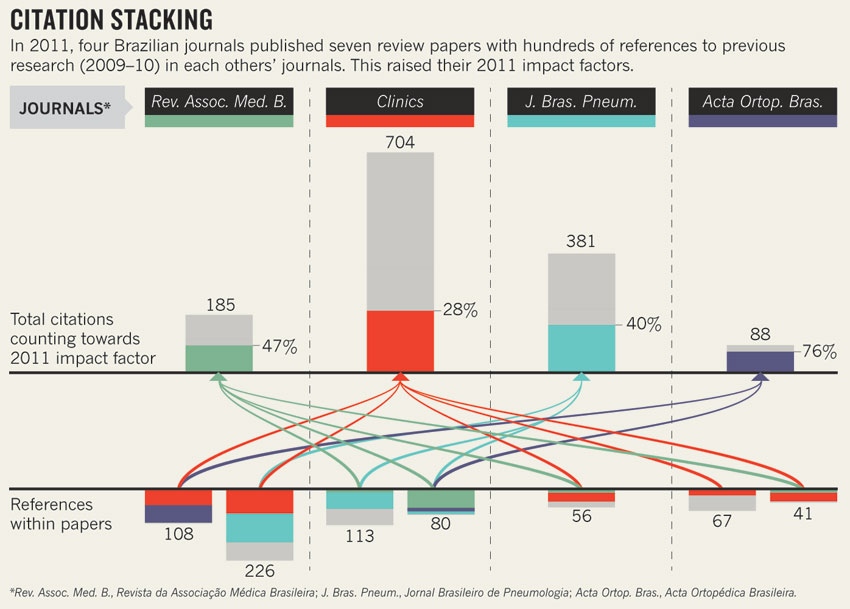
Mauricio Rocha-e-Silva thought that he had spotted an easy way to raise the profiles of Brazilian journals. From 2009, he and several other editors published articles containing hundreds of references to papers in each others’ journals — in order, he says, to elevate the journals’ impact factors.

Because each article avoided citing papers published by its own journal, the agreement flew under the radar of analyses that spot extremes in self-citation — until 19 June, when the pattern was discovered. Thomson Reuters, the firm that calculates and publishes the impact factor, revealed that it had designed a program to spot concentrated bursts of citations from one journal to another, a practice that it has dubbed ‘citation stacking’. Four Brazilian journals were among 14 to have their impact factors suspended for a year for such stacking. And in July, Rocha-e-Silva was fired from his position as editor of one of them, the journal Clinics, based in São Paulo.

…. Editors have tried before to artificially boost impact factors, usually by encouraging the citation of a journal’s own papers. Each year, Thomson Reuters detects and cracks down on excessive self-citation. This year alone, it red-flagged 23 more journals for the wearily familiar practice. But the revelation that journals have gained excessively from citations elsewhere suggests that some editors may be searching for less detectable ways to boost their journals’ profiles. In some cases, authors may be responsible for stacking, perhaps trying to boost citations of their own papers.

The journals flagged by the new algorithm extend beyond Brazil — but only in that case has an explanation for the results emerged. Rocha-e-Silva says the agreement grew out of frustration with his country’s fixation on impact factor. In Brazil, an agency in the education ministry, called CAPES, evaluates graduate programmes in part by the impact factors of the journals in which students publish research. As emerging Brazilian journals are in the lowest ranks, few graduates want to publish in them. This vicious cycle, in his view, prevents local journals improving.

Abel Packer, who coordinates Brazil’s system of free government-sponsored journals, known as SciELO, says that the citation-stacking venture was “unfortunate and unacceptable”. But he adds that many editors have long been similarly critical of the CAPES policy because it encourages local researchers to publish in high-impact journals, increasing the temptation for editors to artificially boost their own impact factors, he says.

Nature 500, 510–511 (29 August 2013) 

Read the articledoi:10.1038/500510a

University of Queensland asks for a paper to be retracted and returns a grant!

September 3, 2013

An unusual event in the academic world. Commendable and exemplary – I think.

The University of Queensland (not to be confused with the Queensland University of Technology – QUT – which has also recently been in the news) has taken the unusual step of asking a major journal to retract a paper published by a former staff member and has returned a grant from an NGO thought to have been awarded on the basis of the discredited paper.

The University Press Release ;

The University of Queensland (UQ) is investigating events that have led to the retraction of a paper published in an academic journal. 

As a result of its investigation to date, UQ has asked the journal that published the paper to retract it on the grounds that: “no primary data can be located, and no evidence has been found that the study described in the article was conducted.” 

A former UQ staff member from the Centre for Neurogenic Communication Disorders Research was corresponding author on the paper. 

Published online in October 2011 in the European Journal of Neurology, the paper was titledTreatment of articulatory dysfunction in Parkinson’s disease using repetitive transcranial magnetic stimulation

The journal has agreed to the retraction. 

The paper in question seems to be this one:

B. E. Murdoch(1), M. L. Ng(2) and C. H. S. Barwood(1), Treatment of articulatory dysfunction in Parkinson’s disease using repetitive transcranial magnetic stimulation,  European Journal of Neurology, 19: 340–347. doi: 10.1111/j.1468-1331.2011.03524.x

The paper has been cited 8 times.

Author Information

  1. Centre for Neurogenic Communication Disorders Research, School of Health and Rehabilitation Sciences, The University of Queensland, St. Lucia, Qld, Australia
  2. Speech Science Laboratory, Division of Speech and Hearing Sciences, The University of Hong Kong, Hong Kong, China

*B. E. Murdoch, School of Health and Rehabilitation Sciences, The University of Queensland, St. Lucia, Qld 4072, Australia

ABC News reports:

The University of Queensland says a Parkinson’s disease study published by a former staff member may not have actually been carried out.

The university released a statement today saying that “no primary data can be located, and no evidence has been found that the study described in the article was conducted.”

UQ has asked the academic journal that published the research to retract the article, and the journal has agreed. The university said Professor Bruce Murdoch, a former staff member from the university’s Centre for Neurogenic Communication Disorders Research, was one of the authors of the article.

… The investigation is continuing and the Crime and Misconduct Commission has been informed, the statement said.

UQ has also returned a $20,000 grant from “a non-government organisation” because it fears the money was allocated on the basis of information in the article.

It said there was no National Health and Medical Research Council (NHMRC) funding for the paper.

“By having the paper retracted, the university enables the global scientific community to learn that the research reported in the paper has no place in the body of scientific knowledge and so cannot be used as a basis for further research,” the statement said.

“Just make up an elemental analysis…..”

August 8, 2013

ChemBark has the details of this case where sloppy writing and/or editing shows up some not so ethical behaviour:

Just make up the data..

Just make up the data ……

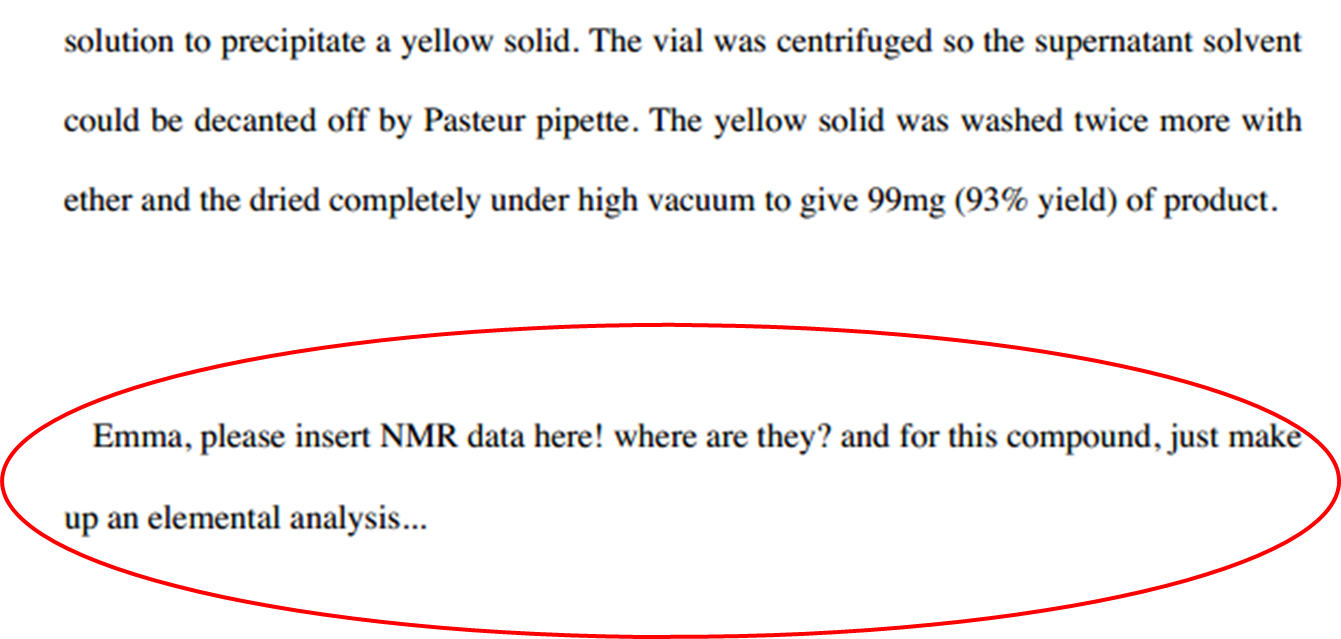
This instruction apparently from the senior author to the first author was found inadvertently left in the Supplemental Information for this paper – which has been archived here in case it disappears: SI Emma E Drinkel et al.

What is particularly noteworthy is the casual nature of the instruction to “just make up the data…”. It would almost appear that faking data is a routine and regular procedure. Less shocking but a telling commentary on the review process is that such a statement made it all the way to publication.

Emma E. Drinkel, Linglin Wu, Anthony Linden and Reto Dorta, Synthesis, Structure and Catalytic Studies of Palladium and Platinum Bissulfoxide Complexes, Organometallics, Article ASAP, DOI: 10.1021/om4000067

The affiliations of the authors is given as  the University of Zurich, but the senior author, Professor Reto Dorta now seems to be at the University of Western Australia while Emma Drinkel is in Brazil at the Universidade Federal de Santa Catarina.

ChemBark:

A recently published ASAP article in the journal Organometallics is sure to raise some eyebrows in the chemical community. While the paper itself is a straightforward study of palladium and platinum bis-sulfoxide complexes, page 12 of the corresponding Supporting Information file contains what appears to be an editorial note that was inadvertently left in the published document:

Emma, please insert NMR data here! where are they? and for this compound, just make up an elemental analysis…

This statement goes beyond a simple embarrassing failure to properly edit the manuscript, as it appears the first author is being instructed to fabricate data. Elemental analyses would be very easy to fabricate, and long-time readers of this blog will recall how fake elemental analyses were pivotal to Bengu Sezen’s campaign of fraud in the work she published from 2002 to 2005 out of Dalibor Sames’ lab at Columbia.

The compound labeled 14 (an acac complex) in the main paper does not appear to correspond to compound 14 in the SI. In fact, the bridged-dichloride compound appears to be listed an as unlabeled intermediate in Scheme 5, which should raise more eyebrows. Did the authors unlist the compound in order to avoid having to provide robust characterization for it? ….

Related:

 Insert data here … Did researcher instruct co-author to make up results for chemistry paper?

When Authors Forget to Fake an Elemental Analysis

Results falsified but only “inadvertently” by researchers at Queensland University of Technology

July 31, 2013

There are strange goings-on down under at the Queensland University of Technology (QUT).

The story has all the necessary ingredients for a genuine scandal. Falsified results in a grant application and a paper, the paper retracted, grant money awarded on the basis of the alleged results, a University with commercial interests in the alleged results of the alleged research, a whistleblower’s name illegally revealed by the Vice Chancellor of the University, and the Crime and Misconduct Commission accused of colluding with the University.

The University has found that the falsification of results was inadvertent and not fraud and nothing to worry about.

===============

UPDATE: Now the QUT “investigation” which came to the “finding” that the falsification was “inadvertent” and not fraud is itself being questioned by the federal agency that gave the scientists a $275,000 grant for stem cell work.

31st July: The National Health and Medical Research Council is not satisfied with some of QUT’s investigative procedures and wants a review by the Australian Research Integrity Committee. The move is unusual, with the ARIC set up in 2011 to ensure research allegations of misconduct are investigated properly taking on just a handful of cases.

============================

It is compelling reading and lives up to the convoluted tradition of Australian politics. But I have some difficulty in telling the “good guys” from the “bad guys” – if there are any “good guys” in this saga at all!

29th July: QUT reputation at risk after grant application and research mistakes

RESEARCHERS at one of Queensland’s top universities have admitted to incorrectly filling out a lucrative grant application in a mistake that could cost the university hundreds of thousands of dollars.

The “inadvertent” mistake by Queensland University of Technology scientists has put the university’s reputation at risk, the Vice-Chancellor says. The National Health and Medical Research Council is examining the circumstances under which it awarded QUT a $275,000 grant for research, and QUT boss Peter Coaldrake said the university faced having to pay it back. 

Whistleblowers have exposed errors in the reporting of embryonic stem cell research, prompting an internal probe into alleged misconduct and the retraction of a key research paper. The lead researcher has admitted to The Courier-Mail that an “inadvertent mistake” occurred in the writing of the grant application and an associated scientific paper published in 2010.

The NHMRC awarded the money to fund research into stem cell cultivation at QUT’s prestigious Institute for Health and Biomedical Innovation. The scientists were working on developing a “world-first” product to safely grow human cells in the lab without the use of risky animal proteins.

However, university insiders accused the researchers of exaggerating some results. “It was alleged that some data in the grant application had been falsified,” Prof Coaldrake said.

The scientists were subsequently cleared by a QUT inquiry. QUT later told the NHMRC there was no misconduct in the grant application. The journal involved has since retracted the article, a highly unusual step. …

30th July: QUT researchers cleared of fraud

AN “inadvertent” mistake in filling out a grant application by researchers at Queensland University of Technology saw the university awarded $275,000 for stem cell research and which has subsequently lead to an internal probe into research misconduct and the retraction of a research paper, the Courier Mail reported yesterday.

The NHMRC awarded the grant for research into stem cell cultivation at QUT’s Institute for Health and Biomedical Innovation. The scientists were working on developing a “world-first” product to safely grow human cells in the lab without the use of risky animal proteins, the Courier Mail said.

But the researchers were accused of falsifying some results, even though the scientists were subsequently cleared by an internal inquiry of any wrongdoing.

The whistleblowers who drew attention to irregularities in the research say QUT has a conflict of interest because it is a shareholder in a company called Tissue Therapies which was set up with the express purpose of developing and commercialising products based on the research.

30th July: Premier Peter Beattie gave QUT researchers in grant controversy an extra $225,000 for related work

QUT scientists at the centre of a controversy over a $275,000 federal grant for a now discredited journal paper also received $225,000 from then premier Peter Beattie for related work, as part of a 2007 funding package worth more than $1 million.

But while QUT has informed the Crime and Misconduct Commission and the National Health and Medical Research Council about errors in the application for the federal grant and the retraction of a key research paper, the university has not told the State Government.

31st July: QUT vice-chancellor Peter Coaldrake reports himself to CMC for disclosing whistleblower’s identity

QUT Vice-Chancellor Peter Coaldrake has reported himself to the Crime and Misconduct Commission after disclosing the identity of a protected whistleblower.

Prof Coaldrake named the person in an interview with The Courier-Mail in which he discussed the allegations by the whistleblower of research misconduct by QUT scientists. Prof Coaldrake later turned himself in to the CMC.

QUT later confirmed the employee’s status as a whistleblower protected by the Public Interest Disclosure Act. This law makes it an offence for public officials to disclose the person’s identity without their consent, except for the purposes of official investigations. The offence carries a fine of up to $9000. …… In the same interview Professor Coaldrake declined to name four academics from other universities involved in investigating research misconduct allegations involving a retracted scientific paper. He said this was because he wasn’t sure if the academics’ identities were known by the stem cell researchers being investigated. … QUT has declined to explain why Prof Coaldrake volunteered the name of the whistleblower.

Ahluwalia’s PhD cleared of fraud by Imperial College

July 31, 2013

I have posted extensively about Dr. Jatinder Ahluwalia’s scientific misconduct while at University College London and earlier at Cambridge. He was awarded his PhD by Imperial College London in a collaborative industrial doctorate with Novartis as his sponsor.

Following the ruckus, Imperial College investigated his PhD but have now cleared him of any fraud but their report does complain that access to Ahluwalia’s lab books was restricted by Novartis and only supervised access was permitted. Ahluwalia’s career in academia has virtually come to an end but I do have a suspicion that his PhD supervisors at Imperial College (Dr. Istvan Nagy) and at Novartis ( Dr Marco Compagna) cannot be completely free of all blame.

On the atmosphere in the research group, Dr Nagy suggests that Jatinder Ahluwalia was under no pressure to publish or to produce results in Dr Nagy’s group and Dr Nagy felt that a climate to produce fraudulent data did not exist, since there was no reason to produce papers in a hurry.
From discussions with Dr Nagy on the set-up of Dr Ahluwalia’s supervision arrangements it appears that the separation between Novartis and Imperial may have led to errors in supervision, where any mistakes that Jatinder Ahluwalia may have made in methodology and interpretation could not easily be checked.

THES and Retraction Watch cover the story.

THES: 

Imperial College London has cleared disgraced researcher Jatinder Ahluwalia of committing fraud during his industrial doctorate at the institution. 

However, a report setting out the finding also reveals that Imperial experienced considerable difficulties in investigating its suspicions due to the reluctance of the industrial collaborator on Dr Ahluwalia’s studentship to grant access to his lab books.

The investigation was announced in August 2011, after Dr Ahluwalia’s co-authors agreed to retract a 2003 Journal of Neurochemistry paper, of which he was first author, following the failure of his former supervisor, Istvan Nagy, to replicate its findings.

In 2010 a paper written while Dr Ahluwalia was a postdoctoral researcher at University College London was retracted by his former boss, Anthony Segal, after a UCL committee found that he had manipulated his results and had probably interfered with colleagues’ experiments to cover his tracks.

It subsequently emerged that Dr Ahluwalia had been dismissed from the University of Cambridge’s PhD programme in 1997 after his supervisor suspected him of faking results.

He then did a PhD at Imperial between 1999 and 2002, funded by a Medical Research Council “Case” studentship, in collaboration with the pharmaceutical company Novartis.

In 2009, while the UCL investigation was ongoing, Professor Segal informed Imperial of his suspicions about the 2003 paper. No misconduct was found during a subsequent investigation, but the paper was corrected in 2010 after “an arithmetical error” was identified.

Following its 2011 retraction, a six-person panel investigation panel – which included Imperial’s pro-rector for education, dean of students and student union president – was formed to check Dr Ahluwalia’s PhD work for fraud. None was found. …..

Dr Ahluwalia left the University of East London, where he had been a senior lecturer in pharmacology, in 2011 following an internal investigation. His current whereabouts are unknown.

Retraction Watch: 

We’ve uploaded the entire report here.

Ahluwalia, as Retraction Watch readers may recall, has had a paper in Nature retracted, as well as one in theJournal of Neurochemistry. The Nature retraction followed an investigation at University College London, where he was a postdoc, and he then left the University of East London after we reported that he had been dismissed from Cambridge the first time he had tried to get a PhD.

Imperial, where he earned his doctorate, began investigating more than two years ago. They began looking in whether he should lose his PhD after the Journal of Neurochemistry retraction, because that paper formed the basis of his thesis. They found:

The panel determined that there was no evidence of research misconduct in Dr Ahluwalia’s thesis. It noted that fraudulent activity by Dr Ahluwalia had been reported elsewhere but that this did not suggest that misconduct had occurred at Imperial. As no evidence of fraud or misconduct at Imperial had been identified, the award of the PhD should stand.

Part of the reason the investigation took so long was because of problems accessing Ahluwalia’s data, given that his supervisor was a :

An initial confidential review of the thesis and publications was carried out by a private firm contracted for the purpose and identified the need for further investigation. In parallel to this a protracted negotiation ensued between the College and Novartis for the panel to have access to Dr Ahluwalia’s notebooks which were in Novartis’ possession. Eventually supervised access to the notebooks on Novartis’ premises was agreed by Novartis.

Animal studies biased to give “positive” results

July 18, 2013

It is not suggested that the bias is any form of deliberate misconduct but a new paper shows that animal studies are subject to an “excess significance bias”.

Tsilidis KK, Panagiotou OA, Sena ES, Aretouli E, Evangelou E, et al. (2013) Evaluation of Excess Significance Bias in Animal Studies of Neurological Diseases. PLoS Biol 11(7): e1001609. doi:10.1371/journal.pbio.1001609

Author Summary

Studies have shown that the results of animal biomedical experiments fail to translate into human clinical trials; this could be attributed either to real differences in the underlying biology between humans and animals, to shortcomings in the experimental design, or to bias in the reporting of results from the animal studies. We use a statistical technique to evaluate whether the number of published animal studies with “positive” (statistically significant) results is too large to be true. We assess 4,445 animal studies for 160 candidate treatments of neurological disorders, and observe that 1,719 of them have a “positive” result, whereas only 919 studies would a priori be expected to have such a result. According to our methodology, only eight of the 160 evaluated treatments should have been subsequently tested in humans. In summary, we judge that there are too many animal studies with “positive” results in the neurological disorder literature, and we discuss the reasons and potential remedies for this phenomenon.

Roli Roberts writes at the PLOS blog:

But a study just published in PLOS Biology by Konstantinos Tsilidis, John Ioannidis and colleagues at Stanford University shows that a meta-analysis is only as good as the scientific literature that it uses. That literature seems to be compromised by substantial bias in the reporting of animal studies and may be giving us a misleading picture of the chances that potential treatments will work in humans. ….

Rather than wilful fraud, the authors of the PLOS Biology study suggest that this excess significance comes from two main sources. The first is that scientists conducting an animal study might analyse their data in several different ways, but ultimately tend to pick the method that gives them the “better” result. The second arises because scientists usually want to publish in higher profile journals that tend to strongly prefer studies with positive, rather than negative, results. This can delay or even prevent publication, or relegate the study to a low-visibility journal, all of which reduce their chances of inclusion in a meta-analysis.

The new work raises important questions about the way in which the scientific literature works, and it’s possible that the types of bias reported in the PLOS Biology paper have been responsible for the inappropriate movement of treatments from animal studies into human clinical trials. What do we do about it? Here are the authors’ suggestions:

  1. Animal studies should adhere to strict guidelines (such as the ARRIVE guidelines) as to study design and analysis.
  2. Availability of methodological details and raw data would make it easier for other scientists to verify published studies.
  3. Animal studies (like human clinical trials) should be pre-registered so that publication of the outcome, however negative, is ensured.

 Well, these are all excellent, but most people would also say that there are problems elsewhere in the system – in the high-profile journals’ desire to a have a cute story with well-defined conclusions, and in the forces exerted on authors by institutions and funding bodies to publish in those high-profile journals.

Global warming “hockey stick” is turning into a baseball bat

June 29, 2013

(A fun comment at CA is particularly apposite!

Posted Jun 28, 2013 at 5:18 PM 

@Steve McIntyre

From Fig. 4 above:

it’s quite obvious that in 2009 and again in 2011, you shamelessly plagiarised Briffa 2013

Easily the worst sin in the academic book, run a close second only by disrupting the space-time continuum in order to perform the plagiarism)

======================================================

Steve McIntyre’s objections to the Yamal tree (“the most important tree in the world”) in the global warming hockey stick are being vindicated as the new version of the data series resembles a baseball bat much more than a hockey stick.

Full story at Climate Audit and at WUWT

yamal_chronology_compare-to-b13