Archive for the ‘Space’ Category

Habitable exoplanet Gleise 581g may not exist

October 13, 2010


Artist's impression of the planetary system ar...

Gleise 581 system: Image via Wikipedia


An earlier post reported on the finding of a potentially habitable exoplanet.

But the planet may not exist:

Yesterday at an exoplanet meeting in Turin, Italy, Switzerland-based astronomers announced that they could find no trace of the prized planet in their observations of the same planetary system.

All the excitement has been over the subtlest of wiggles in the motion of the star Gliese 581 that lies just 20 light-years from the sun in the direction of the constellation Libra. A consortium of institutions led by the Observatory of Geneva in Switzerland had already discovered four planets circling Gliese 581 by sorting out the subtle motions of the star that are induced by the gravitational tugs of any orbiting planets.

On 29 September, a U.S.-based team led by astronomer Steven Vogt of the University of California, Santa Cruz, announced that it had discovered a fifth planet. The American team used a combined set of observations: One 11-year-long set consisted of 122 measurements made by the team, while the other set was 4.3 years long and consisted of 119 measurements published by the consortium.

Designated Gliese 581g, the new planet has at least three times the mass of Earth—large enough to hold on to a watery atmosphere—and orbits at a distance from its star that would allow any water to remain liquid. That would make 581g a happy home for life as we know it.

But at this week’s Astrophysics of Planetary Systems meeting, astronomer Francesco Pepe of the Geneva Observatory and the Swiss group reported that he and his colleagues could find no reliable sign of a fifth planet in Gliese 581’s habitable zone. They used only their own observations, but they expanded their published data set from what the U.S. group included in its analysis to a length of 6.5 years and 180 measurements. “We do not see any evidence for a fifth planet … as announced by Vogt et al.,” Pepe wrote Science in an e-mail from the meeting. On the other hand, “we can’t prove there is no fifth planet.” No one yet has the required precision in their observations to prove the absence of such a small exoplanet, he notes.

Virgin Galactic’s VSS Enterprise makes its solo flight

October 11, 2010


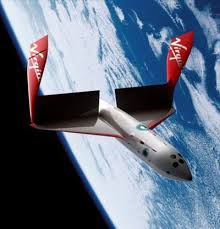
Drop test (Virgin Galactic)

The Enterprise spaceship is released from underneath the Eve carrier plane


Virgin Galactic conducted the first piloted gliding flight of its commercial suborbital spaceship, the VSS Enterprise, today, releasing the winged rocket plane from the WhiteKnightTwo mothership at an altitude of 45,000 feet above the Mojave Desert.

With Scaled Composites pilot Pete Siebold and copilot Mike Alsbury at the controls, the futuristic twin-tail spacecraft glided to a touchdown at the Mojave Air and Space Port 11 minutes after its release from WhiteKnightTwo, also known as Eve. The craft was not equipped with a rocket motor for the glide test.

“The VSS Enterprise was a real joy to fly, especially when one considers the fact that the vehicle has been designed not only to be a Mach 3.5 spaceship capable of going into space but also one of the world’s highest altitude gliders,” Siebold said in a Virgin Galactic press release.

Branson said he expects rocket-powered test flights to begin next year, followed by test flights into space “hopefully by the end of next year.”

Read more: http://news.cnet.com/8301-19514_3-20019149-239.html#ixzz121kUYP79

Read more: http://www.bbc.co.uk/news/science-environment-11511604

Hayabusa particles could be extraterrestrial

October 10, 2010

I posted earlier on the return of the ion engine powered Hayabusa.

Hayabusa started its journey in 2003 and met up with the asteroid Itokawa in 2005. The plan was to fire small metal projectiles at the asteroid to generate small pea size samples of the asteroid. This plan failed when the projectile firing device failed to function. After a long journey the spacecraft returned to Earth in June this year.

The sample capsule released by the Hayabusa asteroid probe. (Mainichi)

The sample capsule released by the Hayabusa asteroid probe. (Mainichi)


Though the inner capsule had no mm sized particles as hoped, some dust was found in the sealed container. Until recently, many of the fine particles found in the capsule had been believed to be aluminum powder or dust that had slipped into the capsule on Earth during manufacturing or Hayabusa’s launch reports the Mainichi Daily News.

However, the research team collected some 100 particles that are smaller than 0.001 millimeters in size from the inner cylinder of the capsule, called the “sample catcher,” and concluded some of them may be cosmic materials. The particles, which are invisible to the human eye, were collected by remote control using a special Teflon spatula — about 6 millimeters long and 3 millimeters wide — and examined with an electron microscope. Japan Aerospace Exploration Agency (JAXA) plans to further analyze the samples by splitting each particle and examining their crystal structure at Spring 8, a large-scale synchrotron radiation facility in Hyogo Prefecture, starting next month to determine where they are from. The procedure may also provide new information on the birth of the solar system.

“We cannot yet tell (whether the particles are from Itokawa) from their external features, but we have found many particles and there is a chance (that they are extraterrestrial),” said Munetaka Ueno, a researcher at JAXA’s Institute of Space and Astronautical Science.

Today Mainichi reports that:

Rocky particles (circled) are seen on the tip of a spatula used to scrape materials off of the sample capsule. (Photo courtesy of JAXA).

Rocky particles (circled) are seen on the tip of a spatula used to scrape materials off of the sample capsule. (Photo courtesy of JAXA).

The particles in a sample capsule released by the Hayabusa asteroid probe on its return to Earth were largely rocky materials, researchers have announced. At a lecture of the Japanese Society for Planetary Sciences in Nagoya on Oct. 8, a team of researchers released electron micrographs of the particles that were retrieved from the capsule, reporting that most of them were rocky.

According to the research team, including experts from the Japan Aerospace Exploration Agency (JAXA), they have detected at least 100 particles from the capsule, with most of them measuring less than 0.001 millimeters in size.

Since the rocky particles are diverse in composition, researchers will further inspect them at SPring-8, a large synchrotron radiation facility in Sayo, Hyogo Prefecture, to determine if they are terrestrial or from the asteroid Itokawa.

Chang’e-2 enters final working orbit around the moon.

October 9, 2010

Chang’e-2 has now entered into its final 118 min orbit and formally starts its mission of mapping the moon and preparing the way for Chang’e-3.

http://news.xinhuanet.com/english2010/china/2010-10/09/c_13548648.htm

Chang’e-2, following instructions from the Beijing Aerospace Control Center (BACC), started the third braking at 11:17 a.m. and entered the 118-minute, round working orbit 15 minutes later, changing the satellite’s apolune from 1,825 km to about 100 km, the BACC said. The satellite will begin scientific exploration activities soon.

Chang’e-2 lifted off from the Xichang Satellite Launch Center, in southwest China’s Sichuan Province, on Oct. 1. The moon probe completed its first braking on Wednesday and the second on Friday.


Chang’e-2 enters penultimate lunar orbit

October 8, 2010

http://news.xinhuanet.com/english2010/sci/2010-10/08/c_13547437.htm

China’s second unmanned lunar probe, Chang’e-2, has successfully completed its second braking at perilune on Friday, which decelerated the satellite and allowed it to enter a 3.5-hour orbit, according to the Beijing Aerospace Control Center (BACC).

Chang’e-2, following instructions from the center, started the second braking at 10:45 a.m. and entered the 3.5-hour elliptical moon orbit 17 minutes later, said Ma Yongping, vice-director of the BACC.

The second braking was to decelerate the satellite to prepare it for the final braking and its entering the designed 118-minute working orbit, Ma said.

Previous posts on Chang’e-2

https://ktwop.wordpress.com/2010/10/08/change-2-starts-transmitting-data-from-lunar-orbit/

https://ktwop.wordpress.com/2010/10/06/change-2-enters-12-hour-lunar-orbit/

https://ktwop.wordpress.com/2010/10/03/change-2-mission-on-track/

https://ktwop.wordpress.com/2010/09/30/chinas-second-moon-probe-change-2-to-launch-this-weekend/

Chang’e-2 starts transmitting data from lunar orbit

October 8, 2010


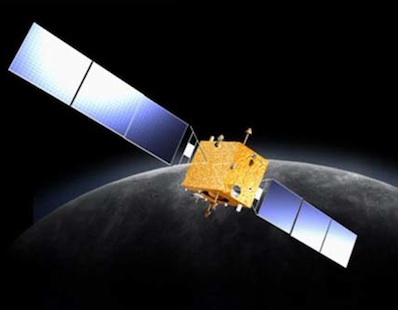
Chang'e-2 lunar probe: Credit: CNSA


Chang’e-2 remains on track and the scond orbit correction planned for Sunday may not be necessary.

From the Beijing Review:

All scientific exploration equipment has begun operation on China’s new lunar probe,Chang’e-2. The instruments that collect information about the space environment between the Earth and the Moon have sent back their first batch of data. The ground control center received the first readings from Chang’e-2 early Tuesday morning. The equipment on board detects a wide array of information such as gamma radiation levels.

The control center has confirmed that all instruments are working correctly.

The center announced that the second correction of Chang’e-2‘s orbit has been cancelled, as data proves the satellite is travelling strictly to plan following the first correction.

Experts said the satellite might change its orbit slightly due to the influence of the atmosphere and cosmic environment. Timely correction is therefore needed to prevent Chang’e-2 from deviating from its designed orbit.

The probe went through its first trajectory correction 17 hours after its successful launch. According to the original plan, the second correction would have been on Sunday. The control center is now watching closely for the timing of its next orbit correction. It’s the first time a Chinese lunar probe has directly entered an Earth-Moon transfer orbit without orbiting the Earth first.

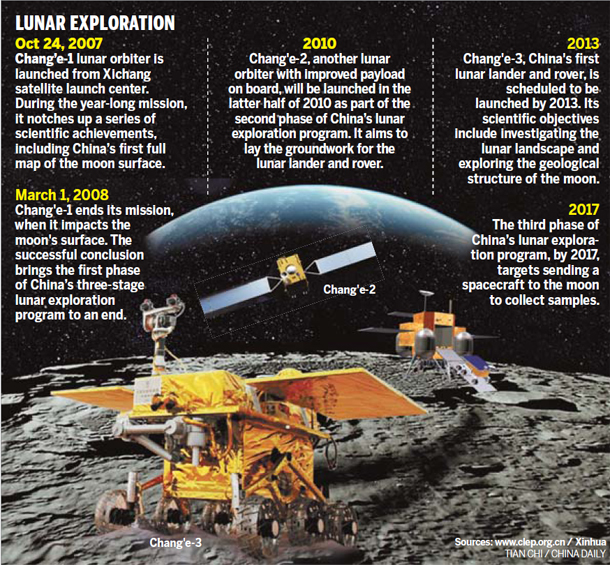
Chang’e-2 satellite was launched just before 7 p.m. on October 1, inaugurating China’s second phase of a three-step moon mission, which will eventually culminate in a soft landing on the Moon.

From Spaceflight Now:

Chang’e 2 will map candidate landing sites for the next mission in China’s lunar program, which targets a robotic touchdown on the moon after launch in 2013. Another project in China’s long-term plans is a vehicle to return soil and rock from the moon back to Earth.

After its $134 million baseline mission at the moon is finished, Xinhua reports Chang’e 2 could enter an extended phase.

Officials are considering three scenarios for Chang’e 2’s overtime, including sending the spacecraft away from the moon and into deep space, giving Chinese engineers practice in operations further from Earth. The satellite’s propellant could also return Chang’e 2 to Earth orbit, according to Huang Jiangchuan, a chief designer quoted in Xinhua.

Chang’e 2 could also continue circling the moon, relaying more science data before attempting a landing or impact on the surface, officials said.

Chang’e 1 was deliberately crashed into the moon at the end of its mission in March 2009.


Chang’e-2 enters 12 hour lunar orbit

October 6, 2010

Chang’e-2 enters 12 hour lunar orbit

China’s second unmanned lunar probe  Chang’e-2, completed its first braking Wednesday, which decelerated the spacecraft and successfully allowed it to enter a 12-hour orbit, according to the Beijing Aerospace Control Center (BACC). Chang’e-2, following instructions from the center, started the first braking at 11:06 a.m. and entered the 12-hour elliptical moon orbit 32 minutes later. It was the first braking for Chang’e-2. The space- probe needs to brake another two times before it can enter the designed 118-minute working orbit. The braking “laid a solid foundation” for Chang’e-2 to carry out scientific explorations in its final orbit, BACC said in a press release.

Compared with Chang’e-1, it is more challenging for Chang’e-2 to brake as it must do so at a closer distance to the moon and at a higher speed. A Long-March-3C carrier rocket carried Chang’e-2 into space blasting off from the Xichang Satellite Launch Center, in southwest China’s Sichuan Province, at about 7 p.m. Friday.

To acquire more detailed moon data, Chang’e-2 will enter a lower lunar orbit about 100 km above the surface, compared with the 200-km altitude of Chang’e-1, according to the control center. Before its first braking, the lunar probe had traveled nearly 350,000 km.

Screen shows the virtual animation of the first braking of Chang'e II lunar probe in Beijing Aerospace Control Center in Beijing, capital of China, Oct. 6, 2010. China's second unmanned lunar probe, Chang'e II, completed its first braking Wednesday, which decelerated the satellite and successfully made it enter a 12-hour orbit, according to the Beijing Aerospace Control Center. (Xinhua/Tian Zhaoyun) (xzj)

Cheng'e - 2 enters 12 hour lunar borbit

Two satellites into orbit

In other news today a Long March 4B rocket carrying two satellites of the “Shijian VI-04” group lifted off from the launch pad in Taiyuan, capital of north China’s Shanxi Province, Oct. 6, 2010. The satellites which have entered their space orbits will carry out probes on space environment and radiation and conduct space science experiments, according to the Taiyuan Satellite Launch Center.

Chang’e-2 mission on track

October 3, 2010

Chang'e programme: Xinhua

On Saturday scientists successfully activated the attitude control engines on Chang’e-2 and trimmed the satellite for the first time on its journey, according to a flight control official in Beijing. “During Chang’e-2’s 380,000-km journey to the moon, we will conduct more orbit corrections if necessary to ensure that it enters a lunar orbit,” said Ma Yongping, vice director of the flight control center. Chang’e-2 blasted off on a Long-March-3C carrier rocket from the Xichang Satellite Launch Center, in southwest China’s Sichuan Province, at about 7 p.m. Friday. It is China’s first unmanned spacecraft to be boosted from the launch site directly to the earth-moon transfer orbit, greatly reducing the journey time from that of its predecessor Chang’e-1.

Chang’e-1 took about 13 days to travel to a lunar orbit after orbiting the earth in a geosynchronous orbit and then transferring to the earth-moon transfer orbit. Chang’e-2 is expected to travel for about 112 hours, or almost five days, to arrive in a lunar orbit. To acquire more detailed moon data, Chang’e-2 will enter a lower lunar orbit about 100 km above the surface, compared with the 200-km altitude of Chang’e-1, according to the control center.

Sinus Iridum - Bay of Rainbows

The satellite will eventually be maneuvered into an orbit just 15 kilometer above the moon. At that point, Chang’e-2 will take pictures of moon’s Bay of Rainbows (Sinus Iridum)  area, the proposed landing ground for Chang’e-3, with a resolution of 1.5 meters. The resolution on Chang’e-1’s camera was 120 meters, said Wu Weiren, chief designer of China’s lunar orbiter project.

Russian hotel enters space tourism race

September 30, 2010

Virgin Galactic

In 2007, Genesis II, an experimental spacecraft designed to test the viability of a space hotel, was successfully sent into orbit by Bigelow Aerospace. Boeing have announced that they will be able to take tourists into space in 5 years.

The Galactic Suite

Virgin Atlantic has announced its intention to begin redeeming tickets on commercial space flights within the next 18 months – by some time in early 2012. In 2009 the Barcelona-based developers of The Galactic Suite Space Resort said their orbiting hotel was on target to accept its first paying guests by 2012.

Today the BBC reported that a Russian company has unveiled an ambitious plan to launch a “cosmic hotel” for wealthy space tourists. Orbital Technologies says its “comfortable” four-room guest house could be in orbit by 2016, Russia’s RIA Novosti news agency reports. Guests would be ferried to the hotel on a Soyuz shuttle of the type used to transport cosmonauts to the International Space Station (ISS). The new hotel would offer greater comforts, according to Sergei Kostenko, chief executive of Orbital Technologies. “Our planned module inside will not remind you of the ISS. A hotel should be comfortable inside, and it will be possible to look at the Earth through large portholes,” he told RIA Novosti.

It is not clear how the “cosmic hotel” would be built, but the company’s website names Energia, Russia’s state-controlled spacecraft manufacturer, as the project’s general contractor. Energia builds the Soyuz capsules and Progress cargo ships which deliver crew and supplies to the ISS.

China’s second moon probe Chang’e-2 to launch this weekend

September 30, 2010

From Space.com:

On Thursday, workers will begin fueling the Long March rocket that will blast the unmanned Chang’e-2 probe into space from Xichang Satellite Launch Center in Sichuan province, Xinhua reported. Launch will occur “at an appropriate time” between Friday — China’s National Day, when the country marks 61 years of Communist rule — and Sunday (Oct. 3).


Chang'e-2 lunar probe


Chang’e-2 is the second step in China’s three-phase Chang’e moon exploration program, which is named after China’s mythical moon goddess. Chang’e-2 will test out technology and collect data on possible landing sites for the Chang’e-3 spacecraft, which is scheduled to land on the moon in 2013. According to the state news agency, Chang’e-2 should arrive at lunar orbit about five days after launch. It will eventually swoop down to an orbit just nine miles (15 km) above the lunar surface to take high-resolution pictures of landing areas for Chang’e-3. After snapping the photos, Chang’e-2 will retreat to an altitude of about 62 miles (100 km) to conduct a study of the lunar surface and dirt.

The Chang’e-1 probe  launched in October 2007 and conducted a 16-month moon observation mission, after which it crash-landed on the lunar surface by design, in March 2009.


The launch of Long March 3B Rocket, Xichang Sa...

Image via Wikipedia:Long March 3B Rocket launch