Archive for the ‘Sweden’ Category

Sweden Democrat’s deputy speaker sufficiently emboldened to show his xenophobic colours

December 15, 2014

The Sweden Democrats have been emboldened by the current political turbulence – more akin to a low farce – to speak out much more openly about their core agenda. The Sweden Democrats are a far-right, anti-immigrant, anti-immigration, xenophobic party with its roots in the neo-Nazi world. They have quite successfully managed to keep this agenda hidden under a cloak of pseudo-nationalism and have managed to get into a “balance of power” position. They are the 3rd largest party in the Swedish parliament and have even managed to get a member into the position of Deputy Speaker.

Of course it is the current situation where an extra election has been called which means that even the Deputy Speaker in a sitting Parliament is now focused on electioneering. And the current turbulence is due in no small part to the incompetence of the Red/Green coalition coalition government in putting forward a budget which could not be passed. They put together an extreme, leftist budget which gave the Sweden Democrats the wonderful opportunity to defeat it in parliament. SD members all over the country are both energised and emboldened. Yesterday another party member argued that water-boarding was not, in fact, torture and was perfectly acceptable as an interrogation technique.

Of course the Sweden Democrats are being opportunistic, but it was the farcical situation generated by Stefan Löfven and his Green partners which gave them the opportunity. Moreover the “rehabilitated”, somewhat cleaner image of the Sweden Democrats is primarily due to their personable leader, Jimmy Åkesson. But he is off sick due to stress and many of the Sweden Democrat “cowboys” have had no restraining influence to keep them in order.

There is one area however where the Sweden Democrats have put their finger on the pulse of the problem not just in Sweden but all over Europe. A society can be multi-ethnic but it cannot be multi-cultural. The treatment of “multi-culturism” as a god has been a major blunder. A new culture has to and does evolve if allowed and encouraged to. There is little doubt that most European countries have put too little effort in getting their immigrants to adapt to their new surroundings and instead have encouraged them to develop their own separate enclaves. Preserving cultures from other times and other spaces has been prioritised over encouraging the new culture to evolve. A fear of being labelled racist has led to many types of immigrant behaviour, which are incompatible with the new society, being permitted and preserved. As in Rotherham.

Where the Sweden Democrats go completely wrong is in thinking that a predominant culture can be frozen into a past image and can avoid evolution as necessary immigration occurs. And Björn Söder even though he is Deputy Speaker, has already started electioneering. In his latest interview with Dagens Nyheter he brings his xenophobic views into the open and has managed to bring both his own position and Parliament as a whole into disrepute. Some extracts follow:

Reduced immigration is just one of several means for SD to reach its main objectives: to reshape Sweden in to a more nationalistic country. Sami people, Kurds and Jews can live in Sweden – but they are not Swedes, according to SD’s party secretary Björn Söder. He wants to pay immigrants to leave the country: “It would be great with a repatriation grant.” …..

Who is it that does not fit in to SD’s vision of Sweden?

– We stand for an inclusive society, so anyone who wants to fit. We have an open Swedishness which also includes people with roots abroad. But one must adapt to the Swedish and be assimilated to become Swedish.

Do you have to be a nationalist to be part of the Sweden you want to see?

– Absolutely not. I certainly have a lot in common with a liberal who grew up in Sweden – although we have different political views. But we have a unity, we celebrate the same festivals and also has some basic values in common, that the belief in democracy and the rights of women. Therefore, we have a sense of community.

The Swedes who have multiple identities, then? You say that we have people from “other nations” living in Sweden.

– Yes. There are, for example, people belonging to the Sami or the Jewish nation in Sweden.

Can one not be both a Jew and Swedish, at the same time?

– I think most of Jewish origin that have become Swedes leave their Jewish identity. But if they do not do it need not be a problem. One must distinguish between citizenship and nationhood. They can still be Swedish citizens and live in Sweden. Samer and Jews have lived in Sweden for a long time.

The comedian Soran Ismail used to say that he is 100 percent Swedish and 100 percent Kurds. Can not it be so?

– I do not think you can, to belong to two nations that way. However, Kurds could be Swedish citizens. The problem is if there will be too many in Sweden who belong to other nations.

This summer, you shared an article from the SD newspaper Samtiden on your Facebook page. “Swedes in the minority in Malmö,” read the headline. The article wrote that people of foreign origin – at least one parent born abroad – were more than 50 percent of the population in Malmö. You also wrote that in your FB post: “Swedes are now in the minority in Sweden’s third largest city.” Do you mean that everyone with a foreign-born mother or father is not Swedish?

– Wasn’t it that  Swedes were in the minority in the age group under 18?

No, I do not think so [I check later and the article is about all the people of Malmö].

– Anyway many living in Malmo are not Swedish, they are representatives of other nations. Not least, the Arab nation.

Which country is the “Arab nation”?

– No, there’s no country of that name. Arabs coming from several states. It is in any case desirable that a States’ geographical boundaries should coincide with the spread of its people.

It sounds like the argument Putin uses when he activates the Russian minorities in Ukraine, Estonia and Latvia.

– The problem there is that the Soviet Union placed great Russian nations in the Baltic States, it was a strategy of taking over. It is an imperial, chauvinistic nationalism that has nothing to to do with SD’s ideology 

If many residents of Malmö are not a part of the national community that you and your party want to build – what do you do with them?

– They must adapt and become a part of the Swedish nation. We have an open Swedishness, an individual can become Swedish regardless of background. But it requires that they be assimilated. And the problem with Malmö is that we have brought in too many. If very many from other nations live together in Sweden, it creates foreign enclaves in Sweden.

When I listen to you, it sounds as if all who come from an Arab country are alike. But the people of Malmö I know are very different among themselves, even those whose families originated from the same country.

– Sure, it might be so. You and I are also different from each other. But some fundamental value elements unite us. We both grew up in Sweden and it has shaped us. If you have a different cultural background there are other values that unite.

Malmo is multicultural and much of the city’s identity lies in that it is an immigrant city. Those who grow up in Malmö today speak a different dialect of Skånska than those who grew up here a few decades ago. More like Zlatan. They grow up in an environment where different cultures mixed together. Is that bad?

– I think many of them will lose their identities eventually. They will ask: what country do I belong to? It becomes an identity-less society. And obviously there is a problem in Malmo because the economy is so lousy. The rest of the country must prop up Malmo with fiscal equalization. If Malmö had been so good its problems would not have been so great and so obvious.

Söder is rather simplistic and superficial in his views. But he does have a point. The future of Europe is irrevocably multi-ethnic (and that is a comment only on ancestry). But the multi-ethnic Europe has to develop a new, vibrant, inclusive culture and that can neither be the old culture nor a multitude of separated cultures. You have as many societies as you have distinct cultures. It has to be one, new culture which assimilates the best part of the contributing cultures.
Farce continues as trade unions force the Swedish Social Democrats to dump the Greens

December 11, 2014

Just a week ago the Swedish Social Democratic Prime Minister, Stefan Löfven, lost a budget vote in parliament. The whole process was one of low farce. The budget was one his party and their Green (Environment Party) partners in government and supported by the far Left party had put forward. After the loss he announced that he would call an “extra” election as soon as it was permitted on 29th December and to be held on 22nd March 2015. He was quite belligerent and adamant that the joint budget with the Greens (the one defeated) was the very best for Sweden and that they would go to the hustings on the basis of the joint budget. The Greens were quite happy to ride his coattails for it gave them an exposure and a position at the High Table that they could never otherwise have commanded.

In the next day or two it became pretty obvious that it was the Social Democrats shift far to the left with the Greens and the Left party which effectively blocked any possible cooperation with parties further on the right. But Löfven was not prepared to give up his new found friends on the left. Even though it meant that his government was now required to administer the opposition’s alternate budget which had won in parliament until the new elections. Effectively income tax levels would continue throughout 2015 at the levels of the opposition’s budget. Even some expenditure items would have to remain static for the best part of 2015. He kept repeating the self-contradictory mantra that his party would contest the elections as a separate party but on the basis of the joint budget with the Greens. His propping up of the Greens and his obsession with the goodness of his Red/Green budget was becoming untenable.

Many voices within the Social Democrats pointed out the inconsistencies of this position but he stuck to his partnership. But the final straw came when the head of the Landsorganisation (representing the trade unions of Sweden) came out publicly  with the advice to abandon the Greens and fight the election on their own strengths – not least because any coalition agreements could only be negotiated later if they were not encumbered by the Greens and the Left party.

Dagens Nyheter(1):

Stefan Löfven should go to elections without the Green Party. So says a deeply concerned LO chairman Karl-Petter Thorwaldsson.

“Sweden is in a dangerous position, we are no longer seen as a politically stable country, we risk investment and jobs. The image of Sweden as stable, pragmatic and growth-friendly gave us investment and more jobs”, says LO’s chairman. He now sees this threatened on several fronts.

Mainly because of the parliamentary mess. But also because of the Green Party’s influence,  which he has criticized strongly several times in recent months. Among other things their requirements for nuclear decommissioning, the decision to close Bromma airport and postpone the Stockholm Bypass.

The Social Democrats ignore the trade unions at their peril. And Löfven has now been forced to back down and throw the Greens under the bus. But his contortions to keep his position today in touch with his position a week ago are also a little farcical.

Dagens Nyheter (2):

On Thursday the LO boss Karl-Petter Thorwaldsson put it plainly to DN: “Stefan Löfven should throw MP overboard and go to the polls alone”.

So on Thursday Löfven gave a number of bizarre answers. On the one hand, he had intended to do just that (dump the Greens) all the time – even though his press conference with Gustav Fridolin last week clearly showed that this cooperation was firm and fixed. “We like thecooperation we have and we have a very strong budget,” said Löfven.

Dagens Nyheter is scathing:

  • The Social Democrats are going to go to the polls alone, 
  • but together with the MP (Green Party),
  • with a budget that does not apply anymore
  • but which will anyway form the basis for future policy.

The show goes on. At least farces and pantomimes are quite suited to the festive season.

Swedish House Rules (for the next coalition)

December 9, 2014
  1. No party may cooperate with, or take the support of, the Sweden Democrats 
  2. Without the Sweden Democrats no minority coalition can survive.
  3. Any coalition must command a majority (175 seats)
  4. If the Left Party is included in any way then no party from the right of the divide will participate
  5. The Moderates or any parties to the right of the Moderates, will not participate if the Environmental Party (MP) is included
  6. The Centre Party may participate with a mildly left coalition provided it does not include the Left party

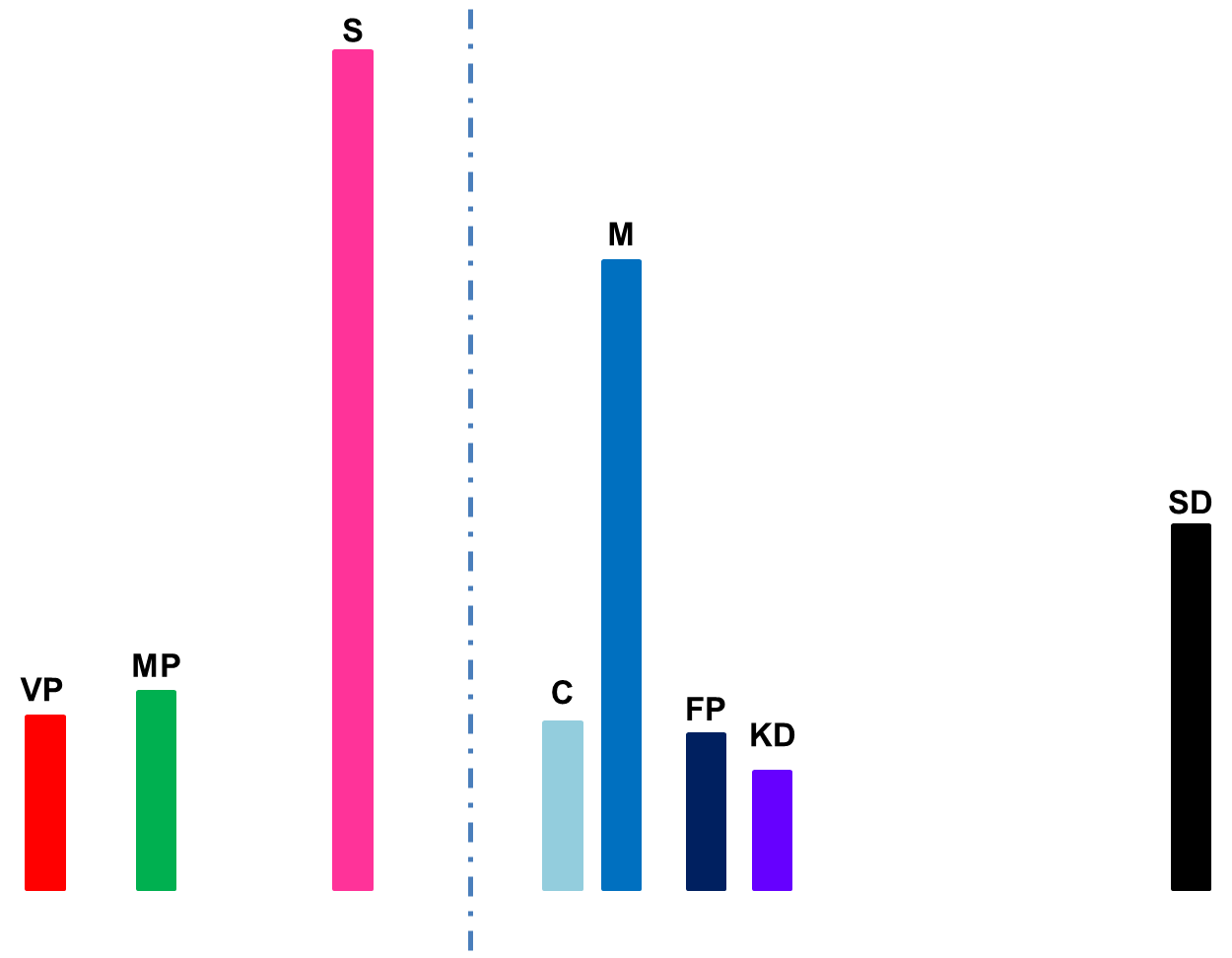
Currently the Swedish Parliament has 349 members from 8 parties.

Social Democrats – 113, Moderates – 84, Sweden Democrats – 49, Environment Party – 25, Centre Party – 22, Left Party – 21, Peoples Party – 19, Christian Democrats – 16.

Swedish political landscape 2014

Swedish political landscape 2014

Following these rules and assuming that the current composition of parliament is not much changed after the extra election in March 2015, only two possible majority coalitions are arithmetically possible:

  1. A Grand Coalition of the Social Democrats and the Alliance group of parties, or
  2. A grand coalition of the Social Democrats and the Moderates

The simple rule is that it has to be a coalition of the middle ground. That excludes the Sweden Democrats on the extreme right and the Left and the Environmental parties on the extreme left.

One consequence is that no matter what majority coalition is formed, the Sweden Democrats will be the largest party in opposition.


Swedish political crisis follows a failure of leadership

December 6, 2014

Leadership and courage do not result from administering a set of rules.  Changing the rules will not produce them either. But even a bad set of rules can be made to work if courage and leadership are present. Minority governments work when the leaders of the minority have the courage and the imagination and the leadership to maintain the temporary majorities necessary and sufficient to govern.

 Contrary to what is being taken as fact, a new general election in Sweden has not yet been called. While the current Red/Green government has had its budget rejected by the parliament and the current Prime Minister, Stefan Löfven, has announced his intention to call a new election, he cannot actually do so until 29th December. The laws require that a new election cannot be called until 3 months after this parliament first met on 29th September. In fact it is perfectly possible – instead – for a no-confidence motion against the government to be called in parliament (10% of members have to call for such a vote) and a simple majority of the vote can shift power from the PM and his government to the speaker of the house. If that happens before 22nd December (Christmas holidays intervening) then Löfven will not be around to call a new election as he intends to do on 29th December. It would then be up to the speaker or any other government which is established to make such a call. In practice Swedish parliaments have never before taken such a bold step and it would take a level of political courage that members of this parliament do not seem to have.

In municipalities all over Sweden a variety of coalitions between the different parties have been formed to create working majorities so that the business of government can continue. It always needs the leader of the largest local party to show some imagination and courage and not a little skill to create these coalitions. Some coalitions sometimes fail on contentious issues which the parties cannot overcome, but then a new coalition emerges so that the business of government continues.

It is this leadership – to first imagine and then to constitute a working majority – which is visible in abundance at local government level which has been absent at the national level. At national level there is now much talk about changing the rules of voting to enable a minority government to govern. This is a red herring. There is much talk also blaming the Sweden Democrat Party of breaking the “Swedish Model”. This, too, is another red herring. The Sweden Democrats may not have followed practice but they certainly broke no rules. 

The Prime Minister, the Social Democrats, their Environmental Party partners and their far Left supporters are all screeching about a failure of the rules and the malicious nature of the Sweden Democrats. Even the opposition is calling for a change of rules. But this is not a case of the failure of the rules. It has been a case of a failure of leadership, a failure of the ability to see what is required to govern and ultimately the skill to govern.

Löfven has not had the imagination to visualise a manner of cooperation with the other parties (whether jointly or separately) which would have given a working majority. He has taken the easy path of not crossing the Left/Right divide. He brought the Greens into government and took the support of the far Left. He effectively raised and strengthened the wall between Left and Right. He missed the first rule of building consensus by allying too closely with small and extreme groups, which immediately alienated all others. As soon as he had allied with one party on the left he made no real efforts to balance that with an ally on the right. Starting from a minority position on the left he only achieved another minority but extreme position which only hardened the position of his opponents. He judged that the opposition would be too fractured to defeat his grouping and that was a strategic blunder. He was reduced later to arguing why the opposition should remain fractured and not come together! But even after the blunder led to the defeat in parliament, he had not the vision or the skill to put together a new working majority. Instead he seems to have abdicated his responsibility to look for a solution and announced his intention to dump the problem back on to the electorate.

Though there are a few voices calling for parliamentarians to table a no-confidence motion, I am not expecting any group of 35 members to show the necessary courage. That will lead to another election on March 22nd. But the issue which should be the deciding issue and which should transcend all others should be that of leadership and the courage to govern.

Low farce as Stefan Löfven gives up – will call a new election on 29th December

December 3, 2014

It has been another busy day in the Swedish parliament and for the political commentators. The 2-month old Red/Green government’s budget (supported by the communistic far Left) was defeated in Parliament. The alternative budget presented by the right-leaning Alliance of opposition parties, was also supported – going against past practice – by the far-right Sweden Democrats, and prevailed. We now have the very odd situation of a Red/Green government now having to administer the opposition’s budget which comes into force on 1st January 2015. It has been a spectacular failure by the Red/Green government after just 2 months in power.

Stefan Löfven, the Prime Minister, could have just resigned and let the speaker try to get a government cobbled together which could manage to get a budget passed. Strictly he could not call a new election since it has been less than 3 months since this parliament first met. Those 3 months are up on December 29th.

Many political commentators called this the most dramatic happening in Swedish politics since 1958! But I thought there was more of low farce than of high drama in the proceedings today. Everybody had announced how they were going to vote yesterday. There was 6 hours of meaningless debate in parliament before the vote.  Each speaker tried to avoid blame. CYA of the lowest order! Löfven called a press conference and lashed out like a very sore loser. He blamed everybody else and then announced that he would be calling a new election on December 29th to be then held on 22nd March next year. He comes from the trade union movement and has had a reputation as a good negotiator in industrial disputes. But his wage negotiation skills were not up to political negotiations. He has moved too far, too fast to the left in appeasing the Greens and the far Left party. So much so that he misjudged his strengths and weaknesses completely. He provided the Sweden Democrats an irresistible opportunity to become the centre of attraction in bringing him down. In fact he also managed with his lurch to the left to alienate the Alliance so much that it became impossible for them to rescue him (even if they had wanted to) from the quagmire of his own making.

So today he threw his hands up in the air and announced he was giving up and that he would call a new election – when he could – and ask the electorate to take the call on his budget. It strikes me that this is not just giving up. It is also a tacit acknowledgement of misjudgements and a lack of competence in managing the process of getting his budget passed.

Maybe he is hoping that before the new election is actually called 26 days from now, that the Alliance or just the Moderate Party (2nd largest party in parliament) will somehow find a way of saving his face by offering him some form of cooperation. Maybe his public announcement that he would campaign together with the Greens is just negotiating tactics. Arithmetically the only way for a majority to form is if the Social Democrats cooperate with the Alliance or just the Moderates. It is highly unlikely that the Moderate Party will just abandon its allies. The chances for the Alliance to form a Grand Coalition with the Social Democrats is extremely small and will extract a heavy price. The Social Democrats would have to dump the Greens and the far Left. That price may be too heavy for the Social Democrats

But I can speculate that if the Social Democrats have the long term in mind and are prepared to dump the Greens and the far-Left, Löfven could retain the post of Prime Minister in a Grand Coalition with the Alliance. They would command a very stable parliamentary majority which could manage to keep the Sweden Democrats completely marginalised. But some of the key portfolios – such as Finance, Defence and Foreign Affairs – would have to go to the Alliance. It may not be politically possible for this crop of politicians, but it could be the best possible thing for the country.

But unless some such cooperation is finalised within the next 26 days, the Swedish parliamentarians would have failed the electorate. And just going back to the electorate may produce the same result and solve nothing.

Amateur dramatics on the Swedish political landscape

December 3, 2014

Yesterday was a busy day in Swedish politics, but it was amateur theatricality and not any high drama. I am left with the perception of some unruly teenagers (the Swedish Democrats) acting like hooligans in a classroom but where the adults (the other parties) have not the faintest idea what to do. They cannot expel the unruly elements and can only threaten not to speak to them. And they are then surprised that the unruliness continues. A most unedifying spectacle.

The Sweden Democrats announced yesterday that they would vote for the opposition’s alternative budget today in parliament rather than merely abstain to allow the red/green government’s budget to pass.

A Government Crisis will therefore be upon is when the vote is taken later this morning.

The government went into full panic mode last night and invited (begged) the opposition alliance (but not the Sweden Democrats or the Left Party) to emergency talks last night. They had to attend of course and they met with the Social Democrats and their Environment Party colleagues. Of course they just reiterated that it was not an opposition’s duty to help the government to pass its own budget and they would just be voting for their own alternative today.

The Swedish Prime Minister, Stefan Löfven, is in a bind. He does not have many options. Once he loses the vote today he can either call a new election (cannot be called before 29th December) or he can dump the green millstone around his neck and try and build a Grand Coalition in the German style with the moderates. Actually this is not that crazy. If he dumps the greens and the far left (who he has accommodated to a great extent so far), it is conceivable that sufficient common ground could be found with the Moderate Party for a very stable, majority government. Of course there would be some areas of ideological conflict but they would both have to leave those differences aside for their term together and revisit them in better days.

My own opinion is that Löfven and the Social Democrats have been weakened rather than strengthened by their association with the Greens and the Far Left. In fact the weight given to these minority parties has – in part – precipitated the crisis. The deep reds and the greens are anathema to the Sweden Democrats. The other parties would like to have no truck with the far-right Sweden Democrats (who I still perceive to be a bunch of junkies and hooligans) even though 13% of the country voted for them. They are attempting to make them political pariahs but they are not being very skillful about it. The other parties are coming across as bullies and are failing to show up the far-right extremists for what they truly are. (They have not yet learned that just shouting how bad the Sweden Democrats are does not address the reasons why their voters shifted their allegiance). Of course, they are all now blaming the Sweden Democrats for the crisis, but the reality is that the Social Democrats have been more than a little incompetent in giving undue weight to the wishes of the greens and the far left in their budget proposition. The bottom line is that the government has not had the skill to put together the support needed to get their budget passed.

All the other 7 parties have been rather clumsy – and inept – in their efforts to marginalise the Sweden Democrats and have only succeeded in catapulting them to the fulcrum of an artificial and ill-conceived crisis. I was listening to some of the comments yesterday from some of the politicians of the past and who are no longer in politics. I can’t help feeling that the current parties are lacking in pondus and could well use some older and more experienced advisors.

I am also quite sure that any sales or marketing manager from industry could teach these political parties a thing or two about how to marginalise a competitor – even in their home market.

Bringing in the extremists from the left or the right will not work.

Swedish political landscape 2014

Swedish political landscape 2014

In Sweden, party politics negates and undermines parliamentary democracy

December 2, 2014

Currently Sweden is caught up in a so-called “Crisis of Government” which only serves to show that the Government itself is completely subservient to party politics and the exercise of Parliamentary democracy by the members of Parliament has become irrelevant. Of course in most parliamentary democracies, the exercise of democracy is always compromised by the party system which ensures that members of parliament represent their parties first and only very rarely their constituents. The members of the Swedish parliament particularly, are party representatives first, spokesmen for their own voters second and don’t even try very hard to represent any broader constituency. Votes in parliament are all settled in advance and the actual proceedings in parliament are for the sake of form and are relegated to be of little relevance. Parliamentary votes are usually just a formality.

But a possible challenge to the cosy, back-room deals is causing a furore.

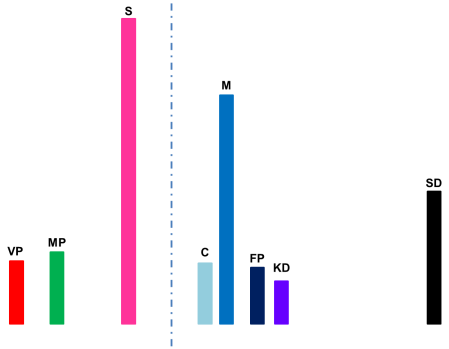
Currently the Swedish Parliament has 349 members from 8 parties.

Social Democrats – 113, Moderates – 84, Sweden Democrats – 49, Environment Party – 25, Centre Party – 22, Left Party – 21, Peoples Party – 19, Christian Democrats – 16.

The Social Democrats and the Environmental Party with 138 seats (of 349) make up the minority government. Adding in the Left Party which supports them from outside the government gives them 159 seats which is still short of a majority. The conservative, market oriented alliance only commands 141 seats. The Sweden Democrats – which is a right-wing, anti-immigration, anti-immigrant party with neo-Nazi roots – is being shunned by all the other parties.  But the balance of power is clearly held by the Sweden Democrats.

The crunch comes tomorrow when the government’s first budget comes up in Parliament for approval. It is normal practice for other parties to oppose by abstaining from voting for the governments budget but instead voting for their own. So even a minority government gets its budget approved as long as all the rest don’t get behind a single alternative budget. The conservative alliance will present their own budget and vote for it but abstain from voting when the government’s budget comes up. The government’s budget has taken on board much of what the Greens and the Left wanted but has ignored the Sweden Democrats and the conservative alliance. It is fairly obvious that the the Greens and the Left are wielding an influence that is far in excess of their strength in parliament. The Greens are leveraging their minority position in a minority government to extort many concessions from the Social Democrats in power.

But now all the parties and all the media are in a tizzy because the Sweden Democrats could challenge the normal cozy, back-room deals usually done by the parties and which are just rubber-stamped by a parliament where all the members stop thinking for themselves and just follow the party line. The Sweden Democrats – who have no chance of getting their own budget passed – are considering backing the budget presented by the conservative alliance. They are perfectly entitled and perfectly within their parliamentary rights to do that since this is closer to their own budget.  But if they do then the choices for the government are limited. They could defer the vote, return the budget to committee and try to come up with something which commands a majority in parliament. Which is, of course, something they should have done in the first place. Or they could call a new election.

The Social Democrats have their knickers in a real twist. They are blaming the Sweden Democrats of not following practice, of extortion and of being irresponsible. They are blaming the conservative parties of allowing the right-wing forces to succeed – by inaction. And that is rather a strange accusation. But I think they protest too much. The Sweden Democrats will decide on their position today. The media are nearly all criticising them for taking so long to announce how they will vote. Which is also rather strange. If all votes are announced before the voting takes place, what then is the purpose of making speeches and arguing and voting in the parliamentary chamber? The democratic powers of parliament have become a matter of form but seem to have no substance.

Why bother with the parliament if all decisions can effectively be taken in the back-rooms outside of parliament.

If the democratic parliament is to have any real meaning then the government needs to present a budget which commands a real majority of the 349 votes where the votes are free and not constrained by party position (i.e. a minimum of 175 voting in favour).

Actually I expect that the Sweden Democrats will chicken out today and the government budget will get passed tomorrow. If they truly represented their voters they would have to make sure that this government budget fails. It will be a lopsided and essentially an undemocratic budget.  It will be undemocratic in that there will be far too much dictated by the Greens and the far Left and well in excess of their due. If the budget passes, it will be a case of tyranny by the minority.

The only really democratic option – which I would like to see – is that the government takes its responsibility which it should have done in the first place. It needs to revise and formulate a new budget which truly commands a free majority in the house.

“Organic farming a catastrophe for food security” – Swedish researchers

November 16, 2014

Most of Sweden is brainwashed into thinking that anything claiming to be “environmentally friendly” or “climate smart” must be a good thing. No politician or newspaper has the courage to challenge environmental political correctness. Normally they are quite rational but when it comes to questioning global warming or GM ideology, they leave all their critical faculties behind and just parrot the dogma. The reluctance to challenge and question borders on political cowardice. “Organic” and “ecological” and “environmentally friendly” and “climate smart” are meaningless labels which have now come to be used to justify lack of critical thinking and to silence opposition.

It does not require much deep thought to see that organic and ecologic farming which produces much lower yields is – inevitably – much more expensive than the conventional – and much more intensive – farming that has been developed over the last century. Global food production is still increasing and there is no global shortage of food today, even though the population exceeds 7 billion. Grain production in 2014 broke all manner of previous records – by using modern, intensive methods. Of course there are still serious inequality and food distribution problems around the world and there is still much undernourishment and hunger. There is actually enough food today to feed the world but it is not all affordable or cannot all be distributed. But the simple fact is that more people are being fed today than ever before in human history. Malthus has been proven spectacularly wrong precisely because of the advances in intensive farming. Global population will reach a peak in about 80 years. Thereafter population will decline but we need to be increasing both the quantity and the quality and, above all, the affordability of food for some time yet.

In Sweden there is a blind romanticism prevailing about anything claimed to be “ecologic” or “organic” or “environmentally friendly”. It shows up everywhere. It is an axiom of all advertising copy that labels such as “green” or “climate smart” or environmentally friendly” are necessary – no matter how convoluted the argument – to get through to the unquestioning and uncritical Swedish consumer. On matters labelled environmental, Sweden is almost totalitarian in its politics. The courage to challenge outmoded and obsolete – but politically correct – dogma is an attribute that is particularly lacking in Swedish politics (and in the media). Consensus has become the new god and seems always to trump facts. Paying lip service to democratic forms has become much more important than questioning the substance. Continuing down the wrong path is more socially acceptable than questioning the path.

So there is much controversy about an article in Svenska Dagbladet today by four reputed agricultural scientists who point out the blindingly obvious – that shifting to ecologic farming would be a catastrophe for food security. The article is by

  • Holger Kirchmann, Professor of plant nutrition and soil conservation, Swedish University of Agricultural Sciences (SLU),
  • Lars Bergström, Professor of Water Quality at SLU,
  • Thomas Kätterer, Professor of Systems Ecology at SLU,
  • Rune Andersson, former program manager at SLU.

Organic farming – the road to starvation.

The belief that organic farming is good for the climate and produces better food is wrong. Only organic farming would be a disaster for future food security and would put further pressure on the environment at a very high cost, writes four researchers from the Swedish University of Agricultural Sciences (SLU), 
Many today believe that organic farming is good for the environment and that it also provides safe and healthy food. Sales increased by 30 percent during the first half of 2014 (DN 4/11) and the state supports organic farming with many millions. But virtually all popular beliefs about organic farming are incorrect. We discuss this in our book “The ecological dream.” Our conclusions in the book – based on serious research, our own and from others – are unambiguous:

  • Consumers get no better food or any better environment if they buy organic food.
  • The extensive subsidies for organic farming – about 500 million kronor a year – would have greater social benefit if used in improving the environmental effects of mainstream agriculture. 
  • Organic foods are not free of toxins.
  • Organic food is not more nutritious than conventionally grown food. 
  • Increased organic farming would severely affect food security, both in Sweden and worldwide.
  • Organic farming does not give a lower input of nutrients to surface and groundwater.
  • Organic farming is not better for the climate.

The most drastic effect is that we will only produce half as much food on the arable land we have today. Official statistics show that agricultural yields decrease between 30 and 60 percent depending on the crops we grow – at least for grass and most of the potatoes.

To compensate for the loss of food, we must cultivate a much larger area of arable land than today. If you calculate that yields are on average 40 percent lower in organic farming, it means that at 100 percent organic growing needs acreage to be increased by a further 1.7 million hectares, from the current 2.6 million acres. That much arable land has never before existed in Sweden. ………. 

My translation of the article from the Swedish is here (pdf): Organic farming – the road to starvation SvD

“That demmed elusive submarine”

November 14, 2014

They sought it here, then they sought it there,

The Swedish Navy looked everywhere,

It moves by stealth, it can’t be seen,

That demmed elusive submarine

with apologies to Baroness Emma Orczy and her Scarlet Pimpernel

The Supreme Commander of the Swedish Armed Forces, Sverker Göranson, held a press conference today. He asserted that it was now confirmed that a foreign mini-submarine of unknown (read Russian) nationality had violated Swedish territorial waters in the Stockholm archipelago on October 17th. It is not known how it got there and it is not known how it got away.

Prime Minister Stefan Löfven was also at the press conference, “We don’t know who is behind this, but it is totally unacceptable,” he said.

Löfven warned the world at large that Sweden would not put up with this sort of thing and, please, not to do it again. If it happened again he was even prepared to use military force! Neither the Russians or any other foreign power has claimed responsibility. Of course, in order to use military force it would be necessary to detect any incursion somewhat faster than one month later. In this case the warning about under water activity by a foreign power was first raised not by the military’s warning systems but by a “credible informant”.

The military is, I suppose, reasonably satisfied since the defense budget has been increased. This should now also add some impetus to the campaign to join NATO.

Source: Swedish Radio

Foreign mini sub found in Swedish waters – confirmed

“Green” ministers in Swedish government off to a rocky start

November 7, 2014

It has only been a month since the new Red/Green government took over in Sweden. So it is early days yet. Inexperience abounds both among the Social Democrats (the senior coalition partner) and among the Environment party ministers. The Social Democrats are running a little scared and appear to be bent on appeasing far left and Green party demands. The far left party is not in government but has an inordinate influence since the coalition itself does not have its own majority. The Green party has already stopped many development projects around Stockholm (as they usually do) and the Social Democrats have not been strong enough to stop their job destruction.

The Green party does not have party leaders – only spokespersons – which is a wonderful way of evading responsibility. They have six ministers in the new government. The group is very politically correct with 3 men and 3 women. But with ages ranging between 31 and 51, I observe that they have little chance of (and no interest in) reflecting the views of the increasing number of senior citizens.

Any new government must have its share of inexperience and I have no quarrel with that. But incompetence in a minister is not so forgivable. They have not particularly enhanced their reputations so far. Instead many have been demonstrating an inexperience which borders on either an embarrassing level of naiveté or some level of incompetence. I don’t have any great expectations of them.

  • Åsa Romson, 42, Deputy Prime Minister and Minister for the Environment and Climate, is usually fairly circumspect in what she says.  She has a doctorate in international environmental rights but her speeches tend to be a string of very politically correct cliches. There is little evidence of an open mind or any great thought beyond the parroting of cliches. She has however demonstrated a sad lack of judgement by appointing a convicted drug trafficker to the Cabinet Office as her closest aide. She has defended her choice on the grounds that he has served his sentence and has paid his debt to society. But she misses the point. It is her judgement in having someone who is known to drink himself senseless and who is a convicted drug trafficker at the highest office of government which is in question. I would have thought that he would be privy to a great many confidential matters and an obvious security risk.
  • Gustav Fridolin, 31, is the Education Minister (!). He has been a peace activist, been arrested by the Israelis in the West Bank  and won Junior Jeopardy at the age of 11. By the age of 19 he was a Member of Parliament. He has also been a TV reporter. He has not attended university or any other form of higher education. Soon after being appointed he addressed all Swedish teachers by YouTube! A remarkably patronising effort directed at teachers as if they were 10 year old children. If I were a teacher I would be horribly depressed by the childish approach of the Education Minister. He too demonstrated some poor judgement when he chose an aide to work within government who was then rejected (after having worked for two days) by the Security Services for being heavily in debt.
  • Per Bolund, 43, is the Deputy Finance Minister and the Minister for Financial Markets and Consumers. He is by education a biologist but never completed his doctorate. He has not made any real blunders yet, though his immediate castigation of Swedish banks when they came through the recent stress tests with flying colours, seemed more a reflex, ideological twitch rather than any considered opinion. As a member of the Environmental party it is not in his genes to ever acknowledge that any part of the finance sector has done well. He is – of course – generally in favour of raising taxes wherever possible.
  • Isabella Lövin, 51, is the Minister of International Development Cooperation (Foreign Aid) and has kept a relatively low profile so far. She made some fine sounding statements about the €16 million Swedish support (out of €1 billion from the EC and the EU)  for helping the African countries fighting Ebola. Unfortunately this was somewhat negated by the subsequent Swedish rejection of a request for treatment of an aid worker suspected to have been infected. She was not the one to make the rejection which was more due to a bureaucratic approach to emergency situations. She has probably supported the government in its largely symbolic – but rather useless – gesture of recognising the state of Palestine. Another “feel good” action without objectives.
  • Mehmet Kaplan, 43, is of Turkish origin and is the Housing and City Development Minister. In July this year he equated the ISIS jihadists with freedom fighters. He has been very active in the past in trying to get subsidies for mosques but his record on Sharia Law and radicalisation of young Muslims is rather ambivalent. The right-wing Sweden Democrats like to target him, but he does gets a little bit of a free ride from the media and other politicians because of his opponents’ fear of being seen as islamophobic and politically incorrect. (A little reminiscent of the politicians who did not dare enough in Rotherham). He has yet to make his mark.
  • Alice Bah Kuhnke, 43, is the Minister of Culture and Democracy and has made a rather inept start. She has a degree in political science and is best known as a children’s programme and talk-show host on Swedish TV. She had a disastrous radio interview where she rejected many questions for being hypothetical. Her attempts to correct the fiasco with her own article in the press only made it worse. Surprisingly she is not comfortable in granting the press access and tries to control and micro-manage their questions. She is also getting herself horribly mixed up whenever she tries to equate culture with ecology and sustainable development. Her take on what constitutes culture leaves a little to be desired.

This group of six do not fill with me any great confidence but it is early days yet.

Maybe they will all grow into their jobs. Maybe they will perform better than my very low expectations.

But as a group they have not started very well. I am left with the impression that they are all a little too light-weight for the responsibilities that they may well fail to carry. There is a real risk that this group of six will only help in bringing this government further into disrepute.