Archive for the ‘Syria’ Category

Whose boots will prevail in Syria?

October 5, 2015

It does not require rocket science to see that ISIS will only, can only, be defeated finally by boots on the ground.

The US and its partners assumed that “moderate rebels” in Syria would provide the boots on the ground to take over, once they had managed to get rid of Assad. But the assumption that the “moderate rebels” formed any sort of cohesive group which could bring stability has proven to be grossly wrong. They are so splintered and fractured and cover such a wide range of objectives that they can only ensure instability. The further assumption that the rag-tag being supplied with weapons and money to effect regime change, did not also include radical and fanatic Sunnis and Wahabis has been at best, incompetent, and at worst, disastrous. The Russians are, it seems, making a different calculation.

Any scenario which pictures the defeat of ISIS will require that their followers are left with no physical or political space to occupy and control. And that is going to require that their space is then occupied by someone else. Air attacks by the US led coalition or by Russia can only prepare the way, but without a real physical presence the effects of such air attacks can only be temporary. Without filling up the space with some form of political stability, any political vacuum will always provide room for the fanatics.

Of a Syrian population of about 23 million, 9 million are displaced and are refugees within Syria or abroad. Around 3 million are estimated to have left Syria. Around 75% of the Syrian population were Sunni muslims, 12% were Alawites (a secretive branch of Shia Muslims) and about 8% were Christians. Assad is of course an Alawite. As Shias the regime is supported by the Hezbollah from Lebanon and from Iran’s Shia (90% of Iran’s population are Shia and about 9% are Sunni). If Assad were to step down, but was replaced by another Alawite, then the Alawites, many of the Christians and even some of the moderate Sunnis, could probably live with a regime which provided stability. The fly in the ointment is financial support for the various Sunni and Wahabi rebel groups in Syria (including the hard-line terrorist groups such as Al Qaida, al-Nusra and ISIS) which comes mainly from Saudi Arabia and the Gulf States. US support for rebel groups in Syria has, under Saudi influence, often supported the Sunni line. ISIS cannot be politically suffocated as long as its external financing continues.

Even with a defeated ISIS, sympathisers will still remain. But they will not be in control. A “defeat” can only mean that they no longer have any control over any settlements within which they might still exist, and that they have no safe havens within which to hole-up. That cannot happen unless control over all geographical areas effectively lies with some body – or bodies – that reject the fundamental claims of the Islamic State.

The mutual hatred between ISIS and Shia Muslims is a key factor. No Sunni rebel group fighting against Assad is not without some sympathy for ISIS. This virtually disqualifies any of the current rebel groups being supported by the US coalition, from being capable of supplying the political control needed to squeeze out ISIS. Certainly the US and its coalition partners are not going to supply the physical presence on the ground. The Russians are not going to send in troops beyond military advisors to Assad either.

So who does that leave? Whose boots on the ground are going to prevail?

The Russian calculation seems to be that the regime (later without Assad) together with Hezbollah, Iraqi Shias and some Iranian presence will be sufficient to defeat ISIS and squeeze them out. It is not impossible, but the Saudis will not take kindly to that. That would be seen as an unacceptable blow to the Sunni ego.

And then whether such an end-game is allowed to stand will depend upon whether the US is prepared to satisfy the Saudis by challenging the Russians (and the Iranians and Hezbollah) in their support of the Assad regime. I suspect that the Russians are calculating that Obama will only keep shifting his red line rather than actually cross it. As long as the Russians keep the eventual stepping down of Assad as being inherent in their plans, Obama will, reluctantly, go along.

It seems a highly dangerous path to this end-game where the regime (without Assad) but with help from Hezbollah and Shias from Iraq and Iran supply the boots on the ground to get rid of ISIS. But at least it is an end-game which is not impossible. And it seems to be the only one available. The US and their European partners seem not to have thought very far beyond the removal of Assad.

 

Winter storm gives a day with no deaths by fighting in Syria

January 9, 2015

And even while the Paris atrocities seem to be coming to a final resolution, there is always hope. Roll on another ice age.

From Reuters:

A day without death in Syria

 Nobody was reported killed by fighting in Syria on Wednesday, January 7, 2015, the first day without casualties in three years, after a fierce winter storm quelled violence, a group that monitors the war said.

A boy walks past a snowman along a road covered with snow in the Duma neighborhood of Damascus, January 7, 2015. REUTERS/Badra Mamet


Men walk along a street during snow fall in the Duma neighborhood of Damascus, January 7, 2015. Nobody was reported killed by fighting in Syria on Wednesday, the first day without casualties in three years, after a fierce winter storm quelled violence, a group that monitors the war said. REUTERS/Badra Mamet


US, Iran and Syria are now “allies” against ISIS

June 17, 2014

image: global security

ISIS now controls Tal Afar in northwestern Iraq near Mosul and Saqlawiya west of Baghdad. Fighting is reported in Fallujah, Baqubah and Samarra and within 50km of Baghdad.

But strange bedfellows are emerging.

Iran was once Evil Incarnate and the US was the Great Satan. But the “enemy of my enemy” can lead to once unthinkable alliances.

The US is talking about some form of military cooperation / coordination with Iran while Syrian planes have attacked ISIS convoys within Iraq.

Fox NewsThe Iranian government, which the White House is now looking to as a possible partner to help counter the insurgency threatening to split Iraq, was cited just months ago by the Obama administration’s own State Department as a prime instigator in that country. Counterterrorism officials warned about Iran’s meddling in Iraq as part of its report on state sponsors of terrorism. 

….. Further complicating the situation, senior U.S. Defense officials confirmed to Fox News that Syrian war planes struck two separate convoys belonging to the insurgent Islamic State of Iraq and Syria on Saturday. 

According to sources familiar with the incident, the Syrian planes struck with the help of Iranian intelligence. There is no bomb damage assessment from the attack, but it is the first time there have been reports of Syrian warplanes having crossed into Iraq since ISIS fighters swept across Iraq beginning a week ago. 

The strike raises the prospect of the United States, Iran and Syria all battling the same enemy in Iraq. ….. 

Sen. Lindsey Graham, R-S.C., ….. likened it to the U.S. aligning with Stalin during World War II, because he “was not as bad as Hitler.” 

In Iraq the government is banning access to social media like Facebook and Twitter which have apparently been very successfully used by ISIS in their little “blitzkrieg” last week and in posting horrific videos of their massacre of captured government soldiers.

Meanwhile the US has sent 275 military personnel to Baghdad to protect US interests.

And will the US come to support Assad against the Saudi supported rebel groups in Syria?


Obama’s “promotion of democracy” leads to de facto support for Al Qaida in Syria and Neo-Nazis in Ukraine

March 1, 2014

Obama will go down in history as a follower rather than a leader, let alone the “leader of the free world”.

I have a theory that Obama’s indecision, his dithering and his aversion to risk of any kind has led to his actually supporting Al Qaida in Syria and is now leading him to help Neo-Nazis in the Ukraine. All in the name of promoting “democracy”. A quick strike in Syria was never on the cards in spite of all Obama’s bluster. He is incapable of taking any actions with such associated risk. Instead he supported the arming of rebel groups which are now being dominated by Al Qaida. His best option now – paradoxically – is that Assad manages to keep Al Qaida at bay. Remarkably the best chances for a real  “democracy” – eventually –  is now with Assad in power such that Al Qaida does not prevail. (And the example of “democracy promotion” leading to the rise and fall of the Muslim Brotherhood in Egypt should not be so soon forgotten. The Egypt with Sissi is not so different from Mubarak’s Egypt).

After Helping Arm Al Qaeda In Syria, US Government Says Al Qaeda In Syria A Threat To US

….. The Syrian Civil War is the epitome of a conflict that has no US national interest involved – neither side is allied with the United States nor is likely to ever be nor is there any vital security or even economic interest at stake.

But despite this total lack of relevance to the American people and country, the Obama Administration tried to enter the war. First there was an attempt to pretend the Assad government was a threat to the United States because it had chemical weapons, but then Assad agreed to remove the weapons. So then President Obama bypassed an American law to prevent arming terrorists to arm the “moderate” rebels within Syria.

Not long after Obama dodged the anti-terrorist law, the Al Qaeda faction of the Syrian rebels was in possession of the weapons Obama sent to Syria. So yes, after refusing to follow a law that was supposed to prevent arming terrorists, Obama ended up arming terrorists. Abysmally stupid does not even begin to describe this policy.

Now the supposedly “democratic” movement in Ukraine is being taken over by the Neo-Nazis. Obama is blustering again against Russia and the inevitable Russian intervention in the Crimea. He threatens that any Russian intervention will have “costs” – whatever that means. It is in part the US meddling in the Ukraine – ostensibly to promote “democracy” which has advantaged the Neo-Nazis and brought the Ukraine to where it is.

The Neo-Nazis of Ukraine

Reality on the ground in Ukraine contradicts the incompetent and immoral Obama regime’s portrait of Ukrainian democracy on the march.

To the extent that government exists in post-coup Ukraine, it is laws dictated by gun and threat wielding thugs of the neo-Nazi, Russophobic, ultra-nationalist, right-wing parties. Watch the video of the armed thug, Aleksandr Muzychko, who boosts of killing Russian soldiers in  Chechnya, dictating to the Rovno regional parliament a grant of apartments to families of protesters.

Read about the neo-nazis intimidating the Central Election Commission in order to secure rule and personnel changes in order to favor the ultra-right in the forthcoming elections.  Thug Aleksandr Shevchenko informed the CEC that armed activists will remain in CEC offices in order to make certain that the election is not rigged against the neo-nazis.  What he means, of course, is the armed thugs will make sure the neo-nazis win.  If the neo-nazis don’t win, the chances are high that they will take power regardless.

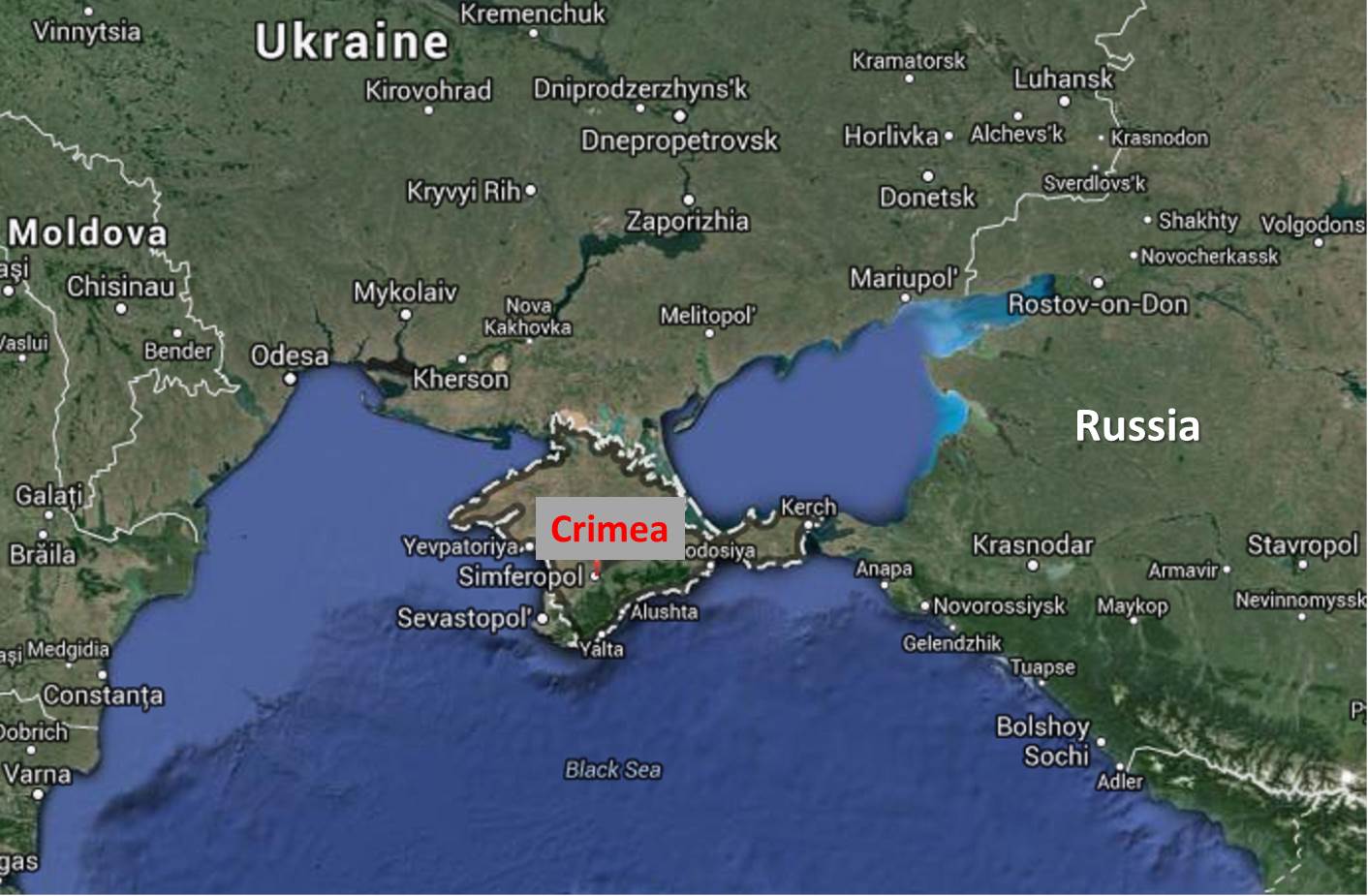
The Russians are already talking about another battle against the Nazis. It seems inevitable that Russia will now ensure its own influence in the Crimea with troops on the ground (even if they bear no Russian insignia). With 60% of the Crimean population being Russian (with 24% being Ukrainian and 12% being Tartars) there is little doubt that Russia will “respond” to calls for help from the Russian population and are already doing so. And once again – paradoxically – it could be Russian intervention in the Crimea which turns out to be the best defense against Neo-nazis exploting the US and Obama’s “promotion of democracy”.

NewsInfo: The newly-chosen prime minister of the Ukrainian southern region of Crimea on Saturday called on Russian President Vladimir Putin to help restore “peace and calm” to the Black Sea peninsula, amid a standoff with the new authorities in Kiev.

Crimea (Google Maps)

Crimea (Google Maps)

Ban Ki-Moon: Puppet without a string ….

January 22, 2014

The UN Secretary General is a puppet on many strings. And when the puppet tries to write the screen-play or to manipulate the puppeteers, the play usually suffers.

Ban Ki-Moon seemed to have forgotten that when he issued his invitation to Iran to the Geneva II talks about Syria last week and tried to write his own script for the talks. It didn’t take long before he had to backtrack.

Iran has insisted all along that it would only attend if it was without conditions. The US has long held that Iran could attend only if they accepted the results of Geneva I (where Iran was not present). So why Ban Ki-Moon tried act independently is not very clear. Presumably he was persuaded to by his staff who believe that the UN has some legitimacy beyond what is provided by the puppeteers.

(Also inviting Australia and Mexico and Korea and Luxembourg leaves me mystified.)

I have decided to issue some additional invitations to the one-day gathering in Montreux. They are: Australia, Bahrain, Belgium, Greece, the Holy See, Luxembourg, Mexico, the Netherlands, the Republic of Korea, and Iran. I believe the expanded international presence on that day will be an important and useful show of solidarity in advance of the hard work that the Syrian Government and opposition delegations will begin two days later in Geneva.

As I have said repeatedly, I believe strongly that Iran needs to be part of the solution to the Syrian crisis.

I have spoken at length in recent days with Iran’s Foreign Minister, Mr. Javad Zarif.  He has assured me that, like all the other countries invited to the opening day discussions in Montreux, Iran understands that the basis of the talks is the full implementation of the 30 June 2012 Geneva Communique, including the Action Plan.

Foreign Minister Zarif and I agree that the goal of the negotiations is to establish, by mutual consent, a transitional governing body with full executive powers.  It was on that basis that Foreign Minister Zarif pledged that Iran would play a positive and constructive role in Montreux.

Therefore, as convenor and host of the conference, I have decided to issue an invitation to Iran to participate.

It didn’t take very long before the US made it impossible for his invitation to remain valid:

NY TimesMr. Ban announced the Iran invitation on Sunday a little before 6 p.m. Eastern time. By that time, it was the middle of the night in Tehran — way too late for government officials to respond, but early enough for Washington to do so. …. 

Less than two hours after Mr. Ban’s briefing, the State Department spokeswoman, Jen Psaki, said in a statement: “The United States views the U.N. secretary general’s invitation to Iran to attend the upcoming Geneva conference as conditioned on Iran’s explicit and public support for the full implementation of the Geneva Communiqué, including the establishment of a transitional governing body by mutual consent with full executive authorities.”

As the New York Times puts it “But in diplomacy, there are no dress rehearsals. Mr. Ban’s choreography went awry, forcing him into a corner. Less than a day after issuing the invitation, the secretary general reversed course. Iran could not attend the talks, he said, because it had not affirmed the ground rules as he said he had been assured.”

It could be that even Ban Ki-Moon’s perception of his own independence was manipulated. Whether the invitation and its withdrawal were orchestrated by the US State Department, and whether the US was reacting to the fears of the Sunnis in the Middle East is unclear. (The report published with great fanfare yesterday about the human rights violations, detentions and executions by the Assad Government yesterday was apparently commissioned by the Government of Qatar. The timing of the publication of this report was also dictated by Sunni interests). I believe that the invitation and its withdrawal – paradoxically – strengthens Iran’s hand since they are conspicuous by not being present – and through no fault of their own.

The barbarism in Syria continues. I have no great expectations of Geneva II but it is part of a necessary process. If Al Qaida is to be kept in check, I think the involvement of Iran is both necessary and unavoidable. Without Iran not all of the Syrian opposition groups will be represented. And without Iran the Al Qaida factions could dominate the opposition.

A puppet with a broken string does not gain an extra degree of freedom. The UN Secretary General cannot entertain any delusions of grandeur or any thought that he can act independently of his puppeteers.

Assad’s gambit but is it Putin’s end-game being played out in Syria?

November 10, 2013

The Hindu carries an interesting editorial on Assad’s Gambit:

In extending his cooperation to the OPCW – which has until June 2014 to oversee the elimination of Syria’s chemical stockpile – President Bashar al-Assad has signalled his indispensability to a diplomatic settlement. Mr. Assad has underlined that not only is he in control but he is also willing to make tactical concessions. The odds are now stacked heavily against the Syrian rebels. After the United States shelved its plan to intervene militarily, opposition groups have had to reconcile themselves to the option of sharing power with Damascus. That al-Qaeda and other terror outfits have infiltrated the rebels’ ranks has also substantially diminished the support they initially received from the West. Not surprisingly, many of the rebel factions have expressed their reluctance to participate in the “Geneva 2” diplomatic conference scheduled for later this year. Mr. Assad, on the other hand, has made the Syrian government’s participation contingent on his being allowed to complete a full term in office.

Paradoxically it is the destruction of his chemical weapons which has made Assad an indispensable part of the solution. If it was one of the rebel groups (Al Qaida or a group supported by Turkey or by Iran or by Saudi Arabia or by the Kurds or by the Muslim Brotherhood) which actually did use the chemical weapons (Sarin gas) in September, then their ploy has misfired spectacularly. If it was Assad’s forces which released the gas (whether with or without his knowledge), it has certainly brought matters to a head and – also spectacularly –  shifted the course of this civil war. Syrian Opposition became “armed rebels” and are now equated with “terrorists”. From being about Assad’s repression and justified opposition the conflict is being transformed to Assad versus the terrorists.

Keeping score in the Great Syria Chess Game is not easy and when the chemical inspectors were called in I wrote

Vladimir Putin and Sergei Lavrov are winning. The diplomatic path is now their creation. Suddenly Russia is the peace-maker in the face of US war-mongering! Not only was the US strike on their ally delayed indefinitely, it is now Assad’s Syria – and not the various opposition groups – which is required to engage with the international community. Any opposition forces who seem to be coming in the way of inspecting or securing control of the chemical weapons can now be attacked by Assad with the full support of the international community. Russia can continue supplying Syria with conventional weapons. ….

Bashar al-Assad is winning. He does not really need chemical weapons which cannot effectively be used anyway. Any US strike on his forces is postponed indefinitely. With no prospect of any no-fly zone being declared his air-force could be decisive in the civil war. The supply of conventional weapons from Russia is assured. His claim that rebels and terrorists were responsible for the use of Sarin is backed up by Russia and the UN weapons inspectors have no option but to investigate this (and they are on their way back to Syria).

But I think the Hindu is wrong to think that it is merely the infiltration of rebel groups by Al Qaida which has damaged their support from the West. The point is that the rebel groups supported and supplied by so many surrounding countries are not a home-grown opposition but are essentially a collection of mercenary groups fighting proxy wars for many players. Saudi Arabia and Turkey in particular were and are heavily involved – and may even have been instrumental in starting the armed conflict. Now of course Iran and the Kurds and the Muslim Brotherhood are providing succour and support for their pet groups. Al Qaida has its fighters from all over the region (and from radicalised youth in the West) trying to attain eternal salvation through martyrdom. The EU and the US supply arms through third parties to a variety of the rebel groups – and it often seems they have no idea who the arms are going to. Russia supplies Assad. Israel no doubt stirs the pot whenever it can and using whichever faction is available to maintain the turmoil.

As Aron Lund writes in his report,Divided they Stand” An Overview of Syria’s Political Opposition Factions

The opposition landscape is so fragmented and disconnected, that there is little clarity even among activists themselves about what groups and coalitions are truly effective or enjoy popular support. ….

While it is unlikely that any of today’s political opposition groups will control the future Syria, they are likely to play a significant role in a future transition phase or reconciliation process. Regardless of who rules Syria in the future – the current regime, breakaway elite factions, a government installed with foreign backing, or armed rebels – they will need to connect with the political opposition to legitimize their own position.

Assad’s Gambit may be paying off but it is just a few moves within the Putin initiated defence. Whether the Putin defence also has an end-game in mind is as yet difficult to discern. It may just lead to a stalemate and a long drawn-out conflict. It may lead – in the best scenario – to a gradual political transition where Assad has an “honourable” discharge and exile waiting for him sometime late next year.

There are no longer any outright victories in sight in this multi-dimensional chess game where the rules keep changing. But if there is any overall direction to this end-game it is probably coming from Putin and Lavrov. Whether Obama and Kerry are playing the game, or are just bystanders providing infrastructure for the playing of the game remains to be seen. The EU is almost as divided as the Syrian opposition and are very good at mouthing platitudes. The dilemma that the US and the EU face is that support for secular forces in Syria is inevitably support for Assad. Support for any armed rebel group is also support for Islamist jihadists.

Keeping score in the great Syria chess game

September 24, 2013

It is not possible to say who won or who lost. The Great “Game” will take a long time to reach a conclusion. All that can be done is to see who’s winning and who’s losing.

David Cameron is losing and may have lost. He took a slap in the face from the House of Commons. If he had managed the vote in his favour, the US strike on Syria would have taken place almost immediately. Whether the strike would have achieved much will never be known but Obama would have “walked” his “talk”. Milliband seemed to be winning since he had defeated Cameron but it is becoming clear that he had played his trump far too soon and allowed Putin to make his play. And Milliband can be credited for letting down the US and the special relationship. Tony Blair lost. He showed up as a “rabid dog” revelling in going to war (to try and justify his bad judgements during the Iraq war). And nobody took him very seriously.

Barack Obama is losing. He has confirmed his reputation as a ditherer and that he is risk-averse to the point of being  seen as being ruled by his fears. He has effectively shifted the balance of power in going to war from the Presidency towards Congress. This power given up will be difficult to regain. Without the backing of the UK he was forced to look for ways to extricate himself from his “red line” box.

John Kerry was point-man for Obama and was – for a time – the potential scape-goat. But he has repositioned himself and may even take away some credit for the Russian play. His throw-away line about “no strike if Syria gave up their chemical weapons” is now being spun as an intentional statement.

Francois Hollande is losing. His support for Obama was not enough to allow the US to carry out a strike on Syria. The value of French support – compared to the UK support which was not forthcoming – was diminished. And then to make matters worse his Parliamentarians made it quite clear that they did not support his position even though they were not required to vote. Having supported a strike he was not quite adroit enough to claim any credit for the alternate diplomatic path that resulted. Getting Freedom Fries reverting to be French Fries was his only consolation.

Vladimir Putin and Sergei Lavrov are winning. The diplomatic path is now their creation. Suddenly Russia is the peace-maker in the face of US war-mongering! Not only was the US strike on their ally delayed indefinitely, it is now Assad’s Syria – and not the various opposition groups – which is required to engage with the international community. Any opposition forces who seem to be coming in the way of inspecting or securing control of the chemical weapons can now be attacked by Assad with the full support of the international community. Russia can continue supplying Syria with conventional weapons.

The Syrian Opposition groups (including Al Qaida) are losing the civil war. Assad can now get more weapons replacements than they can. Al Qaida need a weakened Assad to create a winning position and they need a prolonged civil war to achieve dominance among the opposition groups. Both objectives would have been assisted by a US strike.

Bashar al-Assad is winning. He does not really need chemical weapons which cannot effectively be used anyway. Any US strike on his forces is postponed indefinitely. With no prospect of any no-fly zone being declared his air-force could be decisive in the civil war. The supply of conventional weapons from Russia is assured. His claim that rebels and terrorists were responsible for the use of Sarin is backed up by Russia and the UN weapons inspectors have no option but to investigate this (and they are on their way back to Syria).

Iran is winning. President Hassan Rohani is on a roll. First Hizbollah – at Iran’s bidding – helped to keep the Syrian opposition groups at bay when they seemed to be gaining ground. Then he supported the Russian diplomatic initiative. That was followed by an interview  on NBC  and an op-ed in the Washington Post to assure the US and the world that Iran had no intention of developing WMD of any kind including nuclear weapons. Iran’s foreign minister, Mohammad Javad Zarif, sent Rosh Hashanah greetings to Jews worldwide via Twitter and caught the Israelis off-guard. Now Rohani is on his way to address the UN General Assembly. Willy-nilly they are now a part of the diplomatic path for Syria and cannot just be ignored. That engagement allows the Iranian charm offensive to proceed as well on other fronts.

Israel is both winning and losing. It was Israeli intelligence intercepts – not US  – which led to Obama’s threatened strike. A strike by the US was definitely preferred by the Israelis though their objective was to maximise turbulence for as long as possible in Syria.  To be able to get the US to threaten a strike as they wished based on selective intelligence was a coup. Not to have the strike consummated was a setback. If the Iran/Russia influence grows and Assad is more secure than before, then these are also setbacks.

Turkey is losing. The Islamic government was perhaps the strongest supporter of a strike on Assad. Their dislike of Assad is so strong that they would even have supported a strike by Israel. But Turkey’s subservience to and support for all groups Islamic ( Muslim Brotherhood in Egypt) is now becoming an embarrassment for Europe. Their application to join the EU is – I think – already lost.

The Great Game has a long way to run. It has been running for a thousand years and there are many more twists and turns to come. Many pieces will be lost and won by all the parties and there may never be a check-mate and a clear winner in this game. Having a clear winner always requires having a clear loser. Having a clear loser in the Middle East is not always a good thing.

And so a stalemate is probably the closest there is to a win-win.

Obama hits pause button and Senate delays Syria vote

September 10, 2013

As I speculated yesterday, putting Syrian chemical weapons under International control has taken off as a potential “negotiated” solution which could avoid a US strike.

The speed with which the suggestion of international control has been taken on by so many of the parties including Syria (but excluding Al Qaida and the various opposition groups) is – I think – encouraging. But the message from the Obama administration is now incredibly mixed. Instead of giving the impression of an iron fist in a velvet glove the prevailing impression is of Obama having gone too far and now scrambling to avoid implementing a strike.

Even the Senate majority leader felt it necessary to delay any vote in the Senate. Members of Congress were also highly irritated by Kerry’s statement yesterday that the strike would be “unbelievably small”. This must have stung their egos — since of course nothing the Congress votes for can be for anything “unbelievably small”!

Support for President Obama’s call for military airstrikes in Syria is sliding on Capitol HIll.

President Obama’s push for congressional approval for military airstrikes in Syria ran aground Monday, forcing Senate Majority Leader Harry Reid, D-Nev., to delay a procedural vote as opposition builds among senators in both parties.

Six senators, including five Republicans and one Democrat, announced Monday they would vote against a resolution authorizing the use of force — a strong indication that the administration’s efforts to build bipartisan support have been ineffective.

The Senate was scheduled to vote Wednesday on a procedural motion to begin formal debate on the resolution, but Reid announced late Monday the vote would be delayed in order to buy the president more time to make his case to senators and the public.

“What we need to do is make sure the president has the opportunity to speak to all 100 senators and all 300 million American people before we do this,” Reid said.

The delay also came amid reports that Russia was seeking a deal with Syria to dismantle its chemical weapons program. Obama said in television interviews Monday such a deal could circumvent the need for U.S. military intervention, but senators had not been briefed on the development and expressed skepticism.

“I have no idea what’s going on. It’d be great if the Russians could convince Assad to turn over his chemical weapons to the international community. That’d be a terrific outcome. I just am very dubious and skeptical,” said Sen. Lindsey Graham, R-S.C.

Comments made Monday in London by Secretary of State John Kerry describing the military effort as “unbelievably small” also rankled lawmakers. Graham said Kerry “undercut everything the president has been doing for the last couple of days” to build support.

That there was strong opposition to Obama’s war in the House was known but this has now spread to the Senate.

The rapid clip of senators announcing their opposition on Monday raised serious doubts that the president would be able to muster the necessary support in either the House or Senate. The GOP-led House is not likely to take up a resolution unless the Senate can pass it first. A final Senate vote was expected this weekend, but Reid’s decision to delay the formal debate puts the schedule in flux.

Five GOP Sens. Lamar Alexander of Tennessee, Roy Blunt of Missouri, Johnny Isakson of Georgia, Roger Wicker of Mississippi, and Mike Enzi of Wyoming all announced opposition Monday, as did Democratic Sen. Heidi Heitkamp of North Dakota.

Briefings by top administration officials and a weekend conversation with Secretary of Defense Chuck Hagel were not enough to sway Alexander. “I see too much risk that the strike will do more harm than good by setting off a chain of consequences that could involve American fighting men and women in another long-term Middle East conflict,” he said.

If a US strike does not take place the losers will be Obama (for being so strident so quickly) and Al Qaida.


Are Obama / Kerry preparing a face-saving exit?

September 9, 2013

UPDATE!

Looks like my speculations  this morning may not be so far off the mark:

Washington Post: 

Syria ‘welcomes’ Russia proposal on chemical arms

========================================================================

It might just be wishful thinking on my part or it could be that Obama and Kerry are preparing a face-saving path to abandoning their strike on Syria rather than suffer a humiliating rejection in the the US House of Representatives.

For the first time that I have noticed, Kerry is now “offering” Assad a way to avoid a strike – by giving up all his chemical weapons. I could be mistaken but I perceive the beginnings of a change in Kerry’s strident tone. The rhetoric for a strike from Kerry and Obama is not letting up – but it’s the first time that a possibility of a strike not happening has been mentioned. Of course if Congress and the Senate back Obama then there will be no need to back down and the exit path will become unnecessary. I also noted some US voices suggesting that Obama could postpone any vote in Congress until after some – so far – undefined moves in the UN as being advocated by the EU and other countries (including Russia). Putin for his part has also indicated that if the UN were shown the evidence and concurred then he would also support some – as yet unspecified – UN action against Syria.

Of course Assad would not/could not just give up his chemical weapons and certainly not to the US. But it is not unthinkable that he may be willing to put them under the control of his Russian allies. So if a suitable “formula” is evolved where the Russians perhaps “take charge” of Assad’s chemical weapons or in some other way secure their “safe-keeping” then Kerry and Obama could claim that their objective of preventing any further such attacks has been achieved. And if in addition the Russians are acting – or seen to be acting – on behalf of the UN in arranging such a scenario it would not only give Assad a way of saving face but also give the US the possibility to claim that Assad has conceded the supremacy of the UN. More importantly if such a scenario were being arranged it would give Obama and Kerry a “reason” for waiting with the vote in the House and for waiting with the strike.

If , in spite of the “red line having been crossed”, a US strike can be avoided by Assad ceding control of his chemical weapons then it seems to me to be something within the realm of negotiation. Especially when the benefits to the US of a very limited strike are not very evident. The benefits of such a strike  may mainly accrue to Al Qaida.

The key remains the US Congress. All “face saving” only becomes necessary and only comes into play if Obama expects to lose a vote in the House even after (and if) he has won a vote in the Senate. The next few days will tell if Obama’s rhetoric is holding sway in the House or whether he will need to use his exit strategy.

What do Obama, Blair and Al Qaida have in common?

September 6, 2013

They all want a  US strike on Syria – each for his own reasons.

Al Qaida has the most to gain by a weakening – rather than an elimination – of Assad’s regime. That would give them time to consolidate their dominance among the opposition groups while ensuring the eventual demise of Assad.

Tony Blair is desperate to show that all attacks by Western interests which help regime-change in the area are justified in themselves. His duplicity about WMD and Iraq will always dominate his place in History and that rankles. He is still looking for the argument which can support his fantasy that the intervention in Iraq – even without any WMD – was a good thing. He has just been interviewed by the BBC and this is to be aired on Monday. The excerpts released so far clearly reveal how utterly self-centred and self-serving he is.

What exactly Obama hopes to accomplish is quite unclear. It could be for intellectual satisfaction for having – recklessly – made his red-line box for himself. It could be to demonstrate his “moral superiority” and by extension that of the US. He (through Kerry) says 1429 people were killed by sarin gas. The French put the number at 281. The British said it was about 350. How will Obama measure success? By the number of fresh bodies on the ground? Score 1 for every Assad soldier killed! An “eye for an eye” or will he need to multply by ten to ensure that his actions are a deterrent? It is the gassing of children that must be addressed he says.  Is it only the manner of their deaths he wants to react to? How many children have died in US drone attacks so far?

Israel will be very satisfied if Syria remains in internal turbulence for as long as possible. Turkey’s Islamists will be very happy to see Assad go. Will Obama be satisfied for having strengthened Al Qaida and other Islamist groups?

Perhaps Obama with his drones and his “limited and targeted strike on Syria” is just one of the wannabe soldier(s who remain enamored of the lure of bloodless machine warfare”.

I think war is deplorable but unfortunately necessary. Human behaviour has not yet evolved to be able to avoid it. But war without any objective and primarily to demonstrate “moral superiority”?

Robert H. Scales, a retired Army major general, is a former commandant of the U.S. Army War College and writes in the Washington Post:

A war the Pentagon doesn’t want

…. After personal exchanges with dozens of active and retired soldiers in recent days, I feel confident that what follows represents the overwhelming opinion of serving professionals who have been intimate witnesses to the unfolding events that will lead the United States into its next war.

They are embarrassed to be associated with the amateurism of the Obama administration’s attempts to craft a plan that makes strategic sense. None of the White House staff has any experience in war or understands it. So far, at least, this path to war violates every principle of war, including the element of surprise, achieving mass and having a clearly defined and obtainable objective.

They are repelled by the hypocrisy of a media blitz that warns against the return of Hitlerism but privately acknowledges that the motive for risking American lives is our “responsibility to protect” the world’s innocents. Prospective U.S. action in Syria is not about threats to American security. 

 The U.S. military’s civilian masters privately are proud that they are motivated by guilt over slaughters in Rwanda, Sudan and Kosovo and not by any systemic threat to our country.

They are outraged by the fact that what may happen is an act of war and a willingness to risk American lives to make up for a slip of the tongue about “red lines.” These acts would be for retribution and to restore the reputation of a president. Our serving professionals make the point that killing more Syrians won’t deter Iranian resolve to confront us. The Iranians have already gotten the message.

Our people lament our loneliness. Our senior soldiers take pride in their past commitments to fight alongside allies and within coalitions that shared our strategic goals. This war, however, will be ours alone.

They are tired of wannabe soldiers who remain enamored of the lure of bloodless machine warfare. …. 

…. Soon the military will salute respectfully and loose the hell of hundreds of cruise missiles in an effort that will, inevitably, kill a few of those we wish to protect. They will do it with all the professionalism and skill we expect from the world’s most proficient military. I wish Kerry would take a moment to look at the images from this week’s hearings before we go to war again.

Read the whole article.