
But there seem to be some gender inequalities
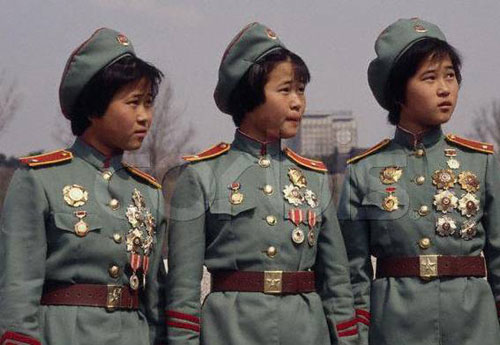
Medals can be inherited …..
I am not sure whether to call this “bad science” or to be generous and call it “trivial science”.
There is a new paper in PLOS ONE (open access) from “researchers” at Boston University:
Effects of Warming Temperatures on Winning Times in the Boston Marathon by Abraham J. Miller-Rushing, Richard B. Primack, Nathan Phillips and Robert K. Kaufmann, PLoS ONE 7(9): e43579. doi:10.1371/journal.pone.0043579
The only conclusions of any little value in this paper are that
Of course they could simply have reported that the variability of temperatures on race day drowned out the effects – if any – of any global temperature change. But that would have been too simple, too truthful and would not have helped towards publication.
The findings of this so-called “research” are:
The effects of global warming clearly cannot be detected in the results of the Boston marathon. In the paper their Figure 2 and Table 1 are fairly trivial but of passing interest. The rest of their modelling efforts (input and output) are just garbage.
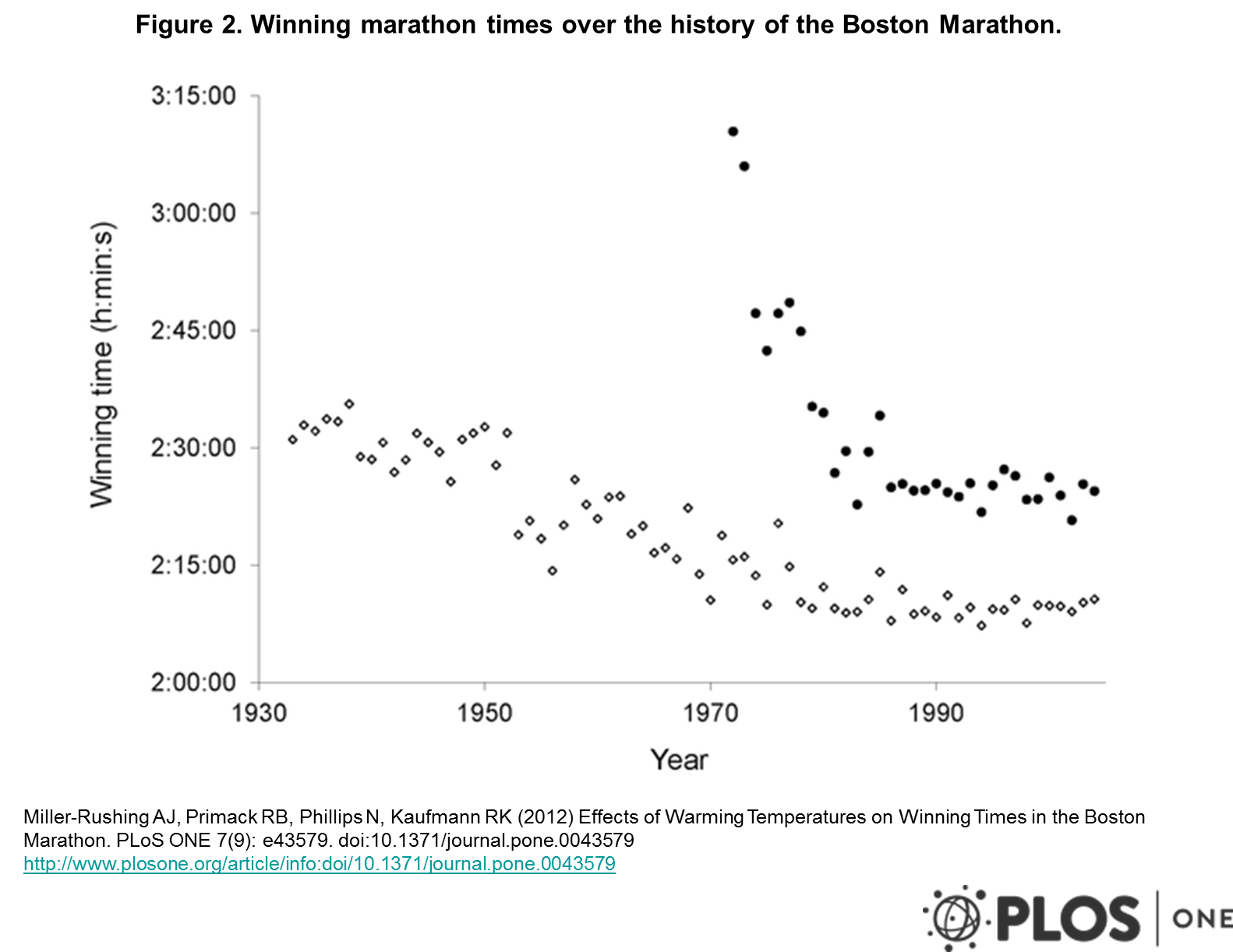
Open diamonds represent men’s times from 1933–2004. Closed circles represent women’s times from 1972–2004. Women’s running times improved rapidly in the first 14 yr of women’s participation in the marathon. From 1983 to 2004, the differences between men and women’s winning times held relatively constant at an average of 15 min 47 s.
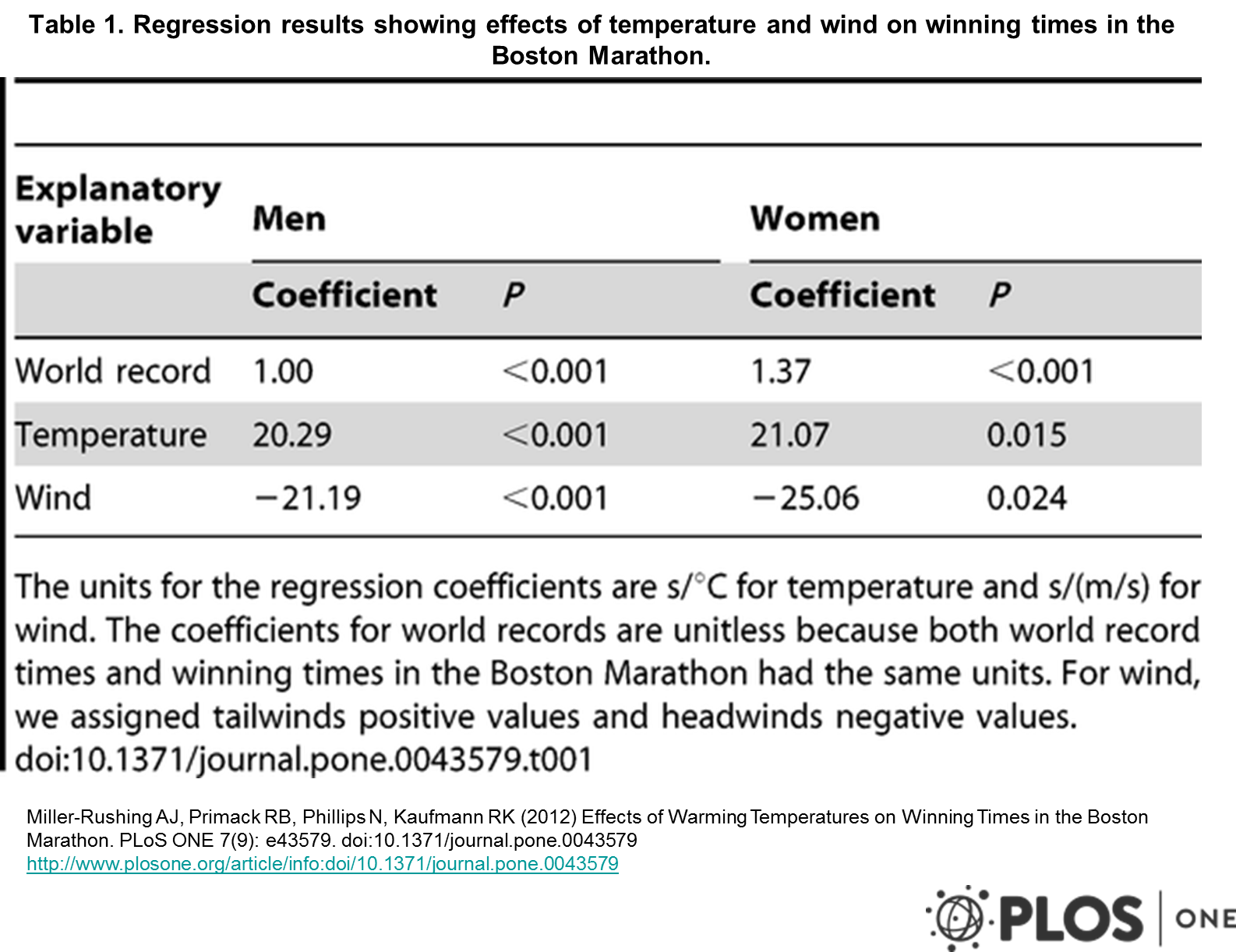
Table 1. Regression results showing effects of temperature and wind on winning times in the Boston Marathon.
Abstract: It is not known whether global warming will affect winning times in endurance events, and counterbalance improvements in race performances that have occurred over the past century. We examined a time series (1933–2004) from the Boston Marathon to test for an effect of warming on winning times by men and women. We found that warmer temperatures and headwinds on the day of the race slow winning times. However, 1.6°C warming in annual temperatures in Boston between 1933 and 2004 did not consistently slow winning times because of high variability in temperatures on race day. Starting times for the race changed to earlier in the day beginning in 2006, making it difficult to anticipate effects of future warming on winning times. However, our models indicate that if race starting times had not changed and average race day temperatures had warmed by 0.058°C/yr, a high-end estimate, we would have had a 95% chance of detecting a consistent slowing of winning marathon times by 2100. If average race day temperatures had warmed by 0.028°C/yr, a mid-range estimate, we would have had a 64% chance of detecting a consistent slowing of winning times by 2100.
On balance I shall just classify this as Trivial Science bordering on Bad Science

We changed to summer time last night. And when I rose at 0600 today – Easter Sunday – (5 am according to my body clock) it was all of -12°C outside!
SMHI defines spring in Sweden as the first day – after 15th February – of 7 continuous days with temperatures between 0 and 10 °C. The “normal” onset of Spring is as below:
Admittedly I am at a latitude of 58.7057° N.
At 58.7 °N spring should have come around 12th March and we are going to be around 3 weeks late (at least).
There is much clearing and spring cleaning to be done but I am not the most enthusiastic gardener in the world. The sun is warm and we should get up to an air temperature of +5°C today. But I have no intention of digging through the remaining frozen snow or risk frostbite while clipping the bushes. I shall have another cup of coffee and wait for time and natural variation to do their work.
I could do with a bit of real global warming – and not that which comes from a mathematical model.
The first time ever that India has managed a white-wash on their opponents in a test series. They won 4 tests of the 4 test series at home against Australia. (They already know how to be white washed!)
But the Australian team can take comfort in the fact that practice paid-off and they won the toss 4 times in a row – and elected to bat each time and lost each time.
And they all learned how to use PowerPoint.
Cricket by PowerPoint
- This is the first time India have won four Tests in a series. They’ve won three in a series on three occasions, two of which were clean sweeps at home – against England in 1992-93, and against Sri Lanka the following season.
- For Australia, this is only their second clean-sweep defeat in a series, after their 4-0 rout in South Africa in 1969-70. This is the sixth time they’ve lost four or more Tests in a series, and the first such instance since the Ashes at home in 1978-79, when an Australian team depleted by the Kerry Packer exodus lost 5-1.
- This is only the second time in Test history that a team has won four or more tosses in a series, and lost four or more Tests in the same series. The only previous such instance was in the Ashes series of 1978-79 mentioned above, when Australia won the toss in five out of six Tests, but lost the series 5-1.
- India have won 12 Tests at the Feroz Shah Kotla, which is next only to the MA Chidambaram Stadium in Chennai, where they’ve won 13. Of their last ten Tests here, India have won nine and drawn one. Their last defeat at this venue was in 1987, against West Indies.
- Cheteshwar Pujara was not only one of the Indian heroes for the match and the series, but also for the entire season: he scored 857 runs in eight Tests 85.70, which puts him in 15th place in the all-time list forruns scored in a season for India. With a 600-run cut-off for a season, Pujara’s average of 85.70 puts him inseventh place.
- Pujara’s unbeaten 82 in the fourth innings came off only 92 balls. His strike rate of 89.13 is the third-best for India in fourth-innings knocks of 75 or more.
- The 104-run stand between Pujara and Virat Kohli is the tenth century stand for India for the second wicket in the fourth innings of a Test match.
- R Ashwin’s series haul of 29 wickets is the seventh-best for India in a Test series, and the best since Harbhajan Singh’s 32 against Australia in 2001. The only Indian bowlers who’ve taken more wickets in a series are BS Chandrasekhar, Vinoo Mankad, Subhash Gupte, Kapil Dev, Harbhajan and Bishan Singh Bedi.
- There were five five-fors for India in the series; only three times have there been more five-fors in a series for India.
- Peter Siddle became the first batsman in Test history to score at least a half-century in each innings of a Test. He scored 51 in the first innings and 50 in the second, top-scoring for Australia in each innings.
- Glenn Maxwell became the first Australian to open the batting and bowling in the same Test since Percy Hornibrook in 1929. Hornibrook, a left-arm bowler who bowled some medium-pace and spin, opened the batting and bowling at the MCG Test against England.
- For only the third time in their entire Test history, Australia opened the attack with two spinners. The last such instance for Australia was in Georgetown in 2003 against West Indies, when Stuart MacGill and Brad Hogg opened the bowling in West Indies’ second innings.
That spring is delayed all over Europe and North America is bad enough (the sun is shining here at latitude 58.7057° N but the temperature is all of – 10 °C).
That people will be “celebrating” Earth hour today is even worse.
But that the annual Pooh Sticks competition (world championship) scheduled for tomorrow has been cancelled in the UK is beyond the pale.
And those to blame are clearly the CRU of the UEA, the IPCC and the WWF.

CANCELLED
We are very sorry to announce that we have to cancel this Sunday’s World Pooh Sticks Championships.
If we had just had a little rain on the day then we would have still played and we would have splashed around in wellington boots and dropped our coloured sticks over the bridges, however we’ve had so much rain over the last few weeks that the river is still too high and fast to have our safety boats on the river and there’s no sign of the rain stopping this weekend.
“I think we all ought to play Poohsticks,” So they did. And Eeyore, who had never played it before, won more times than anybody else; and Roo fell in twice, the first time by accident and the second time on purpose, because he suddenly saw Kanga coming from the Forest, and he knew he’d have to go to bed anyhow. So Rabbit said he’d go with them; and Tigger and Eeyore went off together Because Eeyore wanted to tell Tigger How to Win at Poohsticks. (from “The House at Pooh Corner”)
‘The official Pooh Corner Rules for Playing Poohsticks’ was written in 1996 to commemorate the 70th anniversary of the publication of ‘Winnie-the-Pooh’.
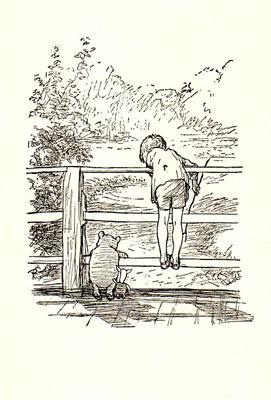
- First, you each select a stick and show it to your fellow competitors. You must agree which stick is which – or whose, as it were.
- Check which way the stream is flowing. Competitors need to face the stream on the side where it runs in, under the bridge (upstream). Note: If the stream runs out, from under the bridge you are standing on the wrong side! (downstream).
- Choose someone to be a Starter. This can be either the oldest or the youngest competitor.
- All the competitors stand side by side facing upstream.
- Each competitor holds their stick at arms length over the stream. The tall competitors should lower their arms to bring all the sticks to the same height over the stream as the shortest competitor’s stick.
- The starter calls, ‘Ready – Steady – Go!” and all the competitors drop their sticks. Note: the stick must not be thrown into the water.
- At this point in the game all the players must cross to the downstream side of the bridge. Please take care – young players like to race across. Remember, other people use bridges and some of them have vehicles or horses.
- Look over the edge of the bridge for the sticks to emerge. The owner of the first Stick to float from under the bridge, is the winner.
Remember: Falling into the water is SAD (Silly And Daft)!
You Dirty Little Rat, You!!!!

Atomic Rat (image http://gotomars.free.fr/atomic_mouse.html)
A rat may have caused this week’s power outage at Japan’s tsunami-hit Fukushima nuclear power plant, says the Tokyo Electric Power Co (Tepco).
The company suspects the rodent may have caused a short-circuit in a switchboard, triggering the power cut.
“We have deeply worried the public, but the system has been restored,” Tepco spokesman Masayuki Ono was quoted as saying by AFP news agency.
Two years ago a quake-triggered tsunami caused meltdowns at the plant.
This week’s outage was a reminder that the plant remains vulnerable despite the government’s claim that the reactors are in a “cold shutdown” state and no longer releasing high levels of radiation.

Britain’s tallest police officer – PC Anthony Wallyn, who is 7ft 2in – was among the officers standing guard at the hospital on Sunday
This may not be bad science but it could be a gross exaggeration of its importance to call it trivial science. A study based on 582 responses gathered by Twitter no less! Unfriending someone on social media can apparently lead to real life avoidance. Almost a profound finding.
How does such nonsense get funded? And why does it ever get published? and reported? But it got presented at a Conference in Hawaii. All is explained.
Unfriending someone on Facebook may be as easy as clicking a button, but a new study from the University of Colorado Denver shows the repercussions often reach far beyond cyberspace.
People think social networks are just for fun,” said study author Christopher Sibona, a doctoral student in the Computer Science and Information Systems program at the University of Colorado Denver Business School. “But in fact what you do on those sites can have real world consequences.”
Sibona found that 40 percent of people surveyed said they would avoid in real life anyone who unfriended them on Facebook. Some 50 percent said they would not avoid the person and the remaining 10 percent were unsure. Women said they would avoid contact more than men.
At this point I had to throw up.
This rubbish comes out of the University of Colorado department of Computer Science and Information Systems.
More shame to them.
.jpg)


 The k2p blog