Archive for the ‘Trivia’ Category

Saffron Sollitt wins 2011 Poohsticks

March 28, 2011

A.A. Milne

Piglet sidled up to Pooh from behind.  “Pooh!” he whispered.  “Yes, Piglet?”  “Nothing,” said Piglet, taking Pooh’s paw.  “I just wanted to be sure of you.”

BBC reports:

Little Wittenham Bridge with the lock keeper's house beyond: image Wikipedia

A nine-year-old girl from Oxfordshire has won the individual prize in the World Pooh Sticks Championships. Saffron Sollitt, from Wallingford, beat 500 other competitors from around the globe at Days Lock in Little Wittenham, near Abingdon, on the River Thames.

Team Kelly took the top spot in the group competition. Last year’s event was cancelled due to high water levels. The competition attracted entries from New Zealand, Germany and the Netherlands.

The championships started in 1983 when the lock keeper noticed walkers recreating Pooh’s pastime on the River Thames.

He thought it would be an excellent way of raising money for his favourite charity, the Royal National Lifeboat Institution (RNLI). The event went from strength to strength until the lock keeper’s retirement when it was passed to the Rotary Clubs of Oxford Spires and Sinodun.

Money raised this year, expected to be excess of £1,500, will go to the RNLI, Little Wittenham Church and other charities supported by the Rotary club.

All about Poohsticks: image theenchanted100acrewoods


Poohsticks is a game first mentioned in The House at Pooh Corner, a Winnie-the-Pooh book by A. A. Milne. It is a simple game which may be played on any bridge over running water; each player drops a stick on the upstream side of a bridge and the one whose stick first appears on the downstream side is the winner. The annual World Poohsticks Championships have been held at Day’s Lock on the River Thames since 1984.

Publicity fail! Nazi newspapers distributed at World Biathlon Championship in Siberia

March 9, 2011

Advertisers and “designers” can sometimes have interesting ideas but incompetent execution can get the better of them. Nostalgia is all very well but distributing wartime Nazi literature in Siberia when the former Soviet Union lost some 24 million lives during WW2 is not likely to go down very well. But I absolve the Siberian organisers of any malicious intent – they are just innocently incompetent with ideas beyond their intelligence.

From The Local.de

Guests attending the opening of the 2011 World Biathlon Championships in Siberia got a surprise when they found Nazi propaganda among the hors d’oeuvres at the reception.

photo: DPA

photo dpa

Organizers thought they had a cute idea: liven up an event for the media by putting out a selection of old newspapers. Little did they know that among them were two pages from notorious Third Reich publications.

One was a reproduction from Der Angriff, or The Attack, a venomous Nazi Party journal published by propaganda chief Joseph Goebbels. The page was headlined “Reich Chancellor Hitler!”

The other, from a 1944 edition of the Deutsche Allgemeine Zeitung, told readers “The invasion has begun.”

Once the gaffe was discovered, a slew of apologies came from the organizers at the Ugra-Classic Theatre Centre in the Siberian town of Khanty-Mansiysk, which has hosted the biathlon event for the past five years.

“There are no political reasons behind this,” insisted centre director Irina Tashenko, who profusely apologized in a letter to the biathlon world governing body, IBU.

Related: Pakistan Navy photoshop fail

Now come the German single-malts

February 27, 2011

The Japanese and the Indian distillers have long been whisky manufacturers and all have their own single-malt brands. And even my favourite brand of Scotch single-malt whisky “Isle of Jura” is now owned by Vijay Mallya’s United Breweries Group.

But now German distillers are shifting their sights from schnapps to whisky.

Der Spiegel:

The Germans, it seems, are not content with just making world-famous beer and schnapps. Now they are taking on the Scots at their own game, with a growing number of distillers producing single malt whisky. And the results, say connoisseurs, are impressive.

With its exposed brick walls and floor-to-ceiling windows, the room could pass for the foyer of a boutique hotel — were it not for the gleaming copper still that occupies pride of place along one wall. It is here that master distiller Cornelia Bohn is preparing another batch of malt whisky. Her distillery is not located in the remote Highlands of Scotland, however, but in the tiny village of Schönermark in the eastern German state of Brandenburg, about an hour’s drive from Berlin.

Bohn is one of a growing number of Germans who are applying their considerable brewing and schnapps-making skills to the ancient Scottish art of single malt whisky. And they don’t lack confidence when it comes to taking on the Scots at their own game.

“My whisky will reflect the open spaces and rolling hills of my countryside,” says Bohn, who owns the Preussische Whisky distillery in Schönermark. “It will be a polarizing whisky, and it won’t be everyone’s darling.”

Bohn, who is one of very few female whisky distillers in the world, began studying the art of whisky making in 2006. She got serious about her passion when she bought and renovated a decrepit 160-year old stable in her village and began making whisky. Her first single malt will hit the market at the end of 2012, after the necessary three-year maturation period.

The label on her bottle, whose name translates as “Prussian Whisky,” shows a rearing black horse wearing a Prussian military helmet. The message is clear: This is a proud German whisky that is not trying to emulate its Scottish ancestors.

Bohn belongs to a group of around 40 malt-whisky makers in Germany, the most prominent of which are the Slyrs distillery in Bavaria and the Spreewald Brewery in Brandenburg. The Sloupisti single malt from the Spreewald Brewery was awarded the equivalent of an Oscar by the high priest of whisky, critic Jim Murray. He included it in the “superstar whiskies that give us all a reason to live” section of the 2010 edition of his “Whisky Bible.”

Plus, German malts are not cheap. The Sloupisti single malt retails at €69 euros ($95) for a 0.7 liter (24 ounce) bottle — around €30 more than an average Scotch. The German whiskies’ high prices reflect not only the time and effort required to produce the spirit, but the fact that small production quantities do not allow for economies of scale. Only about 100,000 bottles of malt were produced in Germany in 2010 — a drop in the ocean compared to the industrial quantities produced in Scotland, where a single distillery can make millions of liters of spirit each year.

Although single malt whisky can be made anywhere in the world, only the beverage made in Scotland may be called Scotch. Nevertheless, malts from other countries are becoming increasingly popular. Japan is currently one of the biggest global whisky producers, and critic Jim Murray chose the Amrut Fusion malt from India as the third best whisky in the world in his 2010 “Whisky Bible.”

Prussian whisky distillery. Cornelia Bohn at the whisky distillery in Schönermark. Photo: Patrick Pleul / dpa

http://www.pnn.de/havel-spree/219102/

From the pharmacy to the distillery

Cornelia Bohn has a weakness for whisky. Now she wants to bring her own brand  on the market. In an old horse stable in the 450-strong village Schönermark (Uckermark) the pharmaceutical engineer has a few days ago opened the “Prussian whisky distillery”

Torsten Roman Brewery of the Spreewald in Brandenburg shows off his Sloupisti single malt whisky which has been praised for its big personality.: photo Torsten Römer


A new market segment!

February 20, 2011

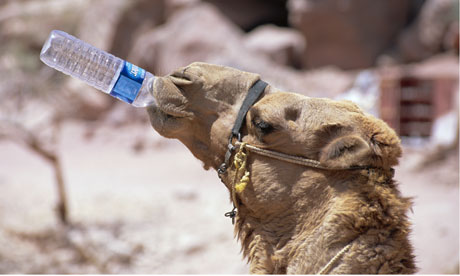
No comment needed!

from the Guardian

Camel drinking, Jordan, Petra.

A new market segment - Camels in Jordan: image The Guardian


One in three Russians believes the sun revolves around the earth!

February 15, 2011

Perhaps humanity as a whole has not come as far as we think from the days of Genghis Khan and the inquisitions of the Catholic Church and witch doctors and shamans.

Reuters reports:

Does the sun revolve around the Earth? One in every three Russians thinks so, a spokeswoman for state pollster VsTIOM said on Friday.

In a survey released this week, 32 percent of Russians believed the Earth was the center of the Solar system; 55 percent that all radioactivity is man-made; and 29 percent that the first humans lived when dinosaurs still roamed the Earth.

The study also found that women were more likely than men to believe the scientific fallacies.

image: crooksandliars.com


JAXA to go fishing for space debris

February 13, 2011

Space junk: image discovery.com

http://www.jaxa.jp/projects/engineering/research/index_e.html

From the Telegraph

The Japan Aerospace Exploration Agency (JAXA) and Nitto Seimo Co aim to tackle the increasingly hazardous problem of rubbish in orbit around the Earth damaging space shuttles and satellites once and for all.

Last year, a US report concluded that space was so littered with debris that a collision between satellites could set off an “uncontrolled chain reaction” capable of destroying the communications network on Earth. It is estimated there are 370,000 pieces of space junk.

The Japanese plan will see a satellite attached to a thin metal net spanning several kilometres launched into space. The net is then detached, and begins to orbit earth, sweeping up space waste in its path.

During its rubbish collecting journey, the net will become charged with electricity and eventually be drawn back towards earth by magnetic fields – before both the net and its contents burn upon entering the atmosphere.

It is likely the nets will target the orbital paths of space shuttles which are constantly monitored for debris.

It is thought that the net will remain in orbit for several weeks, collecting enough rubbish to make the trip financially worthwhile, before sending another net into space.

Inspired by a basic fishing net concept, the super-strong space nets have been the subject of extensive research by Nitto Seimo for the past six years and consist of three layered metal threads, each measuring 1mm diameter and intertwined with fibres as thin as human hair.

The company, which became famous for inventing the world’s first machine to make strong knotless fishing nets in 1925, is aiming for the fuel-free system to be completed within two years.


Canine jobs threatened by explosive sniffing plants!

January 29, 2011

Canine explosives detectors may soon be unemployed as they are replaced by plants. A new paper in PLos One

Antunes MS, Morey KJ, Smith JJ, Albrecht KD, Bowen TA, et al. (2011) Programmable Ligand Detection System in Plants through a Synthetic Signal Transduction Pathway. PLoS ONE 6(1): e16292. doi:10.1371/journal.pone.0016292

Coclusions:

Our system is modular and PBPs can theoretically be designed to bind most small molecules. Hence our system, with improvements, may allow plants to serve as a simple and inexpensive means to monitor human surroundings for substances such as pollutants, explosives, or chemical agents.

From dvice.com

Forget those intrusive airport security scanners, within a few years genetically modified plants could be detecting bombs at airports. Developed by Colorado State University biology professor June Medford, the plants have been manipulated so that they turn white almost instantly when certain types of explosives are in the air around them. Medford says that the goal is to make the plants as sensitive as a dogs nose.

Funding for the project has come from DARPA and the Defense Threat Reduction Agency, who see the plants as an additional line of defense at airports, sports stadiums and government buildings. Medford says that the plants could be in use within four years.

Bomb detecting plants coming soon to an airport near you

Plants turn white on detecting explosives: image dvice.com

Drug smuggling pigeon ring broken

January 19, 2011
Carrier Pigeon

Carrier Pigeon: Image via Wikipedia

From the BBC:

Colombian police say they have captured a carrier pigeon that was being used to smuggle drugs into a prison.

The bird was trying to fly into a jail in the north-eastern city of Bucaramanga with marijuana and cocaine paste strapped to its back, but did not make it.

Police believe the 45g (1.6 ounce) drug package was too heavy for it. Bucaramanga police commander Jose Angel Mendoza said “This is a new case of criminal ingenuity”. The pigeon is thought to have been trained by inmates or their accomplices.

Police said carrier pigeons had been used in the past to smuggle mobile phone Sim cards into the jail.

Good thing this was Colombia and not Singapore – otherwise the pigeon would be facing capital punishment!!

100 year old whiskey from Shackleton’s hut and a shipwreck gives three 200 year old champagnes

January 19, 2011

I am not sure if being frozen for 100 years adds to the process of ageing in a whiskey and in any case ageing usually only takes place in a cask and not in the bottle. Even ageing in a cask is said to be negligible after about 20 years. Champagne however should not benefit from ageing of more than a few years and even a 10 year old champagne may be little better than vinegar. So the value of a 200 year old champagne is historic rather than intrinsic. Shackleton’s whiskey will of course be valued on the historical importance though it may well be very drinkable.

From Discovery News:

Three bottles of whisky abandoned in the Antarctic ice by British explorer Sir Ernest Shackleton have been returned to Scotland.

  • The bottles, from the British Antarctic Expedition 1907, were frozen solid at minus 30 degrees Celsius temperatures but the whisky inside was still liquid.
  • The bottles of Mackinlay’s were part of a cache recovered last year from beneath Shackleton’s Antarctic hut.
  • Tests are now under way to see how the whisky fared after being preserved in the polar chill for so long.

The bottles of Mackinlay’s were part of a cache recovered last year from beneath Shackleton’s Antarctic hut, built in 1908 as part of his failed attempt to reach the South Pole. They made it home Monday to Whyte and Mackay, the brand’s owner, for analysis to see how they have fared after so long preserved in the polar chill.

The wooden crate containing the whisky, marked British Antarctic Expedition 1907, was frozen solid in the minus 30 degrees Celsius (minus 22 degrees Fahrenheit) temperatures but the whisky in the bottles was still liquid. Two more crates of whisky, along with two of brandy, were also discovered but they were left under the floorboards of the hut.  The whisky is believed to have been bottled in Scotland in 1896 or 1897, making it among the oldest in the world. Richard Paterson, Whyte and Mackay’s master blender, said the analysis would be “for the benefit of the whisky industry”.

Also from Discovery News:

Champagne experts have discovered what are believed to be the oldest existing bottles of Heidsieck champagne, salvaged from a shipwreck near the Finnish province of Aaland, local authorities said Monday. Divers stumbled across a cargo of around 150 champagne bottles last July in a two-masted schooner which had run aground sometime between 1825 and 1830, and by last November experts had already identified the world’s oldest Juglar and Veuve Clicquot brands among the bottles. “When re-corking the almost 200-year-old bottles a third brand has now been discovered,” Aaland authorities said in a statement.

Four bottles have been identified as having come from the Heidsieck & Co Monopole house, which is now owned by Vranken Pommery Monopole. Juhlin, who has been helping local authorities re-cork and catalogue the champagnes, added that only one of the Heidsieck bottles was in prime condition.

“The Heidsieck Monopole is around 75 percent pinot noir… It has some flower notes, slightly more toasty notes than the Veuve Clicquot,” he said. Juhlin said he couldn’t put an exact price on the Heidsieck, but said he would not be surprised if it turned out to be the most sought-after and expensive of the three brands. He had earlier estimated that the bubbly from Veuve Clicquot and the now-extinct Juglar could fetch up to 100,000 euros (132,000 dollars) per bottle.


Snow in all US States except Florida

January 12, 2011

A map of snowfall in the United States is revealing right now: 49 states have snow on this 1/11/11 and only one does not.

From the southern snow storm heading north, which is affecting air travel, to the pending storm in New York City, and flurries out west, there’s plenty of white stuff going around.

The lone state without a flake? It’s the Sunshine State…Florida. Locals are celebrating the fact, though interestingly, parts of the state saw snow just days ago.

Even Hawaii has snow, in Mauna Kea on the Big Island.