Archive for the ‘Turkey’ Category

Turkey watches – while ISIS advances against Kurds

October 7, 2014

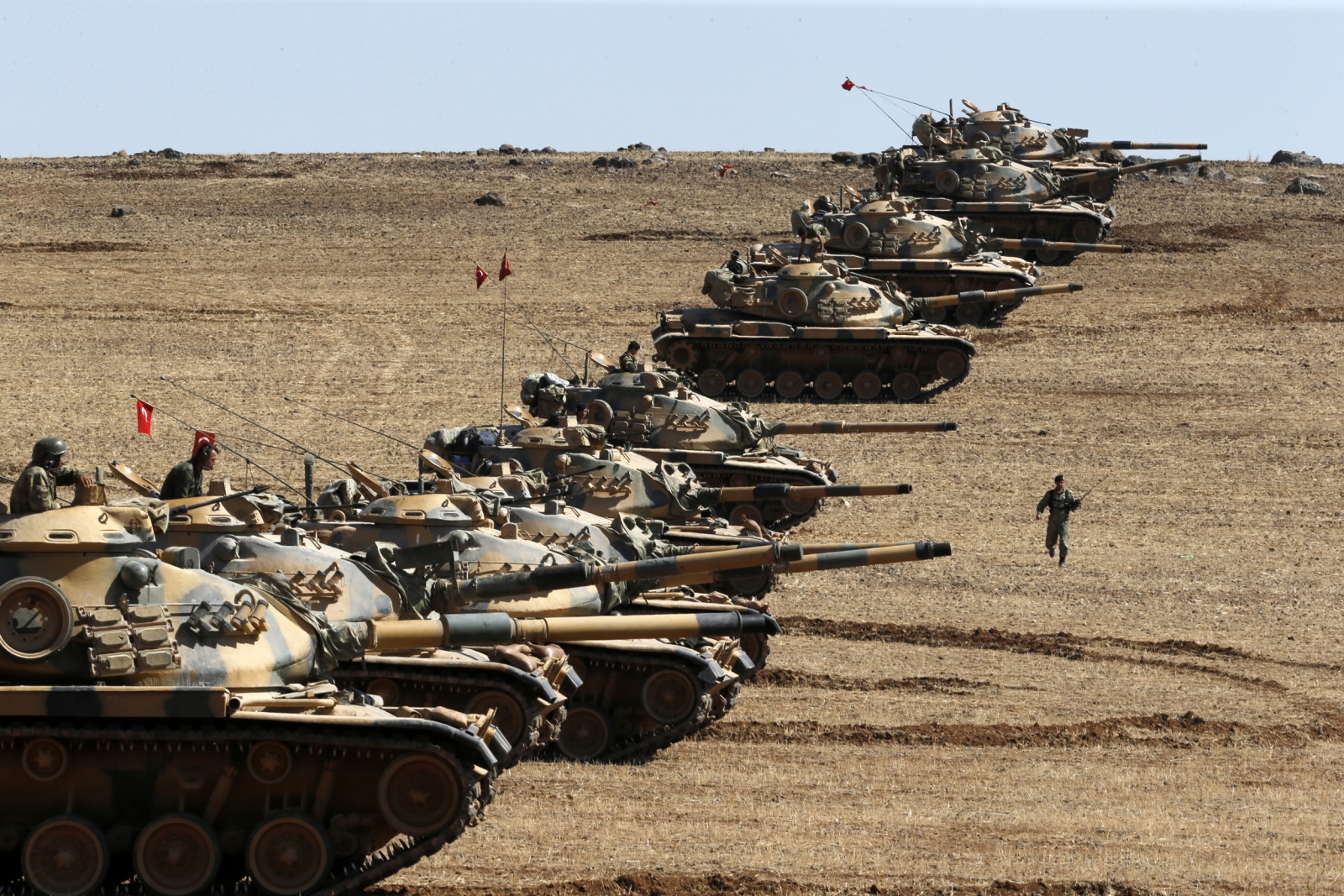
The US is bombing ISIS positions in Syria. But when ISIS advances against the Kurds in the border town of Kobani, Turkey – although a NATO ally – is content to watch. An enemy of the Kurds is almost a friend!!

Turkish tanks on the Syrian border near Kobani – image ibtimes

Of course nothing is simple in the Middle East.

But sometimes it seems to me that anything that weakens the Kurds is considered a “good thing” by the Turkish government. I have the feeling that even Turkey’s membership of NATO is subordinate to their goal of containing the Kurds and preventing the growth of a Kurdistan which stretches across part of present day Turkey. A “Great Kurdistan” as Ralph Peters’ map shows (from this analysis) is Turkey’s nightmare.

Great Kurdistan a Turkish nightmare – graphic Ralph Peters

For Turkey it is a choice between evils. They could well perceive that an ISIS Caliphate may be less of a geographic threat than a Great Kurdistan.

Caliphate claimed by ISIS – graphic zerohedge.com

The many ISIS advances also cast doubt on whether the US air strikes will be anywhere near as effective as Obama hopes and has proclaimed.

Our objective is clear:  We will degrade, and ultimately destroy, ISIL through a comprehensive and sustained counterterrorism strategy.

At Kobani, ISIS advances are not even being contained – let alone degraded and destroyed.

Mathematical turbulence at Ege University, Turkey

August 28, 2013

Back in June I had reported on the strange case at Ege University

Retraction Watch reports on the retraction of a paper by a Turkish mathematician for plagiarism. The author did not agree with the retraction.

But what struck me was the track record of this amazing Assistant Professor at Ege University.

Ahmet Yildirim Assistant Professor, Ege University, Turkey

Editorial Board Member of International Journal of Theoretical and Mathematical Physics

  • 2009       Ph.D      Applied Mathematics, Ege University (Turkey)
  • 2005       M.Sc      Applied Mathematics, Ege University (Turkey)
  • 2002       B.Sc        Mathematics, Ege University (Turkey)

Since 2007 he has a list of 279 publications!

That’s an impressive rate of about 50 publications per year. Prolific would be an understatement.

But the link to his 279 publications is now broken which now only goes to a blank page.

Upon a little further investigation it became clear that not only does he no longer work at Ege University but that his PhD has also apparently been revoked.

Paul Wouters writes:

In mathematics and computer science, Ege university has produced 210 publications (Stanford wrote almost ten times as much). Because this is a relatively small number of publications, the reliability of the ranking position is fairly low, which is indicated by a broad stability interval (an indication of the uncertainty in the measurement). Of the 210 Ege University publications, no less than 65 have been created by one person, a certain Ahmet Yildirim. This is an extremely high productivity in only 4 years in this specialty. Moreover, the Yildirim publications are indeed responsible for the high ranking of Ege University: without them, Ege University would rank around position 300 in this field. This position is therefore probably a much better reflection of its performance in this field. Yildirim’s publications have attracted 421 citations, excluding the self-citations. Mathematics is not a very citation dense field, so this level of citations is able to strongly influence both the PP(top10%) and the MNCS indicators.

An investigation into Yildirim’s publications has not yet started, as far as we know. But suspicions of fraud and plagiarism are rising, both in Turkey and abroad. One of his publications, in the journal Mathematical Physics, has recently been retracted by the journal because of evident plagiarism (pieces of an article by a Chinese author were copied and presented as original). Interestingly, the author has not agreed with this retraction. A fair number of Yildirim’s publications have been published in journals with a less than excellent track record in quality control.  ….. 

How did Yildirim’s publications attract so many citations? His 65 publications are cited by 285 publications, giving in total 421 citations. This group of publications has a strong internal citation traffic. They have attracted almost 1200 citations, of which a bit more than half is generated within this group. In other words: this set of publications seems to represent a closely knit group of authors, but they are not completely isolated from other authors. If we look at the universities citing Ege University, none of them have a high rank in the Leiden Ranking with the exception of Penn State University (which ranks at 112) that has cited Yildirim once. If we zoom in on mathematics and computer science, virtually all of the citing universities do not rank highly either, with the exception of Penn State (1 publication) and Gazi University (also 1 publication). The rank position of the last university, by the way, is not so reliable either, as indicated by the stability interval that is almost as wide as in the case of Ege University.

And a commenter at Poul Waters site adds:

kuantumcartcurt Says:
July 4, 2013 at 12:30 PM

Thanks for this detailed post. It seems that Ahmet Yıldırım’s PhD was recently revoked since it was a direct translation of a book of Ji-Huan He who is also quite a questionable figure in academia (http://elnaschiewatch.blogspot.com.es/2011/02/ji-huan-he-loses-ijnsns.html). It also seems that he was dismissed from the university (again without any official statement).

Here is Ahmet Yıldırım’s PhD ‘thesis’:https://docs.google.com/file/d/0BxUoSj9K4YfeNDIwUUZGRWU1R2c/edit?pli=1
And this is Ji-Huan He’s book: https://docs.google.com/file/d/0BxUoSj9K4YfeZmZvdGpDQUVWY0E/edit?pli=1

It would seem that Ege University is carrying out some house cleaning but neither the University nor the International Journal of Theoretical and Mathematical Physics is saying anything.
Erdogan blows Turkey’s prospects of joining the EU

June 19, 2013

It is not the protests in Turkey but Erdogan’s hard-handed approach to quelling the protests which may have blown Turkeys chances of joining the EU.

It is his response which provides a “politically correct” cloak under which many of those opposed to Turkey’s membership of the EU can hide. Their opposition is primarily because Turkey is an Islamist nation, but the police actions in Turkey come in very handy to hide behind. They can now use Erdogan’s “undemocratic” behaviour as their visible justification for their opposition. Angela Merkel and Germany have long been opposed to Turkey’s membership but have had to walk the tightrope of opposing while not seeming to be giving in to the neo-Nazis and their anti-Turkish campaigns within Germany. I caught Angela Merkel on TV two days ago and she was “apalled, utterly apalled” at the hard response of Erdogan’s police.

Hurriyet: Chancellor Angela Merkel’s conservatives have rejected Turkish membership in the European Union in their German election programme, saying the country would “overburden” the bloc because of its size and economy.

The Christian Democratic Union (CDU) and its Bavarian sister party, the Christian Social Union (CSU), have long opposed Turkey joining the 27-nation bloc, but haven’t stood in the way of EU accession talks that were launched shortly before Merkel took office.

The German line has hardened in recent weeks however because of Ankara’s tough response to three weeks of protests against Prime Minister Tayyip Erdoğan.

On June 17, Merkel said she was “appalled” at Turkey’s handling of the protests, which have turned into fierce clashes between police firing teargas and water cannon, and masked demonstrators throwing bottles and other missiles.

Turkey’s application to accede to the EU was first made 26 years ago in 1987.

 Turkey has been an associate member of the European Union (EU) and its predecessors since 1963. After the ten founding members, Turkey was one of the first countries to become a member of the Council of Europe in 1949, and was also a founding member of the Organisation for Economic Co-operation and Development (OECD) in 1961 and the Organization for Security and Co-operation in Europe (OSCE) in 1973. The country has also been an associate member of the Western European Union since 1992, and is a part of the “Western Europe” branch of the Western European and Others Group (WEOG) at the United Nations. Turkey signed a Customs Union agreement with the EU in 1995 and was officially recognised as a candidate for full membership on 12 December 1999, at the Helsinki summit of the European Council.

All things going well with the negotiations, membership would be on track for 2015. But there is fundamental opposition to an Islamist country of over 70 million becoming a full member. Sarkozy and the right in France were ( and still are) implacably opposed. For many Austrians, Turkey becoming a member would be close to sacrilege. The Spanish remember El Cid (Rodrigo Diaz de Vivar). Brussels (Barroso) has stated that full membership could – at the earliest – come by 2021. Turkey has implied that 2023 – when modern Turkey is 100 years old – may be a deadline.

In December 2011, a poll showed that as much as 71% of the participants surveyed in Austria, the Czech Republic, France, Germany, Italy, Poland, Spain and the UK were opposed to Turkey’s membership in the European Union.

Erdogan’s response to the protests could well provide the cover for the anti-Islamist forces in Europe to prevent Turkey’s accession to the EU for the foreseeable future.

Mathematical genius?

June 4, 2013

Retraction Watch reports on the retraction of a paper by a Turkish mathematician for plagiarism. The author did not agree with the retraction.

But what struck me was the track record of this amazing Assistant Professor at Ege University.

Ahmet Yildirim Assistant Professor, Ege University, Turkey

Editorial Board Member of International Journal of Theoretical and Mathematical Physics

  • 2009       Ph.D      Applied Mathematics, Ege University (Turkey)
  • 2005       M.Sc      Applied Mathematics, Ege University (Turkey)
  • 2002       B.Sc        Mathematics, Ege University (Turkey)

Since 2007 he has a list of 279 publications!

That’s an impressive rate of about 50 publications per year. Prolific would be an understatement.

All peer reviewed no doubt.

Dark and mysterious ways of Turkish academia

March 7, 2013

Professor Debora Weber-Wulff addresses some of the dark and mysterious ways of Turkish academia on her blog. Academic misconduct is apparently wide-spread, largely ignored and is condoned making for a culture with very dubious ethics which has become self-perpetuating . It does not paint a very pretty picture but it is noteworthy that the picture is coming to light only because of the work of a group of other academics. But to break out of the vicious circle will not be so easy.

The Dark Alleys of Turkish Academia

I published a short note in September 2012 about the work of a group of academics in Turkey. A. Murat Eren has now organized a translation of their work into English so that a wider group of scientists can take a peek into the very dark alleys of Turkish academia. …..

….. And then there is the list of academics in Turkey with the most retractions to their name — and their current occupation. Let me quote these here, because it is so shocking:

Only one of the authors with multiple retracted papers is not affiliated with academia. Anyone who knows how difficult it is to get a paper retracted will understand the depth of concern here. How can these people teach at university and mentor doctoral students when they themselves have multiple retractions to their names?

The same chapter also reports on the Sezen case, one that I blogged about in June 2012.

Eren’s conclusions:

  • Turkey’s bad academia is self-perpetuating.
  • People who have committed ethical violations in their dissertations and publications are allowed to become thesis supervisors. Students who are misguided by these create dissertations that equally violate ethics, publish insignificant or duplicated papers, and some of them become the new academic generation, in turn completing the cycle.
  • One of the major problems that perpetuates this cycle is the difficulty of access to dissertations. University libraries limit access with arbitrary reasons, and improvements in YÖK Thesis Archive are far from solving the problem in practice.
  • Even when a dissertation is accessed and plagiarism is seen, penalties are far from being deterrent, due to legal and executive roadblocks.
  • While advanced societies take science theft very seriously, actors of science theft in Turkey silently go on with their duties, thus deleteriously undermining the credibility of the field.
  • Even though today’s scientists in Turkey are not proactive, and they are mostly mute unless they have to defend themselves, I believe that self-criticism will become a way to reveal and eventually eradicate academical problems in Turkey in the future.

I am indebted to the Turkish scientists who have worked on this. I have corresponded with them and did some proofreading on the English version. I hope that this will shine a bright light down the dark alleys

Another plagiarist politician is now appointed Turkish Minister of Education

July 29, 2011

Political and electoral imperatives often lead to people being placed in the most inappropriate positions and being given authority in areas for which they are completely unsuitable.

In Germany, Sylvana Koch-Mehrin had her doctorate rescinded by the University of Heidelberg for containing over 30% plagiarism in May 2011, and shortly after, in June,  she was named EU Commissioner for Research!!

And now in Turkey,   a plagiarist – Ömer Dinçer – has been appointed Minister of Education in Prime Minister Erdogan’s new government!!

Nature News reports:

German politicians found guilty of plagiarism have seen their careers stumble. First came the forced resignation in March of the German defence minister Karl-Theodor zu Guttenberg – the University of Bayreuth withdrew his PhD thesis after identifying extensive plagiarism. Other German politicians wielding doctor titles were then gleefully been targeted by plagiarism software users. Only last month, Silvana Koch-Mehrin of Germany’s Free Democratic Party (FDP) was forced to withdraw from the European Parliament’s Committee on Industry, Research and Energy after the University of Heidelberg had revoked her plagiarizing PhD. Her predecessor on the committee, Jorgo Chatzimarkakis, had his own PhD revoked by the University of Bonn last week for plagiarism.

In Turkey, on the other hand, a controversial charge of plagiarism has not stopped Ömer Dinçer from being appointed minister of education in Prime Minister Erdogan’s new government. The new government was approved by parliament on 13 July.

Dinçer got his PhD from İstanbul University School of Business Administration in 1984. He went on to build up a high flying academic career in parallel with a political career, becoming chief undersecretary in Recep Tayyip Erdoğan’s first government in 2003, and minister of labour in Erdoğan’s second government after 2007 elections.

But he lost his title of professor in 2005 when the Turkish Council of Higher Education YÖK identified extensive plagiarism in his academic book Introduction to Business Administration. Dinçer appealed the charge, but it was upheld in court.

On 8 July newspapers reported that YÖK had quietly cleared him early this year to the dismay of many academics. YÖK confirmed to Nature that it had withdrawn the charge but did not provide reasons.

Dinçer has told newspapers that the charge of plagiarism was part of a smear campaign from a supposed network of people, known as Ergenekon, who favour a military coup.

Related:

The Guttenberg syndrome: Another German politician resigns over plagiarism

Plagiarism and the morphing of a Minister 

Widespread corruption within Turkish customs: Bribes pool of $125 million 


Widespread corruption within Turkish customs: Bribes pool of $125 million

January 9, 2011

In Transparency International’s Corruption Perceptions Index, Turkey ranks together with countries such as the Czech Republic, Hungary, Saudi Arabia, South Africa and Slovenia but somewhat better than Italy.

A bribery ring composed of customs officials in Turkey and including the Director of the Istanbul Region has been revealed. It appears that the 34 arrested shared a bribes pool which in the period of the 6 month investigation is estimated to have contained about $125 million.

From the magnitude of the bribes pool it would seem that Turkey is well qualified for membership of the European Union and the monetary value of this case compares “well” with the Formula 1 bribery case in Germany – though that involved just one individual(?).

It was announced today that:

Thirty-four individuals serving at the İstanbul Customs Regional Directorate have been detained in a major investigation into bribery and corruption allegations at the customs department. The suspects include the chief director of the İstanbul Customs Regional Directorate.

The operation was carried out on Friday.

The allegations against the suspects include the collection of money paid in bribes in a pool and then the distribution of this money to İstanbul customs officials every Friday on the basis of rank and seniority. The investigators claim Chief Director Lütfi Ekinci was aware of this practice among his staff. Ekinci was detained in Mersin, where he was vacationing in his summerhouse.
The suspects allegedly relied on three methods to take bribes from companies importing goods to Turkey. One was to force companies that had all their documents in order to give money, calling this a “donation.” The other method was showing the value of an imported good to be nine-tenths less than the actual value on paper. In other words, an item that would normally cost TL 10 would be recorded as costing TL 1. A third method the officials used was falsifying documents and showing those products that are subject to higher taxes — such as cigarettes — as if they belong in another taxation category. The difference would be taken by the customs officials and added to the bribery pool. Investigators estimate the amount channeled into the bribe fund was TL 200 million ($125 million)…….. The center of the raids was the İstanbul Atatürk Airport Customs and the Ambarlı Customs Zone, but the raids were staged simultaneously at 20 different addresses. Hayrettin Eker, the İstanbul Atatürk Airport Customs Directorate Cargo Terminal chief, and Smuggling Intelligence and Narcotic Department Chief Coşkun Cihanoğlu were also detained in the operation. Documents and computers in the offices of the two men were seized by the police.

The police found TL 20,000 inside an envelope in Eker’s office. A total of TL 150,000 was found on other customs officials detained in the operation, which the investigators claim was taken in bribes. Investigators say the operations will extend to the companies that were involved in the customs bribery scheme.