Archive for the ‘UK’ Category

Cameron’s War: Syria + Sarin = Iraq + WMD?

April 27, 2013

The war in Iraq is over. Everybody is pulling out of Afghanistan.

That a state of violent chaos continues in these countries is really of no consequence. But the subsequent consumption of weapons and ammunition by the US and the UK and in Nato will be a little too low and a growth in this consumption is something to be desired. The Libyan escapade was far too short and too limited in scope to contribute much to the consumption of materials and to the coffers of the weapons industry. And a vigorous and profitable weapons industry does require that that consumption should grow and not just be maintained or  – god forbid – be allowed to decline.

The weapons industry needs a new war. After all if the existing weapons and ammunition don’t get used up how can one sell any more in these times of financial cut-backs. France has Mali. But the US and the UK desperately need a new war. The US needs a new war for economic reasons.

Washington PostAs U.S. wars end, drop in spending hurts economyA surprising 11.5 percent annualized drop in military spending is holding back the economic recovery, …

Obama would like to leave office having won a war of his own. Bush’s war on terror is a little unsatisfactory since it can never be won and it is not something Obama has created himself. Getting Osama provided little profit for the weapons industry. Cameron needs a new war for purely domestic reasons. He will have to face a new election in 2015. He needs to recreate his own image –  to try and live up to the heroic legacies of Winston Churchill in WW2, Margaret Thatcher in The Falklands and of Tony Blair in Iraq. Once upon a time, wars were declared when there was a genuine belief that no other options were available and a clear enemy could be defined. Bush and Blair (and Howard) and the neo-cons changed all that. They realised that the reasons for a desirable war could always be manufactured. Dossiers could be “sexed up” to invent enemies and provide evidence of their evil doings. Of course the “enemy” needed to be relatively weak so that a “victory” would not be jeopardised but sufficiently strong so that both air and ground forces could consume their equipment. Later if anybody found out that the reasons to go to war had been manufactured, they could just blame faulty intelligence.

It could be happening again in Syria. Cameron really needs to reinvent himself and if it takes a war to do that – then so be it. To just follow in the footsteps of “Slimy Tony” is a little demeaning, so this time the evidence for Syria and Sarin gas will have to be manufactured much more carefully than for Iraq and WMD.

BBCThe US president said there was “some evidence that chemical weapons have been used on the population in Syria, these are preliminary assessments, they’re based on our intelligence gathering.

“We have varying degrees of confidence about the actual use, there’s a range of questions about how, when, where these weapons have been used,” he said.

Mr Obama insisted more evidence was still needed and that there would be a “vigorous investigation”.

But proof of their use would be a “game changer”, he said.

“Horrific as it is when mortars are being fired on civilians and people are being indiscriminately killed, to use potential weapons of mass destruction on civilian populations crosses another line with respect to international norms and international law.

“All of us, not just the United States, but around the world, have to recognise how we cannot stand by and permit the systematic use of weapons like chemical weapons on civilian populations,” he said.

….. Earlier Mr Cameron told the BBC’s political editor Nick Robinson: “I choose my words carefully, but what I see does look very much like a war crime is being committed in our world, at this time, by the Syrian government.”

War has become just another tool of economic stimulus and for building the images of the war-leaders.
Prolific Cardiff Professor cleared of misconduct

April 11, 2013

The Shenanigans at Cardiff University led to an investigation by the University  into alleged research misconduct in the laboratory of its dean of medicine, Prof. BP Morgan. He has now been cleared of any misconduct but one of his former co-workers, Rossen Donev,  has been singled out for the manipulation of images. ( Dr. Donev is listed as a lecturer at Swansea University’s College of Medicine). The investigation seems to have found that Prof. Morgan could not have known about his co-worker’s image manipulation even though he was a co-author. Some 40 papers were investigated and image manipulation was found in 4 instances all by the former researcher. Some of the papers have been retracted.

It is laudable that the source of the misconduct has been identified though there is a tiny hint of  a whitewash and some scapegoating when the only guilty person is no longer at the University and every body else is completely exonerated. Does Prof. Morgan have no responsibility at all for misconduct conducted within his group?  The ubiquitous practice of the head of a lab or research group automatically being included as a co-author is not quite satisfactory when the “leader” takes no responsibility for his soldiers. There is something not quite right when there are lots and lots of papers published by the Dean, Professor B P Morgan, (172 papers and 35 review articles or chapters since 1998 – giving 207 publications in about 180 months!)”. You can’t just take the credit for authorship of more than a paper a month and then not take any responsibility for any wrongdoing. Apart from Dr. Donev, everybody else seems to have “had Doctor’s papers”!

BBC: The dean of Cardiff University’s school of medicine has been cleared of research misconduct after claims images were manipulated in academic articles. Professor Paul Morgan and other members of his research group were cleared by a formal investigation panel.

But four allegations of image manipulation in articles were upheld against a former staff member. Prof Morgan, who researches diseases, said the actions of one individual had a “profound effect” on his reputation. A clinical academic, the professor heads a team which Cardiff University’s website said is “internationally recognised for its expertise and contribution to the field of complement biology”. He remained in his post during the investigation by the panel, which was chaired by a former Cardiff circuit judge. …. 

…. The inquiry rejected all allegations against Prof Morgan and members of his research team, but upheld four allegations of misconduct against the former university employee.

The panel also said that Prof Morgan – the co-author of the four articles in question – would not have been aware that the individual had included manipulated images in the articles.

Cardiff University said it took allegations of academic research misconduct against staff extremely seriously. “The panel did find that allegations of data manipulation against a former member of university staff were substantiated and recommends that protocols are put in place to ensure that data and original image files are in future viewed and assessed prior to submission for publication,” a spokesperson said. “Cardiff University accepts these findings and recommendations and will now take action to put in place procedures to ensure that incidents of this sort do not recur.” …

Surprise! 99.8% of Britishers on the Falklands wish to stay British!!

March 12, 2013

While there seems to be very little merit in the Argentine claim to the Falkland Islands (they didn’t discover the islands, they didn’t settle there permanently and they haven’t invested there), the results of the vote by the Falklanders showing that 99.8% wish to remain British is little more than an exercise in packaging.

The numbers for the referendum are interesting:

  • Population – 2841
  • Registered voters – 1649
  • Turnout 92%
  • Votes counted 1517 (excluding 1 spoiled vote)
  • Votes for 1514 (99.8%)
  • Votes against 3

But this reminds me of a Sales Manager I once worked for who managed to convince his new bosses during his annual performance review that he was due a massive bonus because he had achieved a “100% market share of his market”.  He taught me a great deal about what “selling” was all about!

But there is no denying that 99.8% of Britsishers on the Falklands wish to stay British.

I don’t suppose it would be very difficult to identify the 3 people who voted against.

(Alex Salmond should learn his lesson for the referendum on Scottish independence due in the autumn of 2014. As of now only some 20% of the expected electorate are likely to support him in breaking away from the UK and having to reapply to the EU for membership. If he can just make sure that non-permanent residents (say people with less than 3 or 5 generations born in Scotland) and those who have the majority of their assets outside Scotland don’t get to vote, he could  get a much larger market share of his market. He does not stand much chance unless he manages  – more by crook than by hook – to restrict the vote to just his supporters and even if he does – he still won’t win.)

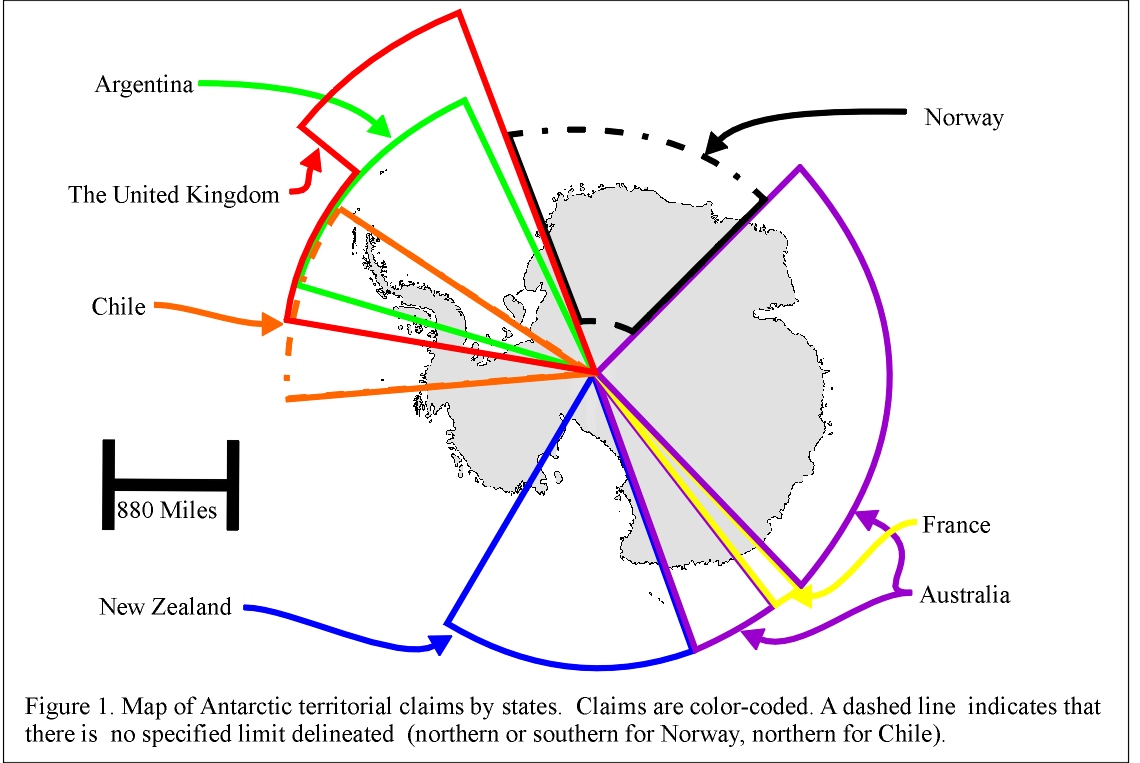
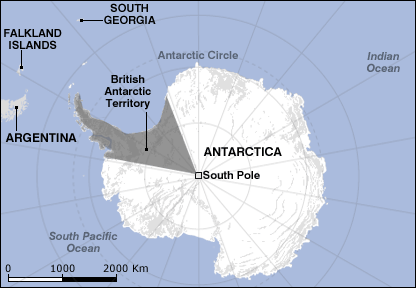
Of course the real interest in “owning” the Falklands – for Argentina and for Britain – is the proximity to Antarctica, the basis it provides for territorial claims and the access it ensures. Territorial claims in  Antarctica have been frozen since 1961 till when 7 nations had registered claims. Currently the entire Argentinian claim falls within the British Antarctic Territory and it must be terribly frustrating for Argentina to find the UK leveraging its ownership of the Falklands all the way to the South Pole.

Antarctic territorial claims(graphic - http://geography.osu.edu/grads/jdavis/fig1.jpg)

Antarctic territorial claims
(graphic – http://geography.osu.edu/grads/jdavis/fig1.jpg)

falklands and antarctica (BBC)

falklands and antarctica (BBC)

“Half of deer population in UK should be culled” to protect countryside and birdlife!!

March 7, 2013

There is a large amount of hypocrisy and no small measure of irony here!

The bio-diversity creed seems to have become “Kill off the successful species and protect the unsuccessful ones”.

BBCDeer: 50% cull ‘necessary to protect countryside’

Around half of the UK’s growing deer population needs to be shot each year to stop devastation of woodlands and birdlife, a group of scientists says. A study published in the Journal of Wildlife Management says this would keep numbers stable.

The deer population is currently estimated at around 1.5 million. The researchers from the University of East Anglia suggest creating a venison market to make a cull ethically and economically acceptable. The Royal Society for the Protection of Animals (RSPCA) commented that any cull must be carried out in a humane and controlled way and be supported by “strong science”.

There are now more deer in the UK than at any time since the last Ice Age. …

…. Dr Paul Dolman, ecologist at the University of East Anglia and lead author, said: “We know deer are eating out the… vegetation of important woodlands, including ancient woodlands.

“Deer are implicated as the major cause of unfavourable conditions in terms of woodland structure and regeneration.

“There is evidence that deer reduce the number of woodland birds – especially some of our much loved migrant birds species like Blackcap and Nightingale, and resident species like Willow Tip. We have a problem.”

Dr Paul M Dolman

Dr Paul M Dolman – Bambi killer

Dr Paul Dolman is one of the “biodiversity” brigade and seems to be a bird-watcher of some note. But like most of this advocacy group he seems more than a little confused. I note that he invokes “strong science” – whatever that may be – to support his vision of a string of farm-shops and gastro-pubs serving venison. It would take more than a few pubs to handle 750,000 deer every year. I like his comment that such meat would be “ethically sourced”! I suppose that makes it all right then. This is not science – it is religion.

“We are not killing something and then incinerating the carcass – what we are talking about is harvesting a wild animal to supply wild free-ranging venison for or tables – for farm shops, for gastro pubs.

“What we are advocating isn’t removing deer from the countryside – what we are advocating is trying to get on top of the deer population explosion and try to control the problems that are being caused.

“And in a way, [venison] provides a sustainable food source where you know where it comes from, you know it is ethically sourced, you know it is safe to eat, and that puts food on people’s tables. As much as I love deer, to be a meat eater but then to object to the culling and harvesting of deer seems to be inconsistent.”

A Guard fit for a Queen

March 4, 2013

BBC

Police officers outside the King Edward VII Hospital in London, where the Queen has been admitted

Britain’s tallest police officer – PC Anthony Wallyn, who is 7ft 2in – was among the officers standing guard at the hospital on Sunday

PC Anthony Wallyn


UK has enough shale gas for a millenium

February 9, 2013

Shale gas reserve estimates keep on increasing. We have the peculiar situation where Russia and some of the large oil companies attack shale gas only because some of their existing business may be threatened. But they all also have strong positions with shale gas. But what is clear is that “peak gas” has been postponed by several hundred years and there is no energy crisis in sight.

Peak Gas will never come

The Times has seen advance copies of the British Geological Survey’s new estimates of shale gas reserves in the UK:

Britain could have enough shale gas to heat every home for 1,500 years, according to new estimates that suggest reserves are 200 times greater than experts previously believed. The British Geological Survey is understood to have increased dramatically its official estimate of the amount of shale gas to between 1,300 trillion and 1,700 trillion cubic feet, dwarfing its previous estimate of 5.3 trillion cubic feet.

According to GWPF:

According to industry sources, the revised estimates will be published by the Government next month, fuelling hopes that new “fracking” techniques to capture trapped resources will result in cheaper energy bills.

It is thought that it will be technically possible to recover up to a fifth of this gas, making Britain’s shale rocks potentially as bountiful as those in the US. Experts stressed that it was still much too early to say how much of the gas it would be economic to get out of the ground to heat homes and help to generate electricity. 

In an interview with The Times today, Ed Davey, the Energy and Climate Change Secretary, tries to downplay hopes of a shale gas glut in the UK pushing down household heating bills, which are at record highs. “It is not the golden goose. The experts are clear that they do not expect this to have a major impact on the gas price.”

The UK Onshore Operators Group (UKOOG), which also represents other onshore oil and gas producers, is aiming to win over public opinion about the shale gas industry, in particular by countering claims that the process of fracking poses an environmental menace.

The shale gas industry is gearing up for a year of intense activity after the Government lifted an 18-month moratorium on fracking in December. The ban was imposed in May 2011 after Cuadrilla Resources, the explorer backed by Lord Browne of Madingley, the former chief executive of BP, set off dozens of earth tremors when it began fracking on sites near Blackpool. The company intends to resume fracking this summer to find out more about the size and commercial potential of its reserves.

Other explorers sitting on vast shale gas deposits will also apply for fracking licences soon. Government officials are preparing to hold an onshore oil and gas licensing round this year which could result in more parts of the UK being opened up for shale exploration.


UK PAC – Wind farm licences are “too generous for the limited risks”

January 14, 2013

The UK PAC calls the over-generous wind farm licences as being shocking. The consumer will just have to pay higher prices.

The problem with subsidies is that it nearly always leads to the subsidies being milked for the benefit of the few and the cost is borne by the many.  The purpose of the subsidy is never usually achieved (unless the benefit is taken to be the windfall that a few enjoy).  Now the UK Public Accounts Committee points out the many blunders in wind farm licencing which will cost the consumer some £17 billion — but the money goes to those investors who got in early!!

There is nothing wrong with wind power per se and it surely has a limited contribution to make. But it is just not commercial or practical for base-load power generation and no amount of subsidy will make it so. I can’t help thinking that the few investors who benefit – directly or indirectly – have close friends among the powers that be that establish the generous subsidy rules. The subsidies are justified on the basis of “reducing carbon footprint” which is meaningless.

The PAC has published its 20th report of this session on offshore electricity transmission (full report pdf here).  The Committee had taken evidence from the Department of Energy and Climate Change, the Gas and Electricity Markets Authority, and industry representatives on the new licensing regime for offshore electricity transmission.

“Not only is it unlikely that this new licensing system for bringing electricity from offshore wind farms onto the national grid will deliver any savings for consumers, it could well lead to higher prices”. ……

….. Margaret Hodge was speaking as the Committee published its 20th Report of this Session. The Department and the Gas and Electricity Markets Authority (the Authority) have introduced an elaborate regime that licences operators of offshore electricity transmission assets following competitions. The terms of the transmission licences awarded so far appear heavily skewed towards attracting investors rather than securing a good deal for consumers.

The transmission operators receive their income from the National Grid which recovers its costs from electricity suppliers and generators. Although all concerned state that no public funds are directly involved, the future payments to licensees, which will amount to around £17 billion, will in fact be passed onto consumers through electricity bills.

The investors’ estimated returns of 10-11% on the initial licences look extremely generous given the limited risks the investors bear. Licensees are guaranteed a fully retail price index-linked income for 20 years regardless of the extent to which assets are used. Yet penalties are limited to 10% of expected income in any one year if the operators fail to provide the transmission facilities when required.

Wind farm performance declines by a third in just 10 years

December 20, 2012

The intermittent nature of wind and the speed restructions on wind turbines means that the load factor of wind farms is low to begin with (about 20 -25% for on-shore units and about 35-40% for off-shore units). But this is only when they are new. They seem to age very rapidly. This study of UK on-shore plants and Danish on-shore and off-shore plants shows that

  1. Wind farms age rapidly with on-shore plants declining in performance by about one-third in 10 years and off-shore plants declining by over 60% in 10 years, and
  2. The economic life of a wind farm is, at best, around 15 years and not the 25 years considered “normal” for a power plant

REF’s press release:

The Renewable Energy Foundation [1] today published a new study, The Performance of Wind Farms in the United Kingdom and Denmark,[2] showing that the economic life of onshore wind turbines is between 10 and 15 years, not the 20 to 25 years projected by the wind industry itself, and used for government projections.  

The work has been conducted by one of the UK’s leading energy & environmental economists, Professor Gordon Hughes of the University of Edinburgh[3], and has been anonymously peer-reviewed.  This groundbreaking study applies rigorous statistical analysis to years of actual wind farm performance data from wind farms in both the UK and in Denmark.

The full report is available here.

The Executive Summary states.

1. Onshore wind turbines represent a relatively mature technology, which ought to have achieved a satisfactory level of reliability in operation as plants age. Unfortunately, detailed analysis of the relationship between age and performance gives a rather different picture for both the United Kingdom and Denmark with a significant decline in the average load factor of onshore wind farms adjusted for wind availability as they get older. An even more dramatic decline is observed for offshore wind farms in Denmark, but this may be a reflection of the immaturity of the technology.

2. The study has used data on the monthly output of wind farms in the UK and Denmark reported under regulatory arrangements and schemes for subsidising renewable energy. Normalised age-performance curves have been estimated using standard statistical techniques which allow for differences between sites and over time in wind resources and other factors.

3. The normalised load factor for UK onshore wind farms declines from a peak of about 24% at age 1 to 15% at age 10 and 11% at age 15. The decline in the normalised load factor for Danish onshore wind farms is slower but still significant with a fall from a peak of 22% to 18% at age 15. On the other hand for offshore wind farms in Denmark the normalised load factor falls from 39% at age 0 to 15% at age 10. The reasons for the observed declines in normalised load factors cannot be fully assessed using the data available but outages due to mechanical breakdowns appear to be a contributory factor.

4. Analysis of site-specific performance reveals that the average normalised load factor of new UK onshore wind farms at age 1 (the peak year of operation) declined significantly from 2000 to 2011. In addition, larger wind farms have systematically worse performance than smaller wind farms. Adjusted for age and wind availability the overall performance of wind farms in the UK has deteriorated markedly since the beginning of the century.

5. These findings have important implications for policy towards wind generation in the UK. First, they suggest that the subsidy regime is extremely generous if investment in new wind farms is profitable despite the decline in performance due to age and over time. Second, meeting the UK Government’s targets for wind generation will require a much higher level of wind capacity – and, thus, capital investment – than current projections imply. Third, the structure of contracts offered to wind generators under the proposed reform of the electricity market should be modified since few wind farms will operate for more than 12–15 years.

Nurse hoaxed by Australian call commits suicide

December 7, 2012

This is more than sad.

Update: The nurse has been named as Jacintha Sadanha. She was married with 2 children.

Update2: It is now early Saturday morning in Australia but there is as yet little regret for this childish prank gone horribly bad. Sky News Australia reports that Sydney-based 2Day FM was continuing to promote its prank call on air during the early hours of Saturday morning in the city”.

The hoaxers, Mel Greig and Michael Christian will no doubt get away with it. After all it was just a clever prank call. They have been bragging about it all week. But can they really not have any responsibility? I can only begin to imagine the harassment and embarrassment and ridicule the poor nurse came under — which was probably multiplied several times by today’s social media.

Mel Greig and Michael Christian: image thesun.co.uk

The Independent:The nurse who took a prank phone call at the Duchess of Cambridge’s hospital has been found dead in a suspected suicide.

The woman received the phone call from two Australian radio presenters and, believing she was speaking with the Queen, passed it to a colleague who revealed private information about the Duchess’ condition.

An ambulance was called to the hospital this morning where the woman was found unconscious.

Paramedics made efforts to revive her but she was pronounced dead at the scene.

The nurse is understood to be the first person to be heard during a hoax call to the Edward VII Hospital from two presenters from the Australian radio station 2Day FM.

…. The woman nurse who has been found dead took the call from the radio DJs in the early hours of Tuesday morning saying: “Hello, good morning, King Edward VII Hospital.”

The presenter, Mel Greig, who was impersonating the Queen said: “Oh, hello there. Could I please speak to Kate please, my granddaughter?”

The woman answered: “Oh yes, just hold on ma’am.” ….

… The two hoaxers, Greig and Michael Christian, were put through to a second nurse who told them: “She’s sleeping at the moment and she has had an uneventful night. She’s been given some fluids, she’s stable at the moment.”

Update! Nurse named but hoaxers are silent

The hospital said in a statement: ““We can confirm the tragic death of a member of our nursing staff, Jacintha Saldanha.

”Jacintha has worked at the King Edward VII Hospital for more than four years. She was an excellent nurse and a well-respected and popular member of staff with all her colleagues.

“We can confirm that Jacintha was recently the victim of a hoax call to the hospital. The hospital has been supporting her at this difficult time.”

Hospital chief executive John Lofthouse said: “Our thoughts and deepest sympathies at this time are with her family and friends. Everyone is shocked by the loss of a much-loved and valued colleague.”

Liverpool Care Pathway for babies is surely euthanasia but it is not painless

November 29, 2012

I have no doubt that the Care Pathways have the best of intentions to make an inevitable death as painless and comfortable as possible. But at best this is euthanasia and at worst it is something else. The latest article in the Daily Mail’s “campaign”  is more than a little disturbing. If a Care Pathway – by definition – is intended to lead to a dignified and pain-free death then causing additional suffering by being put on the Pathway cannot be right. I am not sure where the ethical line goes but I cannot help feeling that a final painless lethal injection may be preferable to 10 days of starvation and thirst and suffering as feeding and fluids are denied and a baby shrinks to death.

(more…)