Archive for the ‘UN’ Category

A Guantanamo in Chicago?

August 5, 2015

I have a perception – from the other side of the Atlantic – that race relations and especially the relations between the police and the black community in the US have deteriorated under Barack Obama. The number of  black people reported killed by police seems much too high. Deaths of black people in police custody seems also unnaturally high. Again my perception is that Obama is dangerously risk averse both domestically and in foreign policy. He has not addressed this issue forcefully. I suspect a certain lack of capability and an undue fear of action.

Chicago is as close to Obama’s “home city” as any. Moreover the current mayor of Chicago, Rahm Emanuel is a close friend of Obama’s and was his former Chief of Staff (2008 – 2010). So one would expect that Chicago would lead the way in race relations under the first “black” president of the US. But it seems that Chicago has been running its own Guantanamo-style facility (Homan Square) in plain view. It also seems that during Rahm Emanuel’s term the use of the facility against black suspects has been maximised.

Chicago Homan Square arrests via The Guardian

Chicago Homan Square arrests via The Guardian

Of course The Guardian leans very heavily to the left and has a tendency to be rather sanctimonious, but their report – even after being discounted for their “goody-goody” bias – is rather disturbing. It does not speak well of what Obama and his friend have achieved in their “home city”.

It seems a real shame that under the first “black” president of the US, race relations, especially between the police and the black community, have apparently deteriorated quite badly.

The Guardian:

At least 3,500 Americans have been detained inside a Chicago police warehouse described by some of its arrestees as a secretive interrogation facility, newly uncovered records reveal.

Of the thousands held in the facility known as Homan Square over a decade, 82% were black. Only three received documented visits from an attorney, according to a cache of documents obtained when the Guardian sued the police.

Despite repeated denials from the Chicago police department that the warehouse is a secretive, off-the-books anomaly, the Homan Square files begin to show how the city’s most vulnerable people get lost in its criminal justice system.

The Chicago police department has maintained – even as the Guardian reported stories of people being shackled and held for hours or even days, all without legal access – that the warehouse is not a secret facility so much as an undercover police base operating in plain sight. “There are always records of anyone who is arrested by CPD, and this is no different at Homan Square,” the police asserted in a March statement.

But an independent Guardian analysis of arrestees’ records, obtained through the Freedom of Information Act, shows that Homan Square is far from normal: 

  • Between September 2004 and June 2015, around 3,540 people were eventually charged, mostly with forms of drug possession – primarily heroin, as well as marijuana and cocaine – but also for minor infractions such as traffic violations, public urination and driving without a seatbelt.
  • More than 82% of the Homan Square arrests thus far disclosed – or 2,974 arrests – are of black people, while 8.5% are of white people. Chicago, according to the 2010 US census, is 33% black and 32% white.
  • Over two-thirds of the arrests at Homan Square thus far revealed – at least 2,522 – occurred under the tenure of Mayor Rahm Emanuel, the former top aide to Barack Obama who has said of Homan Square that the police working under him “follow all the rules”. ……….

Read the report

The Obama legacy will certainly show that he was the first half-black president of the US. More than that, history may only record that “he was one who could have, but didn’t”.
The CAR scandal: Cover-up of incompetence continues at the UN

July 22, 2015

Flavia Pansieri, the UN Deputy High Commissioner for human rights, resigned today after admitting in March that she had failed to follow up on the allegations of sexual exploitation of children in the Central African Republic by French troops and which had been revealed by the Swedish whistle- blower, a UN staff member, Anders Kompass. Initially the UN sought to cover-up by suspending Kompass and putting him under investigation. Even Ban Ki-moon, the Secretary general attacked Kompass for breaking UN rules rather than address the failings of the organisation. Kompass has now been reinstated but still remains under investigation for his administrative misdeeds. He had informed Pansieri about his misgivings but apparently she was too busy with budget cuts at the time and failed to take any action. Now she has resigned “for health reasons”, but the UN High Commissioner himself, Zeid Raad al-Hussein remains. According to Pansieri he also was informed and failed to take action.

Being UN officials, they all have immunity from any liability – even for incompetence and gross negligence. No further action will probably be taken, though Anders Kompass should probably give up any aspirations to promotion within the UN organisation. (I note again that no UN official will ever be held accountable for the negligence which led to cholera being introduced to Haiti by UN troops).

ABC (AP):

The U.N. confirmed Wednesday that Flavia Pansieri has left the post of deputy high commissioner for human rights “for health reasons.” No more details were given.

The allegations by several children as young as 9 of trading oral sex and sodomy for food with French soldiers tasked with protecting civilians in the violence-torn country didn’t become public until late April, almost a year after U.N. staffers first heard the children’s stories. Pansieri’s comments and other leaked documents led the U.N. secretary-general this summer to order an investigation into how the U.N. handled the case.

In a confidential statement for a separate internal investigation, obtained by The Associated Press, Pansieri said she had been distracted from the case by other issues, including budget cuts for several months. “I regret to say that in the context of those very hectic days, I failed to follow up on the CAR situation,” Pansieri said in the statement dated March 26.

She said she and her boss, high commissioner Zeid Raad al-Hussein, had assumed French authorities were handling the allegations, even as France pressed the U.N. for months for more information.

No arrests have been announced, and it appears that the only person who has been punished is the U.N. rights staffer who first notified French authorities.

The French soldiers, who were not U.N. peacekeepers, had been tasked with protecting civilians in a chaotic camp for displaced people in Central African Republic’s capital, Bangui, during vicious violence between Christians and Muslims.

Of course the UN is only as good as its member nations. I sometimes think that the UN, just like the EU, is not a forum for the dissemination of best practices as it should be, but functions instead to level down to the worst standards of a member nation.

US, UK and Canada protect Israel’s nuclear weapons

May 23, 2015

An Egyptian proposal for a nuclear weapons free Middle East as part of the UN nuclear non-proliferation treaty (NPT) was blocked by the US, UK and Canada. The blockage was not unexpected since Israel which is not a signatory to the NPT had already indicated its opposition and on such matters Washington generally obliges Israel. The NPT 2015 conference ended without agreement and the US representative blamed the Egyptians – of course – for making a proposal that had no chance of success. The status quo continues and Israel can maintain all its nuclear warheads. The NPT conference will next be held in 2020.

It is not so surprising that all the western countries which created Israel and now protect its not-so-secret stock of nuclear warheads are the same powers who don’t want any possibility of Iran developing its own nuclear weapons. I can quite accept that Israel will want to protect its own interests. The position of the US and its allies is entirely expected but is also just plain hypocritical. But the myth of Israel not having any nuclear warheads can be put to rest for ever. If they didn’t have any there would be no point in blocking the Egyptian proposal.

Jerusalem PostAfter four weeks of negotiations on ways to improve compliance with the pact, there was no consensus among its 191 signatories. US Under Secretary of State Rose Gottemoeller announced there was “no agreement” and accused some countries of undermining the negotiations.  Gottemoeller did not name any countries but diplomats said she was referring to Egypt. ……. 

Last month, Egypt, backed by other Arab and non-aligned states, proposed that UN Secretary-General Ban Ki-moon convene a regional conference on banning weapons of mass destruction (WMD) as called for at the 2010 NPT review with or without Israel’s participation, without agreement on an agenda and with no discussion of regional security issues.

Those conditions are unacceptable to Israel and Washington.

Decisions at NPT review conferences, which are held every five years, are made by consensus. ……. 

Egypt’s proposals, Western diplomats say, were intended to focus attention on Israel. Washington and Israel say Iran’s nuclear program is the real regional threat. Iran says its program is peaceful. It is negotiating with world powers to curb it in exchange for lifting sanctions. Israel has said it would consider joining the NPT only once at peace with its Arab neighbors and Iran.

There were disagreements on other aspects of the NPT but delegates said the Middle East issue was the most divisive.

And in the meantime ISIS has announced that it is trying to get hold of one of the Pakistani warheads to be able to do something spectacular.

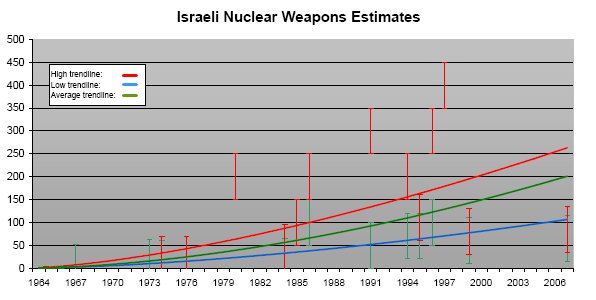
The Israeli nuclear stockpile of nuclear warheads probably lies between 100 and 400.

Estimates for Israel's nuclear weapons stockpile range from 70 to 400 warheads. The actual number is probably closer to the lower estimate. Additional weapons could probably be built from inventories of fissile materials.   http://fas.org/nuke/guide/israel/nuke/

Estimates for Israel’s nuclear weapons stockpile range from 70 to 400 warheads. The actual number is probably closer to the lower estimate. Additional weapons could probably be built from inventories of fissile materials.
http://fas.org/nuke/guide/israel/nuke/

Ban Ki-moon and the UN lose it as they try to hide sexual exploitation of children by UN troops

May 1, 2015

I find Ban Ki-moon embarrassing as the Secretary General of the UN. More often than not, I find his pronouncements generally lacking any indication of personal moral fibre. He parrots the prepared statements of his aides and advisors and his own values are invisible. Certainly the UN, and this Secretary General in particular, have little moral authority left. I find him an even sorrier figure than Kurt Waldheim – and Waldheim with his tacit support of Idi Amin’s applause for the Munich massacre – still leaves a bitter taste. In a sense, what else can we expect? The UN is not an organisation for the dissemination of best practices. Just like in the EU, it is the worst behaviour of a member state which becomes the common standard. The best of the UN, like that of the EU, can only be as good as that of its worst member state. When all UN personnel enjoy immunity from any liability for incompetence, gross negligence and even criminal acts, it is hardly surprising that the “bad apples” get away with it. Not everybody who serves on UN missions is a “bad apple” but there is no shortage of such people. Personnel on UN missions – be they scientists or doctors or peace-keeping troops or administrators – have no incentive from the UN to act responsibly. Nobody will be held accountable for introducing cholera to Haiti just as Dutch troops will not have to face any liability for the massacres in Srebrenica (and a Dutch court refused to act against the Dutch general just a few days ago).

And in the case of the sexual exploitation of children by French soldiers (and soldiers from Chad) in the Central African Republic, there will be many fine speeches from the UN and from the French government, but nobody will be held responsible or brought to account. But in this case where the abuse was known in July 2014 and covered up by the UN, the UN is throwing the book at the whistle-blower. Anders Kompass leaked the internal report on sexual abuses by French troops to French prosecutors. But Ban Ki-moon is talking about the procedural crimes of the Swedish whistle-blower rather than why the UN has kept this hidden for so long. Even the French PM has made a fine speech about pursuing wrong-doers but he has done nothing about this case which the French first knew about 9 months ago.

Expressen:

The Swedish Foreign Ministry’s legal chief Anders Rönquist and Swedish Ambassador Olof Skoog have both defended the whistle-blower Anders Kompass. 
But now the UN Secretary General has come out criticizing the Swede who leaked the report on sexual abuse. “Our preliminary assessment is that the behavior is not the same as whistle-blowing”, says Ban Ki-moon’s spokesperson.
Anders Kompass is still employed at the United Nations in Geneva, Switzerland on the OHCHR, Office of the UN High Commissioner for Human Rights. But he will be absent from his job till 31st July.

Presumably he has been suspended by the UN. His suspension is with the knowledge – if not at the instigation – of the UN  high commissioner for human rights, Zeid Ra’ad al-Hussein.

The Guardian:

The United Nations is guilty of “reckless disregard for serious allegations of wrongdoing” in its treatment of a whistleblower who disclosed details of alleged child abuse by French peacekeepers in Africa, according to a former staff member.

James Wasserstrom, a veteran US diplomat who was sacked and arrested by UN police when he exposed suspicions of corruption by senior officials in Kosovo, said the case of Anders Kompass revealed how the organisation turned on the whistleblower rather than dealing with the wrongdoing he had revealed.

Kompass, director of field operations at the office of the high commissioner for human rights in Geneva, has been suspended for passing to prosecutors in Paris an unredacted internal UN report detailing allegations of the sexual exploitation of boys in the Central African Republic by French peacekeepers.

When the Guardian revealed details of the allegations this week, the French authorities admitted publicly for the first time that they had begun an investigation after receiving the report last July. It details accounts from children as young as eight and nine of serious sexual abuse at a centre for internally displaced people in the capital Bangui.

At the time, the French troops stationed there were part of their country’s peacekeeping mission run independently of the new UN operation Minusca. The UN had commissioned the report following claims on the grounds of sexual misconduct. It was completed in June last year but not passed on until Kompass leaked it directly to the French.

On Thursday, the French president, François Hollande, vowed to pursue the allegations vigorously. “If some soldiers have behaved badly, I will show no mercy,” he said. French judicial authorities said more than a dozen soldiers were under investigation. ………. In France, the claims against more than a dozen soldiers who were part of the peacekeeping mission in CAR continue to cause shockwaves.

The report contains interviews with six children who disclose sexual abuse predominantly at the hands of French peacekeepers. Some children indicated that several of their friends were also being sexually exploited.

The interviews were carried out by an official from the OHCHR justice section and a member of Unicef between May and June last year. The children, who are aged between eight/nine and 15, disclosed abuse dating back to December 2013.

But of course nobody will be held accountable.

And the behaviour of the UN and Ban Ki-moon is – once again – not very edifying.

Plastic in the oceans grossly exaggerated: How the UN spreads bad science

April 30, 2015

It is widely assumed that about 10% of annual plastic production ends up in the oceans. That would mean that about 30 million tonnes end up in our seas every year. But this is just a myth and has been spread by a UN mistake as reported by Nordic Science. The actual number is 2 – 4%. The UN knows it is a mistake but it serves their “political” goals to go slow with any correction. I would go so far as to say that the UN mistake (by a consultant – of course) was quite deliberate. Which advocacy group did that consultant come from – I wonder?

It is tempting to beat our largest drums when fighting pollution. … One of science’s cardinal virtues is accuracy. Despite that, scientists are contributing to the dissemination of numbers with rather nebulous sources.

When ScienceNordic’s Norwegian partner forskning.no recently wrote about new calculations quantifying the plastic debris in the sea, we wondered why the new figures were so much lower than previous findings.

A number of researchers stated that the new calculation methods were the best they had seen to date. So we tried to find out how other scientists had ended up with a much higher figure –ten percent of the world’s plastic output. This was no easy task. The one-tenth figure cropped up ubiquitously, but no one could say what research it was based on. Apparently it didn’t come from research at all.

Some still claim that ten percent of the plastic produced annually ends up in marine environments. In 2013 alone that would equate to 30 million tonnes. This is a staggering amount of plastic for the oceans of the world and the marine life in these seas to cope with.

The latest calculations decrease this share of plastic debris to two to four percent of annual output.

We started searching for the source of the ten-percent figure.

Each reference pointed to another, which in turn referred to another article or paper in an apparent endless chain. Where was the original source?

A UN document for a workshop of international experts on marine debris also referred to a scientific paper. But when we checked that paper there we found no trace of this ten percent estimate.

We contacted the Secretariat of the UN Convention on Biological Diversity, which had commissioned the document from the UN Environment Programme (UNEP). They would not put us in touch with the author of the document, but Jihyun Lee in the Secretariat sent us an e-mail:

“Our consultant quoted the reference in good faith as it was cited in a peer-reviewed paper as being the source of the information. A robust review of this paper by the consultant when he quoted this information could have avoided this mistake. Unfortunately he did not go back to the source reference in this case to double-check the original source.”

The UN document was a draft. The mistake had already been pointed out by a scientist at the workshop and checked out. Jihyun Lee explains that the number will now be deleted from the final report.

But the number had already spread internationally, including to Norway, where the expert on plastics Geir Wing Gabrielsen of the Norwegian Polar Institute quoted it in the media.

“When I read a scientific article or a UN report, I expect the references made to be correct and they should be possible to confirm. It is unfortunate when, as in this case, numbers are impossible to track down,” he writes in an e-mail.

Read the whole article

Forskning.no finally traced the 10% number through many a false citation to a non-peer-reviewed conference presentation by a Professor Richard Thompson of Plymouth University who now admits he had no basis for the number but says it was based on “grey” literature. Which advocacy group did his “respected source” come from?

“ It was from a respected source, it seemed credible and I believed it as did others,” he writes in an e-mail to forskning.no. But he doesn’t answer the question of why he neglected to investigate the reference which the number comes from.

Thompson writes that he relied on grey literature, in other words, information from the authorities, organisations or academics who have not been peer reviewed through formal scientific publications. Typically, this could be a report, a work note or a presentation. 

“On further digging there is no substance to them – they were guesses and I should not have used them. I have not used the quote again,” he writes.

No doubt the consultant and the grey literature were from some advocacy group, such as Greenpeace, who have no qualms about making up information when it suits their purpose. Lies are justified as necessary because their “ends are good”. I note that the UN bureaucracy believe that the end justifies the means and their means include disseminating “grey information” as if it was gospel. It is not so surprising then that the UN IPCC reports on climate are full of highly dubious grey literature.

The UN’s scientific panels are little better than advocacy groups. Accuracy and truth have just become collateral damage in the furthering of their political goals. And the IPCC leads all the rest.

Lima Climate conference agreement contains no commitments by anybody

December 16, 2014

The UN Conference of the Parties, Twentieth session, held in Lima Peru from 1st to 13th December 2014 is now over. The conference agreement is well worth reading as an  example of how an exercise with 9,000 delegates from 196 participating countries, could spend some $ 50 million over 2 weeks to accomplish – by their own expectations – absolutely nothing. The only decision of any significance to be taken by the parties is to meet again.

COP20 Lima Agreement (pdf)

But all 9,000 had a great time.

(In my judgement, the lack of accomplishment was a great success).

The agreement contains 22 clauses:

  • one clause “confirms”
  • three clauses “decide”
  • three clauses “agree”

All the remaining clauses are merely wishes and hopes with no commitments or obligations. Just waffle.

  • one clause “underscores”
  • one clause “urges”
  • one clause “acknowledges”
  • one clause “invites”
  • one clause “encourages”
  • one clause “welcomes”
  • two clauses “note”
  • three clauses “request”
  • four clauses “reiterate”

Looking just at the clauses which “confirm”, “decide” or “agree”:

The only “confirmation” comes first in the agreement and it is to meet again for COP 21 and adopt another agreement! Just a self-serving clause perpetuating the meetings.

The three “decides” also commit to nothing very much. The first “decides that any protocol which is legally binding shall be balanced. (This is a wonderful loophole. Any country which believes the protocol to be unbalanced can then ignore it). The next “decide” is that the working group will make a draft text. (The purpose of this is to make sure that all those working on this text can get paid). The third rather long “decide” only says that a technical examination will continue. Wow! But note that it establishes a framework – and thereby the funding – for “a series of in-session technical expert meetings”. Meetings galore – and the delegates shall have a great time.

There are also three “agree” clauses. The first says that all parties agree that each party will do better in the future. The second merely says that all developing countries and small island states may make special pleadings. The third says that each party may provide quantifiable information on how they intend to contribute. Not a commitment or obligation in sight.

It really is time that these meetings ceased and the IPCC was disbanded.

The clauses (my bold)

Confirms:

  1. Confirms that the Ad Hoc Working Group on the Durban Platform for Enhanced Action shall complete the work referred to in decision 1/CP.17, paragraph 2, as early as possible in order for the Conference of the Parties at its twenty-first session to adopt a protocol, another legal instrument or an agreed outcome with legal force under the Convention applicable to all Parties;

Decides:

  1. Decides that the protocol, another legal instrument or agreed outcome with egal force under the Convention applicable to all Parties shall address in a balanced manner, inter alia, mitigation, adaptation, finance, technology development and transfer, and capacity-building, and transparency of action and support;
  2. Decides that the Ad Hoc Working Group on the Durban Platform for Enhanced Action will intensify its work, with a view to making available a negotiating text for a protocol, another legal instrument or an agreed outcome with legal force under the Convention applicable to all Parties before May 2015;
  3. Decides to continue the technical examination of opportunities with high mitigation potential, including those with adaptation, health and sustainable development co-benefits, in the period 2015–2020, by requesting the secretariat to:
    (a) Organize a series of in-session technical expert meetings which:
    (i) Facilitate Parties in the identification of policy options, practices and technologies and in planning for their implementation in accordance with nationally defined development priorities;
    (ii) Build on and utilize the related activities of, and further enhance collaboration and synergies among, the Technology Executive Committee, the Climate Technology Centre and Network, the Durban Forum on capacity-building, the Executive Board of the clean development mechanism and the operating entities of the Financial Mechanism;
    (iii) Build on previous technical expert meetings in order to hone and focus on actionable policy options;
    (iv) Provide meaningful and regular opportunities for the effective engagement of experts from Parties, relevant international organizations, civil society, indigenous peoples, women, youth, academic institutions, the private sector, and subnational authorities nominated by their respective countries;
    (v) Support the accelerated implementation of policy options and enhanced mitigation action, including through international cooperation;
    (vi) Facilitate the enhanced engagement of all Parties through the announcement of topics to be addressed, agendas and related materials at least two months in advance of technical expert meetings;
    (b) Update, following the technical expert meetings referred to in paragraph 19(a) above, the technical paper on the mitigation benefits of actions, and on initiatives and options to enhance mitigation ambition, compiling information provided in submissions from Parties and observer organizations and the discussions held at the technical expert meetings and drawing on other relevant information on the implementation of policy options at all levels, including through multilateral cooperation;
    (c) Disseminate the information referred to in paragraph 19(b) above, including
    by publishing a summary for policymakers;

Agrees:

  1. Agrees that each Party’s intended nationally determined contribution towards achieving the objective of the Convention as set out in its Article 2 will represent a progression beyond the current undertaking of that Party;
  2. Also agrees that the least developed countries and small island developing States
    may communicate information on strategies, plans and actions for low greenhouse gas emission development reflecting their special circumstances in the context of intended nationally determined contributions;
  3. Agrees that the information to be provided by Parties communicating their intended nationally determined contributions, in order to facilitate clarity, transparency and understanding, may include, as appropriate, inter alia, quantifiable information on the reference point (including, as appropriate, a base year), time frames and/or periods for implementation, scope and coverage, planning processes, assumptions and methodological approaches including those for estimating and accounting for anthropogenic greenhouse gas emissions and, as appropriate, removals, and how the Party considers that its intended nationally determined contribution is fair and ambitious, in light of its national circumstances, and how it contributes towards achieving the objective of the Convention as set out in its Article 2;

What a waste for a pointless exercise where the key action item (carbon dioxide) has no significant impact on the parameter ostensibly to be controlled. No targets, no tools but a great deal of arrogance.

20th Climate games over! They all agree to meet again

December 14, 2014

The global warming community is nothing if not self-serving. We have had 2 weeks of relentless publicity. New alarmist articles have appeared every day. Thousands have flown in and out of Lima. They have had a good time. They have reached agreement to continue having a good time.

THEY WILL MEET AGAIN.

And now, in accordance with tradition, we declare the Climate Games of the 20th COP closed, and I call upon the parasites and wastrels of the world to assemble one year from now in Paris to celebrate the Climate Games of the 21st COP.

The international climate conference will be held at the Le Bourget site from 30 November to 11 December 2015. This will be the 21st yearly session of the Conference of the Parties (COP 21) to the 1992 United Nations Framework Convention on Climate Change (UNFCCC) and the 11th session of the Meeting of the Parties (CMP 11) to the 1997 Kyoto Protocol.

One wonders why.

BBC:

United Nations members have reached an agreement to tackle climate change after negotiations ran into the weekend in the Peruvian capital Lima. The president of the meeting said delegates had approved a framework for setting national pledges.

The deal puts off many critical details until a summit in Paris next year. Environmental groups criticised the deal as a weak and ineffectual compromise, saying it weakened international climate rules. The talks proved tough because of divisions between rich and poor countries over the scale and scope of plans to tackle global warming.

UN climate conference in Lima collapses and defers all contentious issues to next meeting

December 13, 2014

The UN climate conferences are an exercise in futility for something quite unnecessary. But they provide an annual jamboree for the “global warming community” of do-gooders, pseudo-scientists, advocacy groups, bureaucrats and politicians. They have been meeting for over 2 decades and have achieved nothing. The ostensible goal is to get the world to reduce carbon dioxide emissions so as to limit global temperature rise. But during the life of these nonsensical meetings, the world’s emissions of carbon dioxide has increased by over 70%. Carbon dioxide concentration in the atmosphere has risen by about 15% and it is uncertain how much of that is due to man-made emissions. But while all this has been going on, global temperature has remained stagnant and may even have decreased slightly.

So one wonders why the UN keeps hosting these incredibly wasteful and pointless meetings. But of course this is because the meetings are not really pointless – they have a hidden agenda. And this agenda is all about the getting of funds and the redistribution of money. And that automatically divides the participant countries into those who will pay and those who will get. The largely parasitic “global warming community” is always on the receiving end and has a vested interest in keeping these meetings and their funding alive indefinitely. Never mind that nothing significant is achieved as long as their funding continues.

The conference in Lima has been no different. It has all been about rich countries putting money (which countries and how much?) into a pot which other so-called developing countries can dip into (who, when and how much?). It is inevitable that the fringe elements supporting the redistribution of wealth, from the creators of wealth to the consumers of wealth (and these fringes are always consumers), are well represented at these conferences. Listening to some lobby groups it sounded like “a conference for the promotion of socialist ideals”. Greenpeace made an utter fool of itself again by their cheap publicity stunt causing damage, pollution and desecration of the Nazca Lines site. John Kerry showed up for a day and made his alarmist speech. Al Gore made a speech on the sidelines noticeable for the number of empty seats.

In any event the Lima conference is now winding down. No major agreements were reached (thank goodness) and a final draft being circulated pushes all contentious issues to the next conference (which at least achieves the purpose of continuing the meetings). One positive is that for the first time since 1992, the favourite – and critical – expression of the countries which seek to get money of “common but differentiated responsibility” is not referred to. Without an agreement on these differentiated responsibilities all talk about who will donate and how much and who will receive and how much becomes entirely meaningless. The latest draft effectively mouths platitudes and leaves each country to set its targets and its own levels of action. This is also a good thing.

Another positive is that countries making pledges of funding for the Global climate fund (target $100 billion and about $10 billion pledges received) are now just transferring or allocating money from their normal Foreign Aid budgets – which therefore cost nothing extra. I was pleased to hear that the pledges have been “ridiculously low”.

“We are disappointed,” said India’s Prakash Javadekar. “It is ridiculous. It is ridiculously low.” Javadekar said the pledges to the green climate fund amounted to backsliding. “We are upset that 2011, 2012, 2013 – three consecutive years – the developed world provided $10bn each year for climate action support to the developing world, but now they have reduced it. Now they are saying $10bn is for four years, so it is $2.5bn,” he said.

If this reluctance to pay for something pointless and ineffective is real and continues, then it could be the return of a much -needed realism and a very good thing for the world.

Reuters:

United Nations climate talks, which ran on into a an extra day on Saturday, are heading for a watered-down deal on limiting global warming, leaving many of the toughest issues for next year’s Paris summit.

Peruvian Environment Minister Manuel Pulgar-Vidal, hosting the talks, told delegates that a new text on Saturday morning to try to break impasses was not perfect, but reflected common ground.

Rich and poor nations were at odds after two weeks of talks in Peru over how to share the burden of curbing rising world emissions and how to raise a promised $100 billion a year by 2020 to help the poor cope with a warmer world.

Latin American and other oil producers are desperately trying to increase oil sales and curb the revenue losses as the oil price has collapsed. They have no great interest in curbing fossil fuel use. Most countries are phasing out subsidies for renewable energy especially as these subsidies will have to increase to keep renewable energy flowing when oil prices are so low.

Senior country representative are now leaving Lima and are leaving their bureaucrats to complete the final communique which will effectively say nothing and defer everything till the Paris meeting next year.

Ban Ki-Moon: Puppet without a string ….

January 22, 2014

The UN Secretary General is a puppet on many strings. And when the puppet tries to write the screen-play or to manipulate the puppeteers, the play usually suffers.

Ban Ki-Moon seemed to have forgotten that when he issued his invitation to Iran to the Geneva II talks about Syria last week and tried to write his own script for the talks. It didn’t take long before he had to backtrack.

Iran has insisted all along that it would only attend if it was without conditions. The US has long held that Iran could attend only if they accepted the results of Geneva I (where Iran was not present). So why Ban Ki-Moon tried act independently is not very clear. Presumably he was persuaded to by his staff who believe that the UN has some legitimacy beyond what is provided by the puppeteers.

(Also inviting Australia and Mexico and Korea and Luxembourg leaves me mystified.)

I have decided to issue some additional invitations to the one-day gathering in Montreux. They are: Australia, Bahrain, Belgium, Greece, the Holy See, Luxembourg, Mexico, the Netherlands, the Republic of Korea, and Iran. I believe the expanded international presence on that day will be an important and useful show of solidarity in advance of the hard work that the Syrian Government and opposition delegations will begin two days later in Geneva.

As I have said repeatedly, I believe strongly that Iran needs to be part of the solution to the Syrian crisis.

I have spoken at length in recent days with Iran’s Foreign Minister, Mr. Javad Zarif.  He has assured me that, like all the other countries invited to the opening day discussions in Montreux, Iran understands that the basis of the talks is the full implementation of the 30 June 2012 Geneva Communique, including the Action Plan.

Foreign Minister Zarif and I agree that the goal of the negotiations is to establish, by mutual consent, a transitional governing body with full executive powers.  It was on that basis that Foreign Minister Zarif pledged that Iran would play a positive and constructive role in Montreux.

Therefore, as convenor and host of the conference, I have decided to issue an invitation to Iran to participate.

It didn’t take very long before the US made it impossible for his invitation to remain valid:

NY TimesMr. Ban announced the Iran invitation on Sunday a little before 6 p.m. Eastern time. By that time, it was the middle of the night in Tehran — way too late for government officials to respond, but early enough for Washington to do so. …. 

Less than two hours after Mr. Ban’s briefing, the State Department spokeswoman, Jen Psaki, said in a statement: “The United States views the U.N. secretary general’s invitation to Iran to attend the upcoming Geneva conference as conditioned on Iran’s explicit and public support for the full implementation of the Geneva Communiqué, including the establishment of a transitional governing body by mutual consent with full executive authorities.”

As the New York Times puts it “But in diplomacy, there are no dress rehearsals. Mr. Ban’s choreography went awry, forcing him into a corner. Less than a day after issuing the invitation, the secretary general reversed course. Iran could not attend the talks, he said, because it had not affirmed the ground rules as he said he had been assured.”

It could be that even Ban Ki-Moon’s perception of his own independence was manipulated. Whether the invitation and its withdrawal were orchestrated by the US State Department, and whether the US was reacting to the fears of the Sunnis in the Middle East is unclear. (The report published with great fanfare yesterday about the human rights violations, detentions and executions by the Assad Government yesterday was apparently commissioned by the Government of Qatar. The timing of the publication of this report was also dictated by Sunni interests). I believe that the invitation and its withdrawal – paradoxically – strengthens Iran’s hand since they are conspicuous by not being present – and through no fault of their own.

The barbarism in Syria continues. I have no great expectations of Geneva II but it is part of a necessary process. If Al Qaida is to be kept in check, I think the involvement of Iran is both necessary and unavoidable. Without Iran not all of the Syrian opposition groups will be represented. And without Iran the Al Qaida factions could dominate the opposition.

A puppet with a broken string does not gain an extra degree of freedom. The UN Secretary General cannot entertain any delusions of grandeur or any thought that he can act independently of his puppeteers.

UN Climate Conference over – Fortunately nothing was achieved!

November 24, 2013

The UN Climate Conference in Warsaw is over.  We are told that agreement was reached on a compromise. The countries agreed not to make commitments but instead that they would all make “contributions”. To make sure that agreement was reached these contributions are not legally binding. Moreover each nation is only required to specify its “contribution” by the first quarter of 2015 –  if it feels able to. The method of measurement or monitoring the contribution is left to each nation!

The agreement is that each nation may do as it pleases.

Developing countries “believe” in global warming only because they think they can get money from the developed world if they seem to do so. There has been no global warming for 17 years. The supposed link between carbon dioxide and global temperature is well and truly broken. Nobody with any sense believes any longer that any measures taken by any or all countries to cut carbon dioxide emissions can have any impact on our climate. But the UN and political correctness continues with this fiction. Developed countries are no longer prepared to allow the political correctness of global warming and carbon dioxide emissions to lose even more jobs than have already been lost. The vested interests in this fiction and the carbon industry that has sprung up in the last 2 decades are well entrenched – from academia to “green” politicians to lobbyists to “green activists” and to the various industries tied to trying to get rid of fossil fuels. Yet, coal consumption globally has increased by over 80% in the last 10 years and global temperatures have actually declined.

But still some 10,000 bureaucrats and politicians and another 5,000 workers in academia and about twice as many lobbyists and environmentalists travel from one UN conference to the next and achieve nothing but merely plan for the next conference. It seems success is measured by making no commitments whatsoever except to have another conference.

THE UN COP19 conference in Warsaw has ended. Fortunately nothing was achieved. The conferences are now on life-support and being kept alive for nothing other than to keep the conference supporters in jobs. It is time to pull the plug and let these conferences die.

USA Today: 

Avoiding a last-minute breakdown, annual United Nations climate talks limped forward Saturday with a modest set of decisions meant to pave the way for a new pact to fight global warming.

More than 190 countries agreed in Warsaw to start preparing “contributions” for the new deal, which is supposed to be adopted in 2015. That term was adopted after China and India objected to the word “commitments” in a standoff with the U.S. and other developed countries.

The fast-growing economies say they are still developing countries and shouldn’t have to take on as strict commitments to cut carbon emissions as industrialized nations.

The conference also advanced a program to reduce deforestation and established a “loss and damage” mechanism to help island states and other vulnerable countries under threat from rising seas, extreme weather and other climate impacts.

The wording was vague enough to make developed countries feel comfortable that they weren’t going to be held liable for climate catastrophes in the developing world.

U.S. and other rich countries also resisted demands to put down firm commitments on how they plan to fulfill a pledge to scale up climate financing to developing countries to $100 billion by 2020.

It looks like everybody succeeded very well in making no commitments of any substance and they have all agreed to have another conference.

Execution rather than euthanasia is called for.