Archive for the ‘US’ Category

More spying, less intelligence?

June 13, 2014

The level of blanket spying by the US agencies (aided and abetted by so-called intelligence agencies of friendly countries), apparently on anyone and everything, as revealed by Edward Snowden, was amazing but not particularly shocking. It is not just enemies abroad who have been monitored. Even US citizens and organisations  have been subject to eavesdropping, hacking, entrapment and plain theft. The NSA has even targeted the conversations of heads of friendly countries in their insatiable quest for information. The volume of information gathered and still being collected is truly staggering. All kinds of information is collected across every conceivable field. It covers law enforcement interests, foreign policy and industrial espionage. It ranges from financial matters related to tax evasion or money laundering, to the plans of terrorist groups, to the criminal activities of international gangs to industrial espionage of benefit to US corporations.

Of course converting information into intelligence takes much analysis which requires the application of mind. Then converting intelligence into actions requires the will and the ability to act upon the intelligence. In spite of the huge amount of information that has been gathered, I have a clear perception that both the conversion of raw information into intelligence and the translation of intelligence into actions have been conspicuous by their absence.

The events in Iraq over the last week are just one of a long line of instances where either the intelligence services have been caught napping or there is an extraordinary sequence of political failures to act upon available intelligence. Probably it is a combination of both.

By the nature of spying, cases of successful intelligence analysis may never be known. But the number of apparent failures gives no confidence that the extensive spying is leading to any better intelligence. The massive gathering of information has certainly not managed to anticipate or prevent a very large number of unpleasant happenings – both domestically in the US and abroad.

  • 74 school shootings in the US since the start of 2013
  • bank scandals in the last 10 years where raw information was around but was not properly analysed
  • the Boston marathon bombing
  • the Arab Spring and especially the revolution in Egypt and the return of the military more recently
  • the premeditated attack on the US Embassy in Benghazi
  • the consequence of supporting the rebels in Syria and the rise of the jihadists (including ISIS),
  • the return of the Taliban in Afghanstan
  • the rise of ISIS in Iraq and the collapse of the regular, US-trained, Iraqi troops

Of course some of the failures to act may well have been due to a lack of political action rather than a failure of intelligence. Barack Obama is so risk-averse that he generally overthinks every issue and then always chooses the “do nothing” option. In Iraq now, all that was ever supposedly gained during the war there is threatened and crumbling. Even so, in the face of this “urgent emergency” (is there any other kind?) he stated cautiously yesterday that all options were still on the table and that he is considering every option. But he may not actually order anything beyond a few drone strikes in support of  Nouri al-Maliki. And once again – as in the case of Syria – he may find that the US has helped create a monster for the future. And he may find himself reluctantly allied with Iran.

NYTimes:

The possibility of coming to Iraq’s rescue raises a host of thorny questions for Mr. Obama, who has steadfastly resisted being drawn into sectarian strife in Iraq or its neighbor, Syria. Republican lawmakers accused him of being caught flat-footed by the crisis and of hastening this outcome by not leaving an adequate American force behind after 2011.

Reports that Iran has sent its paramilitary Quds Force to help the struggling Iraqi Army battle the militant group, the Islamic State of Iraq and Syria, raised the awkward possibility that the United States could find itself allied with Iran in shoring up an unpopular Shiite government in Baghdad. The White House said it was aware of the reports, but did not confirm them.

Mr. Obama insisted he had been monitoring the threat from Sunni militant groups for several months. The United States, he said, had supplied Iraq with military equipment and intelligence. 

The Washington Post writes that “despite years of training and billions of dollars in U.S. time and equipment, Iraq’s military is still a “checkpoint Army,” more interested in manning roadblocks than developing intelligence and engaging in counterinsurgency missions”.

Saddam Hussain was no doubt one of the “bad guys”. But under his regime no mad jihadist leader or an ISIS army would have been allowed to establish itself, grow and then expand as Nouri al-Maliki’s government with US military support has permitted.

Population Implosion? Even US fertility rates are at lower than replacement level

June 8, 2014

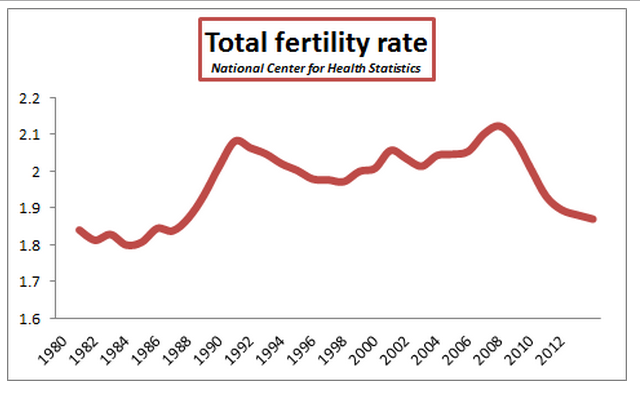
In Iran the Ayatollah Khamenei has announced his 14 point plan (or directive) to try and revive the fertlity rate which is at a potentially catastrophic low. In the US, Hispanic fertility rates have – in recent times – held the fertility rate up just above the replacement level of 2.1. In China the one-child policy has been withdrawn as population has reached its peak and will now decline significantly. In country after country, fertility rates are lower than the replenishment rate. In half the states in India the rate is already below 2.1. By 2050 the total Indian population will start to decline. Generally improvement in living standards with more attention to women’s rights are accompanied by a sharp decline in fertility rates. Now however, the recession is being blamed for the decline in the US.

Till 2100 the main demographic challenge is increasingly going to be the long term decline in fertility and the increasing proportion of the “aged” relative to the working population.

US TFR - Washington Examiner

US TFR – Washington Examiner

Washington Examiner:

U.S. fertility is not recovering from the financial crisis — and demographers aren’t sure why. The fertility rate fell to a record low 62.9 births per 1,000 women aged 15-44 in 2013, according to the National Center for Health Statistics.

The total number of births, at 3.96 million, inched up by a mere 4,000 from 2012, the first increase since the financial crisis. But the total fertility rate, or TFR, the average number of children a woman would have during her child-bearing years, fell to just 1.86, the lowest rate in 27 years. TFR is considered the best metric of fertility. A TFR of 2.1 represents a stable population, with children replacing parents as they die off.

Demographers expected the fertility rate to fall during recession, as financially strapped families put off childbearing. But what has surprised some demographers is both the depth of the decline and the fact that fertility has continued to drop even over the course of the country’s five years of slow but steady recovery. The rate has fallen steadily each year since 2007, when it stood at 2.1 …….. 

One foreseen factor behind the dropoff in childbearing is the rapid decline in Hispanic-American fertility.

 For several decades, high Hispanic childbearing has been driving U.S. population growth. White fertility has been under the 2.1 replacement rate for decades, and ranged from 1.7 to 1.9 in the 2000s. The TFR for black Americans first fell below 2.1 in the early 2000s. 

But the number of children per Hispanic-American woman has plummeted from just under three in 1990 and 2.7 as recently as 2008 to 2.19 in 2012, just above the replacement rate.

That decline has been mirrored in other Hispanic countries. Mexico’s TFR has fallen precipitously, from 6.7 in 1970 to 2.2 in 2012, according to the World Bank. A similar decline has taken place in El Salvador, and to a lesser extent Honduras and Guatemala, all three prominent countries of origin for American Hispanics. ….


Why are Indian-Americans sweeping the US spelling bee?

May 30, 2014

I have watched the US spelling bee competition on TV a few times when visiting the US. For excitement and entertainment I would place it below the Olympics, the World Cup and a good cricket test match but above a 20/20 junket or the Eurovision song contest (which in recent times has just become ridiculous).

But there is something remarkable that is showing up. This year 6 out of the 12 championship finalists, and the top four, were of Indian origin.

The HinduIndian-Americans Sriram Hathwar of New York and Ansun Sujoe of Texas shared the title after a riveting final-round duel in which they nearly exhausted the 25 designated championship words. ………. The past eight winners and 13 of the past 17 have been of Indian descent, a run that began in 1999 after Nupur Lala’s victory, which was later featured in the documentary “Spellbound.”

American Bazaar:

…… although it’s an American competition open to students from all over the country, students of Indian origin have dominated the competition by a significant margin over the last several years. In fact, in both 2012 and 2013, all the top three contestants were of Indian origin.

From 2008-2013, the winner of the Scripps National Spelling Bee has been Indian American: Sameer Mishra, Kavya Shivashankar, Anamika Veeramani, Sukanya Roy, Snigdha Nandipati, and Arvind Mahankali. Since 1999, only five winners have not been of Indian descent, meaning 67% of winners over the last 15 years have been Indian.

Is the ability to spell then learned or is it genetic or both? From the manner in which Indian-Americans have swept this competition in the last few years, there is clearly some genetic component.

Spelling ability is not a measure of intelligence. But intelligence is a necessary – but not a sufficient – ingredient.  Excellent spelling ability as exhibited in the spelling bee competitions would seem to also need memory, drive, focus, education, supportive families and peers in addition. They also practice a very great deal.  A recent winner trained for 4 hours a day and a few thousand hours in total and committed some 100,000 words to memory. Spelling ability and reading skills are known to be linked but it is not too clear as to which depends upon which. Good spellers have been found in some surveys to be more organised than the “average”.

The Age: Kids who are good readers are often great spellers too, and now Australian scientists have uncovered a genetic explanation as to why. Researchers from Sydney, Melbourne and Brisbane tracked 650 sets of young twins to work out how much reading and spelling abilities are controlled by genes. 

The study found that the ability to read and spell were about 50 per cent inherited, with a child’s upbringing and schooling controlling the other half. But what was most remarkable, says University of Melbourne researcher Anne Castles, was the discovery that the same genes were involved in both activities. …… 

…… The scientists also evaluated the two main skills involved in reading – the ability to sound out words aloud and the ability to recognise words by sight that don’t follow the phonic rules, like “yacht”.

They discovered that these specific skills involved two distinctly different sets of genes, which explains why kids are often competent at doing one but not the other.

Poor spellers may be subject to a neurological deficiency. Lesions in the right brain which impaired some visual activity are known to have also causes spelling difficulties – a “spelling dyslexia”. It is also thought that personality traits have some connection to the ability to spell. It is thought that spelling ability is associated with a deep interest in language, its roots, in words and how they sound. Many good spellers make and use mental, visual representations of words.

There may not be a specific spelling gene, but genetics surely have a part to play.

Learn that word:

Why is a population that makes up roughly 1% of the US population so heavily represented at the event? 

1 –  The American school system and culture has a conflicted relationship with memory-based learning. Indian culture values academic achievement highly and values memorization as well, as a building block of higher-level knowledge. This, by the way, is also the reason why Indian Americans are not only dominating the Spelling Bee, but also produce much more than their statistical share of doctors, engineers and executives. 

2 –  Indian Americans/South Asians maintain tightly knit family and social communities, and place a paramount value within their community on academic performance. Social expectations around academic performance tend to be much higher than in other demographic groups. Academic success therefor has a big social pay-off.

3 –  Last but not least, the success at Spelling Bees is fostered by various initiatives that exclusively support Indian American/South Asian students. NorthSouth Foundation and the South Asian Spelling Bee are both set up to support the Indian American/South Asian community of aspiring champions. 

It’s great to win the first prize at the Scripps National Spelling Bee by competing with 10 million students for over $40,000 in prizes. There is certainly more incentive to dedicate the thousands of hours of intense study needed knowing that you can also apply these skills at the South Asian Spelling Bee, where you compete with just a few thousand other kids for a $10,000 first prize. 

Obama retreats – “Yes, We can” has become “But, We won’t”

May 29, 2014

Barack Obama’s two terms in office will come to be remembered for high expectations and his many good intentions let down by his aversion to risk, his caution and his indecision. Yesterday at a speech at West Point he reconfirmed my perceptions when he laid out his vision of a US foreign policy which would be less brash, more focused on diplomacy, more engaged with partners and – above all – cheaper. It could be considered a return to considered prudence after the knee-jerk, costly and ineffective Bush adventures in Iraq and Afghanistan. But in this case I think this is more a reflection of cost pressure, indecision and risk aversion rather than prudence.

He still wants the US to lead – but from the back.

Katy Kay – BBC:

But Mr Obama ducks the trickiest moment of his foreign policy – the red line in Syria and the decision to go to Congress for a vote on force, which ultimately fell apart. This is unsurprising, as the American public has zero interest staying a day longer than planned in Afghanistan, much less committing to another large-scale military mission.The speech reflects the confusion of a country that is fed up with intervention but still likes the idea of being the world leader

The Washington Post report is not very enthusiastic.

Coming more than six years into a presidency devoted to winding down the wars, the speech featured a firm defense of his administration’s handling of foreign crises — including those in Nigeria, Syria and Ukraine — and a suggestion that many critics are out of step with a nation tired from 13 years of war. ….. 

“Here’s my bottom line: America must always lead,” Obama said. “If we don’t, no one else will.” …….. 

But Obama’s speech appeared to be less about changing the terms of the foreign policy debate in Washington than about appealing to a war-weary electorate, which twice chose him as president on platforms of steady withdrawal from foreign military operations. The address echoed Obama’s earlier defenses of his foreign policy — stressing such themes as multilateralism, Muslim outreach and ending torture — as a corrective response to the approach of the George W. Bush administration.

The US is tired with all the interventions George Bush led them into. In that sense Obama’s retreat from intervention as the “first step” is welcome. But the retreat is enforced and cutting cost is one of the key drivers. It appears to me that Obama is more reactive than pro-active. His driving from the back seat is very close to an abdication of leadership.

The heady days and great expectations of “Yes, We can!” have evaporated and Obama will be remembered for “But, We won’t”. 

The puzzle of the reduction of US nuclear warheads

May 7, 2014

Another factoid supporting my perception that Barack Obama is more hype than substance.

Virtually all the reductions of US nuclear warheads since 1983 have been made during the tenures of Republican Presidents (Ronald Reagan, Papa Bush and Bush Jr.) There have been virtually no reductions under Clinton and Obama.

The massive reductions in Reagan and Bush Sr.’s time came – not unexpectedly – as the Soviet Union collapsed. Paradoxically, even during the younger Bush’s war-mongering times, and even with the perceived nuclear threats from Iran and N. Korea, a substantial number of nuclear warheads were dismantled or retired. But virtually nothing has happened under Clinton and Obama.

io9 wonders why?

US reduction of nuclear warheads since 1983 graphic from io9

US reduction of nuclear warheads since 1983 graphic from io9

Another Clinton, another Bush (2)

May 4, 2014

The US Presidential Election is one of the great entertainment events of our time and the 2016 aspirants – declared and undeclared – are getting into position. I am looking forward to an exciting 6 months in 2016; perhaps not as exciting as in 2008 (Obama > Clinton v. McCain ± Palin) but surely not as boring as in 2012 (Obama/Romney). From an entertainment perspective I’m hoping for a Bush – Clinton battle. It could be quite interesting with Clinton attacking George Bush’s legacy and Jeb Bush pouring scorn on Obama’s non-accomplishments! Bill Clinton could be a a hidden flaw in his wife’s stable while Jeb Bush will have to keep his elder brother out of sight!!

Even in our various forms of democracy around the world, “hereditary” politicians have replaced the hereditary barons and kings of old. This is not just in India or Malaysia but also in Japan and across Europe and in the US. Dynastic politics in the US is not new and the passing of political positions of power – always subject to electoral victories – to marital partners or siblings or offspring happens quite often. A year ago a Hilary Clinton – Jeb Bush battle in 2016 seemed – at least – plausible. Now with 2 years to go the room for complete outsiders to emerge is shrinking. It is still very early of course. Each has still to first stand for and win their party’s nomination. Yet judging by the pairings that the polls envisage, the likelihood of a Clinton – Bush fight has just increased.

As of today Clinton would trounce Bush. But things could be much closer in two years. Though there seems to be no Democratic candidate to challenge Clinton, she will likely have to overcome the burden of the negative perception of the Obama years. While the perception of the Reagan years is of economic well-being at home and the Cold war victory abroad, the perception of the Obama years will be quite different. They will be seen as being long on hype and short on substance. A period of economic malaise at home and ineffectual foreign policy abroad. If Obama’s last two years in office continue to be as pedestrian and exhibit the same caution as the preceding six then, Hilary Clinton will have a significant incumbent factor against her.

Jeb Bush is not even the front-runner in the Republican party. He has not yet declared that he will run. But he may well be perceived as being more politically astute than even his father was and far more intelligent than his brother (though that is not saying very much).

Washington Post: 

The 2016 Republican presidential nominating battle is shaping up as the most wide-open in a generation, with a new Washington Post-ABC News poll showing five prospective candidates within four percentage points of one another at the top and a half-dozen more in the mix.

The picture is very different on the Democratic side, where former secretary of state Hillary Rodham Clinton is the clear front-runner. In a hypothetical matchup, Clinton leads former Florida governor Jeb Bush — seen by many GOP establishment figures as the party’s strongest general-election candidate — 53 percent to 41 percent.

Fox News:

A new poll that looked at how Florida registered voters would cast their ballots in a 2016 Republican primary, former Gov. Jeb Bush led by about a 2-to-1 margin over other GOP contenders.

Bush leads in the hypothetical GOP contest with 27 percent compared to 14 percent for U.S. Sen. Rand Paul of Kentucky, 11 percent for U.S. Sen. Marco Rubio of Florida, and 7 percent for New Jersey Gov. Chris Christie. As for other GOP hypothetical candidates, including U.S. Sen. Ted Cruz of Texas, none received more than 6 percent.

But when the poll included former U.S. Secretary of State Hillary Clinton in the mix, she beat any potential Republican challenger in a head-to-head match-up, according to the Quinnipiac University survey. In a potential faceoff between the former First Lady and Bush, Clinton snatched 49 percent support compared to 41 percent support for the former governor.

Politico:

The biggest parlor game on Wall Street and in corporate boardrooms these days is guessing whether former Florida Gov. Jeb Bush will run for president and save the GOP’s old establishment base from its rising populist wing.

The second most popular game is guessing what happens if Jeb says no. …….. if Bush doesn’t run, the list of Republican saviors could be short. Some donors fear Christie will never overcome the Bridgegate scandal. Rep. Paul Ryan of Wisconsin so far seems more inclined to stay in the House than to run for president. And to varying degrees, other candidates — such as Florida Sen. Marco Rubio and Govs. Scott Walker of Wisconsin and John Kasich of Ohio — are either unknown or untrusted.

US Ambassador to India apparently sacked

March 31, 2014

It seems the US Ambassador to India, Nancy J Powell,  has been forced to resign by the Obama Administration (read John Kerry’s State Department) after just 2 years in her position. The story doing the rounds is that she earned the displeasure of her bosses for

  1. totally misjudging and underestimating the Indian reaction to the diplomat Khobragade’s prosecution in New York,
  2. misjudging the political developments and therefore not patching up and developing a proper relationship with Narendra Modi who is likely to be the next Prime Minister of India after the imminent general election, and
  3. being “missing from the action” by going off on long trekking excursions.

The thinking is that Washington wants to “reboot” the US/India relationship which is currently “frozen” and that requires a new, more politically savvy person – though Nancy Powell was herself a career diplomat. During her 37 year career, Powell, has served as US ambassador to Uganda, Ghana, Pakistan, Nepal and India. Also if Narendra Modi does become the next Prime Minister, Nancy Powell continuing as Ambassador would not be possible. It would be better therefore if she was already out of the way and did not present a potential liability.

These at least are the reasons which can openly be deduced. However there has also been an involvement of the US Embassy consular staff in support of getting US visas for the family of the maid who Devayani Khobragade was accused of mistreating. Apparently members of the maid’s family worked for some consular officials in India and the whole prosecution may have been engineered by US consular officials breaking many of their internal rules – and the buck for that stops with Nancy Powell.

IndiaToday: It was a series of diplomatic cables sent on behalf of US ambassador Nancy Powell that led to her being forced to resign by the US State Department, which didn’t want to be saddled with the Nancy legacy for doing business with a new government in New Delhi.

 Top diplomatic sources said that Powell authorised cables during diplomat Devyani Khobragade arrest row described the Indian position as weak and that it will not escalate the matter as the country was in an election mode, the reverse happened because of elections round the corner there was an unprecedented Indian anger and response which dipped the relationship to an all time low.

Earlier too Powell was blamed for not advising the Washington to do business with Narendra Modi and the US only courted Narendra Modi recently after the intervention of the US State Department.

The envoy was also blamed for being on frequent trekking tours and even the Ministry of External Affairs in New Delhi had informed the interlocutors in Washington that her conduct was not helpful to the relationship.

The Obama Administration has said  – as they had to – that they had no differences with Powell and that her retirement was a planned event.

Crimea is a fait accompli – as White House is so relieved that Putin deigned to call

March 29, 2014

The news this morning is that Vladimir Putin called Barack Obama to discuss Ukraine. But the tone from the White House is that this was a great diplomatic victory for Obama since it was Putin who initiated the call. So far it has always been Obama calling Putin to draw red lines in the air.

(Reuters)Russian President Vladimir Putin called U.S. President Barack Obama on Friday to discuss a U.S. diplomatic proposal for Ukraine, the White House said, adding that Obama told him that Russia must pull back its troops and not move deeper into Ukraine. It was believed to have been the first direct conversation between Obama and Putin since the United States and its European allies began imposing sanctions on Putin’s inner circle and threatened to penalize key sectors of Russia’s economy. …… The White House noted specifically that it was Putin who called Obama, who is ending a four-country trip in Saudi Arabia and had just returned to his Riyadh hotel after talks with King Abdullah.

And so another crisis is solved – until the next one. But the Kremlin account is somewhat different to the White House account

NYT: “President Obama underscored to President Putin that the United States continues to support a diplomatic path in close consultation with the government of Ukraine and in support of the Ukrainian people with the aim of de-escalation of the crisis,” the White House said in a statement. “President Obama made clear that this remains possible only if Russia pulls back its troops and does not take any steps to further violate Ukraine’s territorial integrity and sovereignty.”

In its statement posted on its official website, the Kremlin said Mr. Putin “drew Barack Obama’s attention to continued rampage of extremists who are committing acts of intimidation towards peaceful residents, government authorities and law enforcement agencies in various regions and in Kiev with impunity. …. In light of this,” it added, “the president of Russia suggested examining possible steps the global community can take to help stabilize the situation.”

The Crimea is a done deal. The US and the EU have to maintain some face while accepting that reality. What is also apparent is that the Russian view of  right wing extremists and neo-nazis is shared by the current “government” of the Ukraine. The EU and its “expansive but naive imperialism” bears a heavy responsibility for the rise of the Right Sector and its violent ways. And now the Ukraine is running a pogrom to disable if not wipe out the Right Sector. (Not so dissimilar to the current campaigns against Golden Dawn in Greece and the Muslim Brotherhood in Egypt).

BBC: A Ukrainian ultra-nationalist leader has been shot dead in what officials describe as a special forces operation. Oleksandr Muzychko, better known as Sashko Bily, died in a shoot-out with police in a cafe in Rivne in western Ukraine, the interior ministry said. He was a leader of Right Sector, a far-right group which was prominent in the recent anti-government protests.

BBC: Ukraine’s interim President Olexander Turchynov has condemned the ultra-nationalist Right Sector, saying the group is bent on “destabilisation”. Right Sector activists blocked the parliament (Rada) building in Kiev on Thursday night and smashed windows. They blamed the interior minister for the killing of a Right Sector leader. …..

….. At a parliament session on Friday, Mr Turchynov, called the Right Sector rally outside parliament “an attempt to destabilise the situation in Ukraine, in the very heart of Ukraine – Kiev. That is precisely the task that the Russian Federation’s political leadership is giving to its special services”. Right Sector activists are furious over the death of Oleksandr Muzychko, better known as Sashko Bily, one of their leaders. The interior ministry said he died on Monday night in a shoot-out with police in a cafe in Rivne in western Ukraine.

Transnistria (image blatantworld.com)

Transnistria (image blatantworld.com)

Putin does not seem to have discussed – or needed to discuss – the Crimea. That is now a fait accompli. Instead he has taken up the case of Moldova and Transnistria. In Moldova too, it is the EU’s expansionism which has led to some of the internal rifts. I note also that the Ukraine and Moldova have been wooed enthusiastically by the EU and had made more progress than Turkey has in its long running saga of seeking EU membership. (Turkey will never be allowed to become a member – in my opinion  – because it is a Muslim country).

NYT: While not mentioning Crimea, the Kremlin drew attention to Ukraine’s blockade of Transnistria, a breakaway, pro-Russian region of Moldova, another former Soviet republic to the south. Frozen for years in an international limbo, neither accepting Moldova’s rule nor formally part of Russia, Transnistria has relied on land access through Ukraine for crucial imports.

The Kremlin said a new blockade would “significantly complicate the living conditions for the region’s residents, impeding their movement and normal trade and economic activities,” and it urged negotiations to address the situation.

Russia has more than 1,000 troops in Transnistria, the remnants of a peacekeeping force deployed since 1992, and it has relied on overland access through Ukraine to supply them. The next talks on the conflict are scheduled for Vienna on April 10 and 11.

Some officials in the region have asked to follow Crimea and become part of Russia. Moldova has been working toward the same sweeping political and free trade agreements with the European Union that prompted Russian opposition in Ukraine.

The Crimean crisis is over. The Moldovan (Transnistria) crisis is next.

And President Obama can bask in the glory of “having forced” Vladimir Putin to call him.

A story in 3 maps: EU and NATO push and Russia pushes back

March 19, 2014

It is the play of simple geopolitical forces which itself is based on the drawing of lines on maps. The creeping expansion eastwards of the EU and NATO has given little thought to the response it must inevitably invite. I put much of the Ukrainian crisis down to the thoughtless behaviour of the EU. That behaviour itself is inevitable given that foreign policy in the EU is driven by a confused mix of 28 countries and by the insatiable bureaucratic hunger in Brussels for an ever-increasing bureaucracy by including ever-more countries into the pot (providing that they are non-muslim). The rush to expansion is – in part – the reason why the EU is mired for so long in the financial crisis. With 28 countries involved policy is often clumsy and heavy-handed with little place for nuance and diplomatic skill.

The current breaking point was reached when the EU (aiding and abeting the US in the expansion of NATO) clumsily encouraged internal dissent in the Ukraine and activated the far-right, neo-Nazi forces. Did they really expect no response? And does the EU really want to be associated with the neo- Nazis of Ukraine who are carrying on their traditions from the 1940’s? I think it was the rise of the neo-Nazis as the final straw which Russia found unacceptable. I find the award of the Nobel Peace Prize to the EU a travesty and only confirms that the Peace Prize tarnishes the Nobel brand.

Today the response is in the Crimea. Logically, the EU and NATO expansion pressure will invite Russia to exercise even more control over the Eastern Ukraine, Kazakhstan, Belarus, Kyrgyzstan, Uzbekistan, Tadjikistan and Turkmenistan.

1. Expansion of the EU.

2. Expansion of Nato

nato expansion (image mike faille)

nato expansion (image mike faille)

3. Where will Russia push-back?

where next for Russia

where next for Russia

Crimea: Hypocrisy when the US and the West attack a democratic referendum

March 17, 2014

Personally I do not believe in referenda as a sustainable democratic method. If all decisions were taken to referenda we would essentially have an anarchy. But the use of referenda – occasionally but often not with great circumspection – has become a common practice in so-called democratic countries whenever an administration finds itself at odds with the great unwashed electorate and at risk of losing an election.

The Crimea has no great tradition or history as a part of Ukraine. It was merely attached to Ukraine in 1954 for administrative and prestige purposes during Khrushchev’s time. I find the developments in the Crimea are now showing up the double standards that always apply in international “diplomacy” in a very clear and sharp light. It is always a case of “do as I say” and never of “do as I do”.

There is little doubt that the Crimean referendum yesterday reflects the wishes of the majority of the inhabitants of that autonomous territory. The Tartars and the Ukrainians living in the Crimea largely boycotted the vote. But it was a direct vote on a simple question. It is being criticised for being illegal and unconstitutional by Obama and the EU and the “West”. But it cannot be criticised for being undemocratic. The claim that it was unconstitutional is a little weird since the current administration in Kiev can hardly be called constitutional. At best one could say that neither the acting government in Kiev (which is not an elected government any more) nor the referendum are in line with the currently suspended Ukrainian constitution.

EU Ministers are rushing to condemn the referendum – but they are careful to quote issues of legality and constitutional impropriety. They are careful not to call the referendum undemocratic. Hague and Cameron particularly show up as being triple-tongued and double-faced. The Crimea – under the Ukrainian constitution – had more autonomy than Scotland has in the UK. How then is a referendum in Scotland on independence acceptable but a referendum in the Crimea is not?  Hague claims that the referendum makes a “mockery of democracy” but that is an intellectually bankrupt statement. He might as well call for all of the UK to vote in Scotland’s referendum for that referendum not also to be a mockery of Democracy. David Cameron is struggling to balance between offering a referendum on EU membership and yet making it a vote which has no possibility of the UK leaving the EU. Democracy will not apply if the vote is “No” to membership. The electorate wants a referendum, so he offers them one. But the UK Parliament – which has surrendered many of its powers to Europe – is loth to allow the unwashed electorate any such power.

The reality today is that almost all “democratic” countries use voting systems which are nowhere near as direct or as represntative of an electorate’s wishes as a refrendum. The US Presidential elections with its electoral college is a case in point. Party democracies in Europe are extremely indirect reflections of the wishes of the electorate. It is political parties which control the names on the party lists. The broad electorate only chooses a Party, and the Party hierarchy and membership usually choose the representatives. The manner in which names enter the Party lists is hardly democratic. European countries which practice proportional representation have a quite “undemocratic” representation in their Parliaments. Extreme minorities have a disproportionately large presence in Parliaments.

There is a lot of noise and bluster from Obama and Kerry and all the EU politicians. But it is the imprudent wooing of Ukraine by the EU and US meddling which has created the current crisis in Ukraine. It is their indiscriminate support of any opposition (just as in Syria) which has allowed the advance of the violent far-right neo Nazis.

I also note that while Obama’s popularity is at an all-time low of 41%, Vladimir Putin’s popularity is at an all-time high of over 70%. And democracy, after all, is just a popularity contest. But the simple fact is that most of the Crimea would prefer to be with Russia than with Ukraine. Obama and his friends may call it illegal and unconstitutional but the Crimean vote yesterday was totally democratic.