Archive for the ‘Volcanos’ Category

Mt. Etna bursts into life

January 14, 2011

The European Space Agency reports:

Sulphur dioxide plume over Mediterranean

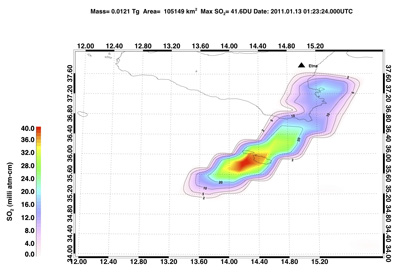
This image, which was acquired by the Atmospheric Infrared Sounder on NASA's EOS-AQUA satellite, shows the plume of sulphur dioxide currently being carried over the Mediterranean Sea. Credits: NASA, Norwegian Institute for Air Research

13 January 2011


Europe’s largest active volcano, Mount Etna on the Italian island of Sicily, erupted briefly yesterday sending flames and ash hundreds of metres into the air.

This image, which was acquired by the Atmospheric Infrared Sounder on NASA’s EOS-AQUA satellite, shows the plume of sulphur dioxide currently being carried over the Mediterranean Sea.

The data have been processed by the Norwegian Institute for Air Research within the framework of ESA’s Data User Element and can be used to warn aviation companies on the hazardous plume.

File:Mount Etna snow-toppd.jpg

Mount Etna, Sicily, topped in snow 5 February 2009: image Wikimedia

Mt. Merapi rumbles on and rains cause cold lava floods

January 10, 2011

Mount Merapi has continued erupting in the past two or three weeks but at much lower intensities than the  fatal eruptions which occurred on October 26 and November 5.

Island Crisis reports that:

YOGYAKARTA, INDONESIA (BNO NEWS) — With heavy rainfall accompanied by sporadic but strong wind currents, Indonesia’s Yogyakarta was hit by the largest outflow of cold lava and mud, locally known as lahar dingin, since October’s Merapi eruptions, local media reported.

The cold lava damaged several bridges and created chaos as traffic flow was cut off for around 18 hours on one of the city’s main highways, which was flooded under meter-deep lahar in several areas. “In addition to destroying the Gempol main bridge on the Putih River, lahar also destroyed bridges in other villages, leading to the isolation of hundreds of residents in seven hamlets,” Heri Prawoto, head of the Magelang district’s Disaster Management Office, told the Jakarta Globe.

But the resilience of humans is amazing.

The Merapi Golf Course in Yogyakarta, covered in ash. image credit: DigitalGlobe.

In Merapi’s Shadow, a Tourism Boom

The golf courses may be covered in volcanic ash, but tourists are flocking to Indonesia to see devastated villages near the recently eruptive Mount Merapi volcano.

Tourists with a curiosity about the aftermath of earthquakes, tsunamis and volcanic eruptions are being courted to the central Javanese city of Yogyakarta, Reuters reports.

The eruptions, which began on Oct. 26, killed more than 350 people and created nearly 400,000 refuges. That destruction, it seems, is a selling point for local travel agencies desperate for tourists’ dollars. “In the new volcano tour package, we’ll take customers to explore the closest village to the peak and see how bad the devastation is,” Edwin Ismedi Hinma, of the local tour agencies association, told Reuters. “Then we’ll take them to a river to watch cold lahars flood past.”


Borobodur courtyard reopened but 90% of ash remains to be removed

November 22, 2010
Borobudur temple view from northeast plateau, ...

Borobudur temple view from the northeast: image via Wikipedia

The Borobodur site was closed to the public after the eruptions of Mount Merapi began on Oct. 26. The temple complex was partly reopened for tourists over the weekend. Yogyakarta airport is now open. The Jakarta Globe reports:

Officials are concerned the acidic soot will hasten the wearing of the temples, Borobudur in particular, which is covered in up to 3 centimeters of ash. “Since Nov. 11, we’ve taken emergency action to keep Borobudur clear of ash by cleaning up 72 stupas and the main stupa, and wrapping them in plastic,” Junus Satrio Atmojo, the Culture and Tourism Ministry’s head of historical and archeological sites, said Saturday.

The government has allocated a total of Rp 600 million ($67,200) to clean up the Buddhist temples of Borobudur, Pawon and Mendut, as well as the Hindu temple complex of Prambanan, he said. “Cleaning up Borobudur and the three other temples requires that we be extra careful and work step by step to prevent the ash lodging in the pores of the rock surface,” Junus said.

“It’s not a question of hiring more people to help clean up, but of the equipment that we need to buy.” That includes Rp 248 million for Borobudur. “Cleaning up Borobudur and the three other temples requires that we be extra careful and work step by step to prevent the ash lodging in the pores of the rock surface,” Junus said. “It’s not a question of hiring more people to help clean up, but of the equipment that we need to buy.”

“Our experience from the Aceh tsunami in 2004 tells us that cultural heritage and historical buildings are always the last to be budgeted for in the disaster recovery fund, and that’s why we need outside donors,” he said.

“Donors don’t necessarily have to give us cash. We’d be grateful for items such as plastic sheets, hoses, baking soda and anything else we can use to clean the monuments.”  Junus added that Unesco, which lists Borobudur as a world heritage site, had only been able to offer sending an expert to gauge the damage, as it had no experience dealing with volcanic clean-ups. “We politely declined, as we have plenty of Indonesian experts,” he said.

Temple officials have reopened the Borobudur yard and the first of the temple’s nine levels to the public, but the rest of the site remains closed for cleaning.

“That’s because we haven’t been able to remove all the volcanic ash covering the temple,” Iskandar M Siregar, head of technical services for Borobudur management, said on Saturday. “We’re using brooms and dust pans to clean it up, so we can’t go any faster,” he said. “So far, we’ve collected 20 cubic meters of ash.” Iskandar said this represented less than a tenth of the total volcanic ash at the site.

He also rebuffed calls to wait for the rains to wash away the ash, pointing out that this would only complicate matters. “That’s because the ash would wash into the temple’s drainage system and damage it,” he said.

Clean-up crews are trying as much as possible not to use mechanical equipment, which could damage the rock surface of the temple, he said.
“We have to hurry because the ash has a corrosive character, that accelerates the weathering of the stupas and stones,” Iskandar said.
Flights resume from Yogyakarta, Mt. Merapi quiet

November 21, 2010

AFP reports:

Indonesia’s Yogyakarta airport, which had been closed for about two weeks by the eruption of the Mount Merapi volcano, reopened for operations Saturday, officials said.

Merapi, which means “Mountain of Fire”, has killed 283 people since it began erupting last month and more than 270,000 are still living in temporary shelters.

Volcanic ash and clouds belched high into the sky threatened the safety of aircraft, causing dozens of international flights to and from the country to be cancelled.

But the mountain’s activity level has now decreased, although an alert remains in place.

Transportation Ministry director general of aviation Herry Bhakti told AFP: “The Yogyakarta airport has resumed operation at 12:00 pm (0500 GMT) today. The effect of volcanic ash has been insignificant.”

Merapi Evacuees Ignore Volcano Threat to Go Home

November 15, 2010

Jakarta Globe:

Thousands of Indonesian families returned to their villages Monday even as scientists warned Mount Merapi volcano remained a severe threat and more bodies were found buried in the ash. Carrying their belongings on motorcycles and pickup trucks, more than 30,000 people had left emergency shelters after the government reduced a 20-kilometre (12-mile) exclusion zone by as much as half in certain districts. Most of the returnees were from Boyolali, Klaten and Magelang districts where the danger zone had been reduced.

Mount Merapi, a sacred landmark in Javanese tradition whose name translates as “Mountain of Fire”, had killed 259 people as of Monday’s count. Disaster Management Agency spokesman Sutopo Purwo Nugroho said 367,548 people were still living in shelters on Monday, about 30,000 fewer than on Sunday.

Merapi spewed clouds of gas and ash as high as four kilometres Sunday but volcanologist Subandrio said this was “small compared to the 14 kilometres in previous days”.

“It’s safe for people to go home as long as they stay outside the danger zone,” he added. The government maintained the 20-kilometre danger zone for Sleman district, on the southern slopes of the mountain, as “there’s still a probability of heat clouds going in that direction”, he said.

In another report The Jakarta Globe says that evacuees leaving the camps have been asked to sign waivers before returning home:

About 600 evacuees left two shelters in Boyolali on Friday to return to their homes in the Selo and Cepogo subdistricts. Volunteers at the shelters tried to persuade them to stay, but the evacuees were insistent. Those who wanted to leave were eventually made to sign a statement saying that they were leaving the shelters voluntarily.

“We will still monitor them and give them food aid because food is still scarce at the mountain slopes,” a volunteer told Metro TV. Another shelter located in Tlogo village, Prambanan subdistrict, Klaten, was almost empty. Most of the 1,200 evacuees had returned to their homes, arguing that their cattle and fields were deserted.

Mount Merapi in 1920

File:COLLECTIE TROPENMUSEUM Rijstvelden bij de vulkanen Merapi en Merbaboe op Java. TMnr 60007940.jpg

Mt. Merapi ca. 1920: Thilly Weissenborn (Fotograaf/photographer). Lux Fotostudio (Fotostudio).wikimedia commons

Merapi eruptions slowing down but still deadly

November 13, 2010

Mount Merapi volcano continued spewing hot gas ash but not as violently as before. But the death toll continues to climb as people succumb to their injuries.

Mount Merapi spews volcanic material as seen from Argomulyo, Indonesia, Friday, Nov. 12, 2010.(AP Photo/Achmad Ibrahim)

The Jakarta Globe now puts the toll at 240 lives:

Indonesia’s Mount Merapi volcano has killed 240 people since it began erupting late last month, with more than 390,000 people in makeshift camps, an official said. That figure continues to rise as people with severe burns die from their wounds and officials count those who have died from respiratory problems, heart attacks and other illnesses related to the blasts.

In addition, search operations continue for bodies buried under a thick layer of ash that shrouds whole villages. On Friday, soldiers pulled eight more bodies from around one hard-hit village, said Waluyo Rahardjo, who works for the search and rescue agency.

The Associated Press reports:

Ash has continuously shot out of the crater since it roared to life Oct. 26, occasionally canceling international flights into and out of Jakarta, hundreds of miles (kilometers) to the volcano’s west. After the output slowed overnight, an advisory from the Volcanic Ash Advisory Center in Darwin, Australia, showed the ash patch was well clear of the capital. The airport in Yogyakarta, at the foot of the mountain, however, remained closed.

Officials warned residents that less ash does not mean the volcano is finished.

“The activity of Merapi is still high, but the intensity of eruptions is reducing now. But people still should be careful. Merapi is still on high alert,” said Surano, a state volcanologist who uses only one name.

While officials struggle to persuade hundreds of thousands of people who live on the volcano’s fertile slopes not to return to their homes, a new kind of evacuee has been seen in recent days. Villagers checking on their homes and crops have seen Javan leopards — who live in a national park near the crater — heading down the mountain.

The cats likely feel the continuing tremors, said Tri Prasetyo, who runs the park, and are seeking safer ground. It’s also possible that prey is scarce in areas scorched by searing gases.

Aceng , a Java leopard, released back into the wild. Credit IAR

The Javan leopard — a subspecies of the cat only found on the island of Java — is critically endangered, with no more than 250 left in the wild. Some put the total population as low as 50.

Joko Tirtono, the manager of a zoo in Yogyakarta, said zoo keepers are now searching villages where the leopards have been spotted and laying traps in which they hope to capture the cats alive.

Mount Merapi eruption images from Nasa

November 11, 2010

The steep-sided, cone-shaped Mount Merapi volcano is both boon and curse to the people of Indonesia. Volcanic ash from its frequent eruptions makes the soil fertile enough to support a large population. It is also one of Indonesia’s most active volcanoes, posing a constant threat to tens of thousands of people who live in its shadow. On October 26, 2010, the volcano once again turned destructive, unleashing a series of eruptions that had killed at least 44 people and forced 75,000 people from their homes, said CNN on November 4.

Eruption at Mount Merapi, Indonesia

Eruption at Mount Merapi, Indonesia: Nov 1st: image NASA


The mountain has been shrouded in clouds throughout the eruption, but on October 30 the Advanced Spaceborne Thermal Emission and Reflection Radiometer (ASTER) on NASA’s Terra satellite captured the thermal signature of hot ash and rock and a glowing lava dome. The thermal data is overlaid on a three-dimensional map of the volcano to show the approximate location of the flow. The three-dimensional data is from a global topographic model created using ASTER stereo observations.

The Center of Volcanology and Geological Hazard Mitigation reported that two pyroclastic flows moved down the volcano on October 30. A pyroclastic flow is an avalanche of extremely hot gas, ash, and rock that tears down the side of a volcano at high speeds. ASTER imaged one of those flows.

Merapi shows no signs of slowing. After several days of eruptive episodes, the volcano began an eruption on November 3 that was five times more intense than on October 26 and lasted more than 24 hours. It is the most violent eruption at the volcano since the 1870s, said local geologists.

See more NASA images at:

http://earthobservatory.nasa.gov/NaturalHazards/event.php?id=46815

Eruption at Mount Merapi, Indonesia

SO2 cloud from Mt. Merapi: 4th November: image NASA

Eruption at Mount Merapi, Indonesia

Ash plume from Mt. Merapi 8th Nov: image NASA


New Merapi ash forces Obama to curtail visit, causes more flight cancellations

November 10, 2010

President Obama will cut short his visit to Indonesia by two hours to be able to meet a take-off window created by further ash eruptions from Mount Merapi volcano (431 km from Jakarta) last night and today. Some international flights to Jakarta on Wednesday and Thursday have been cancelled.

The Jakarta Globe.

Mount Merapi erupting again on Wednesday. Four airlines, including Qantas and Malaysia Air, have canceled flights to Jakarta. Some international flights to Bali have also been affected. (EPA Photo)

Mount Merapi erupting again on Wednesday. Four airlines, including Qantas and Malaysia Air, have canceled flights to Jakarta. Some international flights to Bali have also been affected. (EPA Photo)

Indonesia’s Merapi volcano has forced a number of international airlines to cancel flights over concerns about air safety. The volcanic eruptions in central Java also forced United States President Barack Obama to cut short his visit to the country. Obama sliced several hours off his whirlwind 24-hour tour Wednesday.

Mount Merapi, hundreds of kilometers east of Jakarta, has been spewing massive clouds of ash and gas high into the air for more than two weeks, killing at least 153 people and causing travel chaos and forcing two nearby airports to shut down. Syaiful Bahri, who oversees operations at Jakarta’s Soekarno-Hatta International Airport, says that concerns about the ash also forced several international carriers to again cancel flights into and out of the capital. Among them were Cathay Pacific, Value Air, Qantas and Malaysia Air.
An Indonesian government volcanologist said the pace of the eruption had slowed, but Hong Kong’s Cathay Pacific and Australia’s Qantas canceled flights because of the ash. Cathay said it had canceled flights to and from Jakarta on Wednesday and Thursday, while Qantas canceled a Sydney-Jakarta service on Wednesday. “Cathay Pacific will monitor and assess the situation and the possibility of operating flights,” the airline said on its website Wednesday. Jetstar, the low-cost offshoot of Qantas, has also changed its flight schedule for services to the Indonesian island of Bali, canceling flights that arrive at or depart from the popular holiday destination at night.
Officials said safety worries about the ash also meant Yogyakarta airport would stay closed until Monday next week at the earliest.

Mount Merapi rumbles on while Anak Krakatau crater expands and Obama flies in to Jakarta

November 9, 2010
A closer look at Anak Krakatau

Anak Krakatau: Image via Wikipedia

Yogyakarta’s Adi Sutjipto domestic and international airport has been closed until at least next Monday Nov. 15, at which time another decision would be made. Despite the ban on civilian and commercial flights in and out of Yogyakarta, the Indonesian Air Force was still operating Hercules flights to deliver aid to the internally displaced.
More than 300,000 people are believed to be housed in government shelters.

Indonesian rescue workers resumed efforts to retrieve bodies of victims from an eruption of Mount Merapi in central Java on Nov. 5, after surface temperatures forced a halt to the search on Monday. More than 320,000 people are housed at evacuation centers outside the 20-kilometer safety zone in four regencies in Yogyakarta and Central Java provinces, the National Disaster Management Agency said in a statement on its Web site today. Evacuees reached 280,000 people yesterday.

“Volcanic activity is relatively stable this morning compared with yesterday,” said Oka Hamid, a spokesman at Red Cross Indonesia’s Yogyakarta branch. “We recovered two remains in one village but we have to leave another four as the field is hard to reach and they’re all covered with thick ash.”

Meanwhile –

The crater of Anak Krakatau in the Sunda Strait has expanded to a diameter of 25-26 meters, an Indonesian volcanologist says. The news comes as the frequency of eruptions of the volcano, once misidentified as Krakatoa, increases: On Friday there were 615 eruptions, on Saturday 623 eruptions, and on Sunday 668.
Anton S Pambudi, a official from Banten province monitoring the eruptions, said the eruptions over the past two weeks had changed the shape of the crater. Authorities have warned that several other volcanoes in Indonesia are showing increased signs of activity. These include Mount Karangetang on Siau Island in North Sulawesi and Mount Ibu on Halmahera Island in North Maluku.

Banten Governor Ratu Atut Chosiyah said she believed that Anak Krakatau did not pose a threat and that the eruptions, which can be seen from the western tip of Java Island, were interesting to observe.

Philippine Airlines Inc., Emirates, Eva Airways Corp. and Valuair Ltd. resumed flights to Jakarta on Monday after suspending them for two days, PT Angkasa Pura, the Soekarno-Hatta international airport operator said on its Web site. Singapore Airlines Ltd., Cathay Pacific Airways Ltd. and Japan Airlines Corp. restarted services on Sunday.

President Obama arrives in a few hours in Jakarta.

Borobodur Temple covered by Merapi volcano ash

November 7, 2010


Borobudur temple view from northeast plateau, ...

Borobudur Temple: Image via Wikipedia


Update from CNN:

The death toll from recent eruptions at Indonesia’s Mount Merapi continues to rise as the volcano spewed hot ash clouds and gas on Sunday. At least 156 people have died since Merapi started erupting on October 26. Ash columns reached as high as 6 kilometers (3.7 miles), according to the Indonesian Volcanology and Geological Disaster Mitigation Agency.

The Borobudur temple lies about 45 km from Mount Merapi and is currently covered with ash which is being painstakingly cleared.

Employees of Borobudur temple on Sunday were working to keep the historic site from being damaged by the thick black ash that has fallen from nearby Mount Merapi’s eruption.

Karyono, a parking lot employee who has been working there since 1986, was taking the ash off the driveway and the parking lot. Using a small iron shovel, he and his 10 coworkers were squatting and painstakingly taking the ash away in buckets.Karyono said that he has been cleaning since Saturday and piling up the ashes to be dumped elsewhere.

While the cleanup operation continues, the famous temple is closed to visitors from Nov. 5 to 9.

Mount Merapi unleashed nearly 50 million cubic meters of gas, rocks and ash on Friday, its most powerful eruption in a century.

Up to 138 people have now died on Merapi’s slopes in the past ten days of eruptions and gas cloud ash emissions.

Authorities charged with conserving the temple say that

ash up to 3-centimetres deep has covered it and the acidity could erode the temple’s stones. They believe that if the ash it is not cleared away quickly it will accelerate the decay of the stones. The monument comprises six square platforms topped by three circular platforms, and is decorated with 2,672 relief panels and 504 Buddha statues. A main dome, located at the center of the top platform, is surrounded by 72 Buddha statues seated inside perforated stupa. The monument is both a shrine to the Lord Buddha and a place for Buddhist pilgrimage. The journey for pilgrims begins at the base of the monument and follows a path circumambulating the monument while ascending to the top through the three levels of Buddhist cosmology, namely Kāmadhātu (the world of desire), Rupadhatu (the world of forms) and Arupadhatu (the world of formlessness). During the journey the monument guides the pilgrims through a system of stairways and corridors with 1,460 narrative relief panels on the wall and the balustrades. Officials however confirm that over the next few days they will be conducting a technical evaluation for the cleaning process. The temple was again closed down for visitors temporarily after volcanic ash covered it following the Merapi volcano’s powerful eruptions on Friday. When the cleanup is completed visitors will be allowed to visit the site early next week – but they will still not be permitted to climb up to the temple.

Evidence suggests Borobudur was abandoned following the 14th-century decline of Buddhist and Hindu kingdoms in Java, and the Javanese conversion to Islam. Worldwide knowledge of its existence was sparked in 1814 by Sir Thomas Stamford Raffles, then the British ruler of Java, who was advised of its location by native Indonesians. Borobudur has since been preserved through several restorations. The largest restoration project was undertaken between 1975 and 1982 by the Indonesian government and UNESCO, following which the monument was listed as a UNESCO World Heritage Site. It is still used for pilgrimage; once a year Buddhists in Indonesia celebrate Vesak at the monument. Borobudur remains Indonesia’s single most visited tourist attraction.

Since Borobudur was built sometime in the 9th Century it has probably seen – and survived – over one hundred eruptions from Mount Merapi in the following 1200 years. Mount Merapi is Indonesia’s most active volcano and has certainly been erupting regularly at least since 8000 BC. Since 1548 written eruption records are available but earlier eruptions are inferred.


Mount Merapi as seen from Borobudur: image ghumakkar.com