Clinton, Trump, Sanders & Carson – not really spoilt for choice

October 22, 2015

So Biden is not running.

This leaves the US electorate now with the less than enviable prospect of having to vote in one of the motley group of Trump, Clinton, Carson or Sanders as their next President. Not the most inspiring group of names. If leadership is the criterion then Donald Trump is the only one who qualifies. If “politicking” and manipulating the political establishment is what is required then Hillary Clinton is best suited. Ben Carson will come into his own when lobotomising sections of the government or in excising unwanted parts of the bureaucracy. Bernie Sanders could count as the “intellectual” in this group but he is best at opposing and blocking others rather than taking his own initiatives.

The choice is one of firsts. Either the first non-politician, or the first woman, or the first (real) black, or the first socialist as President. It could be the dullest election ever. The only glint of some entertainment in the process is provided by Trump. Of course the criteria for winning the election are different to the qualities needed for being President for 4 years. Of the four I don’t see that Carson or Sanders have what it takes to be even a reasonably successful President.

So I would expect Carson to lose handily to Clinton and Sanders to Trump. But a Carson versus Sanders election could be a bizarre battle to see who was worse. It could be difficult to forecast the contest to lose. Paradoxically it is the bizarreness of such a contest which could inject some interest. The prospect of having an incompetent incumbent in the White House will bring some despair to friendly countries.

That leaves a Clinton versus Trump contest which could actually be a close and fascinating fight. It would pit stability versus volatility and political manipulation against a leader charging in where angels fear to tread. It would be Big government set against Small. Both would be extremely pragmatic though Clinton may be swayed by ideology a little more. Trump will protect the bottom line while Clinton will tend to protect the spending level. Trump’s foreign policy will be openly focused on short-term advantages to the US whereas Clinton’s will be all about long-term geopolitical machinations.

The more I consider a Trump versus Clinton battle, the more difficult I find it to predict how the American voters may decide. But Trump has a real chance of winning even if he does start as the underdog.

That Trump could be the GOP candidate was unthinkable just 3 months ago. It seems the most likely outcome now. That Trump could win the election still seems a little far-fetched, but it has now to be considered more than just a theoretical possibility.

If a not very good actor could become a State Governor and one of the more successful US Presidents, I suppose there is no reason why a real estate mogul could not also make it. 2016 could be the year of the clowns. And the US and the world may just need a clown in the flagging global play.

But with just these 4 names in the hat, the US electorate is not really spoilt for choice.

Deciphering the Harappan script – probably proto-Dravidian

October 21, 2015

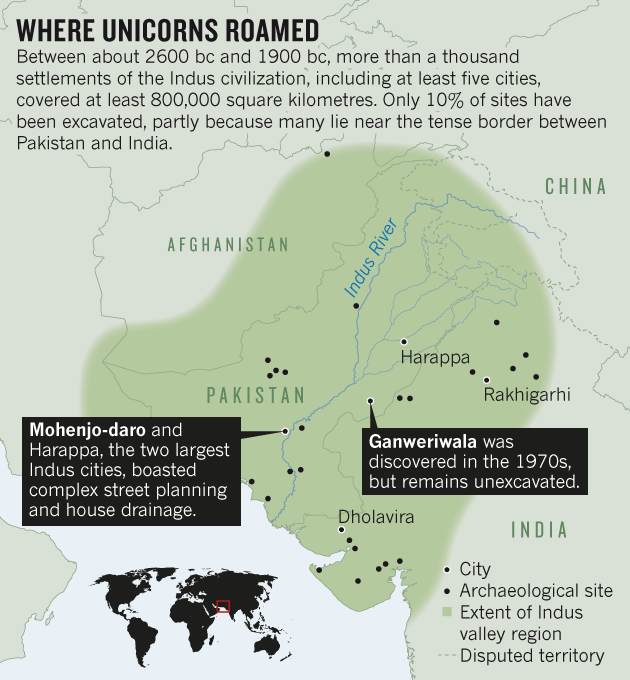
The Indus-Saraswati Valley civilisation reached its peak around 1,900 BCE. It had been flourishing there for over a millennium from about 3300 BCE. But various proto-Harappan cultures had existed in those fertile plains for almost 4,000 years before that (from about 7,000BCE). At their peak they occupied the entire Indus -Saraswati Valley and stretched as far as the Indo-Gangetic plain. At its peak there were some 1,000 settlements and at least 5 “great” cities that we now know of; Mohenjo-Daro, Harappa, Ganweriwala, Rakhigarhi and Dholavira. None of these are truly coastal and it is not improbable that one or perhaps two “great” coastal cities are now submerged and waiting to be discovered. Only about 10% of the known sites have been investigated and the Indus Valley script – which I call Harappan for convenience – has yet to deciphered.

Where Unicorns roamed - graphic by Nature

Where Unicorns roamed – graphic by Nature

But by about 1,000 BCE the glories of the civilisation had disappeared; not swept away in one fell swoop by some marauding invaders or by some great pestilence or some cataclysmic natural catastrophe, but gradually as cities and settlements were abandoned and the population gradually thinned out and reduced to a shadow of its heyday. Coming out of the ice-age around 20,000 years ago, sea-levels were almost 100m lower than today. By 7,000 BCE (9,000 years ago) sea levels were already about 30m lower than at present and were rising fast at around 8-10 m/millennium. The settlements in the region were either on the coast or followed the course of the great rivers. It was a 300 – 500 year process of desertification which saw the Saraswati dry up and the creation of the Thar desert.

Saraswati and Thar Desert

Saraswati and Thar Desert

Where they all went is mainly conjecture but it is likely that they “followed the water”. Some of the sources of the Saraswati would have diverted to flow into the Ganges. That would have taken some people westwards, back along the coast towards the then fertile Persian Gulf, some eastwards across the Indo-Gangetic plain and some southwards along the coast of the Indian subcontinent. Quite possibly some reached the Bay of Bengal and others reached south India and the Indian Ocean. But they did not move into empty spaces. The Indian subcontinent had been continuously settled from the times of homo erectus but by the time of the Toba eruption 74,000 years ago homo erectus had already been replaced by homo sapiens. So when the Harappans moved in, modern humans were already there, but not in large numbers. The earlier settlers probably included the few survivors of a pre-Toba wave of expansion who were then absorbed by later settlers – probably many arrival instances – over some 50,000 years.

Where the Harappans probably went

Where the Harappans probably went

In my narrative it is the Harappans and their language which provided the nucleus for, and eventually became, the family of Dravidian languages. In fact it is probable that some of the roots of what became Hinduism came also with them. I would even suggest that the specialisation of functions (administrators, priests, traders, craftsmen and labour) that must have existed in the meticulously planned, water-resourceful, trading cities of the Indus-Saraswati Valley led to the foundation of guilds and a stratified society. That probably laid the foundations of the caste system which, in its perverted form, currently disgraces the subcontinent.

Andrew Robinson looks at the state of the decipherment of the Harappan script in Nature.

Nature 526, 499–501 (22 October 2015) doi:10.1038/526499a.

Cracking the Indus script

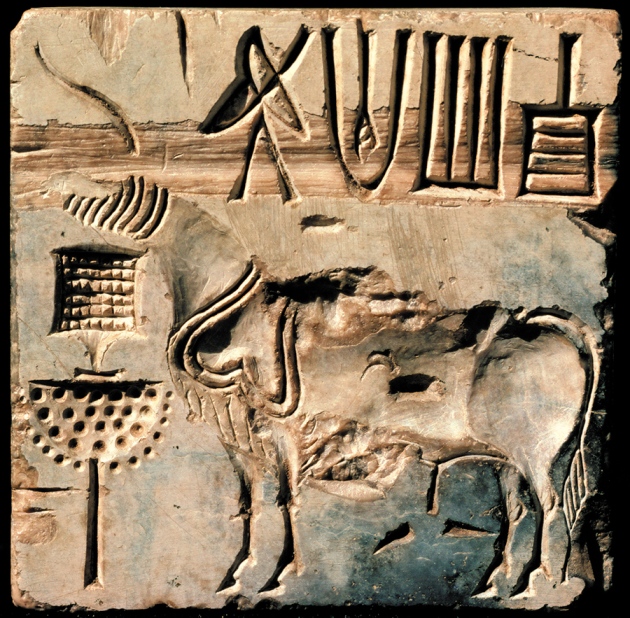
Indus unicorn on a roughly 4,000-year-old sealstone, found at the Mohenjo-daro site. photo – Robert Harding/Corbis

The Indus civilization flourished for half a millennium from about 2600 bc to 1900 bc. Then it mysteriously declined and vanished from view. It remained invisible for almost 4,000 years until its ruins were discovered by accident in the 1920s by British and Indian archaeologists. Following almost a century of excavation, it is today regarded as a civilization worthy of comparison with those of ancient Egypt and Mesopotamia, as the beginning of Indian civilization and possibly as the origin of Hinduism. 

More than a thousand Indus settlements covered at least 800,000 square kilometres of what is now Pakistan and northwestern India. It was the most extensive urban culture of its period, with a population of perhaps 1 million and a vigorous maritime export trade to the Gulf and cities such as Ur in Mesopotamia, where objects inscribed with Indus signs have been discovered. Astonishingly, the culture has left no archaeological evidence of armies or warfare.

Most Indus settlements were villages; some were towns, and at least five were substantial cities …  boasted street planning and house drainage worthy of the twentieth century ad. They hosted the world’s first known toilets, along with complex stone weights, elaborately drilled gemstone necklaces and exquisitely carved seal stones featuring one of the world’s stubbornly undeciphered scripts. …

The Indus script is made up of partially pictographic signs and human and animal motifs including a puzzling ‘unicorn’. ….. 

Whatever their differences, all Indus researchers agree that there is no consensus on the meaning of the script. There are three main problems. First, no firm information is available about its underlying language. Was this an ancestor of Sanskrit or Dravidian, or of some other Indian language family, such as Munda, or was it a language that has disappeared? Linear B was deciphered because the tablets turned out to be in an archaic form of Greek; Mayan glyphs because Mayan languages are still spoken. Second, no names of Indus rulers or personages are known from myths or historical records: no equivalents of Rameses or Ptolemy, who were known to hieroglyphic decipherers from records of ancient Egypt available in Greek. ……

……. Nevertheless, almost every researcher accepts that the script contains too many signs to be either an alphabet or a syllabary (in which signs represent syllables), like Linear B. It is probably a logo-syllabic script — such as Sumerian cuneiform or Mayan glyphs — that is, a mixture of hundreds of logographic signs representing words and concepts, such as &, £ and %, and a much smaller subset representing syllables.

As for the language, the balance of evidence favours a proto-Dravidian language, not Sanskrit. Many scholars have proposed plausible Dravidian meanings for a few groups of characters based on Old Tamil, although none of these ‘translations’ has gained universal acceptance. ……… A minority of researchers query whether the Indus script was capable of expressing a spoken language, mainly because of the brevity of inscriptions. ……. This theory seems unlikely, for various reasons. Notably, sequential ordering and an agreed direction of writing are universal features of writing systems. Such rules are not crucial in symbolic systems. Moreover, the Indus civilization must have been well aware through its trade links of how cuneiform functioned as a full writing system. ……….

What the Harappans wrote and spoke was not Dravidian itself, but it was very likely a proto-Dravidian language, which, with many other influences from what already existed in the South Indian regions they moved into, became the family of Dravidian languages existing today. And it could explain why a Dravidian language can be found today in what is Afghanistan.

Dravidian language subgroups - map Wikipedia

Dravidian language subgroups – map Wikipedia


Saudi Arabia gets away with it again — but why?

October 21, 2015

That Saudi Arabia uses barbaric, medieval methods within Saudi Arabia is almost a cliche. But why they command an almost fawning behaviour by other countries can only be partly explained by the power of their money. Values, it seems, are subverted by Saudi oil money.

Without financing from parties in Saudi Arabia, ISIS could not sustain itself. The madrassas and mosques where feeble-minded, muslim kids are radicalised in Europe and in Asia, are financed to a large extent from Saudi Arabia. The 9/11 terrorists were mainly Saudis. Bin Laden was Saudi.

Dissolute and decadent Saudi and Gulf tourists run riot in Europe, driving recklessly, drinking heavily, cooking, littering and smoking shisha in public parks. All with an impunity as if they had a de facto diplomatic immunity – which of course they seem to have. Even the Saudi King and an entourage of 1,000 were allowed to take over a whole beach in France in spite of local protests. The French acquiesced to the King’s demand that female police officers be removed.

Saudi Arabia would collapse without its expat workers and foreign labour. Their medieval treatment of foreigners is a scandal but is tolerated because they pay well. How on earth did Saudi Arabia get elected as the Chair of UN Human Rights Council Panel?

In the last few weeks the arrogant and decadent behaviour of the Saudis at home and abroad has been on show.

  1. The incompetence of the Saudi authorities led to the death of at least 2177 people at the Hajj stampede, not the 769 that Saudi Arabia admits to (as if that was not bad enough).
  2. Two Nepali women working as maids for a Saudi diplomat were were held captive by his family and used for “entertainment” for their Saudi friends. They were starved and sexually abused by them and other Saudi guests. When the girls were eventually released and the diplomat charged, he just claimed immunity and was whisked back to Saudi Arabia.
  3. The US authorities allowed a Saudi prince to flee rape charges even though he had no immunity. Majed Abdulaziz Al-Saud was arrested but fled while on bail. “Arrested on suspicion of false imprisonment, sexual assault and battery, a Saudi prince has also recently been accused of attacking at least three women and holding them captive for several days. Immediately upon posting bail, the prince reportedly emptied his $37 million mansion and fled the country on a private jet to avoid civil litigation and criminal charges. …. Although the prince is a royal member of the House of Saud, the U.S. State Department eventually confirmed that Al-Saud does not have any diplomatic immunity”.

Is it just oil money that leads the US and European governments to put up with the atrocious behaviour that would lead to calls for regime change in other countries? Of course the US sees Saudi as a balance for Iran in the region. But if the US is serious about its so-called war on terror, the sources of most of the financing of islamic terror organisations lie in Saudi Arabia. King Salman is showing signs of dementia and the country is actually being run by his son – but not very competently. Mohammed bin Salman is just 29 and has never had experience of being anything more than an aide. The incompetence on show has led to one of the grandsons of the founder of Saudi Arabia making public his concerns about the way the country is being run.

A senior Saudi prince has launched an unprecedented call for change in the country’s leadership, as it faces its biggest challenge in years in the form of war, plummeting oil prices and criticism of its management of Mecca, scene of last week’s hajj tragedy. 

The prince, one of the grandsons of the state’s founder, Abdulaziz Ibn Saud,  ……. (but) who is not named for security reasons, wrote two letters earlier this month calling for the king to be removed.

And all of Europe and the US continue to indulge them. Low oil prices for the next decade will – perhaps – reduce some of the Saudi excesses, but there is something more than just oil money at play.

I suspect it is the delusion in US and Europe that they can manage the inevitable restructuring of nations in the Middle East that must come. At some time Iraq has to split three-ways between Sunni, Shia and Kurd. And now it looks inevitable that Syria must also split in some similar manner, with a Sunni part of Syria perhaps merged with a Sunni part of Iraq.

Ralph Peters’ scenario for the Middle East


India and China have already won and the Paris climate conference has become irrelevant

October 20, 2015
Paris conference

Paris conference

India and China have successfully managed to get the UN to focus on the intensity of emissions per unit of GDP and thus can make promises (not legally binding) about future emissions tied to GDP such that they will not be limited in their use of coal in any significant way.

The hype about the UN’s December climate meeting in Paris is gradually growing. Media, politically correct politicians and the global warming religion’s orthodoxy are winding up their rhetoric. Ostensibly the goal is to demonise carbon and to get nations to commit to reducing fossil fuel use such that the global temperature rise “will not exceed 2ºC”. This target of “allowable” temperature rise is not “2ºC caused by man” but just “2ºC”. Nobody actually knows what the rise by “natural causes” might be and what is caused by man. “Global temperature” itself is an artefact, a calculated quantity and calculated by those with a vested interest in showing that it is increasing. It seems that the calculation method is conveniently variable and is adjusted every year to show that the current year has demonstrated the highest ever temperature. Nevertheless the 5,000 participants and 190+ countries have effectively set themselves up to discuss commitments to stop climate change itself. The arrogance is astounding and worthy of King Cnut.

What effect man has actually had on climate is unknown. For almost 20 years now, man-made carbon dioxide emissions have been growing explosively but “global temperature” has paused. Those countries which have increased their own costs of electricity by reducing fossil fuel use (mainly in Europe) have effectively done it all quite uselessly and unnecessarily. Other countries (China and India in the main) have increased their use of fossil fuels such that global emissions of carbon dioxide have continued to grow. And yet there has been no change in “global temperature” except by arithmetical tricks. The last 3 decades of reducing fossil fuel use in Europe have been unnecessary. Three decades of subsidising renewable energy have still not made them commercial in their own right.

Climate policies are all policies where the objectives are not measurable. Policies are being proposed where the effect of the policies on climate itself cannot be measured. All that can be measured are the actions themselves which is both trivial and meaningless. For example countries can measure amounts of money spent but have no clue as to what the resultant effect on climate may be. Emissions reductions can be measured, but not the actual climate effects such reductions may have caused or not caused. For many delegates the purpose is not climate but the redistribution of wealth among nations where climate policy is the vehicle.

Ask a politician what his countries climate policies will achieve and the answer is that it will “contribute to the world’s efforts to stop climate change”. But by how much and how success can be measured are unknowns. It has become a matter of solidarity among nations not of policies with objectives. Not a single country (nor any politician nor any so-called climate scientist) has any inkling about what its climate policies will achieve for climate or even if it will achieve anything at all.

Some of the more savvy politicians and countries have figured out ways to seem to support political correctness while ensuring that their continued – and increasing – use of fossil fuels is not constrained in practice. For India and China the continued use of fossil fuels is critical and necessary for their growth. For the next 20  – 30 years, their carbon dioxide emissions are going to increase regardless of what the Paris meeting decides. India has proposed policies which seem – at first sight – to be drastic reductions in the “intensity of carbon dioxide emissions per unit of GDP” but defined in terms of growth such that coal consumption will have trebled in the next 25 years from 2005. India has now said it will cut emissions intensity by up to 25% of 2005 levels by 2020. China has also said it will reduce the intensity of carbon dioxide emissions per unit of GDP in 2020 by 40 to 45 percent compared with the level of 2005.

India’s GDP has grown from $0.8 trillion in 2005 to be about $2.1 trillion in 2014. China’s GDP has already grown from $2.3 trillion in 2005 to $10.3 trillion in 2014. These “promises” based on GDP are not even going to be legally binding  and there is certainly no cap to the GDP which can be aimed for or achieved. The GDP targets for India and China inherently require a mix of fuels to be used for electricity generation; coal, gas, nuclear and hydro primarily. Solar and wind power may have a large installed capacity and may contribute something to the growth but are not necessary or critical. The Indian and Chinese plans for using more gas and nuclear in their mix automatically brings down the carbon intensity per GDP from the levels of 2005 when both countries were heavily dependent on coal. Their coal plans can therefore proceed unimpeded while still meeting their “promises”. Both countries are relying on GDP growth to effectively reduce their “intensities of carbon emission” without having to reduce the rate at which they increase planned fossil fuel use or carbon dioxide emissions. Both India and China have reached the stage of development where electricity consumption growth is now lower than GDP growth. Both are at low levels of energy utilisation efficiency such that significant demand side improvements can be made. With around 7% growth in India and even with China reducing to, say, 6% growth, the reductions of intensity of carbon dioxide emissions per unit of GDP are impossible to prevent.

Any agreement in Paris will mean India trebling and China doubling its coal burn by 2030. And with “official” sanction to do so. So what “success” in Paris means is that global, man-made, carbon dioxide emissions are going to double (at least). And it also means that any carbon dioxide emission reductions promised by other countries are of no significance whatsoever. It is a very good thing that man-made, carbon dioxide emissions have no significant impact on global temperature.

And the Paris conference is both meaningless and irrelevant.

What Boston took away from the sea

October 19, 2015

Now they say that Boston may be threatened by rising sea levels – except that Boston is still growing itself by reclaiming land from the sea. And sea levels are not actually rising any faster than the rate they have been over the millennia of recovery from the last ice age. Just as arctic ice seems to be quite “normal” while antarctic ice cover is on the high side.

The marshland that has been filled in to allow Boston to expand over the last 150 years is shown very nicely in this animation (from 2010) from Joost Bonsen at Maximising Progress.


Blair did agree to be Bush’s poodle over Iraq

October 18, 2015

What if the invasion of Iraq had not happened? And without the UK support, even Colin Powell’s lies to the UN about Iraq’s WMD would not have been enough. And Tony Blair was no reluctant liar but a willing player in the scheme to dupe the UN.

I wonder what history will make of Tony Blair now that this memo from Colin Powell has been revealed.

Daily Mail:

Smoking gun emails reveal Blair’s ‘deal in blood’ with George Bush over Iraq war was forged a YEAR before the invasion had even started

  • Leaked White House memo shows former Prime Minister’s support for war at summit with U.S. President in 2002
  • Bombshell document shows Blair preparing to act as spin doctor for Bush, who was told ‘the UK will follow our lead’
  • Publicly, Blair still claimed to be looking for diplomatic solution – in direct contrast to email revelations …… 

A bombshell White House memo has revealed for the first time details of the ‘deal in blood’ forged by Tony Blair and George Bush over the Iraq War. The sensational leak shows that Blair had given an unqualified pledge to sign up to the conflict a year before the invasion started.

It flies in the face of the Prime Minister’s public claims at the time that he was seeking a diplomatic solution to the crisis. He told voters: ‘We’re not proposing military action’ – in direct contrast to what the secret email now reveals.

***MAIL ONLINES *** Email from Colin Powell Image vis Glen Owen MOS political reporter

***MAIL ONLINES *** Email from Colin Powell Image vis Glen Owen MOS political reporter

The classified document also discloses that Blair agreed to act as a glorified spin doctor for the President by presenting ‘public affairs lines’ to convince a sceptical public that Saddam had Weapons of Mass Destruction – when none existed.

In return, the President would flatter Blair’s ego and give the impression that Britain was not America’s poodle but an equal partner in the ‘special relationship’.

The damning memo, from Secretary of State Colin Powell to President George Bush, was written on March 28, 2002, a week before Bush’s famous summit with Blair at his Crawford ranch in Texas.

In it, Powell tells Bush that Blair ‘will be with us’ on military action. Powell assures the President: ‘The UK will follow our lead’. ….

Smoking gun emails reveal Blair’s ‘deal in blood’ with George Bush

Johor could manage without Malaysia, but Malaysia without Johor would collapse

October 18, 2015

The corruption in the Malaysian body politic runs deep and is even getting to be too much for the Malay Royal families. The 1MDB scandal may be the last straw. The Royal families are very keen to distance themselves from the shenanigans which the Prime Minister is now enmeshed in. So much so that the spectre of secession has been raised.

BBCMalaysians are no strangers to money politics but the high-profile players and the amount of funds allegedly involved in the so-called “1MDB scandal” have gripped the nation.

It stems from Prime Minister Najib Razak’s strategic state fund called 1Malaysia Development Bhd (1MDB) set up in 2009 when he came into office. The fund is meant to turn Kuala Lumpur into a financial hub. It started to attract national attention when it missed payments for the $11bn (£7.1bn; €9.9bn) it owes to banks and bondholders.

Former Prime Minister Mahathir Mohamad has said the fund has taken on too much debt and lacks transparency. He has also criticised Mr Najib’s family’s “lavish” lifestyle, which has been regularly discussed in the local press.

Then the Wall Street Journal (WSJ) reported it had seen a paper trail that allegedly traces close to $700m from the troubled fund to Mr Najib’s personal bank accounts. Mr Najib is now facing calls to prove his assets are legal.

The Southern state of Johor with its proximity to Singapore is exposed daily to the differences between what Singapore has achieved and what Malaysia has not. So much so that the Crown Prince has now followed his younger brother’s warning shot from June this year to remind the politicians in Kuala Lumpur that if the accession agreements of 1948 are breached then Johor could well decide to secede from the federation.

the 13 states in the Federation of Malaysia

The States of Sarawak and Sabah would follow Johor’s lead and while actual secession is probably a long, long, way away, this is the first time in a long while that I can remember secession being used as a threat – and being taken with some semblance of seriousness. There is even analysis to show that Johor could well go it alone

Malaysia Chronicle: His Royal Highness the Tengku Mahkota of Johor has stated that if Putrajaya breaches the terms behind the Federation of Malaya, Johor as a state may be forced to secede.

His Royal Highness also took great pains to echo the feelings of misery felt by millions and declared that the Royal family was “not a part of this current mess”.

From an economic point of view, how would Johor fare if it were to go its own way? Would it be better off or worse off?

Firstly, if Johor were to become an independent nation, it would probably be a monarchy, governed like an Emirate, as opposed to a Constitutional Monarchy. Some argue that given the experience of countries the last 10 plus years, monarchy as a form of Government may actually hold better prospects than democracy for young democracies with weak law enforcement.

From an economic point of view, Johor would (be) really well positioned. It would probably have extensive rail and tunnel links with Singapore and the flow of goods between Johor and Singapore will be more like the flow of goods between England and France. There would probably be at least two to three high speed rail links into Johor from Singapore creating a megapolis, albeit between two different countries.

As an independent state, Johor will need its own central bank. This will enable financial intermediation and ensure greater economic progress. But it would probably need to be capitalised with a loan of about US $10 billion. From then on, the Johor as an independent country will be responsible for management of its own domestic and external trade. ……

…… Johor as an independent developed state could easily hold a population of 10 million ten years after independence, which means that its GDP is a staggering USD $400 billion; comparable to the entire GDP of Malaysia. …….

Malaysia without Johor would mean a country sharing a border with Negeri Sembilan, Malacca and Pahang. Some parts of this border cuts through virgin jungle and Johor would be required to protect its border, much the same way as the Malaysia – Thai border is protected.

But this would probably mean the demise of Malaysia as a country. Johor can survive without Malaysia, but can Malaysia survive without Johor? Malaysia will probably enter into a severe economic recession and end up as a failed state should Johor secede.

The Malaysian government is not amused, but the general disgust with government ministers and the ruling party is now quite high. Even Mahathir, the former Prime Minister, has seen it as necessary to criticise the present regime.

Interesting times and a possible Balkanisation of Malaysia.

European nuclear moratoria are ineffective and counter-productive as China plans 110 nuclear plants by 2030

October 18, 2015

Update! Numbers have been corrected. By 2030 China plans 110 nuclear plants in operation which is another 60 reactors in addition to the 50 currently in operation or under construction. (I had earlier assumed that the plan was for 110 new reactors).


The European nuclear industry is almost dead as a consequence of,

  1. the ban on nuclear power in countries which have succumbed to environmental political correctness (e.g. Sweden, Germany…)
  2. the ridiculously long and costly permitting processes (environment and safety) in countries where nuclear power has not been banned (UK, Finland…)

As a contribution to the global use (or non-use) of nuclear power, the European reluctance to use nuclear power is entirely meaningless. For the objectives of killing the European nuclear industry and raising costs for electrical power in Europe, the anti-nuclear lobby has been entirely successful.

China currently has 23 nuclear plants in operation and 27 under construction which will be in operation by 2020. By 2020 the Chinese nuclear generating capacity will have almost tripled from the 21GW, 2014 level to be about 58GW in 2020. They have just announced their next five-year plan and some long-term strategies. Another $78 billion has been earmarked to reach 110 nuclear plants in operation by 2030. These plants will be built using indigenous Chinese technology. This technology is now available for export. It is being actively considered for projects in Pakistan and Argentina and now China is even a possible investor in the UK. Each Chinese nuclear plant has a capacity of about 1.1GW (1,100MW). At $78 billion for a further 60 plants, the investment cost planned is about $1200/kW. This is incredibly low, not just for nuclear plant, but for any type of power generating plant. Even assuming a volume effect, it can be expected that Chinese nuclear power plants could be exported at about $1,200-1500/kW.

The Hindu:

China plans to build 110 nuclear power plants by 2030 with an investment of over $78 billion overtaking the U.S. which has 100 such plants amid criticism that Beijing is yet to implement enough measures to develop safety controls in existing projects.

China will build six to eight nuclear power plants annually for the next five years and operate 110 plants by 2030 to meet the urgent need for clean energy, Beijing-based China Times quoted plan analysts as saying. China will invest 500 billion yuan ($78.8 billion) on domestically developed nuclear power plants, the report said. According to the China Times, the country plans to increase its electricity generation capacity to 58 gigawatts by 2020, three times the 2014 level. 

China currently has 23 nuclear power generating units in operation and 27 under construction, about one-third of the world’s unfinished nuclear units.

The construction resumed after the Chinese government which put the brakes on nuclear power plant approvals after the Fukushima nuclear accident in Japan in 2011 permitted their construction after a safety review.

nuclear sites in china (graphic world-nuclear.org)

nuclear sites in china (graphic world-nuclear.org)

In Europe the Olkiluoto #3 nuclear plant of 1,600MW in Finland, was first expected to cost about $2,000/kW, but with all the delays and cost overruns it is going to end up costing about $5,300/kW. Even if the unnecessary approvals and cost overruns incurred just to satisfy the environmental lobbies were not there, the investment cost for new nuclear capacity in Europe would still be about $2,600-3000/kW (compare that with about $1,100/kW for gas fired plant, about $2,500/kW for a coal or onshore wind plant and about $6,800/kW for offshore wind power).

As a comparison, India currently has 21 nuclear rectors in operation with a capacity just under 6GW. A further 6 reactors giving another 4 GW are under construction. The Indian plan is to reach about 63GW of nuclear capacity by 2032 which, of course, will not happen. My experience of Indian power planning is that about 60% of the plan will be implemented (though the track record is improving). So it is quite probable that India will construct around another 40 nuclear reactors (@800MW/reactor on average) by 2032. (In that period Indian coal consumption would also have trebled).

At the Chinese cost of exporting nuclear plant for around $1,200-1,500/kW, it is only to be expected that the electrification of Africa and nuclear expansion in S. Asia will be satisfied to a large extent by nuclear power.  A big chunk of that would be with Chinese technology. I have no doubt that European nuclear plants operate to much higher safety standards than the current Chinese reactors, but the European nuclear industry is now dead and it is Chinese nuclear technology which will be affordable and will prevail.

Considering the goals it was set out to achieve, the European anti-nuclear stance has been totally ineffective (except locally in Europe) and grossly counter-productive:

  1. it has no long-term impact on global use of nuclear energy,
  2. it has effectively killed the European nuclear power industry,
  3. it has effectively reduced the safety levels of all those nuclear plants that will be built over the next two decades, and
  4. it has increased the cost of electric power in Europe.

It is worth remembering that while the Great 2011 Earthquake and Tsunami killed some 18,000 people in Japan, the Fukushima accident it caused has killed no-one directly due to radiation. Now, less than 30 years after the major disaster at Chernobyl, the area is very far from being some nuclear waste-land, and plant and wild-life are thriving as never before in the region.

A loss of elegance in the nature of matter

October 17, 2015

Physics is losing the elegance it once had.

I suppose I am just old-fashioned but I learnt that simpler was better and more elegant – whether in mathematics or science or engineering or literature or poetry.  Shorter reports rather than longer ones, simpler language if more precise, lighter machines rather than heavier ones, elegant physical structures rather than complex ones. No waste, no extraneous fuss. Necessary and sufficient was the ideal.

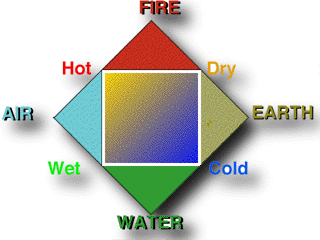
In the ancient world, all things were made up of fire, water, air and earth. It was a simple. elegant and powerful model to explain the world of matter.


Matter a la Aristotle

Matter a la Aristotle (image honolulu.hawaii.edu)

Then in the modern world, 2,500 years later, when over 100 different elements had been discovered, and where each element was built up of unique, fundamental atoms, an even simpler, more elegant and powerful model was discovered/developed. All atoms of all elements were found to be built up from just 3 elementary particles; the proton, the neutron and the electron.

Rutherford-Bohr atom

Rutherford-Bohr atom

It has been downhill from that peak of elegance ever since.

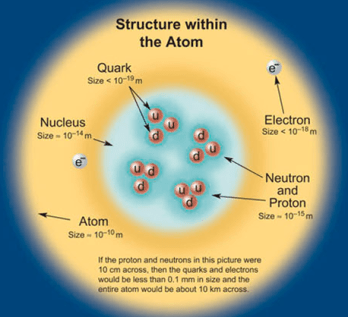
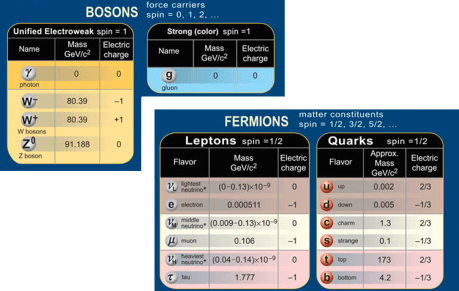
Physics has become a Big Science where billion dollar sledgehammers are used to crack little nuts. Pieces of nut and shell go flying everywhere and each little fragment is considered a new elementary particle. The Rutherford-Bohr model still applies, but its elementary particles are no longer considered elementary. Particles with mass and charge are given constituent particles, one having mass and no charge, and one having charge and no mass. Unexplainable forces between particles are assigned special particles to carry the force. Particles which don’t exist, but may have existed, are defined and “discovered”. Errors in theoretical models are explained away by assigning appropriate properties to old particles or defining new particles. Every new particle leaves a new slime trail across the painting. It is as if a bunch of savages are doodling upon a masterpiece. The scribbling is ugly and hides the masterpiece underneath, but it does not mean that the masterpiece is not there.
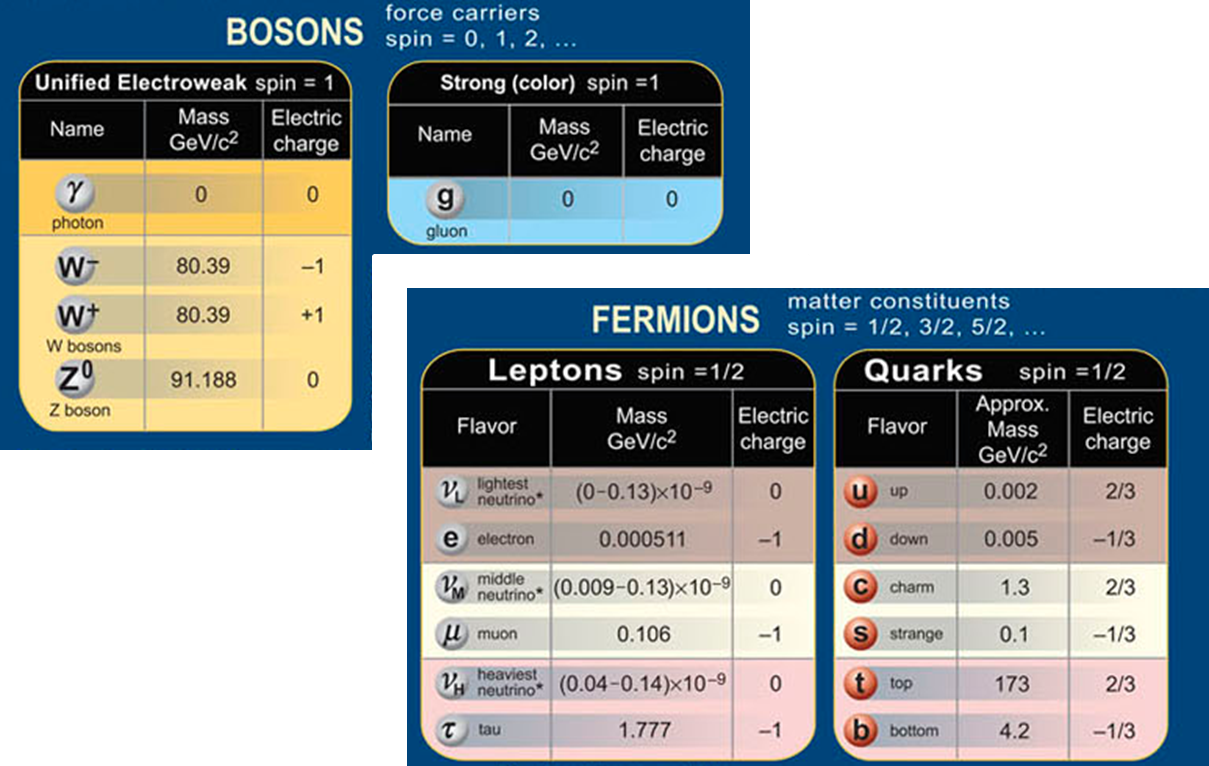
Atom in the standard model 1 - CPEPweb

Atom in the standard model 1 – (image CPEPweb.org)
Atom in the standard model 2 - CPEPweb

Atom in the standard model 2 – (image CPEPweb.org)

The “standard model” does not quite fit observations so new theories of dark energy and dark matter are postulated (actually just invented as fudge factors) and further unknown particles are defined. The number of elementary particle have proliferated and are still increasing. The “standard model” of physics now includes at least 61 elementary particles (48 fermions and 13 bosons). Even the ancient civilisations knew better than to try and build with too many “standard” bricks. Where did simplicity go? Just the quarks can be red, blue or green. They can be up, down, charm, strange, top or bottom quarks. For every type of quark there is an antiquark. Electrons, muons and taus have each their corresponding neutrinos. And they all have their anti-particles. Gluons come in eight colour combinations. There are four electroweak bosons and there ought to be only one higgs boson. But who knows? CERN could find some more. I note that fat and thin or warm and cool types of particles have yet to be defined. Matter and antimatter particles on meeting each other, produce a burst of energy as they are annihilated. If forces are communicated by particles, gravity by gravitons and light by photons then perhaps all energy transmission can give rise to a whole new family of elementary particles.

The 61 particles still do not include the graviton or sparticles or any other unknown, invisible, magic particles that may go to making up dark matter and dark energy. Some of the dark matter may be stealthy dark matter and some may be phantom dark matter. One might think that when dark matter goes phantom, it ought to become visible, but that would be far too simple.  The level of complexity and apparent chaos is increasing. Every new particle discovered requires more money and Bigger Science to find the next postulated elementary particle.

When CERN claimed to have found the God Particle – the higgs boson – they still added the caveat that it was just one kind of the higgs boson and there could be more as yet unknown ones to come. So the ultimate elementary particle was certainly not the end of the road. Good grief! The end of the road can never be found. That might end the funding. And after all, even if the God Particle has been found, who created God? Guess how much all that is going to cost?

Forbes: The Large Hadron Collider took about a decade to construct, for a total cost of about $4.75 billion. There are several different experiments going on at the LHC, including the CMS and ATLAS Detectors which discovered the Higgs boson. CERN contributes about 20% of the cost of those experiments, which is a total of about $5.5 billion a year. The remainder of the funding for those experiments is provided by international collaborations. Computing power is also a significant part of the cost of running CERN – about $286 million annually. Electricity costs alone for the LHC run about $23.5 million per year. The total operating budget of the LHC runs to about $1 billion per year.

The Large Hadron Collider was first turned on in August of 2008, then stopped for repairs in September until November 2009. Taking all of those costs into consideration, the total cost of finding the Higgs boson ran to about $13.25 billion.

I am not a physicist, so maybe all this cost for the sledgehammer approach is worthwhile. I don’t comprehend the “standard model” but I can’t help feeling that many of the current “discoveries” in physics are primarily concerned with getting further funding. So when the CERN public relations machine goes into overdrive and issues breathtaking prose about awesome new finds, I tend to reach for the salt. A “standard model” it may be, but simple it is not and elegance is a long, long way away.

“Simple” and “elegant” are value judgements. I look forward to the time when physics and physicists simplify their house(s) of magic and fantasy and return to those values. And preferably with some elegance and without the sledgehammers of Large Hadron Colliders and supercomputers.

Great fleas have little fleas upon their backs to bite ’em,

And little fleas have lesser fleas, and so ad infinitum

But for the structure of matter, 61+ elementary particles is not just inelegant. It is becoming downright ugly.


Ancient Chinese teeth confirm many and older Out of Africa events

October 15, 2015

Over at 6,000 generations I post about the new paper about the 47 human teeth found in Fuyan Cave, Daoxian, China which are between 80,000 and 120,000 years old.

The 47 human teeth found in Fuyan Cave, Daoxian, China. photo S. XING AND X-J. WU via DiscoveryNews

There were clearly many Out of Africa or Africarabia events starting from 130,000 years ago both before and after the Toba explosion.

80,000-120,000 year old modern humans in S China confirm many and older Out of Africa events

The single Out of Africa event for modern humans is clearly far too simplistic. It is also clear that there were many back to Africa movements as well. Humans expanded sometimes because their old habitats were no longer viable. But, it seems, humans also explored and expanded into new territories from regions of plenty and where they maintained some contact with where they had come from. Probably, just because they could.