Eugenics by surrogacy – Australian style

August 1, 2014

It was an Australian couple in this case but of course there are many who use surrogacy in Thailand and other poor countries to carry out procedures they cannot in their own countries. In nearly all cases of surrogacy the mother is required to abort if a serious medical problem is detected.

In the Sydney Morning Herald:

Gammy, a six-month-old baby abandoned by his Australian parents, could die because his impoverished Thai surrogate mother cannot pay for medical treatment for his congenital heart condition.

The child will never know his twin sister, who was born healthy with him in a Bangkok hospital and has been taken away by their parents, who are living anonymously in Australia.

The story of how 21-year-old Pattharamon Janbua was cheated by a surrogacy agent in Bangkok and left to try to save the life of her critically unwell baby has emerged as Thai authorities move to crack down on IVF clinics, …… 

Ms Pattharamon says three months after a doctor injected the Australian woman’s fertilised egg into her uterus, she discovered she was having twins. The agent promised her an additional $1673 to have the second baby.

The couple asked the Thai mother to abort the Downs syndrome twin which she was not prepared to do.

Four months into the pregnancy, doctors doing routine checks discovered one of the babies had Down syndrome. They told the Australian parents, who said they did not want to take the boy, according to a source familiar with the case.  

“They told me to have an abortion but I didn’t agree because I am afraid of sin,” Ms Pattharamon says, referring to her Buddhist beliefs. 

This couple probably should be barred from being parents but their genes are being carried forward.

How many surrogate conceptions are aborted is not known but they happen –  it is thought – mainly because a medical defect in the fetus has been detected.  However, it is known that many surrogate clinics do select for the sex of the child and babies of the undesired gender are also aborted. Many of the Thai surrogacies for Australians are for same-sex couples. I don’t believe that any child – if given and capable of an informed choice – would prefer to do without a father or a mother.

Currently around 25-30% of all “normal “human conceptions are aborted. But most of these are abortions for convenience rather than for defects in the fetus. If being a reluctant mother has a genetic component then every abortion is also a genetic deselection of reluctant mothers.

Related: On birth rates, abortions and “eugenics by default”

No mass extinction! Dinosaurs shrank to become birds

August 1, 2014

Sixty five million years ago, the theory goes, a 6 mile long asteroid slammed into the earth and caused the extinction of all non-avian dinosaurs as part of a mass extinction event. Some 50% of all species living at the time – the hypothesis proclaims – vanished in this mass extinction event. It’s the stuff of catastrophe theories and movie scripts.

Smithsonian: Sixty-five million years ago the dinosaurs died out along with more than 50% of other life forms on the planet. This mass extinction is so dramatic that for many years it was used to mark the boundary between the Cretaceous Period, when the last dinosaurs lived, and the Tertiary Period, when no dinosaurs remained. This is called the Cretaceous/Tertiary (or K/T) boundary, and the associated extinction is often termed the K/T extinction event. …….  Most theories focused on climate change, perhaps brought on by volcanism, lowering sea level, and shifting continents. But hundreds of other theories were developed, some reasonable but others rather far-fetched (including decimation by visiting aliens, widespread dinosaur “wars”, and “paläoweltschmertz”­the idea that dinosaurs just got tired and went extinct). It was often popularly thought that the evolving mammals simply ate enough of the dinosaurs’ eggs to drive them to extinction.

But a new paper now suggests that dinosaurs actually shrank as they evolved over 50 million years to become the birds we know today. This still means that it was the dinosaurs vacating space on land which gave rise to the growth of mammal species, but it was not a one-time catastrophic event. No mass extinction then!

No fireworks apparently. Just a gradual, fairly mundane process where the large and cumbersome were deselected as they ran out of the ability to feed themselves and died off.  While the small and the nimble both needed less food and were more capable of getting it.

Michael S. Y. Lee, Andrea Cau, Darren Naish, Gareth J. Dyke. Sustained miniaturization and anatomical innovation in the dinosaurian ancestors of birds. Science, 1 August 2014: Vol. 345 no. 6196 pp. 562-566 DOI:10.1126/science.1252243

University of Southampton Press Release: A new study involving scientists from the University of Southampton has revealed how massive, meat-eating, ground-dwelling dinosaurs evolved into agile flying birds: they just kept shrinking and shrinking, for over 50 million years.  

Today, in the journal Science, the researchers present a detailed family tree of dinosaurs and their bird descendants, which maps out this unlikely transformation.  They showed that the branch of theropod dinosaurs, which gave rise to modern birds, were the only dinosaurs that kept getting inexorably smaller.  

“These bird ancestors also evolved new adaptations, such as feathers, wishbones and wings, four times faster than other dinosaurs,” says co-author Darren Naish, Vertebrate Palaeontologist at the University of Southampton.  

“Birds evolved through a unique phase of sustained miniaturisation in dinosaurs,” says lead author Associate Professor Michael Lee, from the University of Adelaide’s School of Earth and Environmental Sciences and the South Australian Museum.  

“Being smaller and lighter in the land of giants, with rapidly evolving anatomical adaptations, provided these bird ancestors with new ecological opportunities, such as the ability to climb trees, glide and fly. Ultimately, this evolutionary flexibility helped birds survive the deadly meteorite impact which killed off all their dinosaurian cousins.”  

Co-author Gareth Dyke, Senior Lecturer in Vertebrate Palaeontology at the University of Southampton, adds: “The dinosaurs most closely related to birds are all small, and many of them – such as the aptly named Microraptor – had some ability to climb and glide.”  

The study examined over 1,500 anatomical traits of dinosaurs to reconstruct their family tree. The researchers used sophisticated mathematical modelling to trace evolving adaptions and changing body size over time and across dinosaur branches.  The study concluded that the branch of dinosaurs leading to birds was more evolutionary innovative than other dinosaur lineages. “Birds out-shrank and out-evolved their dinosaurian ancestors, surviving where their larger, less evolvable relatives could not,” says Associate Professor Lee.


Obscenity takes many forms

July 31, 2014

When war and destruction becomes a spectator sport. All that’s missing is a hot dog stand.

This picture  by Andrew Burton/Getty Images was published in the New York Times

Israelis gathered on a hilltop outside the town of Sderot on Monday to watch the bombardment of Gaza. Andrew Burton/Getty Images via NYT

Israelis gathered on a hilltop outside the town of Sderot on Monday to watch the bombardment of Gaza. Andrew Burton/Getty Images via NYT

Similar scenes, of Israeli spectators gathered on the high ground above Gaza to view the destruction below, were documented in a Times of London article and a video report from Denmark’s TV2 during Operation Cast Lead in 2009.

Adapting to climate change requires the further development and use of fossil fuels

July 31, 2014

The single thing that differentiates the human species from every other known species on earth has been the control and use of fire.The step change then from primitive to modern humans has been due not least to the control and development of the combustion process and the utilisation of fossil fuels. This in turn has multiplied many times the intensity of energy available to be harnessed by man. I would suggest that the human capability of handling change is largely a function of the power intensity available.

power intensity

power intensity

Fossil fuels have been demonised (by association with carbon dioxide emissions) for the last 30 years. In spite of that most  of the growth in the developing world has been – and continues to be – powered by fossil fuels. Fortunately the lack of evidence of any significant linkage between man-made carbon dioxide and global warming  (which is still the politically correct ideology) is beginning to be realised. The unnecessary, misplaced and ineffective increase of electricity prices in countries which have curtailed their use of fossil fuels has prolonged the recession and has cost many millions of jobs.

We have now had almost 20 years with the highest level ever of fossil fuel utilisation but “global temperature” has remained stubbornly static. In the last decade global temperatures have declined slightly. The hypothesised link between man-made carbon dioxide (which constitutes only about 3% of carbon dioxide emissions) and global temperature is well and truly broken. All the various climate computer models – which build on this link being amplified – have failed miserably.

The indicators of a global cooling cycle having started are piling up.

  1. There is more ice in the antarctic than has ever been measured
  2. There is more ice in the arctic than about a decade ago
  3. Total ice cover is higher now than has ever been measured
  4. Ice cover on the Great Lakes reached levels not seen for over 50 years and has persisted into the spring (even summer) later than has been observed for at least 40 years.
  5. The expected super El Nino forecast for this year has been dampened by a cooling Pacific and only a mild El Nino event – if at all – is now to be expected
  6. Sea level rises are no different to the long term average for sea level recovery since the last glacial minimum and may even have slowed.
  7. The deep oceans are cooling and are no repository of “hidden heat”
  8. The net cooling effect of clouds has been underestimated in nearly all models and cloud cover over the world is increasing (slightly).
  9. Man made water vapour is of greater significance than man made carbon dioxide for climate effects. But man made water vapour is almost insignificant compared to the water vapour flux due to evaporation and respiration.
  10. Solar effects are virtually ignored by all climate models but the sun does not much care for models and is reaching a low level of activity comparable to the Dalton or Maunder Minima.

Crying wolf about global warming has been the politically correct thing to do for 3 decades. Before that it was politically correct to be alarmist about the coming ice age. No doubt all the old fears about an ice age can be dusted off and recycled.

Climate change has been the most powerful force which has shaped human evolution and expansion. Sea level changes and patterns of precipitation and desertification have driven both evolution and migrations. Sea level during an ice age is about 120 m lower than it is today. More land is exposed in equatorial and tropical regions during a glacial period while land is rendered uninhabitable by the ice sheets of the north. But even primitive humanity survived during the glacials.

It is the global cooling cycles and not global warming cycles which will place the greatest demands on farming and energy. The greatest sea level change that humanity has had to – and will have to – adapt to  is the 120 m difference between glacial and interglacial conditions. During an ice age precipitation will drop sharply and river water flows will decline. Hydro power will all but dry up. It is the inevitable coming of the next ice age that will pose the real challenge – not the 1 m sea level rise that may come with another warming cycle. And when the ice age comes again it will be fossil fuels which will keep the home fires burning. It is the further exploitation of nuclear energy and fossil fuels in all its forms – coal, oil, natural gas, shale gas, gas from methane hydrates – that will be needed. It is the availability of power at the intensities provided by nuclear power and fossil fuel combustion which is what will provide humans with the wherewithal to cope with climate change, whether warming or cooling, but especially when the next ice age begins.

Whatever the alarmists would have us do in the short term, reality will eventually bite. The use of fossil fuels will – thankfully – continue as will the exploration for new sources of gas. The next generation of nuclear power plant will be developed – even though nuclear alarmism has led to a dearth of nuclear engineers. No doubt some market niches will be filled by wind and solar power but that will not be very significant in the large picture.


Australia covers up corruption in getting plastic currency contracts

July 30, 2014

The supply of, and the technology for producing, plastic currency are a big business for the Reserve Bank of Australia. Plastic currency is now used by 23 countries around the world. But it is also apparent that Australian parties have been involved in bribing high officials in Malaysia, Indonesia and Vietnam (at least) in securing contracts for plastic currency. The Australian courts are apparently cooperating in some form of cover-up.

That has become apparent from the Wikileaks release of a gagging order by the Supreme Court of Victoria at Melbourne where the court forbids

any discloures, by publication or otherwise, of any information relating to the court case by anyone, including the Australian media, ensuring complete secrecy around the largest corruption case in Australia. The order also forbids any disclosures about the order itself, and specifically commands no mention be made of the affirmed affidavit submitted to the court by Gillian Bird, a career diplomat, currently appointed as a deputy Secretary of the Department of Foreign Affairs and Trade (DFAT). Bird is one of Australia’s most senior and experienced diplomats and is responsible for relations with South East Asia which is why her affidavit, currently held sealed by the court, is so important.

Not only a gagging order but also a gag on revealing the gag!

For such a blanket gagging order to have been issued suggests that some “big” names – both at home and abroad but probably mainly abroad – are running a little scared of embarrassment or something worse.

My “rule of thumb” is that in corruption cases of this sort about 3 – 4% of the contract value will find its way into the hands of individuals (officials/politicians) in the buying country and that from this amount about ½- 1% of the contract value will be channeled back to individuals in the selling organisation. The 3% is an important number since it is what is unofficially accepted as being acceptable as legitimate facilitation costs for selling by OECD rules. If bribes can be held to less than about 3% (including the kick-back to the kick-back), the contract can usually escape too much scrutiny.

Plastic currency is one of the few areas where Australian technology leads the world. As such it provides a very valuable source of revenue (and prestige) for the RBA.

Currently seven Australians have been charged in an ongoing $17 million corruption case:

SMH: A seventh Australian man has been charged over an alleged $17 million banknotes bribery scandal engulfing companies related to Australia’s central bank.

Clifford John Gerathy, 60, of Maroubra, in south-eastern Sydney, faced Melbourne Magistrates Court in Melbourne on Wednesday.

A former Securency sales manager, Gerathy faces two charges of conspiring to bribe a foreign official and falsifying documents in connection to the scandal involving currency contracts.

Before Gerathy appeared in court, the Australian Federal Police said it would be alleged he facilitated payments of $17.2 million in commissions to an agent in Vietnam and falsified accounts in relation to a contract in Malaysia.  …… 

Gerathy will next appear in court on September 23 with his co-accused, all six of whom are from Victoria. The others charged with bribes allegedly paid to secure banknote contracts are Myles Curtis, 55, John Leckenby, 66, Mitchell John Anderson, 50, Peter Sinclair Hutchinson, 61, Barry Thomas Brady, 62, and Rognvald Leslie Marchant, 64.

They all seem to have been represented for the gagging order hearing in front of the Hounarable Justice Hollingworth.

Australia gagging order attendants

Australia gagging order attendants

Australia was the first country to use plastic currency using technology developed jointly by the Reserve Bank of Australia and the Commonwealth Scientific and Industrial Research Organisation (CSIRO). In 1996, RBA and Belgian multinational Union Chimique Belge (UCB) formed a joint venture, Securency Pty Ltd, to service demand for the polymer technology.

CSIRO: ……. polymer and synthetic chemistry was used to develop a non-fibrous and non-porous plastic film, which the banknotes are printed on. This substrate gives high tear initiation resistance, good fold characteristics and a longer lifetime than paper.

The substrate and the specially-developed protective overcoat prevent the absorption of moisture, sweat and grime so that the polymer banknotes stay cleaner.

CSIRO has also developed a variety of overt and covert security features for use on polymer banknotes. These security features are produced from a combination of spectroscopic techniques, synthetic chemistry, nanotechnology, surface science microstructure manipulation and polymer chemistry. …

….. Currently there are over thirty different denominations totalling some 3 billion polymer notes in service in 22 countries worldwide. 

In addition, a press-ready polymer substrate (Guardian™) is available for countries with their own note printing facilities.

Guardian™ is produced by Securency Pty Ltd, a joint venture between the Reserve Bank of Australia and Innovia Films PLC, a European-based manufacturer of polypropylene films.

Innovia Security: 

The first Guardian® banknote was issued as a commemorative $10 note in 1988, the year of Australia’s bicentenary, containing both the first transparent window and first hologram of any type, making it the most secure banknote of its time. After being successfully received by the public, the RBA introduced a $5 note for general circulation in 1992 followed by successive notes in the years following. Throughout the 1990s, Guardian® banknote substrate steadily grew in popularity throughout the world, with the innovative polymer-based technology gaining the trust and confidence of more than 30 Central Banks to either adopt Guardian® for use in mainstream denominations or as a commemorative note as a test and forerunner to future use.

In 1996, the Reserve Bank of Australia (RBA) and Innovia Films entered into a joint venture to create Securency International, an arrangement that was concluded in February 2013 when Innovia acquired the RBA’s 50% share in the business. The RBA proved an outstanding partner in helping Securency establish itself in the global banknote industry during a period in which some of the world’s most successful companies including 3M and Mobil also attempted to enter the banknote substrate market but were unable to do so.


“Euthanasia is both profitable and cost effective”

July 28, 2014

I think an individual should be able to choose, and be assisted, to die peacefully and painlessly – provided he is of sound mind and is suffering from a terminal and painful illness.

But I am afraid that part of the building momentum for euthanasia in Europe is cost driven and not driven by a concern for the individual. Countries with aging populations and with well developed public health programs are facing increasing costs for the care of the elderly. In Sweden and the UK for example this care is often “out-sourced” or privatised. Many of these establishments are owned by risk capital companies – which is a little strange – but not fundamentally wrong. But the “quality” requirements they are required to meet are set by the public institutions doing the out-sourcing. Inevitably these “quality” requirements are specified in such a way that the out-sourcing succeeds and contracts are let. To ensure this the requirements always allow the service provider sufficient room to make a profit. There is a clear incentive for the service provider to “increase the throughput” and reduce the cost per person they are tasked to care for. That – in turn – is leading to a deterioration in the care provided especially to the aged who are no longer competent or able to complain about the service received. It is clearly cheaper to allow a general reduction of service, and to only do more than the minimum if and when a complaint from a relative is received. Of course, relatives have only limited opportunities to notice any deterioration of service. The “out-sourcing” itself is driven by cost. There have been many “scandals” (such as this one) associated with the “quality” of service in “privatised” homes for the aged. But it is not by accident that the State and the municipalities and health authorities have pushed these scandals into the “privatised” sphere rather than to be found wanting themselves. Part of the reason for out-sourcing these services has clearly been to also out-source the scandals waiting to come as care of the elderly inexorably deteriorates. The more the care of the aged deteriorates the more attractive a voluntary euthanasia scheme becomes – for all parties involved.

I have a clear perception that in Sweden the quality of public medical and palliative care for the elderly is already driven by cost considerations. It is illegal in Sweden but age discrimination is endemic. We hear about procedures and expensive treatments being denied to the elderly for many ostensible reasons, but in reality because the patients are – in the judgement of the care-providers – just too old and too big a drain on costs. For public medical and palliative care, a form of unwritten age-discrimination is already in place. The aged patient has little recourse except to opt for private treatment and then euthanasia may be a much more cost effective solution..

The euthanasia debate is picking up steam in Europe but my fear is that though much of it is carried out under the guise of concern for an individual’s right to die, much of the debate is actually being driven by public health cost considerations. Many of the statements by politicians seem to me to be trial balloons or electoral posturing – but they have an underlying smell of preparing for curbing the costs of caring for the increasing number of the elderly.

It may be very cynical but I note that a healthy growth rate in voluntary euthanasia among the aged has many public and social and economic benefits. The cost of health care for the aged is both capped and reduced. The demographic of the ratio of elderly to working population is improved. Medical resources are freed for the more valuable, younger patients. And the aged patient gets what he or she wants.

A true win-win!

BioEdge: 

Euthanasia might be needed for poor people who cannot access palliative care, the new Lithuanian Health Minister has suggested. Rimantė Šalaševičiūtė was sworn earlier this month, but already she has made waves by backing an open discussion of the legalisation of euthanasia.

Without making any specific proposals, she told local media that Lithuania was not a welfare state with palliative care available for all and that euthanasia might be an option for people who did not want to torment relatives with the spectacle of their suffering.  

The minister has also raised the idea of euthanasia for children. She noted that this option had been approved for Belgian children after a long public debate. It was an option which might be appropriate in Lithuania as well after public debate.

Ms Šalaševičiūtė will face an uphill battle in her campaign to introduce Lithuanians to euthanasia. Many doctors and the Catholic Church oppose it. Dr Andrius Narbekovas, who is both a priest and a doctor, and a member of the Health Ministry’s bioethics commission, told the media:

“The Ministry of Health should protect health and life, instead of looking for ways to take life away. It goes without saying that it is … profitable and cost effective … But a democratic society should very clearly understand that we have to take care of the sick, not kill them.”

Lithuania merely reflects the debate all over Europe which is probably most advanced in Belgium where even involuntary euthanasia (is that not murder?) has been proposed.

Politicians and many aged sufferers could find this irresistible: “Euthanasia is both profitable and cost effective”.

Two of my friends have utilised the services of Dignitas. So, for whatever reasons it may come, I do hope that voluntary euthanasia is available to me when my time comes.

Too much biodiversity – time to let some species die out

July 28, 2014

Conservationists would have us believe that the earth is losing species at an alarming rate and that evil humanity is to blame and therefore more and more species must be protected by “freezing” them into an unnatural existence. Alarmist “conservationism” has led to the ridiculous situation where successful species are termed pests and are eradicated. Hopelessly unfit species – if they are cuddly or otherwise attractive to watch – are protected by being sentenced to a “frozen” existence in zoos or in “protected” and totally unnatural and anachronistic habitats.

I was just watching a program about the highly successful urban coyotes of N. America. They have found a new prey in domestic pets and are thriving. But having adapted successfully to the changing environment they have – needless to say – earned  the status of being declared a pest to be wiped out!!

And yet there have never been more species alive than there are today.

A new review paper warns with great alarm about another impending mass extinction due to the loss of fauna that man has caused. The press release for this paper (why do scientific papers need press releases?) begins thus:

Stanford biologist warns of early stages of Earth’s 6th mass extinction event

The planet’s current biodiversity, the product of 3.5 billion years of evolutionary trial and error, is the highest in the history of life. But it may be reaching a tipping point.

In a new review of scientific literature and analysis of data published in Science, an international team of scientists cautions that the loss and decline of animals is contributing to what appears to be the early days of the planet’s sixth mass biological extinction event.

If biodiversity “is the highest in the history of life” and many species are incapable of adapting to the world they live in, perhaps it is time for them to exit gracefully.

Perhaps the progress of humankind requires that some of these obsolete species must be allowed to disappear.

The dangers of reducing biodiversity are being hyped to a ridiculous extent. Without the mass extinctions of the past, most of the species living today would never have evolved. If the dinosaurs had not gone extinct we would not be around. And the disappearance of the dodo has not increased any threat to humanity.

Related:

Fighting against species extinction is to deny evolution

Genetic adaptation – not stagnating conservation – is the way to help threatened species

Between debilitation and satiation: The behavioural space

July 28, 2014

This is the second part of series of posts describing what I call the Engagement Theory of Motivation and which I have found useful during my working career.

The first part was posted on 23rd July 2014: Manipulation, motivation and behaviour

=========================

2: Between debilitation and satiation: The behavioural space

The space within which rational behavior can be expected and elicited is constrained by the debilitations of intolerable deficiencies on the one hand and needs which are satiated and incapable of providing further satisfaction on the other.

Eliciting desired behaviour lies at the core of all human social interaction. I take “manipulation” and therefore motivation merely to be tools for eliciting behaviour from our fellows. As tools they are neutral and neither good nor bad.

Since Maslov (1954) first came up with his hierarchy of needs there have been many theories and hypotheses of motivation proposed. I find his hierarchy is fundamentally sound. His approach is still the simplest, most practically applicable approach. It remains I think the most useful – if qualitative – way of addressing motivation and behaviour in the work place.

Hierarchy a la Maslow

Hierarchy a la Maslow

Fig 1. Maslov’s hierarchy of needs

I take Maslow’s lower-order needs (physiological and safety needs) to be mainly – but not exclusively – physical and his higher-order needs (social, esteem and self-actualisation desires) to be mainly – but not exclusively – cognitive.

The space for eliciting rational human behaviour lies in the planes of his satisfactions and dissatisfactions. I postulate that all conscious, rational human behaviour is aimed at decreasing  internally perceived deficiencies giving dissatisfactions or increasing internally perceived desires (needs) giving satisfactions. I take these planes to be that on which the “state of human condition”, at any given time, can be plotted as a representation of the individual’s satisfactions and dissatisfactions at a particular time. The axis of time is not explicit but it is implied since only one “state of human condition” exists at any given time. For an individual to go from state 1 to state 2 on the behavioural therefore implies – and requires – the passage of time.

Read the rest of this entry »

The changing colours of the world’s population

July 26, 2014

I like playing with numbers and – more often than not – the numbers do tell the tale.

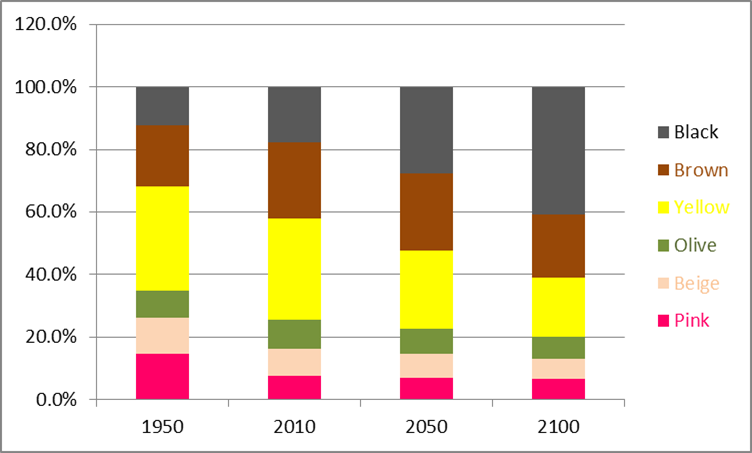
The human species comes in a variety of colours and this skin colour is a genetic trait. (They are different races whether we wish to admit to it or not but they are all part of the same species). I choose to classify the world’s population as six colours.

  • Pink (euphemistically called white – but I note that “pink supremacy” does not have quite the ring of “white supremacy”)
  • Beige
  • Olive
  • Yellow
  • Brown, and
  • Black

I use the data from the medium scenario of the  UN’s 2012 World Population Prospects and assign all countries a colour in 1950. In reality of course there is a mix of colours in most countries with the US possibly presenting the most significant “melting pot”. In any country, the changes to the colour mix comes primarily from immigration and only to a very minor extent from the genetic mixing of the colours. I arbitrarily assign colours and percentages to countries and regions as follows (1950 as the reference point):

  1. Pink – Northern Europe, Western Europe, Australia/New Zealand, N America 80%
  2. Beige – Central and Western Asia and Eastern Europe
  3. Olive – Southern Europe, Central America 80%, South America 70%
  4. Yellow – East Asia, SE Asia and Polynesia (excluding Australia/New Zealand), South America 10%
  5. Brown – Southern Asia
  6. Black – Africa, N America 20%, Caribbean, Central America 20%, South America 20%

Of course this is just playing with the numbers. Of course there are mixtures of races in all countries. I could as well have included SE Asia in the brown as the yellow. My purpose is to picture the primary colours of the world population as they change and not to distinguish every hue.

But demographic numbers are cold and inexorable and inevitable.

Fertility rates do not change that quickly and intentional changes are not that easy to achieve. The effects of the Chinese one-child policy will really kick-in only in the next 50 years as Chinese population declines. Between 2050 and 2100, China will face the aging challenge faced by Japan already today and which will be increasingly faced by Europe  in the next 30-50 years. Indian population will peak around 2050 and will then decline as the reductions of fertility now taking place work their way through. Africa will only just be reaching peak population by 2100.

By 2100 world population will have stabilised at around 10.5 billion and may be slightly on the decline.

The changes to the colours of the world’s population are already fixed for the next 100 years.

Changing colours of the world population table

Changing colours of the world population table

Changing colours of the world population

Changing colours of the world population

This is just a picture of what humanity will look like in 2100.

The last 50 years has seen a sharp decline in the pink races and an increase in the brown and yellow races. The next 50 years will see the yellow races beginning to decline and the brown and  black races increasing sharply. For the 50 years to 2100, the browns will stabilise and only the black races will still be increasing. By 2100 a relatively stable mix of races may be in place.

If fertility rates develop as expected then the mix of races in 2100 is likely to persist for some considerable time thereafter. This picture is silent as far as immigration is concerned and is also silent as to the extent to which races are mixing. It is my perception that the US and Australia are much more open to the mixing of races whereas Western Europe, Japan and China are not. Eastern Europe is still stuck in a 1950’s world-view of humanity and its races. The challenges of aging faced by Japan now and later to be met by Europe and China will likely use immigration as one of the main solutions. But it will probably take at least 3 or 4 generations before the genetic mixing of races is accepted in these countries.

Paradoxically it is the “politically correct” version of multiculturalism prevalent in much of Western Europe which actually preserves races in their silos and prevents mixing. They have missed the fact that just trying to preserve cultures of the past does not help in creating the culture of the future. But they cannot live in the past forever.

There will be greater movement of peoples around the world. People will move from countries with low GDP. They will move to countries with high GDP’s but where the aging problem is acute and where the proportion of productive population must be increased to cope. Movement of people in large numbers will cause many problems for the immigrants themselves and for the areas of aging population they move to. But for the next 100 years this shift of peoples northwards will – and has to – increase.

John Derbyshire: Consider the numbers. The three countries contributing the most to the Children’s Crusade coming in across our southern border—Guatemala, El Salvador, and Honduras—are home to 29 million people. If the entire populations of those three countries decamped to the USA our population would increase only nine percent.

Many more than three countries are contributing to the human flood into Europe across the Mediterranean and through Turkey. The five most commonly mentioned in news reports and the Eurostat databases are Syria, Eritrea, Somalia, Afghanistan, and Sudan–homelands for a total of 106 million people. If they all moved into the 28-nation European Union, the EU population, currently 506 million, would increase by 21 percent. …..

…… Thus, while both the USA and the EU live figuratively in the shadow of dams with vast numbers of wretched people in dysfunctional nations backed up behind them, the EU’s dam is far wider and higher than ours, the shadow correspondingly deeper.

The wealth gap is greater over there, too. GDPs per capita for Guatemala, El Salvador, and Honduras are 10, 14, and 9 percent of the US figure. Compare Syria, Eritrea, Somalia, Afghanistan, and Sudan at 15, 3, 2, 3, and 8 percent of the EU average—and that Syria figure is from 2011, before the civil war.

Africa as a whole, even with oil-rich Nigeria and Angola and still-functioning South Africa, is far poorer than Latin America.


Related: Will Americans and Europeans ever become identifiable races.


Narendra Modi needs to dump the Shiv Sena and crack the whip within the BJP

July 24, 2014

The biggest credibility challenge that Narendra Modi faces is to convince Indians – and the outside world – that he represents something much larger, secular and inclusive than the narrow, religiously-bigoted  and exclusive position espoused by the RSS and some even more extreme Hindu nationalist groups. But he has to do this equitably but without giving the perception of appeasing the Muslim fanatics.

And he has to clean his own house first. His ally in Maharashtra, the Shiv Sena, is now an embarrassment and a liability. Within his own party also there is no dearth of intellectually retarded loud-mouths. They are all now a burden and unless he cuts them down to size they have the potential to negate all his efforts to be  inclusive.

The Shiv Sena is a special case and I think Modi can afford to dump them. They have just made utter fools of themselves:

IBN: A video has now surfaced showing Shiv Sena Thane MP Rajan Vichare forcing a Maharashtra Sadan Muslim staffer to eat during his Ramzan fast. CNN-IBN has accessed footage which shows Vichare force feeding the staffer.

The video gives credence to the allegations that Shiv Sena MPs abused the employee and forced him to eat, even as the Shiv Sena continues to deny the claims. Shiv Sena MP Anant Geete in the Lok Sabha on Wednesday said that the claims being made by the Opposition are false.

DNA: Taking law and order into his own hands is not something new for Rajan Vichare, the Shiv Sena MP from Thane who force-fed a Muslim catering supervisor to break his Ramzan fast at Maharashtra Sadan last week. In the last 25 years, around 24 cases have been registered against the senior Sena leader in various police stations of Thane. 

Defending his recent act, Vichare said, “I was protesting against the quality of food at Maharashtra Sadan.” Later, Vichare was forced to apologise and issued a statement saying, “I regret if anyone’s religious sentiments were hurt. I did not know that the employee was a Muslim. I respect all religions and have even attended roza as well as iftar parties.

The Shiv Sena party leader, Uddhav Thackeray, has been engaged in some verbal contortions while apologising – but not seeming to apologise – and has been reduced to mumbling that it was all about the food quality and nothing to do with religion. But Shiv Sena is not the force it was when his father Bal Thackeray was in charge. Neither intellectually nor politically. When no party member dared to deviate from the party line as determined by Bal Thackeray. (I recall when I regularly used to meet the Minister of Power – who was then a Shiv Sena nominee in the coalition government of the time. First it was Suresh Prabhu and later it was Anant Geete. After every substantive meeting, I usually had to go to Bombay to meet Bal Thackeray and reconfirm whatever had been discussed with the Minister). Uddhav Thackeray does not have that sort of iron control over his party members and they are now apparently rushing around – the analogy is headless chickens – all doing their own thing. The Shiv Sena remains a force – if only in Maharashtra – but they are in a declining spiral and my reading is that it would be least damaging for Modi to dump them now – early on in his term – and cap his losses.

With his own party members Modi will just have to lay down the law and get rid of the intellectually challenged. And there are quite a few of them.

The BJP leader in Telegana, a certain K Laxman, of no great intellectual stature (and not to be confused with VVS Laxman), has been stupid enough to attack a leading Indian sports star – because she happens to be Muslim and is married to a Pakistani. He was idiot enough to attack Sania Mirza the tennis player. If there is one thing that unites Indians and transcends politics and religion and caste, it is sport. And cricket and tennis lead all the rest.

FirstPost: In a statement that could almost have been designed to reclaim the ‘pointlessly offensive’ tag from Shiv Sena MP Rajan Vichare, Telangana BJP leader K Laxman on Wednesday slammed the TRS government’s decision to appoint tennis star Sania Mirza as brand ambassador of Telangana, terming her a “daughter-in-law of Pakistan”.

“Sania was born in Maharashtra and settled in Hyderabad only later and, hence, is a non-local”, he told reporters, pointing out that she is married Pakistani cricketer Shoaib Malik. “If 1956 is the criteria for deciding the nativity of Telangana, where was Sania born and when did she come to Hyderabad? And whom she married should also be a criterion for selecting her.”

So much for aman ki asha.

The comment has predictably created an uproar with members of the TRS, the Congress and other opposition figures falling over each other to criticise it, and for good reason. The statement reflects a toxic combination of anti-Muslim bigotry and sexism that is the preserve of rightwing ideologues.