Corruption is in the genes of the EU

October 20, 2013

In the developing world venality is often a matter of survival. In Europe venal behaviour is a matter of choice. The EU bureaucracy in Brussels has corruption in its genes and tax-payer’s money running through its veins. It is remarkable that so many ostensibly democratic countries (at least in name) have so easily surrendered their powers to a bloated and corrupt group in Brussels.

It is not Best in Class that applies. The Least Common Factor applies in Europe. Brussels is as corrupt and as wasteful and as inefficient as the worst country in Europe. In this case the corruption and the condoning of corruption in Brussels is as bad as in Greece. And corruption in Greece was not a small contributor to their financial problems.

Der Spiegel writes:

Anti-corruption officials in Brussels have failed to investigate reports of squandered EU funds at a training institute in Greece, a German paper reported Friday. Well-connected teachers were allegedly paid up to €610 per hour for up to 225 work hours per month.

The European Anti-Fraud Office (OLAF) has reportedly ignored repeated tip-offs about squandered European Union funds in Greece, according to an article in the Friday edition of the Süddeutsche Zeitung. The German daily reports that a Greek civil servant uncovered multiple cases of nepotism and vastly inflated salaries while inspecting the finances of a vocational training institute. Officials in Brussels have apparently not acted on any of the whistleblower’s suspicions, which he communicated in several letters, the paper added.

According to the newspaper report, Giorgos Boutos, a government finance official in Athens, began auditing the books of the Organization for Vocation Education and Training (OEEK) in 2006. The institute receives and distributes EU funds earmarked for vocational training in Greece. Boutros repeatedly stumbled upon irregularities and documented the cases in numerous letters to OLAF.

…. The case involves at least €6 million ($8.2 million). It’s not an excessive sum of money, but it is well documented. Boutos was able to substantiate the irregularities in his letters to the EU with contracts, hotel bills and bank statements. He reportedly found that 75 percent of the misappropriated money had come from the EU.

The details provided by the Süddeutsche Zeitung are sure to raise eyebrows. Some of the instructors are said to have been paid for up to 225 hours per month, even during periods when they were abroad. Hourly wages for teachers were reportedly as high as €610. The alleged corruption was compounded by apparent instances of nepotism: The son of a cabinet member taught a course on silver-plating watches, the wife of a Socialist politician led classes on both dentistry and geography, and relatives of the institute’s leader held jobs there.

….. It wasn’t until seven months — and several more inquiries — later that Boutos received fresh news about the case. Still, that letter merely stated that OLAF was in the process of “a comprehensive reorganization,” and asked him to be patient. 

Meanwhile, Boutos told the newspaper, many similar cases of misspent EU funds now fall under the statute of limitations because the EU took too long to address them. Exactly €516,000 of misappropriated EU funds have been repaid. But Boutros stressed that the EU could demand that all such funds be paid back — that is, if it really wanted to.

Boutos also questioned whether investigations had been delayed because some suspected fraud cases involved relatives of government and party officials — or whether Brussels even cared at all about such instances.
Global Warming gone missing: Arctic ice back to “normal” and Antarctic ice at highest ever recorded levels

October 20, 2013

IF THE GLOBE IS WARMING, WHERE’S THE HEAT?

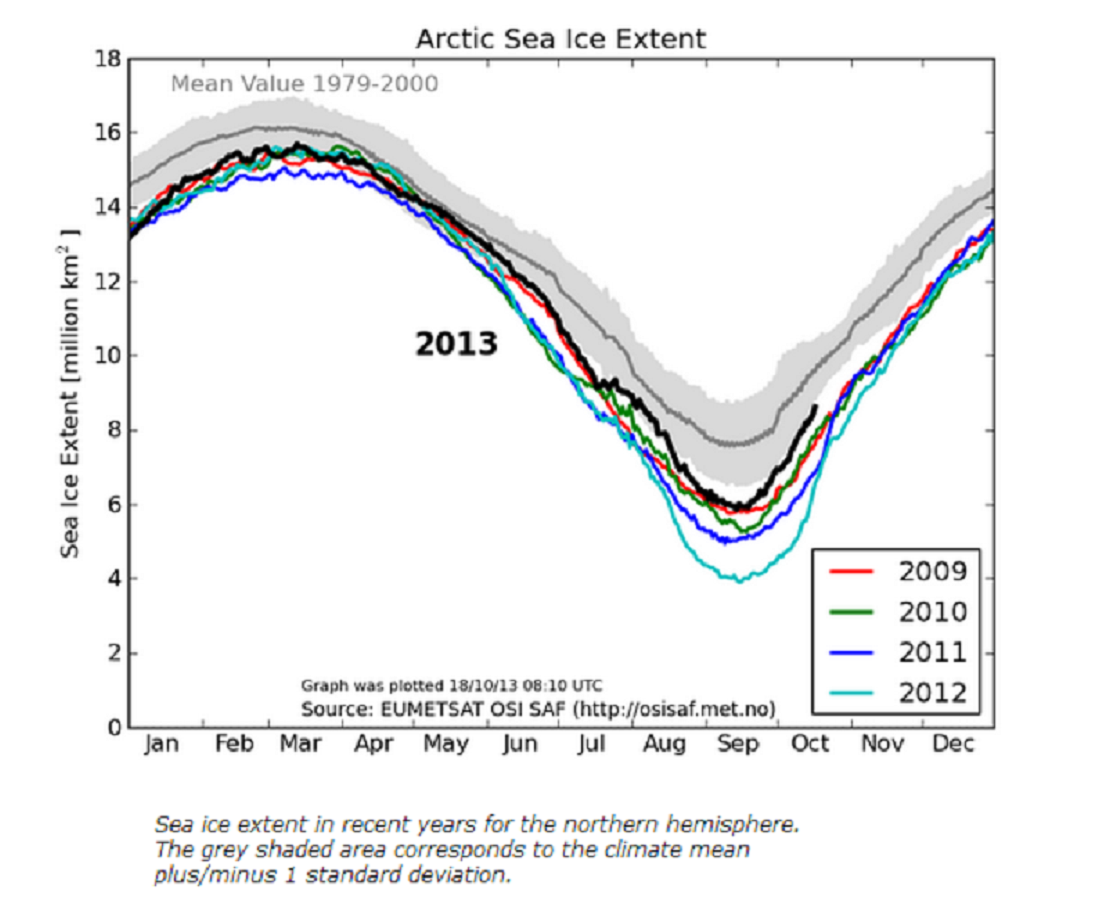
Arctic Ice levels are increasing fast and are within 1 standard deviation of the 1979-2000 mean.

Arctic Ice Extent 20131018 DMI Centre for Ocean and Ice

Arctic Ice Extent 20131018 DMI Centre for Ocean and Ice

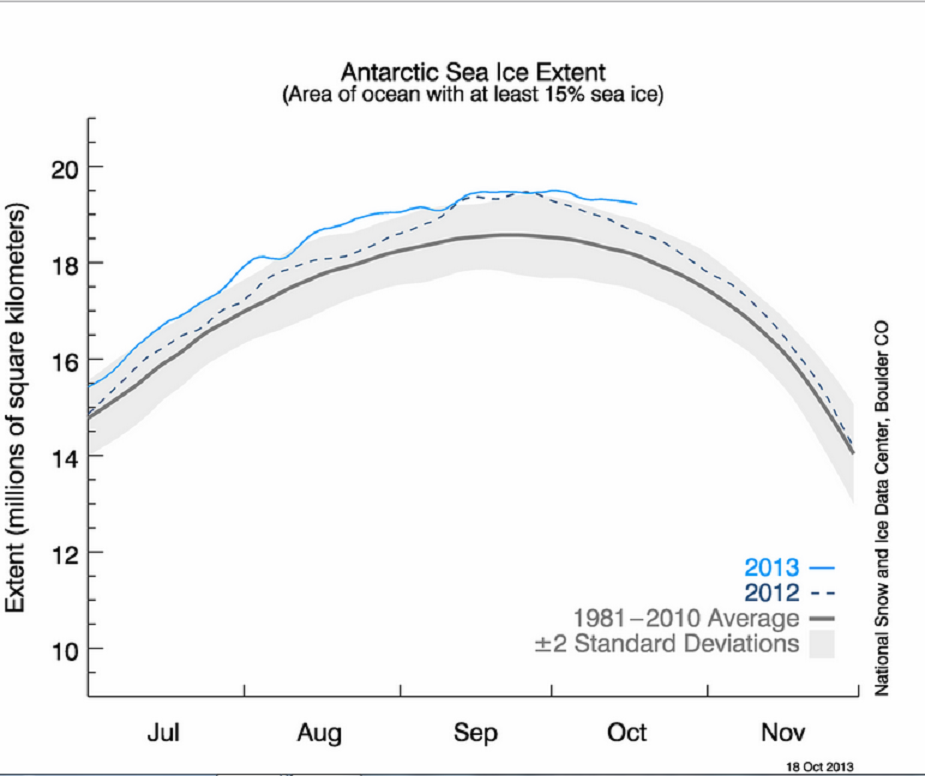
In the Anatrctic ice extent should normally have started reducing by 22nd Sepptember but kept increasing till about 1st October. At maximum it reached levels never recorded before. It is currently at a level more than 2 standard deviations higher than the long term 1981 – 2010 average.

Antarctic Ice Extent 20131018 NSIDC Boulder

Antarctic Ice Extent 20131018 NSIDC Boulder

This leads to obvious but simple conclusions:

  1. Over the last 34 years therefore, Arctic ice extent has shown great variability but is currently at values within one standard deviation of the 30 year average.
  2. Global warming – if it is taking place – has not left any significant signature in the extent of Arctic Ice which is larger than “natural variability”.
  3. Over the last 32 years Antarctic ice extent has consistently shown a small but steady increase.
  4. Global warming – if it is taking place – is completely absent in the record of the ice extent.

It could be argued – but it would stretch credulity – that heat is being stored in the deep ocean (having bypassed the surface waters by a hitherto unknown form of “deep sea radiation”)  and that this will all be released in a coming catastrophic event (to be known as the Ehrlich Rapture) in 2047.

Or, it could be argued – again with little credibility – that man-made particulate emissions from China in the Northern Hemisphere and from Indonesian forest fires in the Southern Hemisphere have reflected away the Sun’s radiation and prevented the warming that should have taken place. This argument then fails since it would appear to describe a very successful  application – if inadvertent – of geo-engineering.

Or we could choose the parsimonious explanation. There has been no global warming for the last 2 decades or so.

Any discussion about whether or how much warming is caused by carbon dioxide emissions becomes moot if there is no warming.

WHERE’S THE HEAT?

Snow sweeps in very early this year

October 19, 2013

Snow has already come to Bavaria. Parts of Russia and the US have also seen some very early snow. Now, in just the 3rd week of October, snow has swept over northern Sweden. I have not had to clear any snow yet but I have had ice to scrape of the windshield for the last few mornings. I had only planned to change to winter tyres at the end of the month but I might have to bring this forward (to prepone it).

It is only weather of course! I wish somebody could tell me of any effects of global warming that could actually be experienced.

Autumn over as winter snow sweeps Sweden

Snow and sub-zero temperatures hit widespread parts of Sweden on Thursday night and will carry on through Friday and beyond, with meteorologists warning motorists that now is the time to change to winter tyres.

The coldest temperature of the season was recorded on Thursday night in Karesuando, in far northern Sweden near the Finnish border, where the mercury dropped to -12.5ˆC. Snow fell in Västernorrland, Dalarna and Gävleborg, and in many areas further north, but experts said the snow is nothing to worry about. 
“I believe that in most places it’s only been a few centimetres of snow that have settled,” Sandra Andersson of Sweden’s weather agency SMHI told the TT news agency. SMHI issued a class 1 warning, stating that motorists should beware of slippery roads, although no damage was reported throughout the night.

The Amazon contains 390 billion trees of 16,000 species (approximately)

October 19, 2013

Something to remember for your next game of Trivial Pursuit.

The Amazon contains 390 billion trees and 16,000 species and half the trees are accounted for by just 227 species.

Nobody actually counted them.

The ~6-million-km2 Amazonian lowlands were divided into 1° cells, and mean tree density was estimated for each cell by using a loess regression model that included no environmental data but had its basis exclusively in the geographic location of tree plots. A similar model, allied with a bootstrapping exercise to quantify sampling error, was used to generate estimated Amazon-wide abundances of the 4962 valid species in the data set. We estimated the total number of tree species in the Amazon by fitting the mean rank-abundance data to Fisher’s log-series distribution.

The data is generated by a mathematical model.  It is not clear how the 16,000 species is estimated from just 4,962 valid species. “This is very valuable information for further research and policymaking” says Hans ter Steege. It must be – after all a paper has been published in Science! According to the mathematical model roughly 6,000 tree species in the Amazon have populations of fewer than 1,000 individuals, which automatically qualifies them for inclusion in the International Union for Conservation of Nature (IUCN) Red List of Threatened Species. But these species are so rare that scientists may never find them.

( I can’t help thinking that there must be very many species of tree coming to the end of their “natural” existence which we know nothing about. And does it matter?).

H. ter Steege et al, Hyperdominance in the Amazonian Tree Flora. Science, 2013; 342 (6156): 1243092 DOI: 10.1126/science.1243092

Graphic

A map of Amazonia showing the location of the 1430 Amazon Tree Diversity Network (ATDN) plots that contributed data to this paper.

Field Museum Press Release: 

Researchers, taxonomists, and students from The Field Museum and 88 other institutions around the world have provided new answers to two simple but long-standing questions about Amazonian diversity: How many trees are there in the Amazon, and how many tree species occur there? The study will be published October 17, 2013 in Science.

The vast extent and difficult terrain of the Amazon Basin (including parts of Brazil, Peru, Columbia) and the Guiana Shield (Guyana, Suriname, and French Guiana), which span an area roughly the size of the 48 contiguous North American states, has historically restricted the study of their extraordinarily diverse tree communities to local and regional scales. The lack of basic information about the Amazonian flora on a basin-wide scale has hindered Amazonian science and conservation efforts.

“In essence, this means that the largest pool of tropical carbon on Earth has been a black box for ecologists, and conservationists don’t know which Amazonian tree species face the most severe threats of extinction,” says Nigel Pitman, Robert O. Bass Visiting Scientist at The Field Museum in Chicago, and co-author on the study.

Now, however, over 100 experts have contributed data from 1,170 forestry surveys in all major forest types in the Amazon to generate the first basin-wide estimates of the abundance, frequency and spatial distribution of thousands of Amazonian trees.

Extrapolations from data compiled over a period of 10 years suggest that greater Amazonia, which includes the Amazon Basin and the Guiana Shield, harbors around 390 billion individual trees, including Brazil nut, chocolate, and açai berry trees.

“We think there are roughly 16,000 tree species in Amazonia, but the data also suggest that half of all the trees in the region belong to just 227 of those species! Thus, the most common species of trees in the Amazon now not only have a number, they also have a name. This is very valuable information for further research and policymaking,” says Hans ter Steege, first author on the study and researcher at the Naturalis Biodiversity Center in South Holland, Netherlands.

The authors termed these species “hyperdominants.” While the study suggests that hyperdominants – just 1.4 percent of all Amazonian tree species – account for roughly half of all carbon and ecosystem services in the Amazon, it also notes that almost none of the 227 hyperdominant species are consistently common across the Amazon. Instead, most dominate a region or forest type, such as swamps or upland forests.

The study also offers insights into the rarest tree species in the Amazon. According to the mathematical model used in the study, roughly 6,000 tree species in the Amazon have populations of fewer than 1,000 individuals, which automatically qualifies them for inclusion in the International Union for Conservation of Nature (IUCN) Red List of Threatened Species. The problem, say the authors, is that these species are so rare that scientists may never find them.

Ecologist Miles Silman of Wake Forest University, another co-author of the paper, calls the phenomenon “dark biodiversity”.

“Just like physicists’ models tell them that dark matter accounts for much of the universe, our models tell us that species too rare to find account for much of the planet’s biodiversity. That’s a real problem for conservation, because the species at the greatest risk of extinction may disappear before we ever find them,” says Silman.

While the authors are confident that these hyperdominants also dominate the vast expanses of Amazonia where scientists have never set foot, they do not know why some species are hyperdominant and others are rare.

The authors note that a large number of hyperdominants – including Brazil nut, chocolate, rubber, and açai berry – have been used and cultivated for millennia by human populations in Amazonia.

“There’s a really interesting debate shaping up,” says Pitman, “between people who think that hyperdominant trees are common because pre-1492 indigenous groups farmed them, and people who think those trees were dominant long before humans ever arrived in the Americas.”

Bora’s gardening leave ends in resignation from Scientific American

October 19, 2013

Following the noise and the revelation that his sexual harassment was not just an isolated incident, Bora Zivkovic’s position was no longer tenable. The resignation from Scientific American was almost inevitable but editor-in-chief Mariette DiChristina cannot escape some reprimand. Both she and the magazine need to make some kind of public statement and acknowledgement that their support for their own DN Lee was wanting. The Press release about Bora’s resignation contains nothing about her initial censorship “Following recent events, Bora Zivkovic has offered his resignation from Scientific American, and Scientific American has decided to accept that resignation”.

IndyWeek:

Scientific American has an anti-harassment policy. We offer live and online anti-harassment training to those who manage employees. We’ve recently begun providing such training to individuals who work with freelancers and contractors as well. We take allegations, such as those that have appeared online this week, very seriously. When Monica Byrne contacted Scientific American a year ago, we investigated her report, offered the Company’s apologies and Ms. Byrne acknowledged in her blog that she was satisfied with our response. We were unaware of any additional allegations until this week.

Zivkovic, who lives near Pittsboro, has admitted to engaging in inappropriate and unwanted sexual advances toward Byrne. However, he claimed it was an isolated incident. In the last week, at least a half-dozen women have come forward with similar accounts of interactions with him.

The mathematics of a pizza bite (by Sheffield University for Pizza Express)

October 19, 2013

English: Picture of an authentic Neapolitan Pi...

It is now crystal clear.  Eugenia Cheng is both a mathematician and a pizza lover.

A median bite from an 11” pizza has 10% more topping than a median bite from the 14” pizza.

On the perfect size for a pizza

cheng-pizza pdf
Eugenia Cheng
School of Mathematics and Statistics, University of Sheffield
E-mail: e.cheng@sheffield.ac.uk
October 14th, 2013
Abstract
We investigate the mathematical relationship between the size of a pizza and its ratio of topping to base in a median bite. We show that for a given recipe, it is not only the overall thickness of the pizza that is affected by its size, but also this topping-to-base ratio.

Acknowledgements: This study was funded by Pizza Express.

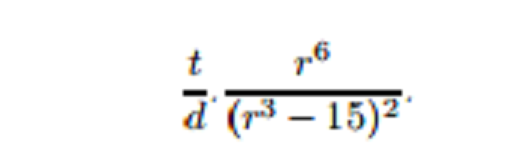
The ratio of topping to base in a median bite is given by

Formula for median pizza bite (Cheng)

where

r = radius of pizza (half the diameter) in inches
d = volume of dough (constant)
t = volume of topping (constant)
α = scaling constant for the edge

The Greenpeace 30 could be free tomorrow but ……

October 19, 2013

It has been one month since the Greenpeace pirates were apprehended by the Russians.

The high profile Greenpeace strategies to get them released have been less than competent. They seem to be particularly incompetent regarding the Law of the Sea. Rather than getting their pirates released, nearly all their actions have been counter productive and have led to a hardening of the Russian position, the denial of bail, the inclusion of drug running charges and now even the threat of terrorism charges. That Greenpeace believes it stands above Governments and can determine what constitutes acceptable or unacceptable behaviour does not endear them to either the Russian Government or Russian Courts.

  1. They have tried bluster and moral indignation.
  2. They have tried arguing that the ends justify the means.
  3. They have managed expressions of support for their cause by rock stars
  4. The Head Pirate has written an idiot  “letter to Putin” in the form of a Press Release
  5. They have persuaded the Dutch Government to institute legal proceedings against Russia
  6. They persuaded the Dutch Government to get their police to apprehend and beat-up a Russian diplomat
  7. They have persuaded some Nobel prize winners to plead for the dropping of piracy charges.
  8. They have tried to complain that the conditions of detention are “inhumane”
  9. They have orchestrated emotional appeals by the families of the pirates.
  10. They have made press releases out of emotional letters from the pirates in captivity.

But humility and any hint that they might be wrong is not within Greenpeace’s genes. My expectation is that Greenpeace will continue to follow arrogant, ineffective and incompetent – but all high profile – strategies. They will only irritate and harden the Russian position even further against the criminals. (See what all the high profile, but equally incompetent, international publicity achieved for Pussy Riot).

What Greenpeace has not done but which they could do and which would probably get their pirates released in about a day is

  1. Get off their moral high horse,
  2. Acknowledge that they broke the law
  3. Get Kumi Naidoo to swallow his pride and grovel
  4. Apologise
  5. Arrange for each one of the detained to apologise to the court, and
  6. offer to give up their passports and accept some form of “house arrest” in exchange for bail, and
  7. provide individual and unconditional assurances that they will not flee.
  8. Assure the Russian courts – individually and collectively – that they will refrain from illegal actions and will abide by the decision(s) of the courts
  9. Assure their own Governments – individually and collectively – that they will refrain from illegal actions and will abide by the decision(s) of the courts
  10. Get their Government Heads to pass on such assurances to Putin (and effectively stand guarantor for the assurances given)

But I do not expect that Greenpeace and its pirates will ever acknowledge their arrogance or moral turpitude.

I expect the Russians will keep them locked up for some time longer. They may well add charges of terrorism – especially if any foreign Government tries to pressure Russian diplomats. If Greenpeace only sits on its high horse and continues to bluster, the 30 may well be there till just before Christmas.

And winter has come early to Murmansk.

Related: The Pirates of Greenpeace

Women in the Chinese Navy

October 18, 2013

Women have been in the Chinese Military for a long time and the Chinese navy is a major force in the Indian and Western Pacific Oceans.

Xinhua is running a photo feature about women in the Chinese Navy.

(Photo: news.cn/Chinanews.com)

(Photo: news.cn/Chinanews.com)

(Photo: news.cn/Chinanews.com)

All very smart and photogenic.

The high heels and dress whites may be OK for members of the band, or for a party

but not I think for working with the rigging on a wet deck!! Of course posing with the rigging on a wet deck is another matter.

German Catholic Church (and the Bishop of Limburg) are wallowing in taxpayer’s money

October 18, 2013
Photo: DPA

Bishop of Limburg, Franz-Tebartz Van-Elst photo DPA (via The Local)

The excesses of the Catholic Bishop of Limburg, Franz-Peter Tebartz-van Elst, have been much in the headlines. But what I  certainly had not realised was to the extent to which the Catholic Church in Germany is financed by public money.

It certainly seems to be a case of wallowing in a trough of taxpayer’s money – which the taxpayer cannot easily opt out of and which is subject to few controls.

The Bishop’s expensive habits catalogued here at The Local (Italy) include:

  1. a luxurious complex being built next to Limburg Cathedral in the state of Hesse. Earlier this week it emerged the costs had overrun by ten times the initial estimate from around €3 million to €31 million.
  2. €350,000 on built-in-wardrobes,
  3. €25,000 on a conference table 
  4. €783,000 on a garden
  5. his own apartment in the complex is costing €3 million with €478,000 going on furnishings (the bishop’s bathtub cost €15,000)
  6. guest rooms will cost €1.1 million
  7.  the new chapel costs €2.67 million

Jochen Riebel, the spokesperson for the diocesan finance council, told newspaper the Frankfurter Allgemeine Zeitung the bishop was “either a sophisticated deceiver or that he’s just plain sick.” 
A commission is being set up by the Catholic Church in Germany to investigate the spending. 
The bishop’s expensive tastes have landed him in the headlines before. He was criticized last year after magazine Der Spiegel revealed he flew first class to India to visit poor children.  
And on Thursday prosecutors claimed the bishop made false statements in affidavits submitted in two civil claims against Der Spiegel after the article appeared. They have now called for a punishment which could include fines

But it is the financing of the Catholic Church in Germany which is even less healthy than the Bishop. Another article in The Local (Italy) reports:

Limburg Cathedral Wikipedia

Its wealth has been estimated at €430 billion with interests ranging from television stations to mineral water. 

The €31-million bill for Franz-Tebartz Van-Elst’s residence, including €15,000 on a bath tub and €350,000 on built-in-wardrobes, has put the finances of the Catholic Church, much of which comes from taxpayers and state subsidies, into the spotlight.

Carsten Frerk, an outspoken critic of the Catholic Church in Germany, estimated its wealth at around €430 billion with about €140 billion of that in capital, theFrankfurter Allgemeine newspaper reported. Frerk researched the church’s ledgers for a year for a book published in October 2010. But only a small part of the church’s finances are public and many of their records remain secret.

Bild newspaper reported on Thursday the church was Germany’s second-biggest employer after the state, running everything from schools and kindergartens toTellux, the TV company which makes the Tatort crime drama.  It also makes money from its breweries and selling mineral water called Adelholzener. The church also owns ten banks, countless insurance businesses and 30 housing associations, Bild reported.  

The church’s largest public form of income is the “church tax”, a system whereby taxpayers register their membership of a church or religious group, and a percentage of their tax goes to that church. The tax dates back to the medieval tithes, a one-tenth share of goods collected by churches in the Middle Ages. …. The Catholic Church collected €5.2 billion in church tax in 2013, a 15 percent increase on 2000. But in order to keep up with inflation, it would have needed an increase of 22 percent. …….. it also receives a state subsidy every year, a throwback from a still-valid 1803 agreement between them and the government of the day. 

The subsidies paid to the Catholic and Protestant churches out of the treasury this year hit a record high of €481 million, €6.6 million more than in 2012, reported the Humanist Union of Germany (HVD). Alongside these benefits, the church enjoys exemption from corporation, trade, income and capital gains tax thanks to its status as an “organization of public rights.” Universities also have this status, but have their finances are partially controlled by the state, while the churches do not have this oversight.

….. The scandal has also led to some churches revealing the extent of their reserves. Cologne, the largest and reportedly richest diocese in Europe, said on Tuesday it had reserves of €166 million in 2012. The small diocese of Trier had a reserve of €84 million, Reuters reported. Tebartz-van Elst’s seat, in the small town of Limburg – with a population less than a thirtieth of Cologne’s – holds reserves of €100 million.

But no matter how enormously wealthy the Church is, the vulgarity of the Bishop of Limburg takes some beating.


One more scientist of Indian origin found to have faked data in the US

October 18, 2013

Nitin Aggarwal – a researcher in cardiology – apparently falsified and invented data. Once again a scientist of Indian origin caught faking data. Perhaps it’s the peer pressure – but it does make for depressing reading.

This is scientific fraud and  – once again – I wonder why scientists and scientific bodies should not be held liable and accountable for their “product” which is whatever they publish.

Maybe it is time to sell my shares in BMS.

Retraction Watch reports:

Nitin Aggarwal, formerly of the Medical College of Wisconsin, faked data in his PhD thesis, grant applications to the NIH and American Heart Association, and in two papers, according to new findings by the Office of Research Integrity.

(The case would have apparently first been published in the Federal Register on October 2, except for the government shutdown.)

Here were their findings:

…the Respondent engaged in research misconduct by falsifying and/or fabricating PHS-supported data in six (6) figures that were included in the following two (2) publications, one (1) grant application to the American Heart Association (AHA), one (1) grant application to NIH, and the Respondent’s Ph.D. thesis:

  • Aggarwal, N.T., Principal Investigator (P.I.), National Scientist Development grant application to the American Heart Association No. 11SDG7650072, “Sulfonylurea rReceptor-2 splice variant and mitochondrial mechanisms for cardioprotection and arrhythmia” (hereafter the “AHA grant application”).
  • K99 HL113518-01, “Mitochondrial ATP-sensitive K-channels and pharmacological approaches for cardioprotection,” Aggarwal, Nitin, Ph.D., P.I.
  • Aggarwal, N.T. “Endothelial 15-lipoxygenase regulates vasorelaxation and blood pressure in rabbits in normal and pathological condictions.” A Dissertation Submitted to the Faculty of the Graduate School of Biomedical Science of the Medical College of Wisconsin in Partial Fulfillment of the Requirements for the Degree of Doctor of Philosophy, Milwaukee, Wisconsin, 2008 (hereafter the “thesis”).

…………

Aggarwal won a $1,000 award for his dissertation in 2009. According to his LinkedIn profile and a recent speaker announcement, he’s now working at Bristol Myers-Squibb. We’ve tried to reach BMS for comment, along with the Medical College of Wisconsin, and will update with anything we learn.

Update, 6 p.m. Eastern, 10/17/13: The Medical College of Wisconsin tells us they have no comment on the ORI’s findings.