Facebook and Twitter are “publishers”, not merely “couriers”

July 30, 2013

Social media like to claim that they merely provide a “platform” or  are just “communication enablers” or only provide “communication media” and therefore that they are not responsible – and should not be held responsible – for the content they disseminate.

But they protest too much.

It is quite wrong to compare Facebook or Twitter or LinkedIn to a telecommunications enterprise or a postal service or a courier service or an e-mail service provider. In all of these a specific identifiable “sender” directs a communique to a specific, identified “receiver”. The carrying of the communique to the specific receiver is the service provided by the communications enterprise and is not in any sense “publishing”. The service provided by the social media is more than just the provision of a soap box in Hyde Park (a platform) or the provision of a Board or a Wall in a town square onto which a newspaper could be appended. Any website could be a platform for comments but the website owner must take ultimate responsibility for the content published on the web-site.

Facebook and Twitter disseminate their users communiques to a general audience without discriminating as to who may receive the communique. Their business models rely on this audience being as large as possible. Their advertising revenues depend upon the dissemination being as wide and as “indiscriminate” as possible. They are not so different to a radio or a TV broadcast where the broadcaster tries to reach as large an audience as possible. The broadcaster is clearly responsible and accountable for the content of the broadcast. A free newspaper being distributed at all Metro stations but where revenues are dependent upon advertising also has a responsible publisher. Any advertising revenue accrues to the publisher.

The clincher for me is that the placement of advertisements based on circulation is decisive proof of the existence of a publisher. All published material does not contain advertising. Not all advertising is proof of the existence of a publisher. A billboard or sandwich-board owner for example, is not a publisher. But the mere existence of advertising based on circulation numbers or “reach” or any similar parameter is conclusive proof – I think – of the existence of a publisher. And it is the person or organisation responsible for the circulation who takes the advertising revenues and in consequence must be the responsible and accountable publisher.

Freedom of speech does not really enter the argument. The publisher may choose to publish whatever he pleases. He may refrain from “censoring” his users if he so wishes. Or he may – at some cost – ensure that the content he publishes meets criteria that he sets himself. But he remains responsible and accountable for what he publishes. Facebook and Twitter cannot abdicate their responsibility because they choose not to exercise the quality control they could.

It seems to me to be self-evident that Facebook and Twitter are not “billboards” or “sandwich-boards” but are full fledged “broadcasters”. And a broadcaster is a publisher. They could take responsibility for the content they disseminate if they wanted to. It just costs. They can be held accountable for what they indubitably do publish – and they should.

A retraction can achieve more publicity than the original paper

July 30, 2013

A jaundiced view of retractions and questions of a cynical kind:

  1. Could an article or paper be deliberately written so as to be retracted later for the ensuing publicity?
  2. Can a deliberate retraction be managed so as to generate credit for the journal or the author who requests the retraction?
  3. And is it not “perfectly correct” to cite a retracted paper in a subsequent paper as a  “publication (retracted)”?

A retraction – if sufficiently “interesting” – can get more publicity than the original paper. It may be a cliche but it is nonetheless true  that there is no such thing as bad publicity. And if the retraction is at the “request of the authors” the author may actually demonstrate and even build a reputation for integrity!

This story at Retraction Watch of an article pulled by Slate raises my suspicions that just publicity was actually the objective.

RetractionWatch: 

Slate has retracted an essay they published as part of a partnership with Quora, an online question-and-answer site, after acknowledging that they “did not vet the piece properly.”

The piece garnered hundreds of comments, many of which questioned whether its claims were legit, and some of which pointed out that the author may have posted questionable material on the web before.

This now appears where the article, originally published at 5:01 p.m. on Thursday, July 25, originally did:

Editor’s note: On July 25, Slate published in this space an essay from its partner site Quora titled “Are Doctors Biased Against Obese People?” Because the piece did not meet our editorial standards, we have taken it down.

On Friday at 6:09 p.m., brandchannel started a post about the article with a quote from the piece:

When I was pregnant, one OB called me disgusting and told me to have an abortion.

brandchannel doesn’t mention the retraction, which Slate tells us happened Friday night, just over 24 hours after it as originally posted. But brandchannel anticipated that move, including the entire Slate-Quora piece saved for posterity, …..

I note also from Professor Debora Weber-Wulff’s blog that retracted papers still show up being cited – as retractions – in other papers. The paper is in PLoS and is supposedly a peer-reviewed online publication.

36. Rathinam C, Klein C (2012) Retraction: transcriptional repressor gfi1 integrates cytokine-receptor signals controlling B-cell differentiation. PLoS One 7.

Retraction? Are they citing the retraction of the article as a reference for what had been stated in the article retracted? 

Retracted papers are also being included in CV’s! I suppose that the paper was accepted for publication – even if later retracted – is some kind of an achievement!

It reminds me of the old story where CV’s in India would regularly include something like

“BA, 1943, University of Aligarh (fail)”.

This was considered – socially and academically – acceptable as proof that the author had at least done the course and had appeared for the examination!

Czechs jump off the renewables train to nowhere

July 30, 2013

From Power Engineering:

The Czech Republic’s government has voted to end support for renewable power generation in a bid to reduce rising consumer electricity bills.

The law proposes to stop subsidies for new projects and goes in to effect from 2014.

Subsidies for renewable-power sources have raised prices for Czech energy users in the past three years as the cost is passed on through customer bills.

Prime Minister Jiri Rusnok said in the statement, that rising electricity prices “threatens the competitiveness of our industry and raises consumers’ uncertainty about power prices.”

Only hydro, wind and biomass power plants that got construction permits in 2013 will be eligible for support if they’re completed before the end of 2014, the statement said.

Peter Ziegler RIP

July 29, 2013
PAZiegler s.jpg

Prof. Peter A Ziegler

Professor Peter Ziegler passed away a few days ago aged 84.

RIP

Prof. Peter Ziegler (1928 – 2013) was a Swiss geologist  and Titular Professor of Global Geology at the Geological-Paleontological Institute, University of Basel. He is a member of the Royal Netherlands Academy of Sciences, the Polish Academy of Arts and Sciences, the Russian Academy of Natural Sciences and the Academia Europaea.

I posted in March about his presentation on the “Mechanisms of Climate Change” from February this year.

Climate Change Ziegler 2013 (pdf)

Earthquakes release methane from methane hydrates

July 29, 2013

“Natural” release of methane from methane hydrates by earthquakes is more common and more significant than has been thought or accounted for in climate models.

The inescapable conclusion is that effects  being attributed by the demonisation of carbon to man made carbon dioxide emissions (even if real) may well be partly due to the natural release of such methane.  The global temperature pause for the last 17 years or so and the clear but small decline in global temperatures for the last 5 years is quite clear. At the same time emissions from fossil fuel combustion have been steadily increasing. These are a clear indication that the supposed linkage between carbon dioxide concentration and man-made carbon dioxide emissions on climate is very suspect if not completely broken.

It is also becoming increasingly clear that climate models – even though very complicated – are far too simplistic and just don’t (can’t) take all factors into account. Clouds, aerosols, particulates, solar effects, lunar cycle effects through the tides, ocean cycles and now earthquakes are all poorly understood and largely ignored in climate models. There is far more in the realms of the unknown about the climate than is known. We don’t even know what we don’t know.

David Fischer, José M. Mogollón, Michael Strasser, Thomas Pape, Gerhard Bohrmann, Noemi Fekete, Volkhard Spiess & Sabine Kasten, Subduction zone earthquake as potential trigger of submarine hydrocarbon seepage, Nature Geoscience (2013) doi:10.1038/ngeo1886

Here we present geochemical analyses of sediment cores retrieved from the convergent margin off Pakistan. We find that a substantial increase in the upward flux of gas occurred within a few decades of a Mw 8.1 earthquake in 1945—the strongest earthquake reported for the Arabian Sea. Our seismic reflection data suggest that co-seismic shaking fractured gas-hydrate-bearing sediments, creating pathways for the free gas to migrate from a shallow reservoir within the gas hydrate stability zone into the water column. We conservatively estimate that 3.26×10⁸ mol of methane have been discharged from the seep site since the earthquake. We therefore suggest that hydrocarbon seepage triggered by earthquakes needs to be considered in local and global carbon budgets at active continental margins.

New York Times:

Dr. Fischer and his colleagues analyzed sediment cores taken in 2007 from two locations in the northern Arabian Sea where hydrates were present and seepage was occurring. They found chemical signatures in the cores suggesting that the methane flow greatly increased sometime in the mid-20th century. Looking through seismic records, Dr. Fischer found that a magnitude 8.1 quake occurred in the area in 1945. The quake, which was centered less than 15 miles from where the cores were taken, and a resulting tsunami, killed up to 4,000 people.

The conclusion was inescapable, Dr. Fischer said. “The quake broke open gas-hydrate sediments and the free gas underneath migrated to the surface.” The hydrates themselves did not dissolve. “They remain there,” he said.

Dr. Fischer said the researchers chose the core locations in the Arabian Sea because they wanted to get a better understanding of how methane seepage was related to tectonics, and the area is in an active zone where one of the earth’s tectonic plates slides beneath another. But they were not thinking about the effect of individual earthquakes, and his discovery of the 1945 quake in the records “was probably a moment I’ll never forget,” he said.

The upward flow of methane is continuing today, and the researchers do not know when it might stop. All told, they estimate that nearly 10 million cubic yards of methane have been released from the core sites over the years. But that is a conservative figure, Dr. Fischer said, because immediately following the quake the flow would have been much higher.


Vatican — duping or duped about VSEL stem cells?

July 29, 2013

Vatican theologians have a long history of going to extraordinary lengths and convolutions to align theology with every new scientific advance. It has not been unknown for theologians to try and massage the facts and to direct new research along theologically “acceptable” paths.

The Vatican – and other religious organisations – consider the use of adult stem cells to be ethically quite acceptable whereas they consider the use of embryonic stem cells to be unethical since it involves the “murder” of the embryos. And they have put their weight behind VSEL (very small embryonic-like) stem cells. But they have gone overboard in promoting the possible benefits of the use of adult stem cells even to the extent of holding conferences about the potential benefits. But many researchers are appalled by theology overriding science and holding out false hopes.

Nature: April 2013

The Second International Vatican Adult Stem Cell meeting, held on 11–13 April in Vatican City, was a shamelessly choreographed performance. Sick children were paraded for television, sharing the stage with stem-cell companies and scientists desperate to hawk a message that their therapies must be speeded to clinical use. ….

A kilometre away at the Italian senate, meanwhile, parliamentarians further eroded protection for vulnerable patients targeted by stem-cell companies. On 10 April, they amended an already controversial ministerial decree (see Nature 495, 418–419; 2013) with a clause that would redefine stem-cell therapy as tissue transplantation, thereby releasing it from any regulatory oversight. If the second parliamentary chamber endorses this amendment, Italy will be out of step with the rules of the European Union and the US Food and Drug Administration, both of which define stem cells modified outside the body as medicines.

Many scientists around the world were appalled by the events in Rome, and rightly so. It is wrong to exploit the desperation of the disabled and the terminally ill and to raise false hopes of quick fixes, as some at the Vatican meeting tried to do. It is also wrong to try to use such patients as experimental animals by bypassing regulatory agencies, as the Italian parliament seems to want to do. ….

Now it seems that the Vatican has either been duped about very small embryonic-like stem cells or has been involved in perpetuating the myth that these cells even exist and offer an alternative.

RawStory:

Scientists at Stanford University School of Medicine issued a report this month that said a type of stem-cell alternative approved by the Vatican and other theologians has turned out to be a myth. According to an essay by bioethicist Arthur Caplan, Dr. Irving Weissman and his team have concluded that so-called very small embryonic-like (VSEL) stem cells are at best a laboratory error and at worst a deliberate fraud perpetrated on the scientific and religious communities.

In 2011, the Vatican called a press conference to present Polish stem cell biologist Mariusz Z. Ratajczak, who claimed that he had discovered heretofore unknown stem cells present in adult cells. These tiny cells, he claimed, could perform the same tasks as embryonic stem cells, including tissue regeneration and the miraculous capacity that embryonic stem cells have to mimic other types of cell tissue. Moreover, these VSEL cells, said Ratajczak, could be harvested from adult cells without harming human embryos or relying on them for cell material.

“The theologians,” wrote Caplan, “were delighted.” They believed that the new technology could halt what they see as the murder of unborn children. The Vatican took the unprecedented step of investing heavily in NeoStem, a company claiming to specialize in VSEL research and production, in hopes that the new technology would render the destruction of embryos for stem cells obsolete. ….. The trouble is, the cells don’t exist. At least, according to Weissman, who said that his team not only hasn’t been able to make VSELs perform their tissue-regenerative miracles in the laboratory, they can’t find them at all. …

….. Rüdiger Alt, head of research at Vita 34, an umbilical cord blood bank in Leipzig, Germany — whose team also failed to get results from Ratajczak’s methods — told the journal Nature, “Weissman’s evidence is a clincher — it is the end of the road for VSELs.”

Bioethicist Caplan wrote that supporters of VSEL research “say their peers just don’t have the techniques down for finding them. But it is just as likely that in their hope to find a solution to stem cell research acceptable to the Roman Catholic Church and other religious groups they have let themselves find something that is just not there.”

He concluded, “Until someone other then those tied to the power of VSELS for religious or business reasons can find them, be wary of any claims about their power to heal.”

Noted in Passing – 28th July 2013

July 28, 2013
two-kids-under-a-banana-leaf-in-the-rain-indonesia

Friends under a banana leaf: Photograph by Kendisan Seruyan (via twistedsifter)

I tend to take alarmist claims about the demise of species with a large grain of salt. As supported by this story about a species of North American bumblebee which virtually disappeared and which has now reappeared.

I don’t believe the scientists who say they know the secret of Usain Bolt and his speed.

Matt Ridley compares HS2 to Hadrian’s Wall.

For a “settled science”, there is a great deal which is still being found about how carbon dioxide affects plants. Wetland plants are found not only to absorb more carbon dioxide with high concentration of the gas but they also then emit less carbon dioxide.

John Hawks considers the Denisovans and the pre-Toba, post-Toba question.

Joschka Fischer who was German Foreign Minister and Vice Chancellor from 1998-2005 considers Egypt after Morsi.

Global population of polar bears keeps increasing (about 5,000 since 2001) even though some vested interests keep adjusting the numbers to try and show that there has been no significant change. They seem however to have abandoned efforts to show numbers declining.

That science is self-correcting may be true in the long term (more than a few decades) but it is largely a myth within the lifetime of scientists.

In the New Yorker, Atul Gawande considers the contrasting speeds at which anesthesia and the use of antiseptics spread and generally how ideas disseminate in the practice of medicine.

His involvement with Muammar Gaddafi is no great surprise but I suspect that we have not yet heard the full history of Tony Blair’s venality.

Any even natural number greater than 2 can be written as the sum of two prime numbers. Plus Maths on the Goldbach Conjecture.


Canada used indigenous children to “study” malnutrition

July 28, 2013

Yet another depressing story of how, in the name of “science”, the “establishment” made use of less “worthy” populations to carry out medical experiments.

This time in Canada from 1942 -1952.

There was no difference of principle and only one of degree between the medical experiments carried out in Nazi Germany and those carried out on native or disadvantaged populations in Australia, Canada, and the USA (among many other countries).

We may like to think that it does not happen any more. I am not so sure. The real story of Haiti and its cholera and the use of cheap, untested vaccines is yet to be told Similarly, some of the stories about the intentional “creation” of new strains of influenza and the subsequent discovery and dissemination of new vaccines for their cure may never ever become public.

Mosby, I. Social History 46, 145–172 (2013). Administering Colonial Science: Nutrition Research and Human Biomedical Experimentation in Aboriginal Communities and Residential Schools, 1942–1952

Abstract: Between 1942 and 1952, some of Canada’s leading nutrition experts, in cooperation with various federal departments, conducted an unprecedented series of nutritional studies of Aboriginal communities and residential schools. The most ambitious and perhaps best known of these was the 1947–1948 James Bay Survey of the Attawapiskat and Rupert’s House Cree First Nations. Less well known were two separate long-term studies that went so far as to include controlled experiments conducted, apparently without the subjects’ informed consent or knowledge, on malnourished Aboriginal populations in Northern Manitoba and, later, in six Indian residential schools. This article explores these studies and experiments, in part to provide a narrative record of a largely unexamined episode of exploitation and neglect by the Canadian government. At the same time, it situates these studies within the context of broader federal policies governing the lives of Aboriginal peoples, a shifting Canadian consensus concerning the science of nutrition, and changing attitudes towards the ethics of biomedical experimentation on human beings during a period that encompassed, among other things, the establishment of the Nuremberg Code of experimental research ethics.

Nature also reports:

Canadian government scientists used malnourished native populations as unwitting subjects in experiments conducted in the 1940s and 1950s to test nutritional interventions. The tests, many of which involved children at state-funded residential schools, had been largely forgotten until they were described earlier this month in the journal Social History by Ian Mosby, who studies the history of food and nutrition at the University of Guelph in Canada.

The work began in 1942, when government scientists visited several native communities in northern Manitoba and discovered widespread hunger and malnutrition. “Their immediate response was to study the problem by testing nutritional supplements,” says Mosby. From a group of 300 malnourished people selected for the tests, 125 were given vitamin supplements, and the rest served as ‘untreated’ controls. ….

Nancy Walton, a medical ethicist at Ryerson University in Toronto, Ontario, and former chairwoman of the university’s research-ethics board, says that such a project would never be allowed today, “but in the context of that time, it’s unfortunately not surprising”. Awareness of the need for informed consent in human studies was growing — informed consent was a central tenet of the Nuremberg Code, developed in the late 1940s — but the idea had not yet been adopted around the world.

“It’s not just bad ethics, it’s bad science,” Walton says of the Canadian government research. “They didn’t appear to try and prove or disprove any hypothesis that I can see, or make any statistical correlations.”

Indeed, says Mosby, very little of value came out of the research. He found no evidence that the northern Manitoba study was completed or published. The school experiments were presented at conferences and published, but they led to no important advances in nutritional science or improvements in conditions at the schools. “They mostly just confirmed what they already knew,” Mosby says. ….


The lunar nodal cycle and its effects on climate

July 27, 2013

A paper has just been published in the International Journal of Climatology showing that the lunar nodal cycle influences “the low-frequency summer rainfall variability over the plains to the east of subtropical Andes, in South America, through long-term sea surface temperature (SST) variations induced by the nodal amplitude of diurnal tides over southwestern South Atlantic (SWSA).”

Eduardo Andres Agosta, The 18.6-year nodal tidal cycle and the bi-decadal precipitation oscillation over the plains to the east of subtropical Andes, South America, International J of Climatology, DOI: 10.1002/joc.3787

Abstract: This work shows statistical evidence for lunar nodal cycle influence on the low-frequency summer rainfall variability over the plains to the east of subtropical Andes, in South America, through long-term sea surface temperature (SST) variations induced by the nodal amplitude of diurnal tides over southwestern South Atlantic (SWSA). In years of strong (weak) diurnal tides, tide-induced diapycnal mixing makes SST cooler (warmer) together with low (high) air pressures in the surroundings of the Malvinas/Falklands Islands in the SWSA, possibly through mean tropospheric baroclinicity variations. As the low-level tropospheric circulation anomalies directly affect the interannual summer rainfall variability, such an influence can be extended to the bi-decadal variability present in the summer rainfall owing to the nodal modulation effect observed in the tropospheric circulation. The identification of the nodal periodicity in the summer rainfall variability is statistically robust.

The lunar nodal cycle is not something that is very well known but it is another celestial cycle which is clearly not to be ignored. Naturally the IPCC takes no notice of solar cycles, planetary cycles or lunar cycles and all these are lumped into what could be considered “natural variability”.

(Sourced from Wikipedia)

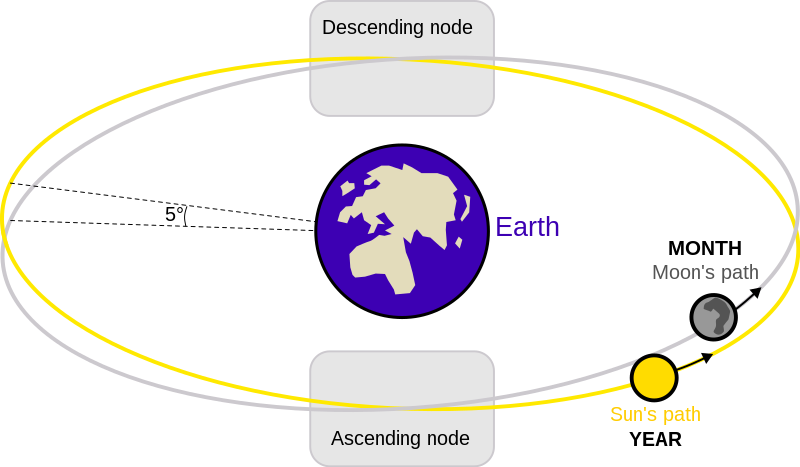
The lunar orbit is inclined by about 5 degrees on the ecliptic. The moon  therefore can lie up to about 5 degrees north or south of the ecliptic. The ecliptic is the plane of the apparent path of the Sun on the celestial sphere, and is coplanar with both the orbit of the Earth around the Sun and the apparent orbit of the Sun around the Earth.

File:Lunar eclipse diagram-en.svg

Lunar eclipse orbital diagram: wikipedia

The lunar nodes precess around the ecliptic, completing a revolution (called a draconitic or nodical period, the period of nutation) in 6793.5 days or 18.5996 years.

The effects of the 18.6 year lunar nodal cycle on climate on tides and geological sediments and on weather and climate have long been of interest (though not apparently for the IPCC).

Nanocycles Method is the English translation of the title of a book published in Russian by Professor of Geology S Afanasiev of Moscow University in 1991,ISBN 5–7045–0109–0.

From “Nanocycles Method” by S Afanasiev, 1991

The lunar node cycle, which is presently 18.6 years, affects the rainfall on a 9.3 year cycle and this shows up as varying thickness layers of deposits, or varves, in geological formations. 

However the moon’s orbit is gradually getting larger over time and so its period is slowing down. The rate of movement of the nodes is also decelerating and Prof Afanasiev has determined the accurate nodal cycle period for the whole of the last 600 million years.

The cycle of the lunar node is important in affecting the weather because it plays a part in determining tides in the atmosphere, oceans and solid body of the earth. The atmospheric tides affect rainfall which in turn affects river flows and hence the deposition of geological varves, or annual deposits in geological layers. ….. 

At the present time, with a nodal cycle of 9.3 years, successive nodal cycles begin 0.3 years later in the seasons each cycle. Therefore after 3 or 4 cycles the nodal cycle start return to the same time of year again. The average period of the cycle when the nodal cycle comes at the same time of year is 9.3/0.3 or 31 years. Specific occurrences of nearly the same season, within 0.1 year, will occur after 28, 65 and 93 years and so on. 

…. Because the lunar nodal cycle period has changed from 9.147 years to 9.298 years in the last 1.0 million years, the secondary cycle has varied from 62.12 years to 31.21 years. If this cycle can be measured in a deposit to an accuracy of 1 year then it allows the dating of the deposit to an accuracy of +/-0.03 million years.

A small selection of papers dealing with the effects of the 18.6 year lunar nodal cycle is given below:

Transylvanian Hypothesis lives again — Now lunar cycles found to affect sleep

July 26, 2013

Moon sickness is becoming all the rage. Hot on the heels of the report that cardiac surgery results are affected by the phases of the moon comes this study showing that lunar cycles do – in fact – also affect sleep. Our bodies it seems also dance to a lunar rythm and maybe it is time to revive the Transylvanian Hypothesis and revisit all the myths and legends about the effects of the moon (werewolves, induced lunacy, epileptic fits and even lunar effects on general practice consultancy rates!)

A new paper in Current Biology

Christian Cajochen, Songül Altanay-Ekici, Mirjam Münch, Sylvia Frey, Vera Knoblauch, Anna Wirz-Justice. Evidence that the Lunar Cycle Influences Human Sleep. Current Biology, 2013; DOI: 10.1016/j.cub.2013.06.029

from planetsforkids

EurekAlert: 

Many people complain about poor sleep around the full moon, and now a report appearing in Current Biology, a Cell Press publication, on July 25 offers some of the first convincing scientific evidence to suggest that this really is true. The findings add to evidence that humans—despite the comforts of our civilized world—still respond to the geophysical rhythms of the moon, driven by a circalunar clock.

“The lunar cycle seems to influence human sleep, even when one does not ‘see’ the moon and is not aware of the actual moon phase,” says Christian Cajochen of the Psychiatric Hospital of the University of Basel.

In the new study, the researchers studied 33 volunteers in two age groups in the lab while they slept. Their brain patterns were monitored while sleeping, along with eye movements and hormone secretions.

The data show that around the full moon, brain activity related to deep sleep dropped by 30 percent. People also took five minutes longer to fall asleep, and they slept for twenty minutes less time overall. Study participants felt as though their sleep was poorer when the moon was full, and they showed diminished levels of melatonin, a hormone known to regulate sleep and wake cycles.

“This is the first reliable evidence that a lunar rhythm can modulate sleep structure in humans when measured under the highly controlled conditions of a circadian laboratory study protocol without time cues,” the researchers say.

Cajochen adds that this circalunar rhythm might be a relic from a past in which the moon could have synchronized human behaviors for reproductive or other purposes, much as it does in other animals. Today, the moon’s hold over us is usually masked by the influence of electrical lighting and other aspects of modern life.

The researchers say it would be interesting to look more deeply into the anatomical location of the circalunar clock and its molecular and neuronal underpinnings. And, they say, it could turn out that the moon has power over other aspects of our behavior as well, such as our cognitive performance and our moods.