Strength in a Manager: The materials analogy

May 8, 2011

No manager operates without stresses of all kinds. He is continuously subjected to physical, mental, psychological and emotional stresses. They may be cyclic or prolonged or sporadic or intermittent. It is his ability to withstand stress and continue operating without breaking down which we can call his strength of character. An individual’s strength is always present and is brought to bear automatically whenever stress is encountered. It cannot be turned “on” or “off” at will or to suit changing circumstances but it is never absent. It is unique to the individual and different individuals will be more or less suitable for the particular stresses encountered. Strength carries no connotations of inherent goodness or badness but whether it is wholly or partially sufficient or suitable depends on the particular individual and the specific stresses experienced.

The materials analogy

The strength of a material is a measure of its ability to withstand stress without failure by fracture or by rupture.

The strength of character of a person is a measure of his ability to withstand the stresses he encounters without failure by “breaking down”.

Napoleon Hill 

“Character is to man what carbon is to steel”

It is remarkable that so many of the terms used in materials science to describe the strength of materials are also applicable to human character. Strong, tough, resilient, brittle, malleable, tempered, hard, stiff, yield, stress, strain, deformation, ductile, elastic, rigid, fracture, fatigued and twisted are all words which have very precise meanings when applied to the properties and behaviour of materials. They are also all words which can be used – with very similar meanings – in describing facets of human character.

Stress in materials science is measured in units of the force applied per unit area of the material. Stress may be tensile (longitudinal pulling) or compressive (longitudinal squeezing) or it may be shear (sideways) or it may be torsion (twisting). The strength of a material is determined by its microstructure and defined as the magnitude of the stress that must be applied for the material to fail by fracture or by rupture.

There seem to be many parallels between the properties of inanimate materials and the components of human character. A person’s strength of character is similarly dependent upon his microstructure and is also a measure of his breaking stress. Toughness in a person, just as in materials, is not synonymous with strength but it is a related characteristic. It represents a person’s ability to absorb a great volume of stress or repeated applications of stress where he may yield to some extent, but does not break. As with a material, his resilience marks his ability to absorb setbacks and to recover his equanimity. He can also be subject to repeated stress cycles or difficult working conditions for prolonged periods leading to fatigue or creep where a gradual onset of small failings can lead to a total failure. Stubbornness in character has great similarity to brittleness in a material. The microstructure of the manager’s character, just like that of a material, can be changed by tempering or hardening or some other strengthening processes. Some managers are strong in tension and resist being pulled along by the latest fashion. Others are strong in compression and can withstand the weight of many trying to squeeze them into a particular shape. Just as material properties make them suitable for particular applications, the different characters of managers make them suitable for particular environments or particular tasks.

Properties of materials are amenable to precise tests and the results of the tests, which can be expressed mathematically, apply universally to all materials having the same composition and microstructure. Human characteristics are subject to much greater variation, are not as easily measurable and cannot be as readily predicted. Tests for the ultimate strength of a material are carried out by stressing a standard piece of the material to the point of destruction and the test pieces themselves are thereafter rendered useless. The strength of human character however, is not amenable to similar testing and does not allow of the same quantitative and mathematical approach. The science of materials though, is illustrative of, and does provide some very valuable insights regarding, human character, but it must be emphasized that it is only an analogy. Analogies serve very well for getting clarity in a new area of study by comparison with a familiar area, but there are many aspects of human character which are quite unlike material properties and the analogy no longer applies. Unlike materials, even conflicting character traits can co-exist in a person and the same trait can be manifested differently in different circumstances or at different times. A material is either brittle or it is ductile, but never both. But human character, for example, may be brittle and uncompromising in regard to integrity but flexible with regard to fallibility, both at the same time. A particular manager may be malleable and yielding with his superior while being hard or inflexible with a subordinate.   A manager may exhibit different, and even diametrically opposite, character traits to the same person but at different times. Strength of character is not an independent trait in itself but is a composite of many different features.

From Chapter 6: Essence of a Manager

Singapore elections: A benevolent dictatorship has become a one-party authoritarian “democracy”

May 7, 2011

Lee Kwan Yew in 1963

Lee Kwan Yew built Singapore. He also put in place all the trappings of a multi-party democracy but was effectively the benevolent dictator who controlled every aspect of life for over 40 years (31 years officially as Prime Minister and for a decade afterwards).

But the institutions he set up for legislative representation and the judiciary are all somewhat nullified when the current reality is one of a single party, ruling in a quite authoritarian style under the cloak of a pluralistic democracy. The ruling party has been quite ruthless in using legalites and a compliant judiciary to exclude rival political parties as soon as they begin to show any signs of becoming popular.

Singaporean politics have been dominated by the People’s Action Party (PAP) since the 1959 general election when Lee Kuan Yew became Singapore’s first prime minister (Singapore was then a self-governing state within the British Empire). The PAP has been in government ever since. Singapore left the Commonwealth in 1963 to join the Federation of Malaysia, but was expelled from the Federation in 1965 after Lee Kuan Yew disagreed with the federal government in Kuala Lumpur. Foreign political analysts and several opposition parties including the Workers’ Party of Singaporeand the Singapore Democratic Party (SDP) have argued that Singapore is a de facto one-party state.

The Economist Intelligence Unit classes Singapore as a “hybrid” country, with authoritarian and democratic elements. Freedom House does not consider Singapore an “electoral democracy” and ranks the country as “partly free”. Reporters Without Borders ranked Singapore 140th out of 167 countries in its 2005 Worldwide Press Freedom Index.

… The PAP employs censorship, gerrymandering and the filing of civil suits against the opposition for libel or slander to impede their success. Several former and present members of the opposition, includingFrancis Seow, J.B. Jeyaretnam and Chee Soon Juan perceive the Singaporean courts as favourable towards the government and the PAP due to a lack of separation of powers. …..

Jeyaretnam lost a series of suits to members of the PAP and was declared bankrupt in 2001, effectively disqualifying him from participating in future elections. Similar civil suits have been filed against Chee Soon Juan, leader of the Singapore Democratic Party. In 2005, filmmaker Martyn See shot a documentary on Chee called “Singapore Rebel” and was threatened with a lawsuit for making a “politically partisan” film, which is illegal in Singapore. In 2008, Chee Soon Juan along with his sister Chee Siok Chin were again sentenced to jail for testimony they provided in court. Both have been made bankrupt and are prohibited from leaving the country.

Singapore goes to the polls today and it is noticeable that the events in Tunisia and Egypt have aroused a yearning among many Singaporeans for the strangle-hold of the PAP to be at least weakened if not broken.

BBC:  Politics in the tiny but hugely wealthy state have been dominated by the current ruling party since independence in 1965. But a decision by opposition parties to co-ordinate more closely, and a huge rise in the use of social media, have created a greater sense of competition. The issue dominating discussion is the economy.

Singapore is one of the safest, cleanest and wealthiest countries on the planet – something which should bode well for any incumbent government. And in truth there is little doubt that the People’s Action Party, which has ruled since independence, will be returned to power.

But it is facing a tougher test in this election than ever before. The many parties of the traditionally fragmented opposition have adopted a co-ordinated strategy which has allowed them to challenge almost every seat.

In fact the only uncontested constituency is that of Singapore’s founding father, Lee Kuan Yew.

The challenges facing the country are being discussed. Old orthodoxies are tentatively being challenged. Which is why this election, in normally staid Singapore, is being hailed as the most exciting for a generation.

Whether the Arab spring or the Facebook revolution will be reflected in these elections remains to be seen. But there is no doubt that the PAP is more worried about the effect of the new social media sites than they have ever been. They have even apologised for errors they have made. But Lee Kwan Yew’s legacy will not be so easily  overturned when the majority perceive – as they do – that they have it “pretty good”  and maintaining the status quo is far better than the uncertain benefits of an increased level of freedom.

RIP Seve Ballestersos

May 7, 2011

Severiano Ballesteros passed away this morning.

He was only 54.

He won five major events-  the British Open three times and the Masters Tournament twice among his 87 titles worldwide, including a record 48 on the European Tour. For me he has represented European golf for over 3 decades.

RIP.

Bayreuth University: Guttenberg’s plagiarism was “intentional”

May 6, 2011

Der Spiegel:

Former German Defense Minister Karl-Theodor zu Guttenberg always insisted that he had never meant to plagiarize portions of his Ph.D. dissertation. On Friday, however, the University of Bayreuth said that he copied intentionally.

… On Friday, the University of Bayreuth, which awarded Guttenberg his Ph.D. title in 2006, announced its conclusion that the former conservative ally of Chancellor Angela Merkel had intentionally plagiarized. Guttenberg, the university said in a statement, “extensively violated academic standards and intentionally cheated.”  

It is a sentence which completes one of the most rapid and stunning political downfalls Germany has ever seen. Prior to the questions about his doctoral thesis, the member of the Christian Social Union, the Bavarian sister party to Merkel’s Christian Democrats, had been among the country’s most popular politicians. Many had even tipped him as a possible successor to Merkel in the Chancellery. But in late February, the University of Bayreuth revoked his doctor title pending an investigation and on March 1, Guttenberg resigned from Merkel’s cabinet. He went on to step down from all other political offices.

zu Googleberg: image b92.net

Related posts: The zu Googleberg affaire

Eurozone crisis: Greece considering leaving the Euro and bringing back the drachma

May 6, 2011

The economic and fiscal variations within the Eurozone have become too large to be hidden away and perhaps it is time for the Euro to split. A two-tier Euro could be an interim solution but it makes no sense to force the currency to compensate for and match the wildly different shapes of the member economies.

Greece going back to the drachma or to an “olive” Euro may not be such a bad thing for the rest of the Eurozone though it will only probably lead the Greeks to delay taking the actions that will anyway be necessary. Fiscal profligacy cannot be sustained.

back from the euro to the drachma?

Der Spiegel:

The debt crisis in Greece has taken on a dramatic new twist. Sources with information about the government’s actions have informed SPIEGEL ONLINE that Athens is considering withdrawing from the euro zone. The common currency area’s finance ministers and representatives of the European Commission are holding a secret crisis meeting in Luxembourg on Friday night.

Greece’s economic problems are massive, with protests against the government being held almost daily. Now Prime Minister George Papandreou apparently feels he has no other option: SPIEGEL ONLINE has obtained information from German government sources knowledgeable of the situation in Athens indicating that Papandreou’s government is considering abandoning the euro and reintroducing its own currency.

Alarmed by Athens’ intentions, the European Commission has called a crisis meeting in Luxembourg on Friday night. In addition to Greece’s possible exit from the currency union, a speedy restructuring of the country’s debt also features on the agenda. One year after the Greek crisis broke out, the development represents a potentially existential turning point for the European monetary union — regardless which variant is ultimately decided upon for dealing with Greece’s massive troubles.

Given the tense situation, the meeting in Luxembourg has been declared highly confidential, with only the euro-zone finance ministers and senior staff members permitted to attend. Finance Minister Wolfgang Schäuble of Chancellor Angela Merkel’s conservative Christian Democratic Union (CDU) and Jörg Asmussen, an influential state secretary in the Finance Ministry, are attending on Germany’s behalf.

…… Sources told SPIEGEL ONLINE that Schäuble intends to seek to prevent Greece from leaving the euro zone if at all possible. He will take with him to the meeting in Luxembourg an internal paper prepared by the experts at his ministry warning of the possible dire consequences if Athens were to drop the euro.

“It would lead to a considerable devaluation of the domestic currency against the euro,” the paper states. According to German Finance Ministry estimates, the currency could lose as much as 50 percent of its value, leading to a drastic increase in Greek national debt. Schäuble’s staff have calculated that Greece’s national deficit would rise to 200 percent of gross domestic product after such a devaluation. “A debt restructuring would be inevitable,” his experts warn in the paper. In other words: Greece would go bankrupt.

It remains unclear whether it would even be legally possible for Greece to depart from the euro zone. Legal experts believe it would also be necessary for the country to split from the European Union entirely in order to abandon the common currency. At the same time, it is questionable whether other members of the currency union would actually refuse to accept a unilateral exit from the euro zone by the government in Athens.

What is certain, according to the assessment of the German Finance Ministry, is that the measure would have a disastrous impact on the European economy…..


Bio-gas is out, shale gas is in and there is no “peak” gas in sight!

May 6, 2011

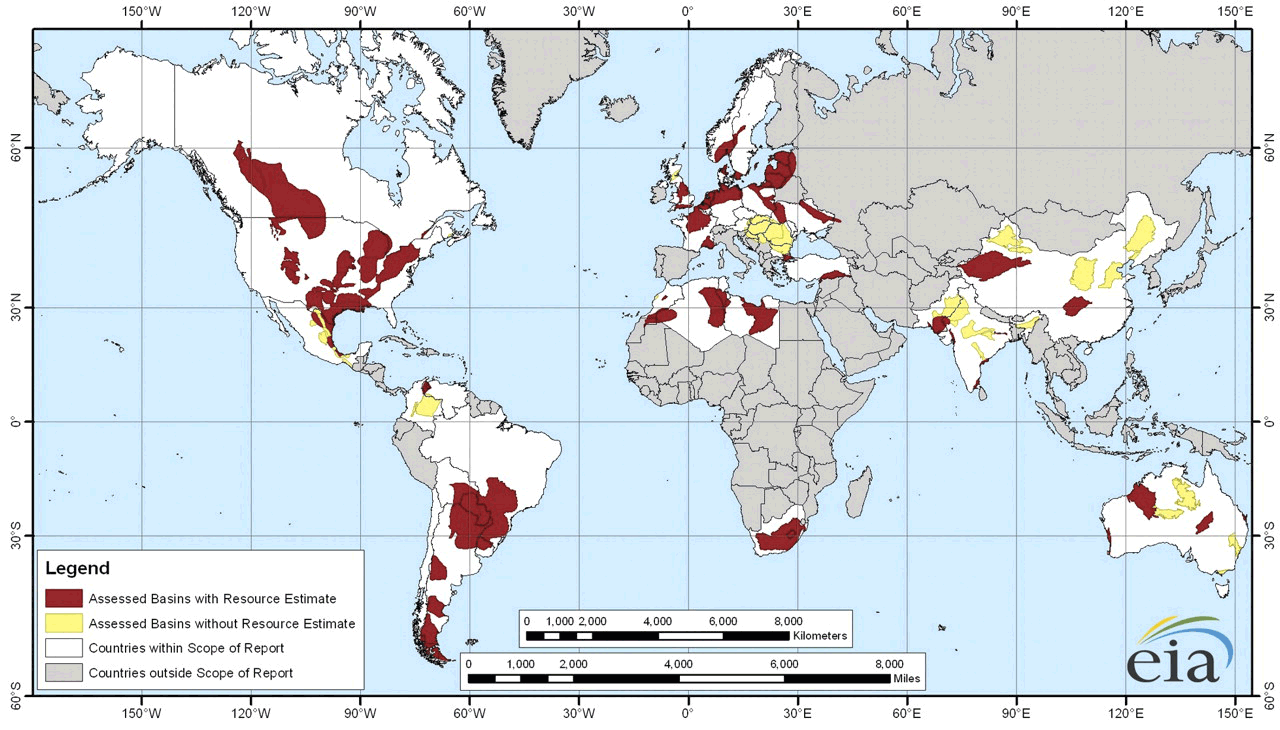
Shale gas is abundant and now beginning to undercut the price of other sources of natural gas. It is already cheaper than LNG transported around the world which requires both terminals for liquefaction and receiving stations for evaporation. Gas-fired power plants are relatively cheap and quick to build. In simple-cycle operation gas turbine based power plant provide the economic method of choice for emergency power and peak power. In combined cycle operation they provide the highest efficiency of all types of fossil fired electricity generation (around 60%). The ratio of gas price to coal price determines whether this can be cheaper than coal fired power generation.

Shale gas is abundant: map via Wikipedia

Total oil, gas and coal resources in the Earth’s crust are estimated at more than 570,000 exajoules. The world will use about 450 exajoules (billion billion joules) of fossil fuel energy this year.

Exajoule

The exajoule (EJ) is equal to 1018 joules. The 2011 Tōhoku earthquake and tsunami in Japan had 1.41 EJ of energy according to its 9.0 on the Richter magnitude scale. Energy in the United States used per year is roughly 94 EJ.

Matt Ridley:

Quantity is not really the point; price is. Most fossil fuels are impossibly hard to extract at a reasonable price. More than half the reserves consist of methane clathrates hydrated gas found mostly on the seabed near the margins of the continents in vast quantities. Nobody knows how to turn them into fuel except at huge cost, although the Japanese are on the case. So the question is not whether we run out of fossil fuels but whether we run out of cheap fossil fuels.

With oil, the answer may be “yes”. A huge amount of oil is still untapped, but most of it is under deep water or in oil sands and is costly to extract. But with gas, the answer is “no”. Most free methane is found in impermeable rocks such as shale, not in permeable “traps” whence it is easiest to extract. Shale gas was thought to be as inaccessible as clathrates, and when it began to be exploited in the 1990s it looked as if it would still come in at the top of the price range. Now technological improvements have brought the price down so far that it undercuts conventional gas. 

The “shale-gas shock” will have far-reaching consequences. It will make gas prices lower and less volatile relative to oil than ever before.

This will cause gas to take market share from coal, nuclear and renewables in electricity generation, and from oil in transport. London buses should follow Washington and Delhi in switching to gas both to save money and to produce less smog.

Shale gas is good news for America and China (which probably has even more of it than America), consumers (cheap fuel means higher standards of living) and farmers (fertiliser is made from gas). It is bad news for Russia and Iran (which hoped to corner the gas market in coming decades), for coal (until now the cheapest fuel for electricity) and for the nuclear and wind industries. The last two had expected to be rescued from dependence on subsidies by rising fossil fuel prices. They may now not be.

The losers are formidable enemies, so there is a movement, whose fans range from Gazprom to Greenpeace, to strangle the shale-gas industry at birth, by claiming that drilling for it contaminates water with carcinogenic and even radioactive chemicals. This turns out to be true only in the sense that coffee is carcinogenic, bananas radioactive and dihydrogen monoxide (water) a chemical.

The use of gas for power generation is perfectly sustainable into the foreseeable future. As the hysteria and alarmism around carbon dioxide causing global warming is debunked and begins to fade away the fashionable and unsustainable focus on bio-gas will also die away. The price of electricity production from gas will be the benchmark for judging whether wind and solar power make any sense. Without artificially imposed penalties on carbon or carbon taxes on fossil fuel, bio-gas can never be more than a marginal fuel of little significance. For bio-gas to have any significance catchment areas become so large that food production is adversely affected. The cost of production is relatively high. Without a carbon dioxide scare and the resulting subsidies, wind and solar power are still not able to compete against any form of fossil fuel power generation or hydro power or nuclear power.

But the success of technologies for the extraction of shale gas ensures availability of significant quantities for a long time to come. These quantities are so large that there is no “peak” in sight and all the alarmist “peak” gas scenarios are rendered meaningless.

Moving peaks: Peak gas will never come

Related: Europe told of potential shale gas bonanza

What is Gaddafi’s connection to Norway? Galyna Kolotnytska has sought asylum there

May 6, 2011

It could be that some of Gaddafi’s wealth is hidden away in oil-rich Norway.

I have posted earlier about Galyna Koloynytska’s return to Ukraine from Libya. She remains loyal to Gaddafi and since she cannot have been politically oppressed in her home country, her sudden appearance in Norway suggests that some of his wealth is stashed here. I still have the opinion that Galyna Kolynytska has a pre-determined role in Gaddafi’s end-game and that she is still following this game plan.

Being very rich or having wealth hidden away in Norway should not – on the face of it – provide grounds for seeking asylum.

Expressen reports:

Gaddafi and Galyna: photo from Expressen

One of  Gaddafi’s private nurses, Galyna Kolotnytska has  sought asylum in Norway, reveals the Norwegian paper VG.

Galyna Kolotnytska had been  Gaddafi’s private nurse for eight years. She accompanied  him on all trips and is described as one of the people who are closest to him. Some time ago, she became world famous when she was mentioned as Mr Gaddafi’s  “buxom blonde” in the WikiLeaks documents that were leaked.

Now, say several sources that she has fled to Norway where she has sought asylum on Wednesday. The Ukrainian nurse was on Thursday night at an asylum reception centre in Oslo, the paper said after having been questioned earlier by Norwegian police.

In February this year, Kolotnytska left Libya and returned to her family in Ukraine.

Related: 

The end is nigh for Gaddafi: Galyna Kolotnytska has returned to Ukraine

Gaddafi & family activate Plan B to save themselves

Teacher Wang gets away with it!!

May 5, 2011

Following up from my previous post, it would seem that Teacher Wang need not fear new legal actions against his creative marketing techniques!!

From the Taipei Times:

The Central Weather Bureau yesterday said it would not pursue legal action against a doomsayer who claimed on his Web site that a magnitude 14 earthquake would hit Taiwan next month.

Freight containers converted into houses that are allegedly to be used by followers of “Teacher Wang” stand in Puli, Nantou County: Photo: AFP/Sam YEH

The bureau said the individual, known as “Teacher Wang” (王), had written on his blog that based on his reading of the Chinese classic I Ching (易經) — also known as the Book of Changes — the super earthquake would hit at 10:42:37am on May 11.

He also claimed that a tsunami would hit on May 17 that could generate a wave as high as 170m.

Some media picked up Wang’s claims and a TV station interviewed him about his “research,” the bureau said.

After Wang’s Web post, some of his followers in Puli (埔里), Nantou County, began building about 170 shelters converted from cargo containers, the Apple Daily reported. Wang also claimed that millions of people would die in the cataclysm.

Wang advised people to stay in cargo containers, which he said would be safer than regular buildings, the paper said, also quoting construction workers as saying that they were rushing to finish by early next month.

To counter what it characterized as groundless claims, the bureau dismissed Wang’s comments as “nonsense” and had initially planned to fine Wang and the blog service provider for allowing Wang to publish comments in violation of the Meteorological Act (氣象法).

The act makes the bureau the only government body allowed to issue weather forecasts or warnings of hazardous meteorological and seismological phenomena. Article 24 of the act stipulates that people who report on such matters without securing permission from the bureau can be fined between NT$200,000 (US$6,973) and NT$1 million.

However, the bureau decided not to impose a fine on either after the blog operator voluntarily removed Wang’s comments.

However, the bureau said it would continue to monitor Wang’s comments.

Paradigm shift: Proof is only needed if Osama is alive – his death no longer does

May 5, 2011

The ground has shifted.

The default position has changed to be that Osama is dead. No further evidence is necessary  or can actually contribute further to that default position. The decision not to release any photographs for now makes sense. The additional benefit it can provide is marginal. No doubt the conspiracy theorists and many others will screech and wail about this lack of evidence and how it may be that Osama was not killed.

They miss the point. The “Kill Osama” game is over.

The common perception and consciousness is  that he is now dead.  It is no longer politically tenable to demand that “something be done about Osama” or to criticise the US administration for not having done enough to achieve justice for 9/11. The burden of proof is no longer on the US Administration to show that Osama is dead but is on those who wish to show that he is alive.

Perception is reality.

President Obama can no longer be criticised for any sins of omission regarding the hunt for Osama bin Laden. A partial closure of events of 9/11 and the “War on Terror” has been achieved.  US foreign policy has been a hostage to the events of 9/11 for almost a decade. Some of the constraints are now removed. It frees Obama’s possibilities for actions which were unthinkable as long as the common perception was that Osama was still alive and 9/11 was an open wound. The wound has not healed yet but it now begins to close. A withdrawal or partial withdrawal from Afghanistan now becomes politically possible. US policy can now begin to look beyond what was possible with the shackles of 9/11.

Whether all this was intentional or just a happy coincidence will never be known.

Perception is reality and the perception now – with or without any further evidence –  is that Osama is dead. From the view point of foreign policy development this is not just a shifting of ground – it is a magnitude 9 earthquake. It can allow a freedom of thought in US domestic and foreign policy which has not been possible for this decade of the “War on Terror”.

This represents a fundamental paradigm shift.

Osama is surely dead but “evidence” is now irrelevant and The New Great Game goes on

May 4, 2011

The information / misinformation is building up.

The truth will probably never be known but this is the region where truth itself is never certain. From the time of Alexander and Darius this is the region of the world where nothing is as it may seem, where there are more layers of intrigue and deceit and lies and misinformation than on the largest onion imaginable. Truth is undefined. Memories are selective. Reality is whatever perception says it is.   History will record whatever comes out in the TV documentary / soap opera that is probably already under production. With the developments in North Africa and the Middle East, a new path to revolution and reform has developed and has proven to be far more effective in meeting the aspirations of people than the mindless violence of Osama.  Maybe I am just an optimist but I think this confirms that Al Queda and their methods are becoming irrelevant.

  • He was armed – He was not armed.
  • He used one of his wives as a body shield –  He did not.
  • She was killed – She was not.
  • She was shot in the leg – She was shot in the head.
  • He was killed in front of his daughter – He was alone.
  • The Pakistani ISI knew where he was – They did not.
  • The Pakistani Army knew where he was – They did not.
  • Photos will be released (CIA) – Photos are too gruesome to be released (White House).
  • His body was dumped from a helicopter – He was put in a coffin and cast into the sea from a warship.
Al-Qaeda: The next generation; An al-Qaeda training camp outside Mogadishu, Somalia. Jihadists are expected to wage a long war of attrition against the West; AP

Al Queda - now without a cause

On consideration I now think the hasty burial at sea and the lack of photographs and the “conflicting” stories and the general mystery have worked very well. If it was an intentional strategy to surround the “evidence” with mystery then it has probably been very clever. Myths may continue but they would have continued anyway no matter what evidence were produced. Strangely the burden of proof has now shifted to those who may wish to claim that he is alive. If the world acts as if Osama is dead then he will be effectively impotent and dead even if he is skulking in some cave in Afghanistan or some ISI safe-house in Pakistan.

Osama bin Laden is no more but The New Great Game goes on.