Are Boeing and the FAA complicit in two B737 Max 8 crashes and 346 deaths?

March 11, 2019

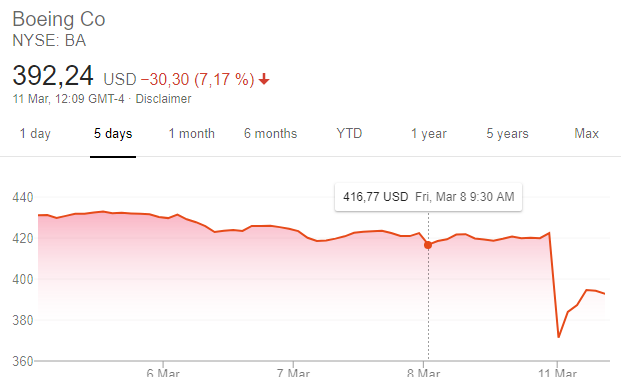
Boeing plays down system flaws as two planes crash and the B737 Max 8 is grounded in China.

It is difficult to avoid the conclusion that management decisions by Boeing, and lax regulatory oversight to help Boeing in the competition against the A320, have now together contributed to two crashes and 346 deaths.

Any passenger on a B737 Max 8 would be justified in asking – before boarding –  if the pilots knew how to override the MCAS system


In October 2018, a Lion Air Boeing 737 Max 8 flying from Jakarta on a domestic flight crashed 13 minutes after take-off, killing all 189 passengers and crew on board.

Now an Ethiopian Airlines Boeing 737 Max 8 has crashed, again shortly after takeoff killing 157.

It is highly likely that in spite of much “damage control” publicity aimed at blaming the pilots in the Lion Air case, it was a design flaw in in a little known system which forced both planes to crash.

Lion Air Flight JT610went down shortly after takeoff in October 2018. A little-known system known as the Maneuvering Characteristics Augmentation System (MCAS) was suspected to be a factor in the disaster, according to a preliminary report by Indonesian investigators in November. MCAS is an automatic feature that detects if the nose of the plane is pitched up too high and pushes it down to prevent the craft from stalling. The system is needed since the engines on the 737 Max are bigger than previous models of 737s. …… 

In the Lion Air crash, Indonesian investigators suspect a faulty sensor triggered the MCAS system, forcing the nose of the plane down. The preliminary report determined the pilots tried to raise the nose of the aircraft more than 20 times during the 11 minutes it was in the air. Eventually, the pilots told air traffic controllers they were flying the plane manually and couldn’t determine their altitude. The plane plunged into the sea moments later.

The similarities between the two crashes are unlikely to be just coincidence.

  • Both Aircraft Were Boeing 737 MAX 8s
  • Both Crashes Happened Shortly After Takeoff
  • Both pilots Struggled to Maintain A Steady Climb
  • Both were first Flights of the Day

What is of more relevance is that Boeing (allowed by the FAA) decided it was not necessary to inform pilots about software changes to the MCAS system to save on pilot retraining costs. Ways of getting around the design flaw which kept forcing the nose down were not disseminated in the effort to downplay the flaw and to save costs. The NYT reported on 3rd February:

Boeing’s strategy set off a cascading series of engineering, business and regulatory decisions that years later would leave the company facing difficult questions about the crash in October of a Lion Air 737 Max off Indonesia. …….

……. But the tragedy has become a focus of intense interest and debate in aviation circles because of another factor: the determination by Boeing and the F.A.A. that pilots did not need to be informed about a change introduced to the 737’s flight control system for the Max, some software coding intended to automatically offset the risk that the size and location of the new engines could lead the aircraft to stall under certain conditions.

That judgment by Boeing and its regulator was at least in part a result of the company’s drive to minimize the costs of pilot retraining. And it appears to have left the Lion Air crew without a full understanding of how to address a malfunction that seems to have contributed to the crash: faulty data erroneously indicating that the plane was flying at a dangerous angle, leading the flight control system to repeatedly push the plane’s nose down.

…… Those decisions ultimately prompted the company, regulators and airlines to conclude that training or briefing pilots on the change to the flight control system was unnecessary for carrying out well-established emergency procedures.

It is difficult to avoid the conclusion that management decisions by Boeing, and lax regulatory oversight to help Boeing in the competition against the A320, have now together contributed to two crashes and 346 deaths.

China has now grounded all Boeing 737 max 8 aircraft.


International Days of Ridiculousness

March 9, 2019

The entire concept of declaring special Days to commemorate something is unsound and faintly ridiculous. It is also counter-productive.  One special day for something inevitably implies 364 (or 365) other, less special days for that something. Every new Day that is declared dilutes and degrades all other special Days.

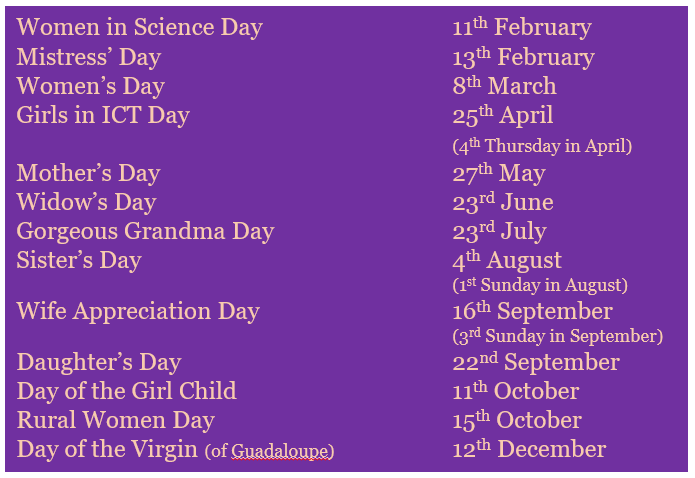
Yesterday was International Women’s Day. But the calendar is getting crowded.

Of course, the days declared by the UN to be International Days are generally well-meaning but end up being sanctimonious nonsense.

I find them irritating and the fact that a a “Day” has been declared, and especially by the UN, is sufficient to alienate me from the cause being promoted.

The United Nations designates specific days, weeks, years and decades as occasions to mark particular events or topics in order to promote, through awareness and action, the objectives of the Organization.

Some of the more ridiculous days are listed below. English, French, Russian, Spanish and Arabic have special Days. Swedish, German, Hindi and Tamil are not so honoured. Why? An International Day for every spoken language perhaps? Should one declared special day be more significant than any other?

More nonsense emanates from the UN than from any other body. Whether enough good comes from the UN to offset the nonsense is no longer very clear for me.

10 February World Pulses Day (A/RES/73/251)
13 February World Radio Day (A/RES/67/124)
21 February International Mother Language Day (A/RES/56/262)
20 March International Day of Happiness (A/RES/66/281)
20 March French Language Day (French)
21 March International Day of Nowruz (A/RES/64/253)
21 March International Day of Forests (A/RES/67/200)
23 March World Meteorological Day [WMO] (WMO/EC-XII/Res.6)
4 April International Day for Mine Awareness and Assistance in Mine Action (A/RES/60/97)
20 April Chinese Language Day (Chinese)
22 April International Mother Earth Day (A/RES/63/278)
23 April English Language Day
23 April Spanish Language Day (Spanish)
26 April World Intellectual Property Day [WIPO]
30 April International Jazz Day (UNESCO 36 C/Resolution 39)
2 May World Tuna Day (A/RES/71/124)
16 May International Day of Living Together in Peace (A/RES/72/130)
16 May International Day of Light [UNESCO] (UNESCO 39 C/Resolution 16)
17 May “Vesak”, the Day of the Full Moon (A/RES/54/115)
1 June Global Day of Parents (A/RES/66/292)
3 June World Bicycle Day (A/RES/72/272)
6 June Russian Language Day (Russian)
7 June World Food Safety Day (A/RES/73/250)
8 June World Oceans Day (A/RES/63/111)
16 June International Day of Family Remittances (A/RES/72/281; GC 38/Resolution 189)
18 June Sustainable Gastronomy Day (A/RES/71/246)
21 June International Day of Yoga (A/RES/69/131)
25 June Day of the Seafarer [IMO] (STCW/CONF.2/DC.4)
29 June International Day of the Tropics (A/RES/70/267)
30 June International Asteroid Day (A/RES/71/90)
12 September United Nations Day for South-South Cooperation (A/RES/58/220)
16 September International Day for the Preservation of the Ozone Layer (A/RES/49/114)
21 September International Day of Peace (A/RES/36/67) (A/RES/55/282)
27 September World Tourism Day
30 September International Translation Day (A/RES/71/288)
9 October World Post Day (UPU/1969/Res.C.11)
20 October (every five years, beginning in 2010) World Statistics Day (A/RES/69/282)
19 November World Toilet Day (A/RES/67/291)
21 November World Television Day (A/RES/51/205)
5 December World Soil Day (A/RES/68/232)
11 December International Mountain Day (A/RES/57/245)
12 December International Day of Neutrality (A/RES/71/275)
18 December Arabic Language Day (Arabic)


A bird’s eye view of the rise and fall of ISIS

March 6, 2019

The simple reality is that it was the support for anti-Assad groups which enabled and fueled the growth of ISIS.

In their fervor to get rid of Assad and effect regime change in Syria, Obama and the EU (led by France) and Saudi Arabia supported varied, and sometimes barbarous, parties as long as they were opposed to Assad. Russia supported Assad but this support was constrained by the Obama/EU led coalition. Many of the anti-Assad rebel groups were already associated with – or became – ISIS which eventually extended from Syria to Iraq. Being anti-Assad, all the rebel groups, and even the most fanatic ISIS units, received money and materials from Obama’s US and the EU. As Sunnis, ISIS also received funding from Salafist sources in Saudi Arabia. Turkey was very happy to see Assad opposed but didn’t like the growth of Kurdish forces opposed to ISIS in “Kurdistan”. ISIS kept growing and expanding their territory throughout the period of US/EU support for the anti-Assad groups. The Iraqis were happy to accept support from Iran (Shia) to oppose ISIS. Obama – albeit reluctantly – refrained from attacking ISIS in Iraq because they were anti-Assad. On Obama’s watch, the US presence in Iraq effectively allowed the unchecked growth of ISIS.

Then Obama lost to Trump.

The US opposition to the Russians support for Assad was subdued. Putin filled the vacuum. Direct Russian military intervention in support of Assad mushroomed. ISIS and the rebel groups were hammered into submission by the Russians. As ISIS retreated, Assad advanced in Syria. So did the Kurds, as they retook territory from ISIS in Syria and Iraq. Even the US under Trump now joined the winning band-wagon and actively opposed ISIS in Iraq.

And now ISIS is on the verge of destruction. The Caliphate has returned to dreamland. Assad is secure again even if Syrian Kurds are empowered to a much greater extent than they were. Turkey is not very happy. Neither is Saudi Arabia. ISIS (Sunni) influence in Iraq has been decimated and the Shia position (Iran) is greatly strengthened.

The Obama/EU strategy for regime change in Syria, which encouraged the growth of the ISIS monster, which was always naive and ridiculous, is now seen to be a disaster defining Obama’s tenure.

In a nutshell:

The winners are Assad, Putin, the Kurds and Trump’s US. Even the Iranian position in both Iraq and Syria is strengthened.

The clear losers are ISIS, France, the EU, Obama’s US, and Saudi Arabia. Turkey is not very happy.


Without the magic of cause and effect there is no science

March 4, 2019

Causality is existential for all the natural sciences and especially for physics.

Causality is magic. It is magic because why it should be so is inexplicable.

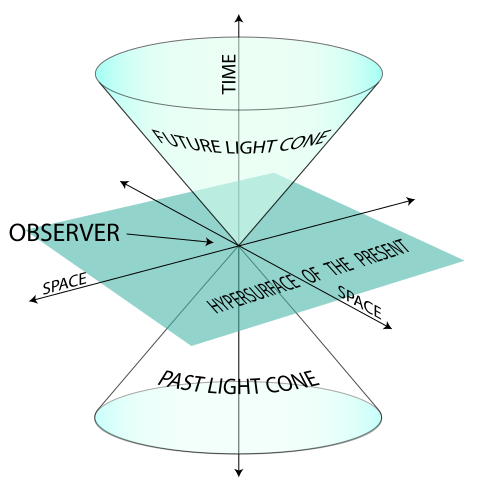
The most fundamental, enabling assumption for all the natural sciences is that identical causes lead to identical effects. The corollary that non-identical events are proof that the causes were not identical is also unquestioned – and unquestionable – for the scientific method. (However it is permitted that different causes may produce effects which are identical). Modern physics and relativity constrain causality. Cause and effect is restricted to the past and future light cones for any event. But this, in itself, implies a region (undefinable) where causality does not apply and does not even try to address why the magic that is causality exists.

Wikipedia

Causality means that an effect cannot occur from a cause that is not in the back (past) light cone of that event. Similarly, a cause cannot have an effect outside its front (future) light cone.

In special and general relativity, a light cone is the path that a flash of light, emanating from a single event (localized to a single point in space and a single moment in time) and traveling in all directions, would take through spacetime.

Being a fundamental assumption, it is not possible for the sciences and the scientific method to address why the assumption of causality exists. The First Cause problem is declared to be uninteresting to science just because it cannot be addressed. Allowing the problem would place all of science within a paradox. If everything has to have a cause then there must be a First Cause. If some things do not need to have a cause then there can be no certainty that anything is the cause of anything else.

The First Cause problem is what actually unifies science and philosophy and theology and religions. None have – or can have – an answer. They just use different labels for the undeniable magic. It has been debated since ancient times but I like the way Bertrand Russel expresses it.

Bertrand Russel- Why I am not a Christian

Perhaps the simplest and easiest to understand is the argument of the First Cause. (It is maintained that everything we see in this world has a cause, and as you go back in the chain of causes further and further you must come to a First Cause, and to that First Cause you give the name of God). That argument, I suppose, does not carry very much weight nowadays, because, in the first place, cause is not quite what it used to be. The philosophers and the men of science have got going on cause, and it has not anything like the vitality it used to have; but, apart from that, you can see that the argument that there must be a First Cause is one that cannot have any validity. I may say that when I was a young man and was debating these questions very seriously in my mind, I for a long time accepted the argument of the First Cause, until one day, at the age of eighteen, I read John Stuart Mill’s Autobiography, and I there found this sentence: ‘My father taught me that the question, “Who made me?” cannot be answered, since it immediately suggests the further question, “Who made God?” ’ That very simple sentence showed me, as I still think, the fallacy in the argument of the First Cause. If everything must have a cause, then God must have a cause. If there can be anything without a cause, it may just as well be the world as God, so that there cannot be any validity in that argument. It is exactly of the same nature as the Hindu’s view, that the world rested upon an elephant and the elephant rested upon a tortoise; and when they said, ‘How about the tortoise?’ the Indian said, ‘Suppose we change the subject.’ The argument is really no better than that. There is no reason why the world could not have come into being without a cause; nor, on the other hand, is there any reason why it should not have always existed. There is no reason to suppose that the world had a beginning at all. The idea that things must have a beginning is really due to the poverty of our imagination. Therefore, perhaps, I need not waste any more time upon the argument about the First Cause.

Russel is wise not to debate it further because penetrating the wall of the unknowable is a futile exercise. It is in the realm of magic.

Leibnitz’s formulation of the Principle of Sufficient Reason is only a formal description of Causality and defines the limits of empiricism and the scientific method. It cannot, however, penetrate the First Cause Problem.

Principle of Sufficient Reason

The Principle of Sufficient Reason stipulates that everything must have a reason, cause, or ground.

This is often formulated as:

  • For every entity X, if X exists, then there is a sufficient explanation for why X exists.
  • For every event E, if E occurs, then there is a sufficient explanation for why E occurs.
  • For every proposition P, if P is true, then there is a sufficient explanation for why P is true.

This is a stipulation, a statement of an assumption. But it is no explanation.

The conclusions I draw are that:

  1. Science is limited to where causality occurs.
  2. Physics admits causality is constrained by past and future light cones.
  3. Physics therefore admits that what lies outside the past and future light cones is unknowable.
  4. Causality is magic.
  5. All science depends upon magic.
 

Arrogance of Ignorance: “I don’t know, but I know you’re wrong”

February 28, 2019

Physics has no clue as to where, how or why the universe began.

Yet, the only thing that all “scientific disciplines” are sure of is that the universe did not begin by any act of any god or on the back of a giant turtle.

There are only two kinds of creation myths that physics (and by that I mean all the “scientific” disciplines) eschew:

  1. The universe as matter and energy has always existed, or
  2. Something was created from nothing

Whether theories about the Big Bang (hot or cold) or cosmic inflation or the naturally occurring “something from nothing” events or loop quantum gravity, they are all creation myths. Just as theories of infinite parallel universes, or cyclic cosmology are also little more than wild speculation. The various mainstream theories of physics and cosmology are as diverse as the Creation Myths of the primitive (“pre-science”) world. And as far-fetched. Conservation of energy and matter have to be ditched – or allowed to vary. Time becomes a parameter emerging from the fabric of our particular universe. All events in the past, present and future exist simultaneously. What existence is becomes uncertain and physics has turned into metaphysics.

Scientific disciplines do not like to contemplate the reality of the unknowable because they would then have to admit that the “scientific method” has no tools to address the unknowable. Determinism has to allow the possibility of, if not the inevitability of, omniscience. (It could be argued that determinism starts of by denying the possibility of any divinity or divine intervention and then ends up having to admit that a god-like omniscience is real). Atheism lacks substance and is of no consequence. There is nothing wrong with speculation of course. Most of our scientific advances (albeit in the world of the knowable) have started of as speculation.

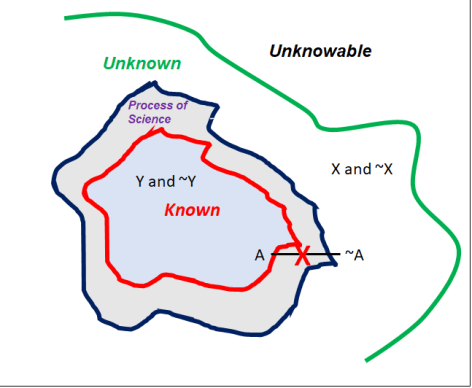
What becomes arrogant, but above all irrational, is when a state of ignorance, of not-knowing, is conflated with a state of knowing that “something is not”.

All beliefs by definition lie in the region of the unknown. Any statement and its negation ( X and not-X) must both either lie in the region of knowledge, or both in the region of the unknown. It is not possible for one to live in the realm of knowledge and its negation to live in the region of the unknown.

It is the arrogance of ignorance and pervades nearly all human activities. It is the breath of life for politicians, TV pundits and “celebrities”. It is the fall-back position for all weak leaders and managers.

“I don’t know, but I know you’re wrong”.


The red thread of the “progressives”

February 26, 2019

It can be sugar-coated but the reality is that abortion is already established as an acceptable method of contraception. It now seems to be that infanticide, immediately after the birth of a baby that could have been eligible for abortion, is also an acceptable method of contraception for US Democrats.

The “progressives” in the US are now finding that infanticide of the newly born can be ethical. Why not babies upto 12 months old?

I am not sure where the “progressives” (typified by the extreme wings of the Democrats in the US, Social Democrats and Liberals in Europe and Labour and Liberals the in the UK) are headed, but their path seems sanctimoniously suicidal.

It seems to me to be more a question of narcissistic self-indulgence than of ethics.


Kejriwal – Fasting unto death?

February 23, 2019

When I was around 10 or 11 and was being punished by my parents for some wrongdoing (usually by the withdrawal of some privilege), I remember I used to “threaten them” that I wouldn’t eat. I remember actually carrying out my threat and missing dinner on two occasions.

My parents were sensible enough not to give in.

There was never a third occasion.

The Chief Minister of the National Capital Region of Delhi, Arvind Kejriwal, is now going on indefinite hunger strike from 1st March to get full statehood for Delhi (and thereby get a salary increase). He says he is prepared to “face death”. Wow!

How brave! How simply frightful! How delightful!

I expect he will face death from a great distance and then turn away.

NDTV:

NEW DELHI: 

Delhi Chief Minister Arvind Kejriwal on Saturday announced that he would start an indefinite hunger strike demanding complete statehood for Delhi next month. “From 1st March I will begin a hunger strike. I am going to fast till we get statehood. I am ready to face death,” Mr Kejriwal said in the assembly.

Gautam Gambhir had the right response to Kejriwal’s histrionics.

Just another manic narcissist.


The unholy trinity causing the growth of antisemitism in Europe

February 21, 2019
  1. Socialists generally see all Jews as part of the Capitalist Enemy. That history goes back to the very beginnings of the Socialist movements in Europe. (It is not to be forgotten that the National Socialists – Nazis – had their socialist connections. They were primarily triggered by their form of anti-communistic socialism where personal interests were to be subordinated to the common good). Radical socialists are so eager to be seen to be pro-Palestine and pro-Hezbollah that they are rabid in their hatred of Israel. With both Jews and Israel being on their hate list it is a simple step to antisemitism.
  2. All Muslims are intrinsically anti-Israel (even if not necessarily anti-Jews). For the not insignificant proportion of radical Muslims, antisemitism is their own article of faith and can be manifested either against Jews or Israel or both. With the increase of Muslims of all sorts in Europe – including the radical kind – it is inevitable that the level of antisemitism is on the rise.
  3. The neo-Nazi descendants of the Nazis. now find themselves on the far right of the political spectrum. They cannot forget their antisemitic roots which lie deep in their souls. However, they are now energised primarily by their opposition to the immigration of “lesser” races and religions (blacks and Muslims). The growth of  these parties as a backlash against Europe’s rather stupidly naive “multiculturalism” carries the strain of antisemitism along with it.

Socialists, neo-Nazis and Muslims make up the unholy trinity now fueling the growth of antisemitism whether in France or Germany or Sweden or in the UK. For the more extreme socialists or Muslims or neo-Nazis, to be antisemitic is a badge of membership. But it is not really very surprising.


Physics cannot deal with nothingness

February 19, 2019

Physics (and all science) is about describing what can be observed and elucidating the causal relationships between observations. The process of science presupposes causality.  If causality is not always a fundamental and pervasive truth, the scientific method cannot elucidate anything. No system of reasoning can prove the assumptions the system itself is built upon. Science cannot, therefore, prove the existence of what it presupposes already exists.  Causality also implies the existence and the flow of time. Effect, it is assumed, can never precede cause. The process of science is necessarily blind to whatever may lie outside its suppositions. Which is why physics cannot deal with the non-existence of time (or space-time) where all the elucidated natural laws must be suspended.

Similarly, physics cannot allow of, or deal with, the unknowable. Many physicists merely deny the unknowable with the proposition that all things that have been, that are or that can be, are knowable and can – in principle – be explained by causality. But denying the unknowable leads to a deterministic world which, in turn, leads to the certainty of omniscience. It does not have to be human omniscience, but omniscience or any omniscient being becomes indistinguishable from a god. Determinism’s omniscience is nothing but divinity through the back door.

The unknowable lies outside the realm of science in general and of physics in particular. Unknowability applies not only to the existence of causality and time but also to the non-existence of nothingness. Clearly “empty” space which has dimensions and which allows the operation of natural laws is not nothing. Space which allows the passage of radiation or gravity waves cannot be nothing. Anything which has, or is attributed, any kind of property cannot be nothing. Our universe is expanding, it is said. It is also said that it is expanding into nothingness; where space and time emerge as the universe expands. But if the surroundings of the universe allow the expansion of the universe then such surroundings have a describable property and cannot be nothing. Nothingness is – and must be – unknowable.

Physics and philosophy both find defining nothingness a slippery business – but so they should, as they must for any unknowable thing.

What Is Nothing? Physicists Debate

…… The first, most basic idea of nothing — empty space with nothing in it — was quickly agreed not to be nothing. In our universe, even a dark, empty void of space, absent of all particles, is still something. “It has a topology, it has a shape, it’s a physical object,” philosopher Jim Holt said during the museum’s annual Isaac Asimov Memorial Debate, which this year was focused on the topic of “The Existence of Nothing.”

As moderator Neil deGrasse Tyson, ….. said, “If laws of physics still apply, the laws of physics are not nothing.”  …… But there is a deeper kind of nothing, argued theoretical physicist Lawrence Krauss of Arizona State University, which consists of no space at all, and no time, no particles, no fields, no laws of nature. “That to me is as close to nothing as you can get,” Krauss said.

Holt disagreed. “Is that really nothing?” he asked.”There’s no space and there’s no time. But what about physical laws, what about mathematical entities? What about consciousness? All the things that are non-spatial and non-temporal.”

Other speakers offered different ideas for nothing, such as a mathematical concept of nothing put forward by science journalist Charles Seife, author of “Zero: The Biography of a Dangerous Idea” (Penguin Books, 2000). He proposed starting with a set of numbers that included only the number zero, and then removing zero, leaving what’s called a null set. “It’s almost a Platonic nothing,” Seife said. The theoretical physicist Eva Silverstein of Stanford University suggested a highly technical nothing based on quantum field theory that involved a quantum system lacking degrees of freedom (dimensions). “The ground state of a gapped quantum system is my best answer,” she said.

Holt suggested another idea of nothing. “The only even remotely persuasive defintition of nothing I’ve heard form a physicist came from Alex Vilenkin,” a physicist at Tufts University, Holt said.”Imagine the surface of a ball. It’s a finite space but with no boundary. Then imagine it shrinking down to a point.” That would create a closed space-time with zero radius.

Every creation myth is about something appearing from nothingness. Even articulated by a physicist every theory about how things came to be, is just another creation myth. The Big Bang singularity is unknowable. I find many of the origin theories unconvincing where nothingness at the macro-level is allowed to produce somethings at the micro level, provided that not-somethings are also produced. Matter begets anti-matter and gravity (negative energy) begets positive energy, and the sum is zero. It is all very conveniently contrived except that why a particular something (and its negation) come to be, rather than some other something remains in the unknowable.

The Creation Hymn in the Rig Veda begins:

Then even nothingness was not, nor existence,
There was no air then, nor the heavens beyond it.
What covered it? Where was it? In whose keeping?

Nothingness is perhaps just where consciousness comes from – and where it goes.


Related:

First nothingness was not, then came the Big Bang and the Gods came later

If space is not empty, what is? The ultimate void?

Knowledge is not finite and some of it is unknowable

On the matter of matter (or how something came from nothing)


Purpose is a consequence only of individual consciousness

February 16, 2019

There seems to be a revival of the 70s concept of Gaia (Mother Earth). The concept, in a haze of hallucinogenic visions, endowed the Earth with consciousness and purpose. It made a new God of the Earth’s biosphere and attained a form of cult status – especially among the mindless and the great unwashed. It seems the millennials too are searching for meaning and purpose and some have revived some of the virtuous and self-righteous cults of 40 -50 years ago.

It brings back the classic dilemma of group versus individual. There can often be conflict between a “group purpose” and an individual. Invoking the “common good” is often used to suppress the individual. Democracy is all about suppressing the minority. Is a group purpose (perceived by who? defined by who?) superior to that of an individual? This is just another manifestation of the same kind of conflict interface which appears between local/global, national/international, bilateral/multilateral and centralised/distributed.

A few months ago I observed:

No Higher Purpose

Consider the characteristics of purpose.

  1. Purpose is not confined only to conscious minds or only to all living things. Purpose, as an objective or a direction, can be attributed to anything. But the attribution and its articulation seems confined to the existence of a conscious mind.
  2. Having (or being attributed with) purpose implies the flow of time. It implies a current state and actions to reach some other desired state at a later time. A purpose can not and does not address a past state.
  3. A purpose as an objective may describe a future state outside the space of perceived causality (and therefore of an imaginary state). But observe that even an imaginary future state can provide a real direction for current actions.
  4. A consciousness does not need to have a purpose and all its actions may be merely reactive. It also follows that if a conscious mind perceives no desired direction (no purpose), then its actions are reactive and merely respond to the prevailing imbalances it experiences.
  5. When more than one conscious mind is involved, individual purposes and the actions they engender, are additive and combine as vectors giving a “net” purpose.

The purpose of purposes is to give direction to actions. If an individual perceives no “higher” group purpose, that individual’s actions are then directed by that individual’s own purposes (or lack of purpose). Even where a group purpose is discernible, it can only be effected by the actions of individuals who subordinate their own purposes to that of the group. “Higher” purpose is irrelevant unless – and until – it is adopted by the entity carrying out the action. A “higher” purpose is ineffective except as disseminated and adopted by the actors.

Ultimately there is no higher purpose than that set or adopted by an individual for himself or herself.

When a group purpose suppresses or overrules an individual purpose, a feedback loop from the individual to the group (registering protest or dissent) is possible. A pseudo group consciousness comes into play (even if that can only be effected through other individuals).

But no form of group consciousness can be ascribed in any way to any species or to life in general or to Evolution or to the Earth or to the Sun.

Ultimately there is no higher purpose than that set or adopted by an individual for himself or herself.

And Mother Earth does not care what humans do or don’t do.