Values embedded in language

March 16, 2019

The most fundamental value there is, is the distinction between “good” and “bad”. It is a characteristic of every individual. For humans this value surely originated from long before we were anatomically modern humans. Within the world of living things, and whether the individual living thing is aware of the value or not, all that aids survival is “good” and all that does not is “bad”.

The fundamental value scale of goodness therefore precedes language. Awareness of the value scale may need consciousness, but what is “good” or “bad” applies to every living thing whether it is conscious or not. Language, of course, is a means of “quantifying” thought. It is language which allows the past and the future and the abstract and the unreal to be described.

Language has allowed us to describe many other value scales. Each scale seems to be independent though it is clear that many of the scales are related. (Length can be related to weight and thickness, beauty can be related to cleverness or to complexity, …….). I cannot find any value scale though, which does not always map – even if sometimes indirectly – to the value scale of goodness.

It is as if “good” and “bad” are embedded in the framework of language, such that every other value scale we may describe always leaves a shadow on the scale of “good” and “bad”. It is therefore we tend to associate certain values with others and, I suspect, it is because of their underlying projection onto the good-bad scale. Beauty is good, noise is bad. Sweet is good, bitter is bad. Tall is good, short is bad. Thin is good and fat is bad. Certain combinations of values feel “right” and others feel very “wrong”. “Tall, slim and beautiful” feels right, but “short, fat and beautiful” is discordant in composition.

Logic and – it would seem – fundamental valuations of good and bad are embedded in language. They make up the framework for language and non-compliance with the inbuilt logic or the values creates discomfort and a discordance.


Lion Air / Ethiopian Air similarity (updated)

March 15, 2019

If

  1. the Ethiopian Air crash was due to the same problem which caused the Lion Air crash, and
  2. Boeing was aware of the problem, and
  3. Boeing had not ensured that Ethiopian could handle the problem,

Then

Boeing has to answer for 157 deaths.


Update 1: Reuters reports that “The trim position of the stabilizer, which moves the jet’s horizontal tail, could help determine whether or not it was set nose down for a steep dive. …. …… part of a stabilizer found in the Ethiopian wreckage was in a unusual position similar to the Lion Air plane”.


Zero Hedge:

Boeing put MCAS in its planes as a protection against an aerodynamic stall, but in the case of the October flight, a sensor malfunction signaled that the plane was in danger when it wasn’t, causing it to dive automatically. Rather than switch off the motor triggering the dives, the pilots tried to counteract it with their controls until it dove into the sea.

The Ethiopian flight showed similar “highly unusual descents followed by climbs”. 

Peter Goelz, a former managing director at the NTSB said: “It certainly puts a magnifying glass on the MCAS system. There’s an implication that there were two similar accidents and that it likely involved the interaction of the MCAS system with the flight of the aircraft.”

Kevin Durkin, an aviation lawyer, said: “If you have a defective product and it turns out Boeing knew about it, this could easily expose them to punitive damages. The standard is whether the company engaged in conduct with a ‘conscious indifference to the safety of others’.”


Every EU country has a fertility rate below the replenishment level

March 14, 2019

Any group of people will eventually become extinct if its fertility rate stays below the replenishment level (2.1 births per woman).  The EU faces the parallel dilemmas of how to

  1. reconcile decreasing fertility rates with any growth strategy
  2. avoiding cultural fragmentation while increasing “non-European” immigration
  3. pay for pensions and the care of the ageing population with a declining “native-born” working population

Eurostat has released its “Birth and Fertility” statistics.

5.075 million babies were born in the EU in 2017, down from 5.148 million in 2016. The total fertility rate reduced to 1.59 births per woman, also down from 1.60 the year before. No country came anywhere near the 2.1 births per woman needed to replenish any population.

France had the highest fertility rate at 1.90 births per woman, followed by Sweden (1.78), Ireland (1.77), Denmark (1.75), and the United Kingdom (1.74). The lowest fertility rates were in Malta (1.26), Spain (1.31), Italy and Cyprus (both 1.32), Greece (1.35), Portugal (1.38), and Luxembourg (1.39).

The average age of first-time mothers is also increasing, at 29.1 compared to 29.0 years in 2016.

The politically correct belief in the EU is that getting a large number of migrants from Africa will boost the work-force and allow pensions and healthcare for the elderly to be maintained. However this has been shown to be a little naive. Many new downsides have been introduced by the new migrants since they have been – relatively – unschooled, unskilled, reluctant to integrate and often requiring a much greater degree of state support, and for a much longer time, than the politicians had hoped for. Many migrants have been slower to enter the work-place than hoped. New stresses are being introduced by the reluctance (or the inability) of the migrants to adapt.

Using immigration alone as an alternative to having children can never work. It only ensures the extinction of the “native population”. Having fewer children in all cases will always lead to the native population becoming extinct. Having fewer children and simultaneously having more immigration, only means that the native born population is swamped and suppressed before becoming extinct. EU politicians are often so enamoured of their pet theories that they are in denial about reality. Immigration can help to provide a demographic breathing space for a limited period and provided the number of migrants can be assimilated. But a permanent, continuous stream of immigration to keep a country alive, while the native population declines, is absurd.

The simple demographic reality (which a few of the Eastern European countries have started to realise) is that any population – if it wants to survive – needs to replenish its children.

The Hungarians have been criticised by the politically correct part of the EU for introducing incentives for having children. This criticism is particularly short-sighted (if not plain stupid). The EU needs fertility rates to increase and soon. Incentives for having children are inevitable and will become standard in almost every country.


Boeing and the “manslaughter” of the 157 killed in the Ethiopian Air crash

March 14, 2019

A few days ago, I commented that:

If the Ethiopian Air crash is a repeat of the Lion Air crash then Boeing has blood on its hands

Well it now seems that Ethiopian crash was indeed a repeat.

And if that is so then there is clearly a case of “manslaughter” possible against Boeing for the 157 lives lost in the Ethiopian crash (though the deaths in the Lion Air crash would be due to “misadventure” rather than “manslaughter”).

BBC:

Dan Elwell, acting administrator at the FAA, said on Wednesday: “It became clear to all parties that the track of the Ethiopian Airlines [flight] was very close and behaved very similarly to the Lion Air flight.”

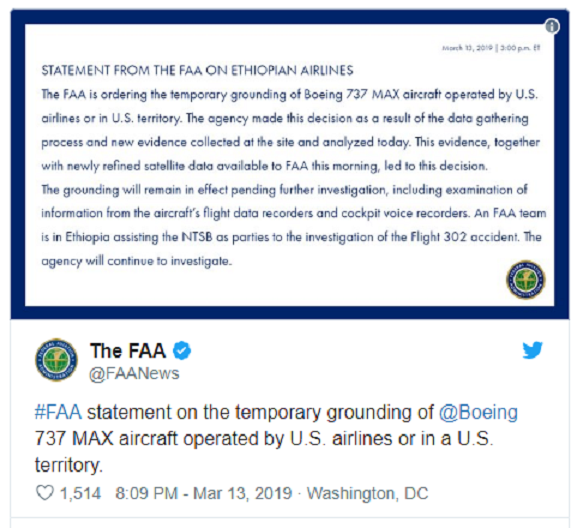
Up until Wednesday, the FAA position was that a review had showed “no systemic performance issues” and that there was no basis for grounding the aircraft.

Earlier in the day, Canada grounded the planes after its transport minister Marc Garneau said he had received new evidence about the crash.

He said that satellite data showed possible similarities between flight patterns of Boeing 737 Max planes operating in Canada and the Ethiopian Airlines plane that crashed.

The flight data is remarkably unstable.

Within the last 12 months I have replaced a phone, a pair of speakers and a router since replacement was cheaper than the diagnosis and repair of a fault. The sophistication of technology in a large number of human appliances (white goods, cars, phones and airplanes) is now such that faults can no longer be rectified by the user. The frequency of faults is declining but when the consequence is the loss of life, that provides no comfort. Specialists – and usually more than one – are needed. In many cases the fault cannot be diagnosed and the faulty appliance is just replaced — with another probably containing the same fault.


NASA database shows that pilots have reported issues in US with new Boeing jet

March 13, 2019

NASA compiles a database of voluntary pilot reports (ASRS) and this database contains at least 2 reports by US pilots who experienced problems with the auto-pilot keeping the nose down on B737 Max 8 & 9 aircraft. It is highly unlikely that the FAA does not factor these in.

Canada today also grounded the aircraft. However they have stated that had studied satellite data and found similarities between the Ethiopian and the Lion Air take-offs.

ASRS:

The ASRS database is the world’s largest repository of voluntary, confidential safety information provided by aviation’s frontline personnel, including pilots, controllers, mechanics, flight attendants, and dispatchers. The database provides a foundation for specific products and subsequent research addressing a variety of aviation safety issues.

The US reports are about the autopilot rather than the anti-stall system. The US experiences are reported in PhysOrg.

Airline pilots on at least two U.S. flights have reported that an automated system seemed to cause their Boeing 737 Max planes to tilt down suddenly.  The pilots said that soon after engaging the autopilot on Boeing 737 Max 8 planes, the nose tilted down sharply. In both cases, they recovered quickly after disconnecting the autopilot..

….

The pilot reports were filed last year in a data base compiled by NASA. ……….. It was unclear whether the accounts led to any actions by the FAA or the pilots’ airlines.

In one report, an airline captain said that immediately after putting the plane on autopilot, the co-pilot called out “Descending,” followed by an audio cockpit warning, “Don’t sink, don’t sink!” The captain immediately disconnected the autopilot and resumed climbing. “With the concerns with the MAX 8 nose down stuff, we both thought it appropriate to bring it to your attention,” the captain wrote. “Best guess from me is airspeed fluctuation” due to a brief weather system overwhelming the plane’s automation.

On another flight, the co-pilot said that seconds after engaging the autopilot, the nose pitched downward and the plane began descending at 1,200 to 1,500 feet (365 to 460 meters) per minute. As in the other flight, the plane’s low-altitude-warning system issued an audio warning. The captain disconnected autopilot, and the plane began to climb. The pilots talked it over later, “but can’t think of any reason the aircraft would pitch nose down so aggressively,” the co-pilot recounted.

Preliminary information released by Indonesian investigators suggests they are looking at the possible role of the Max’s new automated anti-stall technology as a factor in a Lion Air crash in October shortly after takeoff from Jakarta. Data indicates that the pilots struggled with repeated nose-down commands from the plane before it crashed into the Java Sea and killed 189 people.

However, that anti-stall system—called MCAS for its acronym—only activates if the autopilot is turned off, according to documents Boeing has shared with airlines and the FAA. “That’s not to say it’s not a problem,” American Airlines pilot Dennis Tajer said of the incidents reported to NASA, “but it is not the MCAS. The autopilot has to be off for MCAS to kick in.”

……….

It is time for Boeing and the FAA, but primarily for Boeing, to ground the aircrafts till they have sorted out the clearly deficient software.

Boeing share price is in a decline if not yet in a nose-dive.


To be a political pariah

March 13, 2019

I find there is no political party that I can truly identify with.

I disagree every time someone tries to pin a political label on me.

I have the clear perception that for the last 50- 70 years (perhaps since the end of WW2), global politics has been driven by fear and risk-aversion. There have been periods when humans have been driven by wonder and adventurism and courage and there are other periods when alarmism and fear and risk-aversion and CYA prevail. But it is cyclic. No doubt the courage and adventurism will return,

I suppose in the present risk-averse, CYA world, I am a political pariah.

At my age it does not bother me very much.

The list could be much longer of course.


Boeing must itself ground its 737 Max 8 aircraft till software update is completed (in April)

March 12, 2019

Boeing put out a statement last night.

For the past several months and in the aftermath of Lion Air Flight 610, Boeing has been developing a flight control software enhancement for the 737 MAX, designed to make an already safe aircraft even safer. This includes updates to the Maneuvering Characteristics Augmentation System (MCAS) flight control law, pilot displays, operation manuals and crew training. The enhanced flight control law incorporates angle of attack (AOA) inputs, limits stabilizer trim commands in response to an erroneous angle of attack reading, and provides a limit to the stabilizer command in order to retain elevator authority. 

Boeing has been working closely with the Federal Aviation Administration (FAA) on development, planning and certification of the software enhancement, and it will be deployed across the 737 MAX fleet in the coming weeks. The update also incorporates feedback received from our customers.  

The FAA says it anticipates mandating this software enhancement with an Airworthiness Directive (AD) no later than April. We have worked with the FAA in development of this software enhancement.

Today a number of other countries and airlines have grounded the aircraft. The UK joined the ban following Ethiopia, Singapore, China, France, Ireland, Germany, Australia, Indonesia and Malaysia. TUI and Norwegian are among the airlines which have also grounded the aircraft.

It seems to me that instead of getting all their lobbyists to cast doubt on pilots or their training it should be Boeing which itself grounds the aircraft. When Boeing itself is introducing the software enhancement as a result of the Lion Air crash, and possibly has the 157 deaths of the Ethiopian crash on their plate, it is unconscionable for them to allow the planes to fly.They cannot lean back and use the FAA as their backstop. The FAA itself needs to develop a backbone when it comes to US manufacturers.

Boeing cannot just take the position that once was accident, the second merely coincidence and wait for a third crash.


If the Ethiopian Air crash is a repeat of the Lion Air crash then Boeing has blood on its hands

March 11, 2019

If the Ethiopian Air Boeing 737 Max 8 crash turns out to be a repeat of the Lion Air crash just four months ago, then it does not matter whether or not Boeing issued new pilot training manuals or not. It would be a repeat of a crash with a new aircraft within 4 months with devastating effects. Boeing cannot wash their hands off how the same error could have been allowed to happen again. I observe that they claim to have issued new training manuals after the Lion Air crash and are said to have quietly introduced some software patches.

Boeing share price was initially hit. But I also observe that some “analysts” are already trying to shield Boeing and suggesting that perhaps Ethiopian Air may not have been up-to-date with training their pilots. Others chip in that Boeing cannot be held responsible for bad or obsolete pilot training. Other technical “experts” are also being deployed across the air waves to claim that there is no fundamental design flaw. The Boeing protection lobby has swung into action and the share price is now recovering.

But if, for whatever reason, it is a repeat crash then it is clear that Boeing did not do enough to make sure that such loss of life never happened again. 

The blood of the 157 who died are then clearly on Boeing’s hands. How far the FAA shares some blame will probably never be revealed.


Related:

Are Boeing and the FAA complicit in two B737 Max 8 crashes and 346 deaths?


Are Boeing and the FAA complicit in two B737 Max 8 crashes and 346 deaths?

March 11, 2019

Boeing plays down system flaws as two planes crash and the B737 Max 8 is grounded in China.

It is difficult to avoid the conclusion that management decisions by Boeing, and lax regulatory oversight to help Boeing in the competition against the A320, have now together contributed to two crashes and 346 deaths.

Any passenger on a B737 Max 8 would be justified in asking – before boarding –  if the pilots knew how to override the MCAS system


In October 2018, a Lion Air Boeing 737 Max 8 flying from Jakarta on a domestic flight crashed 13 minutes after take-off, killing all 189 passengers and crew on board.

Now an Ethiopian Airlines Boeing 737 Max 8 has crashed, again shortly after takeoff killing 157.

It is highly likely that in spite of much “damage control” publicity aimed at blaming the pilots in the Lion Air case, it was a design flaw in in a little known system which forced both planes to crash.

Lion Air Flight JT610went down shortly after takeoff in October 2018. A little-known system known as the Maneuvering Characteristics Augmentation System (MCAS) was suspected to be a factor in the disaster, according to a preliminary report by Indonesian investigators in November. MCAS is an automatic feature that detects if the nose of the plane is pitched up too high and pushes it down to prevent the craft from stalling. The system is needed since the engines on the 737 Max are bigger than previous models of 737s. …… 

In the Lion Air crash, Indonesian investigators suspect a faulty sensor triggered the MCAS system, forcing the nose of the plane down. The preliminary report determined the pilots tried to raise the nose of the aircraft more than 20 times during the 11 minutes it was in the air. Eventually, the pilots told air traffic controllers they were flying the plane manually and couldn’t determine their altitude. The plane plunged into the sea moments later.

The similarities between the two crashes are unlikely to be just coincidence.

  • Both Aircraft Were Boeing 737 MAX 8s
  • Both Crashes Happened Shortly After Takeoff
  • Both pilots Struggled to Maintain A Steady Climb
  • Both were first Flights of the Day

What is of more relevance is that Boeing (allowed by the FAA) decided it was not necessary to inform pilots about software changes to the MCAS system to save on pilot retraining costs. Ways of getting around the design flaw which kept forcing the nose down were not disseminated in the effort to downplay the flaw and to save costs. The NYT reported on 3rd February:

Boeing’s strategy set off a cascading series of engineering, business and regulatory decisions that years later would leave the company facing difficult questions about the crash in October of a Lion Air 737 Max off Indonesia. …….

……. But the tragedy has become a focus of intense interest and debate in aviation circles because of another factor: the determination by Boeing and the F.A.A. that pilots did not need to be informed about a change introduced to the 737’s flight control system for the Max, some software coding intended to automatically offset the risk that the size and location of the new engines could lead the aircraft to stall under certain conditions.

That judgment by Boeing and its regulator was at least in part a result of the company’s drive to minimize the costs of pilot retraining. And it appears to have left the Lion Air crew without a full understanding of how to address a malfunction that seems to have contributed to the crash: faulty data erroneously indicating that the plane was flying at a dangerous angle, leading the flight control system to repeatedly push the plane’s nose down.

…… Those decisions ultimately prompted the company, regulators and airlines to conclude that training or briefing pilots on the change to the flight control system was unnecessary for carrying out well-established emergency procedures.

It is difficult to avoid the conclusion that management decisions by Boeing, and lax regulatory oversight to help Boeing in the competition against the A320, have now together contributed to two crashes and 346 deaths.

China has now grounded all Boeing 737 max 8 aircraft.


International Days of Ridiculousness

March 9, 2019

The entire concept of declaring special Days to commemorate something is unsound and faintly ridiculous. It is also counter-productive.  One special day for something inevitably implies 364 (or 365) other, less special days for that something. Every new Day that is declared dilutes and degrades all other special Days.

Yesterday was International Women’s Day. But the calendar is getting crowded.

Of course, the days declared by the UN to be International Days are generally well-meaning but end up being sanctimonious nonsense.

I find them irritating and the fact that a a “Day” has been declared, and especially by the UN, is sufficient to alienate me from the cause being promoted.

The United Nations designates specific days, weeks, years and decades as occasions to mark particular events or topics in order to promote, through awareness and action, the objectives of the Organization.

Some of the more ridiculous days are listed below. English, French, Russian, Spanish and Arabic have special Days. Swedish, German, Hindi and Tamil are not so honoured. Why? An International Day for every spoken language perhaps? Should one declared special day be more significant than any other?

More nonsense emanates from the UN than from any other body. Whether enough good comes from the UN to offset the nonsense is no longer very clear for me.

10 February World Pulses Day (A/RES/73/251)
13 February World Radio Day (A/RES/67/124)
21 February International Mother Language Day (A/RES/56/262)
20 March International Day of Happiness (A/RES/66/281)
20 March French Language Day (French)
21 March International Day of Nowruz (A/RES/64/253)
21 March International Day of Forests (A/RES/67/200)
23 March World Meteorological Day [WMO] (WMO/EC-XII/Res.6)
4 April International Day for Mine Awareness and Assistance in Mine Action (A/RES/60/97)
20 April Chinese Language Day (Chinese)
22 April International Mother Earth Day (A/RES/63/278)
23 April English Language Day
23 April Spanish Language Day (Spanish)
26 April World Intellectual Property Day [WIPO]
30 April International Jazz Day (UNESCO 36 C/Resolution 39)
2 May World Tuna Day (A/RES/71/124)
16 May International Day of Living Together in Peace (A/RES/72/130)
16 May International Day of Light [UNESCO] (UNESCO 39 C/Resolution 16)
17 May “Vesak”, the Day of the Full Moon (A/RES/54/115)
1 June Global Day of Parents (A/RES/66/292)
3 June World Bicycle Day (A/RES/72/272)
6 June Russian Language Day (Russian)
7 June World Food Safety Day (A/RES/73/250)
8 June World Oceans Day (A/RES/63/111)
16 June International Day of Family Remittances (A/RES/72/281; GC 38/Resolution 189)
18 June Sustainable Gastronomy Day (A/RES/71/246)
21 June International Day of Yoga (A/RES/69/131)
25 June Day of the Seafarer [IMO] (STCW/CONF.2/DC.4)
29 June International Day of the Tropics (A/RES/70/267)
30 June International Asteroid Day (A/RES/71/90)
12 September United Nations Day for South-South Cooperation (A/RES/58/220)
16 September International Day for the Preservation of the Ozone Layer (A/RES/49/114)
21 September International Day of Peace (A/RES/36/67) (A/RES/55/282)
27 September World Tourism Day
30 September International Translation Day (A/RES/71/288)
9 October World Post Day (UPU/1969/Res.C.11)
20 October (every five years, beginning in 2010) World Statistics Day (A/RES/69/282)
19 November World Toilet Day (A/RES/67/291)
21 November World Television Day (A/RES/51/205)
5 December World Soil Day (A/RES/68/232)
11 December International Mountain Day (A/RES/57/245)
12 December International Day of Neutrality (A/RES/71/275)
18 December Arabic Language Day (Arabic)