The motivation space: Between debilitation and satiation

October 11, 2018

It is an empirical observation that the same person can perform the same action with different degrees of effectiveness depending upon his motivation. The difference between a person being motivated or not for a particular action is a difference, not in his capability or his knowledge or his skill, but must be in the cognitive state of that person when performing that particular action.

In common usage, “manipulation” has a negative connotation but “motivation” is generally regarded as being something positive. This usage reflects the mixing up of what elicits human behaviour on the one hand, with value judgements about the objectives or purpose of causing such behaviour on the other. The means of eliciting behaviour is merely a tool. Manipulating or motivating the behaviour of others is central to being human. Most social interaction involves the influencing of the behaviour of others. I take “motivation” – and particularly “motivation in the work place” – then to be just a particular subset of manipulation to elicit desired human behaviour. By empirical observation, I note that when a person is “motivated” he is not

  • more competent, or
  • more knowledgeable, or
  • more intelligent, or
  • more skillful, or
  • stronger or taller or smarter,

but he is

  • More effective
  • More focused
  • More cooperative
  • More “driven”
  • More dynamic
  • More result-oriented
  • More diligent …….

Thus I take the level of motivation to be a measure of the level of engagement of an individual in the actions he is performing (his behaviour). The more motivated he is the more “effective” his performance is, within the constraints set by his abilities. An unmotivated or demotivated person performs the actions in hand well below the limit of his capabilities. Motivation does not affect capability but it does affect performance.

My basic assumption in my “Engagement” theory of motivation (in preparation) invokes an analogy from the physical world. It is entirely qualitative and only very small parts are subject to quantification. I assume that all human actions (which we call behaviour) are analagous to motion in physics. Further, I take a change to be only in response to a “force of behaviour”. The challenge lies in describing and defining this force. Building on Maslow (Motivation and Personality – 1954) I assume that any human, at any given time, exhibits a “state of human condition” which is a composite of

  1. the levels to which his various needs are satisfied, and
  2. the levels of his various dissatisfactions from deficiencies that are not met

I take “satisfaction of needs” and “dissatisfactions due to deficiencies” as two separate scales, neither of which can be negative and which are not diametrically opposed. Of course there are many needs and many deficiencies and there is a level of satisfaction or dissatisfaction with each of them,

I use the analogy of motivation as a force of human behaviour.  In physics

In physics, a force is any interaction that, when unopposed, will change the motion of an object. A force can cause an object with mass to change its velocity (which includes to begin moving from a state of rest), i.e., to accelerate. A force has both magnitude and direction, making it a vector quantity. – Wikipedia

The analogous definition of motivation then becomes

With human behaviour, motivation is any interaction that, when unopposed, will change the behaviour of a person. Motivation can cause a person having free will to change behaviour (which includes the initiation of behaviour from a state of rest). Motivation has both magnitude and direction, making it a vector quantity. 

Human behaviour is only visible as human actions. For an object to be susceptible to a force it must have mass. The quantity analogous to mass is the freedom of the human to act rationally, i.e. his free will. The force acting on an object must be greater than the sum of all opposing forces in the direction of the acting force, to cause the object to respond. Just as a constrained object may not react to a force, so a constrained human may not react to a motivational force.

For every deficiency there is a tolerable level of dissatisfaction. If this level is exceeded then rational behaviour is no longer possible and an individual can and will only act to reduce the dissatisfaction to the exclusion of everything else. When a deficiency is in the intolerable region the person is debilitated and not amenable to any motivational force. It is the tolerable level of dissatisfactions which defines the behavioural space where manipulation and motivation can be brought into play to influence behaviour.

From Pillai “Engagement theory of motivation”

But it is not only deficiencies and intolerable levels of dissatisfaction which constrain the behavioural space. Rational behavior is also “ignored” when a particular course of behavior only brings more “satisfaction” of a need which has already been satiated. The “satiation boundary” is reached at relatively low levels of satisfaction with Malsow’s lower-order needs and increase sharply as higher-order needs are considered – “mentally satiated” line. At the highest orders of self-actualisation, needs can never be satiated.

(I use“sated” and “satiated” as being identical in meaning).

from Pillai “Engagement theory of motivation”

Intentional motivation can only function within the rational behavioural space and that space lies in the region where deficiencies are not debilitating and needs are not satiated.


Related: https://ktwop.com/2014/07/28/between-debilitation-and-satiation-the-behavioural-space/


On the matter of matter (or how something came from nothing)

October 9, 2018

First you have nothing.

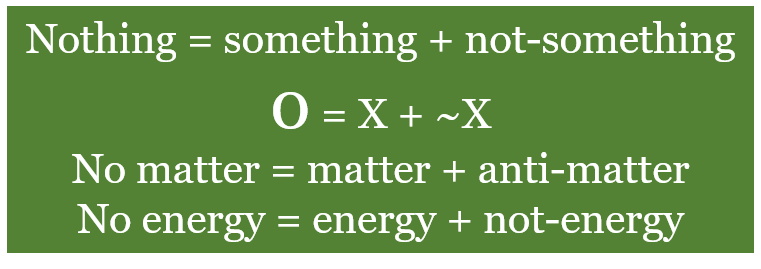
But let’s assume that a smooth and homogeneous “nothing” can spontaneously and inexplicably produce lumps of “something” provided it also produces equivalent amounts of “not-something”, where

something + not-something = nothing

On balance it would still be a global nothing but with local clumps of somethings and not-somethings.

This is a very handy subterfuge often used in science and mathematics. When looking for something unknown, zero can always be converted into the sum of something and not-something. So it is always possible to imagine what the something is, evoke it from zero and claim that the not-something exists but cannot be found.

0 = X + ~X

Anything can be derived from nothing provided its negative counter-part can also be tolerated (in absentia if necessary).

Nothing can be anything

We observe matter.

We haven’t a clue as to where this matter came from. So we devise the concept of matter and an equivalent amount of anti-matter at the origin of everything. But we cannot find this anti-matter in sufficient quantities to negate all the matter we observe. The global nothing is not preserved. That leads to the next subterfuge. It was all energy to begin with. Some of that energy converted itself into matter. That does not quite explain where that energy came from. Of course “nothing” might have decomposed into lumps of energy and of not-energy. The energy, it is then surmised, is that which is driving the expansion of the universe or the inflation of the universe or both. The lumps of not-energy are more elusive. Where that might be is not yet part of the next subterfuge.

It might be that matter has always existed, but in that case where did the energy moving that matter around come from? And why?

Where did all the antimatter go?

Scientists suspect that the Big Bang was a huge tear the fabric of space that ripped equal amounts of matter and antimatter into existence. But today, everything we see is made almost entirely of matter.

Physicists know that something must have happened to tip the balance in favor of matter during the formation of the universe. But the question remains, what was it? Antimatter particles are reflections of their matter counterparts. They are practically identical, except they have opposite electric charges. For instance, the antimatter twin of the negatively charged electron is the positively charged position. If an electron and positron were to meet and metaphorically ‘shake hands,’ they would annihilate each other into pure energy.

Scientists are left with this puzzle: If equal amounts of matter and antimatter were created in the Big Bang—and if matter and antimatter annihilate each other into a ball of pure energy on contact—then the universe should contain nothing but free, unorganized energy. But we exist, and therefore something must have happened to allow matter to survive and antimatter to all but disappear.

Scientists suspect that a tiny portion of matter—about one particle per billion—survived from the early universe to create all the planets, stars and galaxies we see today. And while matter and antimatter look almost identical, scientists discovered that the laws of nature do not apply to them equally.

Researchers found that some matter and antimatter particles can spontaneously transform into their matter and antimatter counterparts. They also found that matter and antimatter particles decay at slightly different rates. Scientists suspect that there is some hidden process influencing the behavior of matter and antimatter—a hidden process that could explain these puzzling observations. US scientists and our international collaborators study the subtle differences in the behavior of matter and antimatter particles at the LHC to paint a clearer picture of why our universe is matter-filled.

The bottom line is that modern physics hasn’t the faintest idea of where the matter and energy in the observable universe came from or why.

At least physics attempts to find answers. Religions brush aside the question and just assume a Creator where the question of where the Creator came from is disallowed.


Rape, the Swedish Academy and the Literature Nobel

October 1, 2018

The task of selecting the Literature Nobel has to be taken away from the Swedish Academy if the prize is not to be forever tainted by the spectre of rape.

Unless all the members of the current Swedish Academy resign and the Academy is reconstituted, the Nobel Foundation will have to take the task of selecting the Literature Prize away from the Academy and give it to some other institution. If not, every future Literature laureate will be forever coupled to an institution which, at best,  turned a blind eye to rape and sexual predation or, at worst, enabled rape and sexual predation. Even changing out all the members may not be enough to take the stain away.

Today Jean-Claude Arnold – referred to in the Swedish media as the “kulturprofilen” (the culture profile) – was sentenced to 2 years in prison for rape. Eighteen women accused him of sexual predation but only one of the cases came to a prosecution. He was married to a member of the Academy. The pair together ran a “club” which received large grants from the Academy.

Jean-Claude Arnault

BBC

A French photographer at the heart of a rape scandal that saw this year’s Nobel Prize for Literature postponed has been handed a two-year prison sentence. On Monday a Swedish court found Jean-Claude Arnault, 72, guilty of raping a woman in an apartment in Stockholm in 2011.

Arnault, who is well known in Sweden, is married to a former member of the centuries-old Swedish Academy.

The crisis forced the academy to cancel this year’s literature award in May. 

In late 2017, some 18 women came forward in a Swedish newspaper to accuse Arnault of sexual harassment and assault in the wake of the #MeToo movement, prompting an investigation by state prosecutors. He later denied all the alleged incidents, many of which were said to have happened at properties owned by the Academy or at his literary club. All but one of the cases ended up being dropped.

In April this year, the Swedish cultural organisation handed over an internal report it had conducted through lawyers to judicial authorities. The same month, it voted against removing Arnault’s wife, the poet and writer Katarina Frostenson, from its 18-person committee. This, along with accusations of conflict of interest and the leaking of Nobel winners’ names, is said to have divided the Academy and sparked a wave of resignations – including by Ms Frostenson and the Academy’s head, Prof Sara Danius. Technically, members of the Swedish Academy cannot resign from their positions, which are assumed for life. But they can stop taking part in its activities.

The members of the Academy have been fighting (like a bunch of horny cats comes to mind) in the media for the last year and a more unedifying spectacle is hard to describe. The unadulterated arrogance and narcissism of the members has been breathtaking.


The limits of science

September 25, 2018
  1. Reality is limited to what is detectable by human senses (and the instruments which extend our senses). What cannot be detected is assumed – but cannot be proven – not to exist. Science is limited to what is known to exist and what is unknown but assumed to be knowable. Science has no means to address what is unknown to be knowable.
  2. Time and causality. Science and its methods rely on causality which in turn relies on the existence of and the passage of time. But what time is and what actually passes, is unknown (being unknowable). Science cannot reach where causality does not exist.
  3. Boundary conditions. There is no branch of science (or philosophy) which does not rely on fundamental assumptions which are taken to be self-evident truths. But these assumptions cannot be proved and they cannot explain their own existence. Science and the methods of science cannot address anything outside their self-established boundary limits.
  4. Even the most fundamental and simple mathematics cannot prove its own axioms (Gödels Incompleteness Theorems). Science cannot address areas outside of the assumptions of mathematics.
  5. Value judgements are invisible to science. The appreciation of any art or music or even literature are not subject to logic or causality or any science. Even the beauty seen by some in mathematics or cosmology or biology is not amenable to scientific analysis. Moral or ethical judgements are beyond the capabilities of science.
  6. The existence of life is self-evident and inexplicable. It is a boundary condition where science has no explanation for why the boundary exists. To call the beginning of life a “random event” is a statement steeped in just as much ignorance as attributing it to a Creator.
  7. The boundaries of consciousness are neither known or understood. The perceptions of a consciousness of the surrounding universe define the universe. The perceptions form an impenetrable barrier beyond which science and the methods of science cannot reach.
  8. Fitch’s Knowability Paradox is sufficient to show the reality of the existence of the unknowable. Neither science nor philosophy or language or mathematics has the wherewithal to say anything about the unknowable. They have no light to shine in this area. An X-ray image cannot be seen in normal light.

Science is utterly dependent upon causality.

So is Determinism, where Determinism is the philosophical theory that all events, including moral choices, are completely determined by previously existing causes. Determinism can never look beyond or resolve the First Cause problem. Of course determinism falls immediately at the hurdle of infinite knowledge being knowable but proponents would counter that “unknown” does not invalidate causality. The First Cause is then merely shunted into the unknown – but knowable. Determinism would claim, by causality and the laws of the universe, that all that was unknown could potentially be known. Equally every event of the past could be traced back through causal relations and be knowable. In fact, determinism which shuns the need for religions and gods, actually claims the existence of Omniscience. More than that, determinism requires that omniscience be possible. Determinism is absurd. “There is no God but Omniscience must be possible”. Reductio ad absurdum.

Causality, determinism and science are all prisoners of, and restricted to, the knowable.


Knowledge is not finite and some of it is unknowable

September 23, 2018

Knowledge is not finite

Knowledge and truth are intertwined. Take knowledge to be made up of truths and of the relationships between truths which are themselves truths. Of course all truths making up human knowledge are only perceived truths. Human knowledge can then only be made up of partial, as-perceived truths (whether or not absolute truths exist) and then can only be a sub-set of all knowledge. Human knowledge consists of justified true beliefs (JTBs).

In the tripartite analysis of knowledge, a justified true belief exists when

  1. a proposition p is true,
  2. an entity S believes p
  3. S is justified in believing p

Addressing now all of knowledge, is it finite or without limits? Is there a limit to all the truths that are, that were and that will be? All of knowledge must encompass all of space, all of time and all of anything beyond space and time. Some things are then self-evident.

  1. In an infinite universe, knowledge is infinite.
  2. If time had no beginning or has no end then knowledge is infinite.
  3. If the number of universes is infinite, knowledge is infinite.

For knowledge to be finite, we would need a finite universe which had no uncertainties at any level and even at the quantum level. The universe could not be open-ended in time. Even if time is an emergent property of something else, that something else could not be open-ended. There could be no duality between particles and waves. Observations would need to be independent of the observer. Moreover, we would also need to know – as a truth – that there were no further truths beyond the finite universe. Even if causality is merely emergent, a perception and unreal, knowledge would still be infinite. Relativity or quantum mechanics or even loop quantum gravity, all require that knowledge be unbounded.

Furthermore, a universe with only a finite number of fundamental particles could still generate an infinite number of truths.

A large but finite number of nodes (junctions) can generate an infinite number of nodes and an infinite network if

  • each node is connected to every other and
  • where a new node is created whenever a connection crosses another connection

In an infinite space, it would not be necessary for connections to cross – but that would then be an infinite universe.

Even with only a finite number of fundamental particles (or waves), the sum of all knowledge would need not only that every particle be known but also that every interaction between particles be known, and also every interaction between the interactions, and so on ad infinitum. (It is somewhat analagous to the human brain where memory is stored not only at every neuron but also in every pathway between neurons, and then in the pathways generated between pathways and so on). Even a finite universe can (and probably does) give an infinite number of truths.

That all of knowledge is finite seems extremely far-fetched if not absurd.

A brain is a repository of knowledge. Clearly human knowledge is just a tiny sub-set of all knowledge and human knowledge is – most likely – finite. The knowledge of humanity will then be the sum of the knowledge of all the humans around at any given time. But the knowledge of humanity will never encompass even the knowledge of all living things with brains, let alone of all things. It may be that a single human brain could itself generate an infinite network, but all our empirical evidence suggests that the human brain is not – and can never be – infinite in its capacity or its capability.

Of course, the human brain may evolve in time into something wondrous. But it will still not reach omniscience.

Not all of knowledge is knowable.

I am persuaded by Fitch’s Paradox that the unknowable exists and is real.

The paradox of knowability is a logical result suggesting that, necessarily, if all truths are knowable in principle then all truths are in fact known. The contrapositive of the result says, necessarily, if in fact there is an unknown truth, then there is a truth that couldn’t possibly be known. More specifically, if p is a truth that is never known then it is unknowable that p is a truth that is never known. The proof has been used to argue against versions of anti-realism committed to the thesis that all truths are knowable. For clearly there are unknown truths; individually and collectively we are non-omniscient. So, by the main result, it is false that all truths are knowable. 

In my world view knowledge comes in three parts.

  1. what is known,
  2. what is unknown but knowable, and
  3. what is unknowable

The unknowable exists and is real.

Most of the past is unknowable. Past events where the repercussions of that event into the present have dwindled into the “noise” from the past are no longer detectable – by any means – as events. Such events can never be traced back as having taken place. The time it takes for the consequences of an event to dwindle into the noise of undetectable nothingness can vary from the immediate past to billions of years. Once below the threshold of detection, that event joins the unknowable. Causality and all the laws of the universe are of no use when the consequences in the present cannot be distinguished and detected. When the data is undetectable, causality is either undefined or inapplicable. For example I cannot remember some events even from this morning. When did I have my second cup of coffee? (I can remember the first). That event – the second cup – has no detectable consequences remaining in my memory or anywhere in the universe. Even omniscience – if it could exist – will not be able to dig up the knowledge of when I had my second cup of coffee. It did happen but exactly when it happened will remain for ever unknown and is now unknowable. While the existence of Genghis Khan is part of knowledge, pretty much all of the events in his life are now unknowable. Certainly his genes have been passed down through the ages but the causal path to backtrack to the “procreational” events he was involved in are now utterly undetectable and unknowable. It is said that some 110 billion humans have lived since the dawn of Anatomically Modern Humans. Most of the events of their lives are unknowable.

Most of the past is now unknowable. Some few isolated major events still can provide evidence of consequences which can be detected in the present.

There is no branch of science or philosophy or language (including mathematics) which does not begin with assumptions taken to be truths but which are not provable. These in fact are boundary conditions of human knowledge. Beyond these boundaries we enter the realm of the unknowable. Science and the methods of science do not have the means to illuminate the unknowable.


Knowledge is infinite, human knowledge is finite and the unknowable exists.


Related:

https://www.forbes.com/sites/startswithabang/2016/01/17/physicists-must-accept-that-some-things-are-unknowable/#6d2c5834ae1a

https://ktwop.com/2018/08/21/when-the-waves-of-determinism-break-against-the-rocks-of-the-unknowable/

https://ktwop.com/2017/10/17/the-liar-paradox-can-be-resolved-by-the-unknowable/


Whether “denial of belief” or “lack of belief”, atheism is a non-ism

September 15, 2018

The conventional use of “atheism” is to describe a denial or a rejection of any belief in religions and gods and deities. To try and avoid the negative connotation of merely rejecting and denying the beliefs of others, some have redefined “atheism” to be the “lack of belief” in religions and gods and deities. As the American Atheists state

Atheism is not an affirmative belief that there is no god nor does it answer any other question about what a person believes. It is simply a rejection of the assertion that there are gods. Atheism is too often defined incorrectly as a belief system. To be clear: Atheism is not a disbelief in gods or a denial of gods; it is a lack of belief in gods.

This replacement of “denial of belief” by “lack of belief” is  merely a cosmetic change. A lack of belief cannot define what there is a lack of belief about. To have a lack of belief in something specific requires that “something” to be defined. That “something” is always gods as variously defined by the beliefs of others. To have a lack of belief in the beliefs of others is no different then to a rejection or denial of those beliefs.

Atheism is entirely reactive. It is concerned with rejecting, denying and ridiculing the belief systems of others. It offers nothing itself in answer to the fundamental questions which led to the rise of religion and their gods in the first place. It is not difficult to attack and ridicule beliefs which – by definition – cannot be proved.  Many prominent atheists in recent times have been philosophers who have criticised religions (and their gods). These include such luminaries as Bertrand Russell and more recently, Christopher Hitchens, Daniel Dennett, and Richard Dawkins. They follow a line of thinkers who go all the way back to when religions were invented. For example, atheist schools existed to counter the Vedic religions as far back as  2,500 – 3,000 years ago. But what is striking is that “atheists” could not exist until religions existed and they had something to attack. (And note that even chimpanzees “believe” in a Sun-god). To criticise religions and their gods is not wrong and I have no time for organised religions and their gods. But that criticism is of no substance unless followed up by addressing the questions which led to the very adoption of the beliefs being torn down.

Atheism is not in itself an “ism”. It is not a belief system or a philosophy or even a practice in itself. It has nothing to defend. It avoids attack because it has no beliefs to offer as answers to the fundamental questions of the beginning of time, the universe and everything. As an “ism” it is empty of substance. (I ignore the “agnostic” which is little more than a politically correct way of avoiding being labelled an “atheist”).

Richard Dawkins prefers distinguishing theist, agnostic and atheist positions along a spectrum of theistic probability—the likelihood that each assigns to the proposition “God exists”

It is only when you get to “determinism” – which incidentally includes a rejection of religions and gods – before the “ism” begins to gain some substance. “Determinism is the philosophical theory that all events, including moral choices, are completely determined by previously existing causes”(But determinism and the limits of science is another story to be discussed elsewhere). To be an atheist provides no substance. You must be something else first.

The proposition that “God Exists” is logically meaningless until “God” is defined. This is the wrong proposition to be addressing. Most religions do not logically come to the conclusion that “God Exists”. They start with that as an assumption which – as with all such assumptions – is taken as self-evident but which cannot be proved. To ridicule this assumption is not difficult. Religions avoid the more fundamental questions by invoking their gods. But this is a method used also by physics and cosmology. The universe is assumed to be homogeneous. The four laws of nature operating in this homogeneous universe are invoked by physicists to avoid the question of why the laws exist in the first place. The Big Bang and Dark Matter and Dark Energy are invoked by cosmologists to avoid the question of why time exists and what time is and what the universe is.

The proposition which must be addressed first is “the unknowable exists”.


Swedish voting procedure – An illusion of secrecy

September 11, 2018

Sweden has a population of just under 10 million and 7.49 million were registered to vote in the general election last Sunday. There were 6005 polling stations so each polling station would deal, on average, with less than 1300 voters. As a comparison, an Indian General Election has 814 million voters and 930,000 polling stations giving an average of less than 900 voters per polling station.

On average a Swedish polling station has 50% more voters than an average Indian polling station. Yet the Swedish voting procedure is almost entirely manual with very little use of electronic devices. Surprisingly, it is also prone to human error in the recording of who has voted.

The voting process has five key steps.

  1. Select a ballot paper from the party of your choice (NOT IN SECRET)
  2. Mark your preference for a particular person on the party list. (IN SECRET).
  3. Put your ballot paper in an envelope. (IN SECRET).
  4. Identify yourself to polling official who crosses you off the electoral list and
  5. places your envelope in the ballot box (NOT IN SECRET).

The voters choice of party is made in Step 1 but there is no pretense of secrecy around this step. The secrecy surrounding Step 3 adds no value. In Step 4 there is no cross check that the name being crossed of the electoral roll is actually the person who has voted.

Considering the voting process as a whole, it is remarkably old-fashioned but steps 1 and 4 are not fit for purpose for even an old-fashioned process.


This year the Swedish election has had international observers. I would be surprised if they did not comment on Steps 1 and 4.


Sweden election 2018: Too many parties spoil the governance

September 9, 2018

We are about to go and vote.

Red/green or Blue or Blue/Brown.

But the simple reality is that Sweden is actually a politically fractured country with 8 significant parties (9 including the Feminist Initiative) who could cross the 4% barrier and get into parliament. There is zero possibility of getting a majority government. Back room deals and the undue influence of minority parties is a foregone conclusion. We have had the undue influence of the Green party in the last Red/Green government. Instead of 2 major parties we will now have 3. The Sweden Democrats is the Joker in the pack.

Whatever transpires we have a politically messy period ahead of us.

There are just too many parties.


Election time in Sweden and stupidity is in the air

August 26, 2018

The Swedish general election takes place in about 2 weeks and it is almost impossible to avoid stupid pronouncements by politicians of all colours and all parties.

There is not a single media outlet which does not have its own agenda. Some openly support a particular party. Others are more sophisticated and oppose particular parties. The most intelligent keep their preferences hidden but support or attack particular policies which, on balance and by a strange coincidence, just happen to be those of a particular party. But there is not a single one which does not have its own agenda. But the worst thing is the oozing, sickly sweet stench of political correctness.

Stupidity is in the air.


And then came counting

August 25, 2018

Origins of human cognitive development go back a lot longer than was once thought. Our first bipedal ancestors who came down from the trees more than 5 million years ago, had  already some concept of “more” and “less” and  perhaps even of rudimentary numbers upto 3 (as rhesus monkeys have today). Genetic analysis of ancient bones is showing that the origin and development of modern humans needs to be taking the Neanderthals and the Denisovans into account and perhaps has to go back at least to the time of a common ancestor from over 1 million years ago. Just considering the last 200,000 years is no longer enough.

I have no doubt that the mastery of fire, the eating of cooked meat, the growth of the brain and, above all, the increased need for cooperation were interconnected and drove human cognitive development. Whether developments happened in one place and spread or happened at many places, perhaps at many times, will always be a matter of speculation. But it is not so difficult to come up with a not implausible time-line of the key developments which gave us first counting and then tallying and arithmetic and geometry and now complex number theory. The oldest evidence we have of counting are tally-sticks from over 50,000 years ago. But counting surely started long before that.


Related:

What led humans to counting and when?

The origins of base 60