The chains of freedom

November 8, 2017

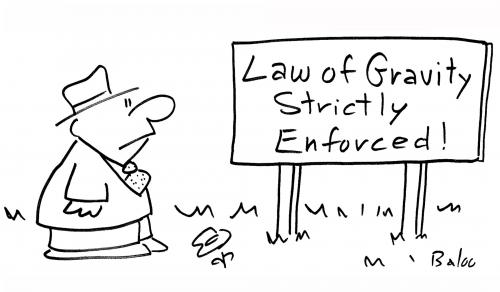
We speak glibly about free will, about the four human freedoms of speech, of religion, from want and from fear. For any entity, living or otherwise, we can define “freedom” as being the “unconstrained power to do”. With that definition, there are no freedoms anywhere because nothing is unconstrained. Nothing, in this universe, has freedom. An electron is not free to be wherever it wishes to be. Even a “free” electron,  untethered to any atom, can only move in compliance with the gravitational and magnetic fields it is subject to, and never faster than the speed of light. The universe itself is inextricably chained to the arrow of time.

At the most fundamental level, the chains of the “natural laws” thus imprison all matter and energy. All living things are then held by the further chains of their genes. Their physical form and attributes and behaviour must lie within the envelopes of possibility fixed by their genes. These chains ensure that a birch tree can never be an oak or a zebra a lion. From the time a seed is planted, it merely reacts to its environment and the changes to that environment. It chooses nothing. In fact, there are no choices to be made.

But humans have free will, it is said. Humans have choices available, it is said. They can choose how they will behave. But I am no longer sure if this is true. Certainly each one of the seven+ billion humans can imagine violating what we understand to be the “natural laws” but not a single one can actually do so. I can imagine myself running faster than Usain Bolt, but it never does, and never will, come to pass. All the chains connecting me to my past are unbreakable. All my possible future states of being are anchored to my current state by another unbreakable chain. All human actions are constrained by

  1. the starting conditions,
  2. what a mind can envisage,
  3. what is physically possible, and
  4. the forces driving the action

Free will, if it exists, is involved in imagining the action and in providing the driving forces for action. Causal Determinism of course allows of no free will. All future events are determined by past events and so on ad infinitum. Some forms of philosophical determinism allow some freedom of choice within a narrow envelope of possible behaviours, though others suggest that the choice of actual behaviour made is, in fact, also predetermined.

I think we need to distinguish between thought and action even if thinking itself is an action. The exercise of free will requires an action. But thinking itself is constrained. Thinking about violating the laws of nature is clearly an act which does not, itself, violate the laws of nature. Thinking about travelling backwards in time itself moves forward in time. Moreover, thinking has its own unbreakable chains. I cannot think, for example, in a language I do not know. What I cannot imagine I cannot even think about. What I cannot imagine is what, to my mind, is unknowable. What is knowable for any mind is a consequence of its capacity, its speed of learning and its knowledge base (experience). Even our possible thoughts then are limited and thus a constraint on our subsequent actions (if any).

image STAR

Every single human is in fact condemned to a life sentence on a prison planet called Earth from which there is no escape. We are in fact prisoners of

  1. what we understand to be the natural laws,
  2. our genes,
  3. the surrounding environment,
  4. our experience, and
  5. our current state

These chains are not susceptible to being broken. Each one of us is so enmeshed in constraining chains that we have few, if any, real freedoms of action.

I am about to make myself a cup of coffee. That was probably determined long before I was born. But I have the illusion that it is a choice I am making freely.


Political Dyslexia

November 7, 2017


Good laws are made to be broken

November 5, 2017

A bad law is one with which nobody complies.

A law which everybody complies with, without any coercion of pain or penalty, is superfluous.

(All natural laws are superfluous in that it is not possible not to comply with them).

Therefore good laws can only exist in the space between bad laws (zero compliance) and superfluous laws (complete compliance), in the space of partial compliance.

Good laws are therefore made to be broken.


Will recognition of “fake news” be followed by “fake science”

November 3, 2017

Collins Dictionary has chosen “fake news” as its word for 2017.

When a partisan publication exaggerates – even wildly – in favour of its own cause, it causes no great surprise.  It is not even too astonishing when it fabricates news or omits news to further its own agenda. The insidious nature of “fake news” is worst when it is a supposedly objective publication which indulges in fake news to further a hidden agenda. So when Breitbart or the Daily Mail or Huffington Post produce much of their nonsense it causes no great surprise and hardly merits the sobriquet of “fake news”, even if much of the “news” is slanted or exaggerated or skewed or just plain lies. It is when a publication, having a reputation for objectivity, misuses that reputation to push its own agenda, that “fake news” takes on a life of its own.

It is not that this is anything new but certainly the US Presidential Election has brought “fake news” to a head. “Fake News” applies though to much more than just US politics. Of course CNN heads the list of purveyors of “fake news”. CNN has never been objective but they once generally checked their facts and used to separate straight reporting from opinion. I used to find them, at least, fairly reliable for factual reporting. But they have abandoned that approach and I find that they not just unreliable but also intentionally misleading. Their “journalists” have all become lobbyists and “CNN” has become synonymous with “Fake News”.

I once was a regular reader of the Washington Post. They were biased but were not unreliable as to the facts. It was quite easy to just discount for bias and get what I thought was a “true” picture. But they, too, have degenerated swiftly in the last 2 years. Stories are not just distorted, they are even fabricated. But the real disappointments for me in the last 24 months has been the New York Times. Not just in the space of US politics. The NYT has its own definitions of what is politically correct in politics, in science and even in the arts. Somewhere along the way they have made a conscious decision that they are “lobbyists” rather than reporters. They have decided that, for what they have defined as being “politically correct”, pushing that view justifies omission, exaggeration, “spinning” and even fabrication. Straight reporting has become extinct.

Lobby groups such as Huff Post and Daily Kos and Red State are full of blatant falsifications but have no news reputation of any significance at stake. They are not, therefore, included in my take on the top purveyors of fake new.

If 2017 has seen the recognition of the widespread use of fake news, I am looking to 2018 to recognise the proliferation of fake science. There is fake science being disseminated every day in big physics (CERN funding), pharmaceuticals, “climate science”, behavioural studies, sociology, psychology and economics. Much of fake science follows funding. Perhaps there will be greater recognition that “good science” is neither decided by nor subject to a poll.


The one or the many

October 31, 2017

It is the classic dilemma of our age which shows up everywhere.

I nearly always tend towards prioritising the one primarily because without the one there cannot be the many, without the local you cannot get to global, without the national there is no international and without the excellence of the few you cannot get the good of the herd. I prefer the highest multiple possible to the lowest common factor. It colours my politics. I prefer the search for excellence rather than the common mediocrity of socialism. I prefer the the internationalism which comes as a consequence of strong nationalism to the bullying of the UN or the EU.

I side with “to each as he deserves” rather than to “each as he desires”. Freedoms flow bottom up from the individual to the group rather than privileges and sanctions flowing from the group down to the oppressed individual.


Eugenics is already being practiced

October 31, 2017

In a survey published in 2008 of the 18 (now 20) countries in EUROCAT, 88% of neural tube defects were detected prenatally and 88% of these were aborted. Of  Downs Syndrome cases, 68% were detected prenatally and 88% of these too were aborted.

Iceland (population of 330,000) has virtually eliminated Downs Syndrome births though in such a small population there are only one or two cases every year. However in Denmark around 98% of Downs Syndrome fetuses are aborted , in France around 77% and even in the US around 67% are aborted.

In Sweden

The mother chose to terminate the pregnancy in 88 percent of cases when the child had anencaphaly, when part of the child’s brain is missing. They also chose abortion in 75 percent of cases where doctors detected bilateral renal agenesis – when the child is missing both kidneys.

Artificial selection

As technology develops, and more fetal abnormalities can be detected, and as abortion becomes less stigmatised, it is not only serious abnormalities which lead to abortion. With abortion on demand, even conditions which are eminently treatable (cleft palate for example) are leading to the choice to abort. The availability and practice of abortion is itself becoming the main vehicle of artificial selection. Correction of fetal defects is usually not possible. Even if genetic “tailoring” for designer babies is not quite there yet, the incidence of fetuses being born with even minor defects is inevitably declining.

Selective abortion is artificial selection, and that is, after all, just eugenics.

Related:

On birth rates, abortions and “eugenics by default”


The universe shouldn’t exist

October 28, 2017

Even if the Standard Model is right and an equal amount of matter and anti-matter was produced at the Big Bang, it still does not explain why the matter and anti-matter did not exterminate each other with a huge flash of energy. Why a huge amount of energy was first triggered to be absorbed to create matter and anti-matter at the Big Bang is brushed aside as being at a singularity, before the laws of physics existed and maybe before even time existed.

CERN has a new press release showing that apart from sign – as the standard model requires – no difference can be detected between a proton and an antiproton.

It is not the new measurements which say the universe should not exist. It is in fact the standard model which says that the universe should not exist. Maybe the standard model has to be modified.

Riddle of matter remains unsolved: Proton and antiproton share fundamental properties

Scientists are still in search of a difference between protons and antiprotons which would help to potentially explain the existence of matter in our universe. However, physicists in the BASE collaboration at the CERN research center have been able to measure the magnetic force of antiprotons with almost unbelievable precision. Nevertheless, the data do not provide any information about how matter formed in the early universe as particles and antiparticles would have had to completely destroy one another. The most recent BASE measurements revealed instead a large overlap between protons and antiprotons, thus confirming the Standard Model of particle physics. Around the world, scientists are using a variety of methods to find some difference, regardless of how small. The matter-antimatter imbalance in the universe is one of the hot topics of modern physics. …….. 

The BASE collaboration published high-precision measurements of the antiproton g-factor back in January 2017 but the current ones are far more precise. The current high-precision measurement determined the g-factor down to nine significant digits. This is the equivalent of measuring the circumference of the earth to a precision of four centimeters. The value of 2.7928473441(42) is 350 times more precise than the results published in January. “This tremenduous increase in such a short period of time was only possible thanks to completely new methods,” said Ulmer. The process involved scientists using two antiprotons for the first time and analyzing them with two Penning traps.

We have to bear in mind  that CERN has a massive confirmation bias. Their primary reason for existence is to confirm the standard model.


The Liar Paradox can be resolved by the unknowable

October 17, 2017

A paradox appears when reasonable assumptions together with apparently valid logic lead to a seeming contradiction. When that happens, then applying the same rules of logic lead to the further conclusion that either

  1. the assumptions were wrong or
  2. that the logic applied was not valid or
  3. that the seeming contradiction was not a contradiction.

Where a paradox lies in wrongly identifying a contradiction, it is just an error. If the paradox is due to an error of applying the rules of logic it is also just a mistake. However sometimes the paradox shows that the logic itself is flawed or inconsistent. That can lead to a fundamental revision of the assumptions or rules of the logic itself. Paradoxes have contributed to whole realm of the philosophy of knowledge (and of the unknowable). Many paradoxes can only be resolved if perfectly reasonable assumptions can be shown to be wrong. Many scientific advances can be traced back to the confrontation of the starting assumptions.

Confronting paradoxes has led to many advances in knowledge. Niels Bohr once wrote, “How wonderful that we have met with a paradox. Now we have some hope of making progress.” A paradox is just an invitation to think again. 

Classical Logic is digital. It allows no grey zone between true and false. What is not true is false and what is not false must be true. This requirement of logic is built into the fabric of language itself. Classical Logic does not allow a statement to be, true and false simultaneously, or neither false nor true. Yet this logic gives rise to the Liar Paradox in its many formulations. The paradox dates back to antiquity and in its simplest forms are the statements

“I am lying”, or

“This statement is false”

There are many proposed ways out of this paradox but they all require some change to the rules of Classical Logic. Some require a term “meaningless” being introduced which requires that a proposition may be neither true nor false. Others merely evade the paradox by claiming that the statement is not a proposition. Bertrand Russel took the radical step of excluding all self reference from the playing field.

Experts in the field of philosophical logic have never agreed on the way out of the trouble despite 2,300 years of attention. Here is the trouble—a sketch of the paradox, the argument that reveals the contradiction:

Let L be the Classical Liar Sentence. If L is true, then L is false. But we can also establish the converse, as follows. Assume L is false. Because the Liar Sentence is just the sentence “L is false,” the Liar Sentence is therefore true, so L is true. We have now shown that L is true if, and only if, it is false. Since L must be one or the other, it is both.

That contradictory result apparently throws us into the lion’s den of semantic incoherence. The incoherence is due to the fact that, according to the rules of classical logic, anything follows from a contradiction, even “1 + 1 = 3.” 

It seems to me that the paradox vanishes if we allow that what is not true is not necessarily false, and what is not false is not necessarily true. The fault lies in our self-determined assumption of the absence of a continuum between true and false. We can as well create a grey zone – some undefined state between and outside the realms of true and false – which would be an unknown state. Perhaps even an unknowable state. It is a strong indication – even if not a proof – that the unknowable exists and that logic needs to be fuzzy rather than digital.

The Liar Paradox is connected to the Fitch Paradox of Knowability

The paradox of knowability is a logical result suggesting that, necessarily, if all truths are knowable in principle then all truths are in fact known. The contrapositive of the result says, necessarily, if in fact there is an unknown truth, then there is a truth that couldn’t possibly be known.

More specifically, if p is a truth that is never known then it is unknowable that p is a truth that is never known. The proof has been used to argue against versions of anti-realism committed to the thesis that all truths are knowable. For clearly there are unknown truths; individually and collectively we are non-omniscient. So, by the main result, it is false that all truths are knowable. The result has also been used to draw more general lessons about the limits of human knowledge. 

Language is invented. Both words and the rules of grammar are invented – not discovered. We are forced to define words such as “infinite” and “endless” and “timeless” attempting to describe concepts which we cannot encompass with our finite brains and our limited physical senses. It is not possible to measure an endless line with a finite ruler.

The unknowable exists and it is therefore that we need the word “unknowable” .


Related:

Known, unknown and unknowable

The unknowable is neither true nor false

Gödel’s Incompleteness Theorems


Could Mount Agung eruption be the VEI 5+ volcano that is overdue?

October 16, 2017

We have not had a VEI 5+ volcanic eruption for 26 years since the Mount Pinatubo eruption in 1991. In 2015, I pointed out that the probability of a VEI 5+ volcano eruption within 5 years was over 95%. The probability of a VEI 5+ eruption in the next two years must now be approaching 99%.

(see also The next VEI 5+ volcanic eruption is overdue).

http://geology.com/stories/13/volcanic-explosivity-index/

It has been 24 26 years since the last VEI 5+ (Mount Pinatubo, 1991, VEI 6) occurred and the probability that a VEI 5+ volcanic eruption will occur within the next 5 years is now over 95%. There are around 10 – 14 VEI 5+ eruptions every hundred years and for the the last 300 years the time between eruptions has been as short as 1 year and as long as 23 years. The current gap could be the longest recorded in three centuries. There are, on average, 2 eruptions of intensity 6 every hundred years and so the probability that an eruption of VEI 6 could occur within 5 years is about 50% (current gap 24 years, average gap 50 years). That a supervolcanic eruption of VEI 7 or greater could occur within the next 5 years is less than 1%.

Mount Agung’s volcanic activity is now reaching levels which suggests that an eruption is “imminent”.

Volcano Agung in Bali is showing worrisome signs of a major eruption, writes German climate blogger Schneefan here. The highest level of activity with multiple tremor episodes were just recorded. You can monitor Agung via live cam and live seismogram.

The 3000-mter tall Agung has been at the highest warning level 4 since September 21.

Schneefan writes that the lava rise has started and that “an eruption can be expected at any time“.

So far some 140,000 people have been evacuated from the area of hazard, which extends up to 12 km from the volcano. Schneefan writes:

Yesterday ground activity by far exceeded the previous high level. Quakes have become more frequent and stronger, which indicates a stronger magma flow (see green in the histogram). Since October 13 there has been for the first time a “nonharmonic trembling (tremor), which can be seen in red at the top of the last two bars of the histogram.”

The colors of the columns in the bar chart from bottom to top stand for perceptible earthquakes (blue) low eartnhquakes (green) surface quakes (orange . Just recently red appeared, signifying non harmonic tremors.  The seismogram below shows what are at times longer period quakes: meaning magma is violently flowing in the volcano. Source: https://magma.vsi.esdm.go.id/.

Since yesterday the seismogram for AGUNG has been showing powerful rumbling (red).

The seismogram of AGUNG shows powerful tremors (level RED). The seismogram is updated every 3 minutes: Source: Seismogramm

Because Agung is located near the equator, a major eruption with ash flying up into the stratosphere would have short-term climatic impacts that could last a few years.

Agung last erupted in 1963 with an explosivity index of VEI 5, sending a plume of ash some 25 km into the atmosphere before leading to a cooling of 0.5°C. The eruption of Pinatubo in the Philippines in 1991 led to a global cooling of 0.5°C.


Stupidity

October 8, 2017

A little irritated today by some stupid behaviour.