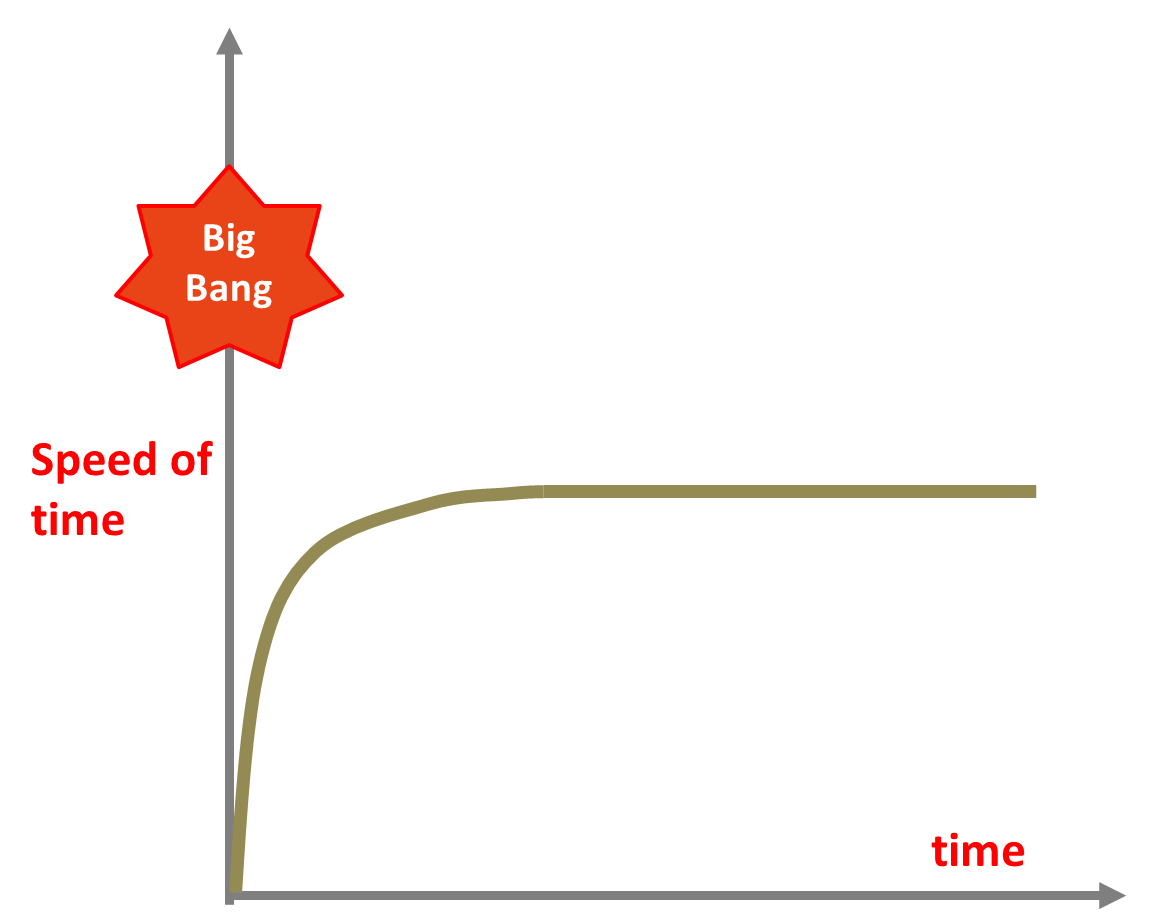
The inherent logic of the universe – but not language – was established by the Big Bang

June 16, 2017

You could call this the First Law of Everything.

Logic is embedded in the universe.

At the Big Bang we have no idea what the prevailing laws were. Physicists merely call it a singularity where the known laws of physics did not apply. It was just another Creation Event. But thereafter – after the Big Bang – everything we observe in the universe is logical. We take logic to be inherent in the Universe around us. We discover facets of this embedded logic empirically and intuitively (and intuition is merely the synthesis of empiricism). We do not invent logic – we discover it. If logic was ever created it was created at the time of the Big Bang.

Language, on the other hand, is invented by man to describe and communicate the world around us. We build into the framework of our languages, rules of logic such that the use of language is consistent with the embedded logic of the universe. But language is not always equal to the task of describing the universe around us. “I have not the words to describe ….”. And then we imbue old words with new meanings or invent new words, or new grammar. But we never make changes which are not consistent with the logic of the universe.

Reasoning with language is then constrained to lie within the logical framework so constructed and therefore, also always consistent with our empirical observations of the universe around us. Given certain assumptions – as expressed by language – always lead to the same logical inferences – also as described by that language. Such inferring, or reasoning, works and – within our observable universe – is a powerful way of extrapolating from the known to the not-yet-known. The logical framework itself ensures that the inferences drawn remain consistent with the logic of the universe.

In the sentence “If A is bigger than B, and if B is bigger than C, then A is bigger than C”, it is the logic framework of the language which constrains if, then and bigger to have meanings which are consistent with what we can observe. The logic framework is not the grammar of the language. Grammar would allow me to say: “If A is bigger than B, and if B is bigger than C, then A is smaller/louder/faster/heavier than C”, but the embedded logic framework of the language is what makes it ridiculous. The validity of the reasoning or of inferring requires that the logic framework of the language not be infringed. “If A is bigger than B, and if B is bigger than C, then A is smaller than C” is grammatically correct but logically invalid (incorrect). However, the statement “If A is bigger than B, and if B is bigger than C, then A is heavier than C” is grammatically correct, logically invalid but not necessarily incorrect.

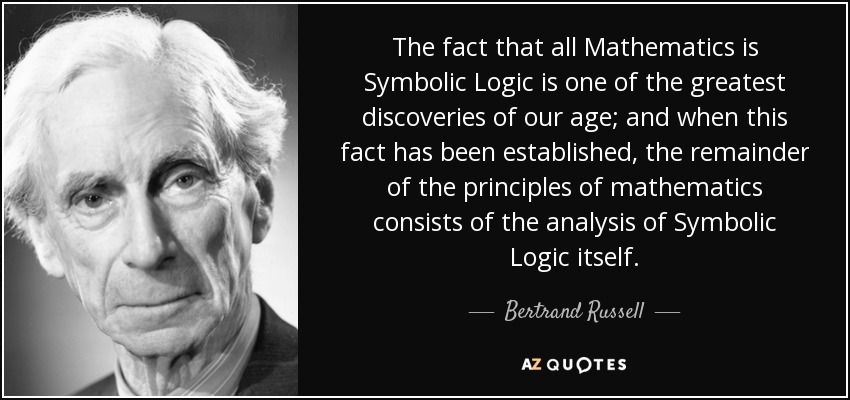
Mathematics (including Symbolic Logic) also contains many languages which provide a better means of describing facets of the universe which other languages cannot. But they all contain a logic framework consistent with the embedded logic of the universe. That 1 + 1 =2 is a discovery – not an invention. That 2H2 + O2 = 2H2O is also a discovery, not an invention. The rules for mathematical operations in the different branches of mathematics must always remain consistent with the embedded logic of the universe – even if the language invented has still to find actual application. Imaginary numbers and the square root of -1 were triggered by the needs of the electrical engineers. Set theory, however, was only used in physics and computing long after it was “invented”.

Languages (including mathematics) are invented but each must have a logical framework which itself is consistent with the inherent logic of the universe.


Number theory was probably more dependent upon live goats than on raindrops

June 14, 2017

It used to be called arithmetic but it sounds so much more modern and scientific when it is called number theory. It is the branch of mathematics which deals with the integers and the relationships between them. Its origins (whether one wants to call it a discovery or an invention) lie with the invention of counting itself. It is from where all the various branches of mathematics derive. The origin of counting can be said to be with the naming of the integers, and is intimately tied to the development of language and of writing and perhaps goes back some 50,000 years (since the oldest known tally sticks date from some 30,000 years ago).

How and why did the naming of the integers come about?  Why were they found necessary (necessity being the cause of the invention)? Integers are whole numbers, indivisible, complete in themselves. Integers don’t recognise a continuum between themselves. There are no partials allowed here. They are separate and discrete and number theory could as well be called quantum counting.

Quite possibly the need came from counting their livestock or their prey. If arithmetic took off in the fertile crescent it well may have been the need for trading their live goats among themselves (integral goats for integral numbers of wives or beads or whatever else they traded) which generated the need for counting integers. Counting would have come about to fit their empirical observations. Live goats rather than carcasses, I think, because a carcass can be cut into bits and is not quite so dependent upon integers.  Quanta of live goat, however, would not permit fractions. It might have been that they needed integers to count living people (number of children, number of wives …..) where fractions of a person were not politically correct.

The rules of arithmetic – the logic – could only be discovered after the integers had been named and counting could go forth. The commutative, associative and distributive properties of integers inevitably followed. And the rest is history.

But I wonder how mathematics would have developed if the need had been to count raindrops.

After all:

2 goats + 2 goats = 4 goats, and it then follows that

2 short people + 2 short people = 4 short people.

But if instead counting had been inspired by counting raindrops, they would have observed that

2 little raindrops + 2 little raindrops = 1 big raindrop.

They might then have concluded that

2 short people + 2 short people = one tall person

and history would then have been very different.


Conservation denies tigers a future as a species

June 13, 2017

There are, it is thought, around 4,000 tigers still living in the “wild”. There may be as many as 8 – 9,000 in captivity (3,000 in China and perhaps 5,000 in the US). The tigers in captivity are in zoos and parks and are, in the US, often bred for “hunting”. Very few (< 100 perhaps) of those in captivity are returned to the “wild” every year. Breeding hybrid tigons and ligers once used to be very popular in zoos but less so now though it is still prevalent for entertainment purposes. The numbers are not very significant.

Tigers are magnificent animals and a cultural icon for humans. No doubt the sabre-toothed tiger was an even more magnificent creature. It is surely a matter of regret that they became extinct a long time ago. As a species they were replaced by others which were more suited to the changing world. If present-day tigers (considered endangered) were to become extinct, it would also be a matter of much regret. But I find the rationale for “conservation” efforts flawed and illogical. The WWF (which is close to being one of my least favourite organisations) writes in a typical woolly-headed, gushing style:

Yet they are more than just a magnificent animal – they are also crucial for the ecosystems in which they live. As top predators of the food chain, tigers keep populations of prey species in check, which in turn maintains the balance between herbivores and the vegetation upon which they feed. Balanced ecosystems are not only important for wildlife, but for people too – both locally, nationally and globally. People rely on forests, whether it is directly for their livelihoods or indirectly for food and products used in our daily lives. ……… Tigers not only protect the forest by maintaining ecological integrity, but also by bringing the highest levels of protection and investment to an area. Tigers are an “umbrella species” – meaning their conservation also conserves many other species in the same area. They are long-ranging and require vast amounts of habitat to survive; an adult male’s home range varies from 150 km2 – 1000 km2.

Tigers are endangered because their habitats are disappearing. That habitat loss is fundamentally irreversible. As a species they already have no significant role to play in the ecosystem prevailing. They have already become a redundant species biologically even if the concept of majestic tigers roaming wild forests still has a massive emotional impact on the selfish human psyche. Creating new tiger reserves – constrained in area by various means –  is little more than creating glorified zoos. They are just parks where the cages are a little bigger.  The tigers themselves are “frozen” into their current, unsuccessful, unsuitable, failed genetic state. They are doomed to continue unchanged and unchanging in a shrinking and ever more unsuitable habitat. There are no natural selection pressures (or artificial selection measures) in play which would make their descendants more capable of surviving in the new habitats due to changes that have already happened and have yet to come. This “conservation” is not about helping the tiger to survive by evolving but is only about freezing them into an increasingly untenable form. It is backwards looking and all about preserving failure.

I am even more convinced that traditional “conservation” is misguided and is done just to satisfy the emotional needs of humans, and not, in any way, forward-looking to help endangered species to adapt and survive into the future.

Fighting against species extinction is to deny evolution   – (ktwop – 2013)

So what then is the objection to – say – tigers becoming extinct which is not just an emotional reaction to the disappearance of a magnificent but anachronistic creature?  The bio-diversity argument is not very convincing and is of little relevance. To artificially keep an unsuccessful species alive in a specially protected environment has no genetic value. It increases the mis-match between the existing environment and the genetic profile needed to survive in that environment. In fact the biodiversity argument is only relevant for “life” in general and never for any particular species or group of species.  It can serve to maintain a very wide range of genetic material in the event of a catastrophe such that some form of life has a chance of continuing. But given a particular environment biodiversity in itself is of little value. …

…. All those species which succeed into the future will be those which continue to “evolve” and have the characteristics necessary to thrive within the world as it is being shaped and changed by the most successful species that ever lived (though we cannot be sure how far some particular species of dinosaur may have advanced). Putting a tiger into a zoo or a “protected” environment actually only preserves the tiger in an “unsuccessful” form in an artificial environment. Does this really count as “saving the species”? We might be of more use to the future of the tiger species if we intentionally bred them to find a new space in a changed world  – perhaps as urban tigers which can co-exist with man.

Smilodon image DinoAnimals.com

I’ll still make a donation to Project Tiger but that is about helping individuals to survive and has nothing to do with saving the species.


First nothingness was not, then came the Big Bang and the Gods came later

June 12, 2017

The Rig Veda was probably written between 1500 and 1200 BC and consists of 10 mandalas (books). The first and tenth books were probably written last. The 129th verse of the tenth mandala contains what is called The Hymn of Creation. Nasadiya sukta

It begins:

Then even nothingness was not, nor existence,
There was no air then, nor the heavens beyond it.
What covered it? Where was it? In whose keeping?

It is not difficult to equate this “then” to “before” the Big Bang and the “it” to all the compressed matter which participated in the Big Bang. (Accepting, of course, that “before” is meaningless when time does not flow).

Then there was neither death nor immortality
Nor was there then the torch of night and day.
The One breathed windlessly and self-sustaining.
There was that One then, and there was no other.

At first there was only darkness wrapped in darkness.
All this was only unillumined water.
That One which came to be, enclosed in nothing,
arose at last, born of the power of heat.

arose at last, born of the power of heat” sounds very like a modern description of the Big BangEven though the Rig Veda’s main 8 mandalas are in praise of various deities, the first and tenth books take a much more agnostic position – perhaps written to bring some balance. The plethora of gods are effectively made subservient to an unknowable, unfathomable creation event. “An atheist interpretation sees the Creation Hymn as one of the earliest accounts of skeptical inquiry and agnosticism”.

Who really knows?
Who will here proclaim it?
Whence was it produced? Whence is this creation?
The gods came later, with the creation of this universe.
Who then knows whence it has arisen?”

First even nothingness was not and existence was not. Then came the creation of the Universe whether by Big Bang or otherwise. And the Gods came later (made by man in the image of man).


The Big Bang singularity is indistinguishable from an Act of Creation

June 11, 2017

Most modern physicists and cosmologists who believe (note – believe) in the Big Bang theory of the Universe believe implicitly in an Act of Creation (the Big Bang Singularity) but then usually ignore the question of how and why the singularity occurred. They focus on the Act of Creation and after but do not address the cause of the singularity or a Creator. Religions of all kinds have their own Creation myths but focus on the presumed Creator much more than on the Act(s) of Creation.

(My own belief is that all religions live in the space of ignorance and physics – like all religions – is ultimately dependent upon Magic).

Stephen Hawking describes the Big Bang Singularity thus:

The situation was different, however, when it was realised that the universe is not static, but expanding. Galaxies are moving steadily apart from each other. This means that they were closer together in the past. One can plot the separation of two galaxies, as a function of time. If there were no acceleration due to gravity, the graph would be a straight line. It would go down to zero separation, about twenty billion years ago. One would expect gravity, to cause the galaxies to accelerate towards each other. This will mean that the graph of the separation of two galaxies will bend downwards, below the straight line. So the time of zero separation, would have been less than twenty billion years ago. 

At this time, the Big Bang, all the matter in the universe, would have been on top of itself. The density would have been infinite. It would have been what is called, a singularity. At a singularity, all the laws of physics would have broken down. This means that the state of the universe, after the Big Bang, will not depend on anything that may have happened before, because the deterministic laws that govern the universe will break down in the Big Bang. The universe will evolve from the Big Bang, completely independently of what it was like before. Even the amount of matter in the universe, can be different to what it was before the Big Bang, as the Law of Conservation of Matter, will break down at the Big Bang. 

Since events before the Big Bang have no observational consequences, one may as well cut them out of the theory, and say that time began at the Big Bang. Events before the Big Bang, are simply not defined, because there’s no way one could measure what happened at them. This kind of beginning to the universe, and of time itself, is very different to the beginnings that had been considered earlier. These had to be imposed on the universe by some external agency.

He goes on, however, to make an unsupportable conclusion.

There is no dynamical reason why the motion of bodies in the solar system can not be extrapolated back in time, far beyond four thousand and four BC, the date for the creation of the universe, according to the book of Genesis. Thus it would require the direct intervention of God, if the universe began at that date. By contrast, the Big Bang is a beginning that is required by the dynamical laws that govern the universe. It is therefore intrinsic to the universe, and is not imposed on it from outside. 

Genesis requires time to begin at 4004 BC and the Big Bang is no different in concept. It too defines the start of time and takes us back to 13.8 (give or take a few) billion years ago. Time is not defined before the Act of Creation – whether by the Big Bang or by the hand of God.

(Note that if the flow of time has a beginning then the concept of a before or an after has no meaning before the beginning of time.  The magical speed of an inconstant time).

Hawking concludes:

The conclusion of this lecture is that the universe has not existed forever. Rather, the universe, and time itself, had a beginning in the Big Bang, about 15 billion years ago. The beginning of real time, would have been a singularity, at which the laws of physics would have broken down. Nevertheless, the way the universe began would have been determined by the laws of physics, if the universe satisfied the no boundary condition. This says that in the imaginary time direction, space-time is finite in extent, but doesn’t have any boundary or edge. The predictions of the no boundary proposal seem to agree with observation. The no boundary hypothesis also predicts that the universe will eventually collapse again. However, the contracting phase, will not have the opposite arrow of time, to the expanding phase. So we will keep on getting older, and we won’t return to our youth. Because time is not going to go backwards, I think I better stop now. 

It seems to me that he contradicts himself when he says “The beginning of real time, would have been a singularity, at which the laws of physics would have broken down. Nevertheless, the way the universe began would have been determined by the laws of physics, …..” 

The Big Bang singularity where the laws of physics do not apply is just another Act of Creation. If the laws of physics do not apply at the singularity then, which laws or whose laws do? Or do the laws of physics change? Do they vary in different universes such as that which may have existed before the Big Bang?

Even a singularity must follow some laws. It is disingenuous of physicists and cosmologists to claim that the laws of physics break down at the Big Bang singularity and not address which or whose laws apply at the singularity. If, however, no laws apply at the singularity then the Singularity is Omnipotent (or Magic or God or whatever other label suits you).

I prefer to think it’s Magic.

The fundamentals of physics are just magic.


Would religions survive if children were not brainwashed into them?

May 25, 2017

Whether “indoctrination” of an empty child’s mind is less reprehensible than the “brainwashing” of an adult mind that has existing beliefs is not the point.  At issue is whether beliefs, which, by definition, exist outside the realm of knowledge, can be force-fed. No religion allows its followers to develop their own beliefs. All religions presume to instill their standard beliefs onto their own adherents and onto potential converts. Can beliefs be externally imposed or must they be developed internally? My own “belief” is that an idea, which is not the result of an individual’s own cognitive processes but is externally imposed, cannot be a true “belief”. All societies permit, and most approve, the indoctrination of children into the religions of their parents (or guardians). Apart from coerced conversions (which are still going on), I would guess that over 95% (and perhaps 99%) of all those who follow a religion, follow that of their parents.

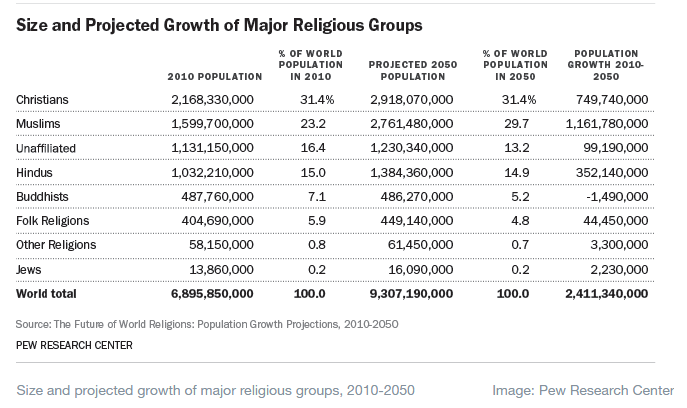
Human behaviour has effectively made religion hereditary. Religion is not controlled by our genes except in that our genes may determine how susceptible we are to indoctrination. Yet our religious beliefs are determined by who our parents are. Unfortunately parents have not succeeded as well in indoctrinating children away from other undesirable behaviour. The growth or decline of religions across the world simply mirrors fertility on the one hand and the coercive conversion of peoples into the religion.

If a group of children were brought up in isolation on a desert island, by robotic instructors confined to teach only in the area of knowledge, and to answer any question in the space of ignorance with a “don’t know”, some of the children may well develop “religious” beliefs with divine power being attributed to the sun and the moon and the winds and the waves. But for there to be war between the sun-worshipers and the wind-worshipers there would first need to be those arrogant enough to anoint themselves as priests. There would be no organised religions without priests appointing themselves as special messengers of the divine powers. There would be no religious wars without “turbulent priests” bent on religious expansion. If every child was allowed, as it felt necessary,  to develop its own religious beliefs, organised religions would never catch hold. And if organised religions did exist they would merely wither and die without a continuous stream of new adherents in the form of brain-washed children growing up.

The problem lies not in whether one believes in gods or not, but in that organised religions exist and that they compete. They compete by claiming that one set of beliefs in the space of ignorance are superior or better than another set, also in the space of ignorance. The claims for the one or for the other are made by turbulent priests. It has been so ever since organised religions came into being. It is still so today, whether it is a mad mullah pronouncing a fatwa or a Hindu God-man calling for the destruction of a mosque or a Buddhist monk attacking unbelievers or a “celibate” Pope pronouncing on family values.

Who will rid us of these turbulent priests?


Sherpas are genetically more efficient at using Oxygen

May 23, 2017

A new paper today confirms that Sherpas are genetically more efficient at using Oxygen. It is another example of an ethnic group where defining characteristics of the group are genetically inherited.

Horscroft, J et al. Metabolic basis to Sherpa altitude adaptation. PNAS; 22 May 2017; DOI: 10.1073/pnas.1700527114

EurekAlertSherpas have evolved to become superhuman mountain climbers, extremely efficient at producing the energy to power their bodies even when oxygen is scarce, suggests new research published today in the Proceedings of the National Academy of Sciences (PNAS). …..

When oxygen is scarce, the body is forced to work harder to ensure that the brain and muscles receive enough of this essential nutrient. One of the most commonly observed ways the body has of compensating for a lack of oxygen is to produce more red blood cells, which are responsible for carrying blood around the body to our organs. This makes the blood thicker, however, so it flows more slowly and is more likely to clog up blood vessels.

Mountain climbers are often exposed to low levels of oxygen, particularly at high altitudes. This is why they often have to take time during long ascents to acclimatise to their surroundings, giving the body enough time to adapt itself and prevent altitude sickness. In addition, they may take oxygen supplies to supplement the thin air.

Scientists have known for some time that people have different responses to high altitudes. While most climbers require additional oxygen to scale Mount Everest, whose peak is 8,848m above sea level, a handful of climbers have managed to do so without. Most notably, Sherpas, an ethnic group from the mountain regions of Nepal, are able to live at high altitude with no apparent consequences to their health – as a result, many act as guides to support expeditions in the Himalayas, and two Sherpas are known to have reached the summit of Everest an incredible 21 times.

Previous studies have suggested differences between Sherpas and people living in non-high altitude areas, known collectively as ‘lowlanders’, including fewer red blood cells in Sherpas at altitude, but higher levels of nitric oxide, a chemical that opens up blood vessels and keeps blood flowing.

Evidence suggests that the first humans were present on the Tibetan Plateau around 30,000 years ago, with the first permanent settlers appearing between 6,000-9,000 years ago. This raises the possibility that they have evolved to adapt to the extreme environment. This is supported by recent DNA studies, which have found clear genetic differences between Sherpa and Tibetan populations on the one hand and lowlanders on the other. Some of these differences were in their mitochondrial DNA – the genetic code that programmes mitochondria, the body’s ‘batteries’ that generate our energy.

To understand the biological differences between the Sherpas and lowlanders, a team of researchers led by scientists at the University of Cambridge followed two groups as they made a gradual ascent up to Everest Base Camp at an elevation of 5,300m.

The study was part of Xtreme Everest, a project that aims to improve outcomes for people who become critically ill by understanding how our bodies respond to the extreme altitude on the world’s highest mountain. This year marks 10 years since the group’s first expedition to Everest.

The lowlanders group comprised 10 investigators selected to operate the Everest Base Camp laboratory, where the mitochondrial studies were carried out by James Horscroft and Aleks Kotwica, two PhD students at the University of Cambridge. They took samples, including blood and muscle biopsies, in London to give a baseline measurement, then again when they first arrived at Base Camp and a third time after two months at Base Camp. These samples were compared with those taken from 15 Sherpas, all of whom were living in relatively low-lying areas, rather than being the ‘elite’ high altitude climbers. The Sherpas’ baseline measurements were taken at Kathmandu, Nepal.

The researchers found that even at baseline, the Sherpas’ mitochondria were more efficient at using oxygen to produce ATP, the energy that powers our bodies.

As predicted from genetic differences, they also found lower levels of fat oxidation in the Sherpas. Muscles have two ways to get energy – from sugars, such as glucose, or from burning fat (fat oxidation). The majority of the time we get our energy from the latter source; however, this is inefficient, so at times of physical stress, such as when exercising, we take our energy from sugars. The low levels of fat oxidation again suggest that the Sherpas are more efficient at generating energy.

The measurements taken at altitude rarely changed from the baseline measurement in the Sherpas, suggesting that they were born with such differences. However, for lowlanders, measurements tended to change after time spent at altitude, suggesting that their bodies were acclimatising and beginning to mimic the Sherpas’.

One of the key differences, however, was in phosphocreatine levels. Phosphocreatine is an energy reserve that acts as a buffer to help muscles contract when no ATP is present. In lowlanders, after two months at high altitude, phosphocreatine levels crash, whereas in Sherpas levels actually increase.

In addition, the team found that while levels of free radicals increase rapidly at high altitude, at least initially, levels in Sherpas are very low. Free radicals are molecules created by a lack of oxygen that can be potentially damaging to cells and tissue.

“Sherpas have spent thousands of years living at high altitudes, so it should be unsurprising that they have adapted to become more efficient at using oxygen and generating energy,” says Dr Andrew Murray from the University of Cambridge, the study’s senior author. “When those of us from lower-lying countries spend time at high altitude, our bodies adapt to some extent to become more ‘Sherpa-like’, but we are no match for their efficiency.” ……

Race is not a social construct as the politically correct would have me believe. Race is real and is a consequence of ancestry. Racial classification is fluid and changes but only over generational time. Sherpa genes help high-altitude living. There are West African genes which help sprinters, East African genes which are beneficial for long-distance runners, Scandinavian genes which predispose to diabetes 1 and Indian genes which predispose to diabetes 2.

And there are genes which predispose to high performance in IQ testing.


Spicing up Swedish food /2 – Köttbullar dopiaza

May 17, 2017

Start with half a kg of your favourite frozen, Swedish meat balls (köttbullar) to feed 2 people.

Though meat balls are now quintessentially Swedish, their origin lies in meat koftas from Turkey going back to around 1750 after King Charles XII’s adventures in the Ottoman Empire. Indian koftas also derive from the Middle East but have accumulated spices and changes of ingredients along the way. Today lamb or mutton or chicken mince is used to make koftas in India but not beef or pork. Spices are used generously and even all vegetarian koftas are used. Frozen meatballs in Sweden usually consist of minced beef or pork or a beef/pork mix  or chicken. They also contain, in various quantities, onions, milk, egg, breadcrumbs, and flour. They are usually seasoned with just salt and pepper and sometimes a little cinnamon.

In an Indian kofta curry, the koftas themselves would be spiced as would the curry. Do-piaza means two onions and any dopiaza dish uses a large quantity of onions added in two separate steps (hence two onions). In this dish the relatively bland köttbullar are marinaded in spices prior to cooking the dopiaza.

Ingredients: 500 g frozen köttbullar, 5 medium onions. 100 g crushed tomatoes, 2 teaspoons chillie powder, (one teaspoon chillie powder can be replaced by 2 green chillies if available), 3 cloves garlic,  2 cm ginger, 2 teaspoons coriander powder, 1 teaspoon cumin powder, 1 teaspoon cumin seeds, seeds from 3 cardamom pods, 1 teaspoon black peppercorns, ½ teaspoon turmeric, 1 teaspoon garam masala, 100 ml plain yoghurt, fresh parsley or dill if coriander is not available.

Mix a marinade of the yoghurt with the coriander powder, cumin powder, cardamom seeds and 1 teaspoon chillie powder. Add in the defrosted köttbullar and make sure that they are all well coated in the marinade. Leave in a fridge for at least 3 hours (overnight is fine).

Chop two onions coarsely and 3 onions very finely. Ginger and garlic should be peeled and crushed (a ginger garlic paste being ideal).

Use a heavy skillet pan with a closely fitting lid.

Heat some oil in the skillet and saute the coarsely chopped onions till they are just softened and translucent. Put aside into a bowl.
Heat some more oil and at high heat fry the cumin seeds and black peppercorns till they spit. Reduce to medium heat and add the rest of the chillie powder and allow to fry for 10-15 seconds. Add the finely sliced onions the ginger, the garlic and the green chillies (if any). Saute together on medium heat for 1 – 2 minutes.

Add the köttbullar together with all the marinade. Add the crushed tomatoes. Braise for 5 -8 minutes on medium heat. Now add the turmeric and stir well. Reduce to very low heat, cover the skillet and cook/simmer for 15 minutes. 

Add the coarsely chopped onions and garam masala. Stir gently and cover again. Leave on low hear for a further 10 minutes.

Garnish with fresh coriander (or dill or parsley).


Serve hot with a long-grain rice.


Spicing up Swedish food /1 – Pyttipanna a la Madras

May 16, 2017

I quite like traditional Swedish food (which is pretty bland but not quite as tasteless as some people imagine). That includes such dishes as isterband, kåldolmar, stekt lever med lök, Janssons frestele, köttbullar. köttgryta, ärtsoppa, pannbiff, pyttipanna, gravad lax, fattiga riddare and gubbröra. 

However, to suit my palate, I tend to tweak most traditional recipes when I am in control of the kitchen. Quite simple modifications can elevate traditional Swedish, everyday dishes (husmanskost) from the merely mundane to the seriously delicious.

Here is number 1.

Pyttipanna a la Madras

The recipe is based on a half-kg bag of frozen pyttipanna (feeds two). A wok (or large frying pan) is most suitable for preparation.

(Of the various frozen brands available, I find the finely diced  – finhackad – versions to be the most suitable for absorbing additional flavours).

Ingredients : half-kg bag of frozen pyttipanna; o.5 tsp cummin seeds; 1 -2 tsp chillie powder (or 4 – 8 large, crushed, dried red chillies); 2 cloves garlic (crushed); half can of crushed tomatoes; 1tsp garam masala;  0.5 tsp black peppercorns, chopped parsley, 2 rashers of bacon, crushed potato chips.

Heat 2 tblsp of cooking oil (olive oil. does not get get hot enough). When hot enough (2 mins) add the peppercorns and cummin till the seeds spit and pop, add and stir fry the red chillies not more than a minute), add the crushed tomatoes. Stir 2 minutes. Add the frozen pytt (which can be pre-cooked in the microwave to save time). Stir fry till done (6 -8 minutes from frozen or 3 minutes with pre-cooked pytt). Sprinkle with crushed potato chips and garam masala.

Top with a fried egg and two crispy bacon rashers for each serving with sliced beetroot or preferably, cucumber, on the side. Garnish with the parsley. Salt to taste.

Options: Frozen prawns can be added together with the frozen pytt. Half a ttsp of mustard seeds can be added and fried with the cummin for extra flavour and texture.


Human evolution wish list

May 9, 2017

Evolution is reactive and has no direction. Evolution only gives the good-enough. If it can be said to have a goal it is the growth in numbers of the surviving population. “Quality of life” is irrelevant to evolution. But if it favoured excellence it could have been much more focused on the “improvement” of humans rather than just the increase of population.

My top ten wish-list.

  1. Inheritable memory
  2. Eyes with light sources
  3. Third eye for uv
  4. Telescopic limbs
  5. Hard-wired translation in the brain
  6. “Intelligence” based fertility
  7. Scent producing organ
  8. Direct absorption of light and heat energy by skin
  9. Organs for production and detection of radio waves
  10. X-ray sight