Seven countries are currently on the US list for immigration restrictions, Iran, Iraq, Libya, Sudan, Yemen, Syria, and Somalia. However there are clear indications from Trump’s chief of staff that other countries could get added to the list. Reince Preibus said on CBS News on Sunday:
“The reason we chose those seven countries was, those were the seven countries that both the Congress and the Obama administration identified as being the seven countries that were most identifiable with dangerous terrorism taking place in their country. …… Now, you can point to other countries that have similar problems, like Pakistan and others. Perhaps we need to take it further. But for now, immediate steps, pulling the Band-Aid off, is to do further vetting for people traveling in and out of those countries,”
These seven countries covered by Trump’s order are also included in a list of countries labeled as specially designated countries (SDCs) that “have shown a tendency to promote, produce, or protect terrorist organizations or their members.” This list – held by the Immigration and Customs Enforcement department (ICE) consists – it is thought – of 35 countries. The list as of 2011 is still available. However, Barack Obama apparently added Israel to this list but his list was later scrubbed from public view.
While the immigration restrictions are temporary, ostensibly to check screening processes, since these 7 countries are “failed states” and cannot provide sufficient information, government to government, further countries from the list may also be subjected to temporary restrictions. I suspect that this is why Saudi Arabia is not on the list. The government there is fully functioning and has probably promised the US information about travellers. (Much of the support for Saudi support for Sunni, terrorist groups, is from non-governmental sources). Pakistan does not always provide information about terrorists which it has – especially if this is Taliban or Kashmir related. It would not be surprising to see immigration from Pakistan also being subjected to restrictions.
These are countries that harbor and train terrorists. These are countries that we want to know who is coming and going in and out of to prevent calamities from happening in this country.
……….. He was elected president in many respects because people knew that he was going to be tough on immigration from countries that harbor terrorists. And I can’t imagine too many people out there watching this right now think it’s unreasonable to ask a few more questions from someone traveling in and out of Libya and Yemen before being let loose in the United States.
ICE List of Specially Designated Countries (SDCs) that Promote or Protect Terrorists
July 2, 2011
Screening Aliens From Specially Designated Countries
The Department of Homeland Security Office of Inspector General issued a report in May 2011 titled “Supervision of Aliens Commensurate with Risk” that details Immigration and Customs Enforcement’s (ICE) detention and supervision of aliens. The report includes a list of Specially Designated Countries (SDCs) that are said to “promote, produce, or protect terrorist organizations or their members”. The report states that ICE uses a Third Agency Check (TAC) to screen aliens from specially designated countries (SDCs) that have shown a tendency to promote, produce, or protect terrorist organizations or their members and that the purpose of the additional screening is to determine whether other agencies have an interest in the alien. ICE’s policy requires officers to conduct TAC screenings only for aliens from SDCs if the aliens are in ICE custody.
According to the report, ICE provided this list of specially designated countries. ICE policy requires officers to perform a TAC for detained aliens from these countries.
All industrialized democracies — and most that are not — require voters to prove their identity before voting. Britain was a holdout, but last month it announced that persistent examples of voter fraud will require officials to see passports or other documentation from voters in areas prone to corruption.
The real problem in our election system is that we don’t really know to what extent President Trump’s claim is true because we have an election system that is based on the honor system. …….. The Justice Department has also opposed every effort by states—such as Kansas, Arizona, Alabama and Georgia—to implement laws that require individuals registering to vote to provide proof of citizenship.
It is politically incorrect to question the US voting system. After all, it is the greatest democracy in the world!
But what is notable among all the various politicians and the media who claim there is no significant ineligible voting is that they all just make bald assertions or state “that there is no evidence of illegal voting”. Of course there isn’t. But there is no evidence that ineligible voting is not happening – or that it is not happening on a large scale. First, data on eligibility is never published and, in most cases is not even collected. The onus is surely on the election commissions to check and ensure that voters are all eligible, not for others to prove that some voters are or were ineligible.
Only citizens are supposed to vote in federal elections. Even “green card holders” are not eligible to vote in federal elections. Since 1996, a federal law has prohibited non-citizens from voting in federal elections, subject to punishment by fines, imprisonment, inadmissibility, and even deportation. But while voter registration forms require that a box for citizenship be ticked (a self-declaration), the immigration status for non-citizens is rarely – if ever – checked. There are virtually no prosecutions and even then, only if someone complains against a particular individual.
Non-U.S. citizens are not allowed to vote in the federal elections. Non-U.S. citizens include Green Card holders, those in the U.S. on nonimmigrant visas, undocumented immigrants, refugees and asylees. These categories of immigrants do not have the right to vote for the President of the U.S.
Natural born U.S. citizens and naturalized citizens can vote in the Presidential Elections. U.S. citizens have more rights than legal permanent residents. Green Card holders can remain in the U.S., work here and also bring certain categories of relatives to the country. But they are not granted all the rights granted to U.S. citizens, including the right to vote, serve on juries and work in certain government positions. Though the immigration status granted to legal permanent residents is permanent, they might lose their Green Cards if they commit deportable crimes.
Green Card holders who misrepresent their status as a U.S. citizen and vote in the federal election are more likely to lose their immigration status in the U.S. This misrepresentation can also make them deportable from the country.
Federal law does not prevent non-citizens from voting in state or local elections.
I have heard many anecdotes of green card holders (by definition non-citizens) who did vote in the 2016 US elections. This is not definitive evidence of course but suggests that very little checking is done. What is even more remarkable, and quite amazing, is that neither identification nor proof of status as a citizen is required as a matter of routine when voting.
Plain stupidity.
The bottom line is that no non-citizen is eligible to vote. The opposition to having ID to vote is primarily from politicians who wish to make use of ineligible voting. A large number of the voters – especially in States like California – in the 2016 elections were non-citizens. A significant number were green-card holders.
Stupidity
Add to this that even citizens are permitted to be registered in more than one state. They are not supposed to vote more than once, but there is no check that they do not.
It is not just likely – but is highly probable – that as many as 5 million voters in the 2016 presidential election were ineligible to vote.
………. A voter registration form was thrust in my hands. The very first item on these forms, in Virginia and the rest of America, was “I am a citizen of the United States of America,” with YES and NO blocks to check.
“Don’t I need to show you some proof of citizenship?” I asked. She replied “no.” I asked her how she could verify that I wasn’t lying. Sensing she might be on a slippery slope, she called over a supervisor from the Registrar’s Office and told the woman of my concern. The official told me they never checked citizenship status because I would be penalized if I lied. Really? So I asked her how she would verify my truthfulness, or those of the dozens of new voters being registered that day. Defensively, she replied that they checked all registrations for accuracy at the Registrar’s Office when they were turned in.
I called the Registrar Monday, and asked if they do indeed verify citizenship status. I was told that they didn’t unless someone made a specific complaint against an individual applicant.
……… nobody at the Registrar’s Office is checking citizenship.
The brutal truth is that illegal aliens vote, and in large numbers. Voter fraud is not exclusive to illegal aliens. There are also legal aliens (green card, H1B visas, tourist visa holders, etc.) who vote illegally. And it’s not just Latin Americans. The non-citizen demographic includes South Asian tech workers, Irish overstays, West and Horn of Africa immigrants, and Asian students. Then there are dual-state voters (college kids, snowbirds, transients), reincarnated voters, and un-purged voters long moved from their precincts.
While few cases are prosecuted, it’s not because few crimes are committed.
So much for the greatest democracy in the world where – in my estimation – upwards of 5% of the votes cast are ineligible.
The three Milankovitch orbital cycles, due to eccentricity (100,000 years), axial tilt (41,000 years), and precession (23,000 years) have long been thought to be connected to the onsets of glacial or interglacial conditions. New research now suggests that growth of sea ice in the Southern Hemisphere at particular times of the Milankovitch cycles could be the trigger for a new glacial age. The work suggests that different orbital cycles have been predominant at different times.
“For the past million years or so, the 100,000-year glacial cycle has been the most prominent. But before a million years ago, paleoclimate data suggest that pace of the glacial cycle was closer to about 40,000 years. That suggests that the third Milankovitch Cycle, which repeats every 41,000 years, was dominant then.”
Jung-Eun Lee, Aaron Shen, Baylor Fox-Kemper, Yi Ming. Hemispheric sea ice distribution sets the glacial tempo. Geophysical Research Letters, 2017; DOI: 10.1002/2016GL071307
Abstract
The proxy record of global temperature shows that the dominant periodicity of the glacial cycle shifts from 40-kyr (obliquity) to 100-kyr (eccentricity), about a million years ago. Using climate model simulations, here we show that the pace of the glacial cycle depends on the pattern of hemispheric sea ice growth. In a cold climate the sea ice grows asymmetrically between two hemispheres under changes to Earth’s orbital precession, because sea ice growth potential outside of the Arctic Circle is limited. This difference in hemispheric sea ice growth leads to an asymmetry in absorbed solar energy for the two hemispheres, particularly when eccentricity is high, even if the annual average insolation is similar. In a warmer climate, the hemispheric asymmetry of the sea ice decreases as mean Arctic and Antarctic sea ice decreases, diminishing the precession and eccentricity signals and explaining the dominant obliquity signal (40-kyr) before the mid-Pleistocene transition.
Climate simulations show how changes in Earth’s orbit alter the distribution of sea ice on the planet, helping to set the pace for the glacial cycle.
Earth is currently in what climatologists call an interglacial period, a warm pulse between long, cold ice ages when glaciers dominate our planet’s higher latitudes. For the past million years, these glacial-interglacial cycles have repeated roughly on a 100,000-year cycle. Now a team of Brown University researchers has a new explanation for that timing and why the cycle was different before a million years ago.
Using a set of computer simulations, the researchers show that two periodic variations in Earth’s orbit combine on a 100,000-year cycle to cause an expansion of sea ice in the Southern Hemisphere. Compared to open ocean waters, that ice reflects more of the sun’s rays back into space, substantially reducing the amount of solar energy the planet absorbs. As a result, global temperature cools.
“The 100,000-year pace of glacial-interglacial periods has been difficult to explain,” said Jung-Eun Lee, an assistant professor in Brown’s Department of Earth, Environmental and Planetary Studies and the study’s lead author. “What we were able to show is the importance of sea ice in the Southern Hemisphere along with orbital forcings in setting the pace for the glacial-interglacial cycle.”
In the 1930s, Serbian scientist Milutin Milankovitch identified three different recurring changes in Earth’s orbital pattern. Each of these Milankovitch Cycles can influence the amount of sunlight the planet receives, which in turn can influence climate. The changes cycle through every 100,000, 41,000 and 21,000 years.
The problem is that the 100,000-year cycle alone is the weakest of the three in the degree to which it affects solar radiation. So why that cycle would be the one that sets the pace of glacial cycle is a mystery. But this new study shows the mechanism through which the 100,000-year cycle and the 21,000-year cycle work together to drive Earth’s glacial cycle.
The 21,000-year cycle deals with precession — the change in orientation of Earth’s tilted rotational axis, which creates Earth’s changing seasons. When the Northern Hemisphere is tilted toward the sun, it gets more sunlight and experiences summer. At the same time, the Southern Hemisphere is tilted away, so it gets less sunlight and experiences winter. But the direction that the axis points slowly changes — or precesses — with respect to Earth’s orbit. As a result, the position in the orbit where the seasons change migrates slightly from year to year. Earth’s orbit is elliptical, which means the distance between the planet and the sun changes depending on where we are in the orbital ellipse. So precession basically means that the seasons can occur when the planet is closest or farthest from the sun, or somewhere in between, which alters the seasons’ intensity.
In other words, precession causes a period during the 21,000-year cycle when Northern Hemisphere summer happens around the time when the Earth is closest to the sun, which would make those summers slightly warmer. Six months later, when the Southern Hemisphere has its summer, the Earth would be at its furthest point from the sun, making the Southern Hemisphere summers a little cooler. Every 10,500 years, the scenario is the opposite.
In terms of average global temperature, one might not expect precession to matter much. Whichever hemisphere is closer to the sun in its summer, the other hemisphere will be farther away during its summer, so the effects would just wash themselves out. However, this study shows that there can indeed be an effect on global temperature if there’s a difference in the way the two hemispheres absorb solar energy — which there is.
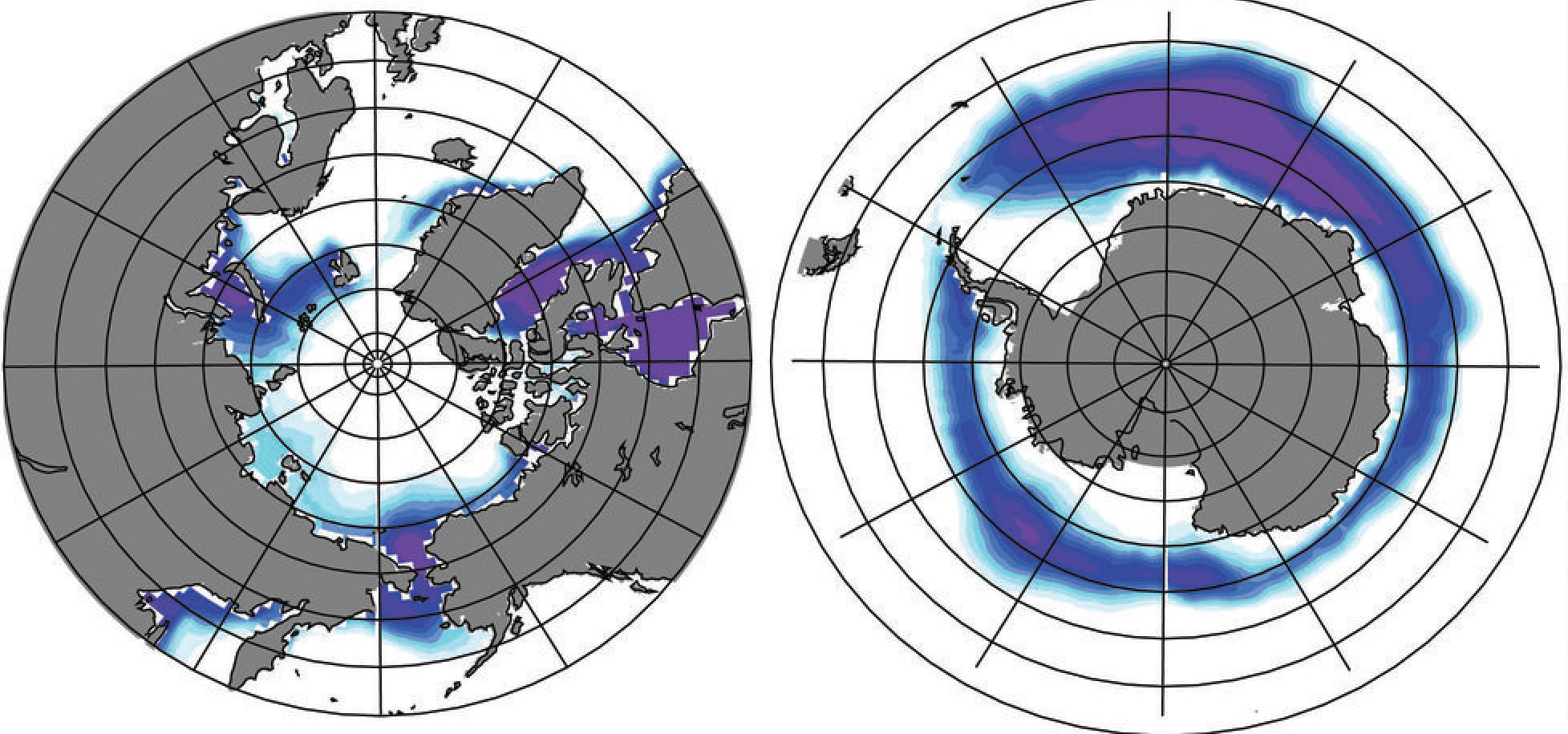
That difference has to do with each hemisphere’s capacity to grow sea ice. Because of the arrangement of the continents, there’s much more room for sea ice to grow in the Southern Hemisphere. The oceans of the Northern Hemisphere are interrupted by continents, which limits the extent to which ice can grow. So when the precessional cycle causes a series of cooler summers in the Southern Hemisphere, sea ice can expand dramatically because there’s less summer melting.
The precession cycle can influence global climate because the Southern Hemisphere has a higher capacity of sea ice growth. The image depicts current variation in sea ice extent in each hemisphere.
Lee’s climate models rely on the simple idea that sea ice reflects a significant amount of solar radiation back into space that would normally be absorbed into the ocean. That reflection of radiation can lower global temperature.
“What we show is that even if the total incoming energy is the same throughout the whole precession cycle, the amount of energy the Earth actually absorbs does change with precession,” Lee said. “The large Southern Hemispheric sea ice that forms when summers are cooler reduces the energy absorbed.”
But that leaves the question of why the precession cycle, which repeats every 21,000 years, would cause a 100,000-year glacial cycle. The answer is that the 100,000-year orbital cycle modulates the effects of the precession cycle.
The 100,000-year cycle deals with the eccentricity of Earth’s orbit — meaning the extent to which it deviates from a circle. Over a period of 100,000 years, the orbital shape goes from almost circular to more elongated and back again. It’s only when eccentricity is high — meaning the orbit is more elliptical — that there’s a significant difference between the Earth’s furthest point from the sun and its closest. As a result, there’s only a large difference in the intensity of seasons due to precession when eccentricity is large.
“When eccentricity is small, precession doesn’t matter,” Lee said. “Precession only matters when eccentricity is large. That’s why we see a stronger 100,000-year pace than a 21,000-year pace.”
Lee’s models show that, aided by high eccentricity, cool Southern Hemisphere summers can decrease by as much as 17 percent the amount of summer solar radiation absorbed by the planet over the latitude where the difference in sea ice distribution is largest — enough to cause significant global cooling and potentially creating the right conditions for an ice age.
Aside from radiation reflection, there may be additional cooling feedbacks started by an increase in southern sea ice, Lee and her colleagues say. Much of the carbon dioxide — a key greenhouse gas — exhaled into the atmosphere from the oceans comes from the southern polar region. If that region is largely covered in ice, it may hold that carbon dioxide in like a cap on a soda bottle. In addition, energy normally flows from the ocean to warm the atmosphere in winter as well, but sea ice insulates and reduces this exchange. So having less carbon and less energy transferred between the atmosphere and the ocean add to the cooling effect.
The findings may also help explain a puzzling shift in the Earth’s glacial cycle. For the past million years or so, the 100,000-year glacial cycle has been the most prominent. But before a million years ago, paleoclimate data suggest that pace of the glacial cycle was closer to about 40,000 years. That suggests that the third Milankovitch Cycle, which repeats every 41,000 years, was dominant then.
While the precession cycle deals with which direction the Earth’s axis is pointing, the 41,000-year cycle deals with how much the axis is tilted. The tilt — or obliquity — changes from a minimum of about 22 degrees to a maximum of around 25 degrees. (It’s at 23 degrees at the moment.) When obliquity is higher, each of the poles gets more sunlight, which tends to warm the planet.
So why would the obliquity cycle be the most important one before a million years ago, but become less important more recently?
According to Lee’s models, it has to do with the fact that the planet has been generally cooler over the past million years than it was prior to that. The models show that, when the Earth was generally warmer than today, precession-related sea ice expansion in the Southern Hemisphere is less likely to occur. That allows the obliquity cycle to dominate the global temperature signature. After a million years ago, when Earth became a bit cooler on average, the obliquity signal starts to take a back seat to the precession/eccentricity signal.
Lee and her colleagues believe their models present a strong new explanation for the history of Earth’s glacial cycle — explaining both the more recent pace and the puzzling transition a million years ago.
It is hardly surprising that “asylum seekers” in Europe are perceived as including many fraudsters. This article is from the Basler Zeitung in Switzerland:
Many Eritreans regularly return to their home country where they are supposedly “threatened with life and limb”. The refugees, who mostly live on social welfare, are a good source of foreign currency for the home country.
The scene took place in July 2016 at Zurich-Kloten Airport. It’s a holiday season. Thousands of people fly for their summer vacation. Among them are numerous people from Eritrea, men, women, whole families. They have travel documents as refugees or as temporary residents, who can stay in Switzerland despite a rejected asylum application. The cantons have issued the documents after the Eritreans have submitted a request and this has been examined by the Confederation.
Many of them do not fly to Italy, Germany or Sweden, where there are a large diaspora of Eritrean communities. They fly to their homeland. Thus, to the very country in which, according to the refugee policy, they are “threatened with life and limb” , and therefore can not at any time be returned after a rejected asylum application, says Councilor Simonetta Sommaruga.
However, the trip does not go directly to Eritrea. Such flights are not available from Zurich at all, but, according to BaZ research, via an intermediate station, for example via Istanbul. From there to the Sudanese capital Khartoum or to Ethiopian capital Addis Ababa. This is shown by the boarding cards of the Eritreers, which have been seen by BaZ in Zurich. Up to fifty people leave daily from Switzerland and fly to a neighboring country of Eritrea. A return flight via Istanbul costs around 650 francs during the high season in summer. At present they are available for 599 francs.
In Sudan or Ethiopia, the Eritreans finally get buses, which bring them home in a few days. From Khartoum there are also flights, which after an hour’s flight lands in the Eritrean capital, Asmara . Four out of five Eritreans in Switzerland receive social welfare. This is evidently generous enough that it is possible for many to travel to their homeland.
So far, the State Secretariat for Migration (SEM), said it was difficult to determine who was going to Eritrea through a neighboring country because there are no direct flights. It was merely a few persons who were abusing the status of asylum. At the end of May 2016 the SEM , as reported by BaZ , claimed that every year about 20 suspicious cases were tested, less than half as many as flew daily just from Zurich-Kloten to Sudan, ……
…. This means, in the plain text, that many Eritreans, who are mostly unable to present their Eritrean passports when seeking asylum, suddenly have travel documents, when they go on home leave, either from the Swiss authorities or from the Eritrean consulate in Geneva or elsewhere. New papers. … (It was) revealed already three years ago that the Eritrean representation in Switzerland not only participated in tax drives from the Eritrean diaspora but also organized travels to Eritrea. Refugees are a source of revenue for the home country. …….
No doubt there are genuine asylum seekers, but the many cases of fraud mean that the seeking of “asylum” has lost both credibility and value.
It is early morning in Europe and the US is still asleep.
Another news cycle has started. (The world news cycle is de facto on US time). But the agenda for this cycle – apart from unforeseen events – is being set by Donald Trump’s late night tweets before going to bed (sent at around 10pm EST). In fact, in my morning sweep of news from around the world, usually starting with New Zealand and Japan and working westwards, I have now started to look first at the Trump tweets.
The tweets this morning:
From the New Zealand Herald to The Australian, through the Indian papers and in the European media Trump’s tweet on the immigration wall is picked up universally to make prominent headlines. The gratuitous remark about CNN (though it is well deserved) is not picked up to the same extent. The comments about Chicago (and the wall, of course) are prominently covered by the US media. CNN also covers the wall and Chicago but refrains from adding fuel to the raging feud they currently have with Trump.
The US (and some European media) also cover the current ban on public statements by US State agencies.
A study carried out in 2014 and reported in the Journal of Electoral Studies concluded that in the 2008 and 2010 elections, a large number of non-citizens voted illegally. In 2008 and 2010 the researchers estimated that 2.8 million votes were cast illegally. It is highly likely therefore that in 2016, where Obama and Clinton were trying specifically to mobilise the illegal votes, that this number was well in excess of 3 million votes.
The main stream media are stating (not suggesting) that Trump’s claim about illegal voters has been debunked. But it hasn’t. The “debunking” consists entirely of pointing to the the lack of hard evidence from Trump. They have no evidence to show themselves that it was lower. The “debunking” story itself is little more than Fake News. In fact, considering the influx of illegal immigrants since 2010, there is a high probability that the number of illegal voters could have been closer to 5 million rather than 3 million.
Some non-citizens cast votes in U.S. elections despite legal bans.
Non-citizens favor Democratic candidates over Republican candidates.
Non-citizen voting likely changed 2008 outcomes including Electoral College votes and the composition of Congress.
Abstract: In spite of substantial public controversy, very little reliable data exists concerning the frequency with which non-citizen immigrants participate in United States elections. Although such participation is a violation of election laws in most parts of the United States, enforcement depends principally on disclosure of citizenship status at the time of voter registration. This study examines participation rates by non-citizens using a nationally representative sample that includes non-citizen immigrants. We find that some non-citizens participate in U.S. elections, and that this participation has been large enough to change meaningful election outcomes including Electoral College votes, and Congressional elections. Non-citizen votes likely gave Senate Democrats the pivotal 60th vote needed to overcome filibusters in order to pass health care reform and other Obama administration priorities in the 111th Congress.
A Harvard paper claimed that the authors were biased but themselves had only their own speculations based on their own biases and no evidence to back up up their claims.
Most of the 3 – 5 million illegal voters were concentrated in heavily Democratic areas and while they boosted Hillary Clinton’s vote totals, probably did not impact the electoral college results very much. Trump won the Electoral College handily and won 30 of the 50 states. In California alone, Clinton won by 4.2 million of the votes. In New York she won by 1.6 million. In the country as a whole she won by 2.9 million, which means that outside of California alone, Trump won the rest of the country by 1.3 million votes, and outside of the two states, Trump won the rest of the country by as much as 2.9 million votes. It seems fairly obvious that most of the illegal voting was probably in California. Clinton spent some $1.6 billion while Trump spent some $600 million.
There are probably some richer illegal voters around.
This continues my thesis that the age of global, multi-lateral agreements is counter-productive (see previous post). Multi-lateral agreements are part of a centralisation paradigm which is becoming obsolete. It is time to shift to smart, distributed, networks which build on bilateral agreements.
An agreement with the EU as a whole (28 countries, or 27 after Brexit) is always more rigid and less flexible than making individual bilateral agreements. Over time, in a changing world, the mutli-lateral deal always ends up as a barrier to growth. It is my contention that since 2008 when the financial crisis was triggered, the rigidity of the EU has been a brake not only on the recovery of individual member countries, but has also acted as a brake on other countries having agreements with the EU.
The Canada – EU trade agreement (CETA) is an illustrative example. Negotiations started in 2004. The terms were agreed in 2014. It was signed in October 2016. It has still to be ratified by all the EU parliaments. It has taken that long because of the differences between the EU member countries. What has been signed is already obsolete since the world has moved on. But the agreement cannot be changed without all the EU countries agreeing. The possibility of renegotiation is an essential requirement for any agreement, but for CETA it is virtually impossible. Canada, and each of the EU member countries would have been far better off, with 27 bilateral trade agreements. Instead of a faceless Brussels negotiating for all 27 as a group (lowest common standards and minimum level of internal disatisfaction applying) each country could, instead, have used a common core agreement as a basis for variations for each country and being negotiated by its own representatives. It would have taken less time than the 13 years for CETA.
GATT was and the WTO is equally inflexible and unfriendly to changes. The WTO rather than allowing free trade has ensured that some countries (mainly the rich countries) can maintain high import duties and quotas in certain products, blocking imports from developing countries. The injustices are enshrined and renegotiation (for example by a country moving from developing to developed status) is virtually impossible. The WTO ensures that there is inbuilt protection of agriculture in developed countries while developing ones are pressed to open their markets. The less developed countries have neither the expertise or the money to fully participate in the negotiations which is dominated by the developed countries. The developing part of the world would have been – and still would be – far better off with making bilateral agreements only as needed with relevant partner countries, rather than being coerced to sign up to grandiose, global agreements.
It is good that Trump has withdrawn the US from the 12 country (China excluded) Trans-Pacific-Partnership (TPP). Apart from being another inflexible multi-lateral agreement it was actually just a political response to the Asia-Pacific-Trade-Agreement (APTA) and the RCEP which China was putting together, both excluding the US. APTA started with Bangladesh, China, India, Lao PDR, Mongolia, South Korea, and Sri Lanka, but has all the disdavantages and inflexibility of multi-lateral agreements. The “Regional Comprehensive Economic Partnership (RCEP) is a proposed free trade agreement between the ten member states of the Association of Southeast Asian Nations (ASEAN) (Brunei, Cambodia, Indonesia, Laos, Malaysia, Myanmar, the Philippines, Singapore, Thailand, Vietnam) and the six states with which ASEAN has existing free trade agreements (Australia, China, India, Japan, South Korea and New Zealand)”.
There are many multi-lateral agreements in Asia Pacific and are more talking shops than any real promoters of trade:
ASEAN Free Trade Area (AFTA)
South Pacific Regional Trade and Economic Cooperation Agreement (SPARTECA)
South Asian Free Trade Area (SAFTA)
Pacific Islands Countries Trade Agreement (PICTA)
Bay of Bengal Initiative for MultiSectoral Technical and Economic Cooperation (BIMSTEC)
Commonwealth of Independent States Free Trade Agreement (CISFTA)
The divide between developing countries and the developed world is blurring. Intelligence is available at each sovereign country. Each country, individually, is best placed to know and to look after its own interests. With a bunch of “idiot” elements, there is strength in “unity”, but when each entity is intelligent, forcing the intelligences to join groups and comply with the lowest common standards is counter productive and “not smart”.
In the EU, for example, forcing the member countries to forego their sovereignty, ignore their own intelligence in favour of some bureaucratically defined “common intelligence” is definitely “not smart”.
I am expanding on an earlier post since I find that there is much loose thinking when it comes to what people perceive as the sins or benefits of globalisation. The globalisation pundits forget that without local there can be no global
Where “globalisation” should have been “think global, act local”, it has instead degenerated to become “decide globally, impose locally”. It is part of the classic balance between centralised and distributed, between society and the individual. What should have been an increase in local decision-making in the light of being better informed about global consequences, has instead become decision-making at the global level with consequences being imposed on or coerced from the much smaller local entities. The “anti-globalisation wave” currently ongoing is the reaction from the “local” entities which feel imposed upon. It applies as much to individuals in America’s rust belts to the Indian engineers being laid off in a multi-national corporate because avoided costs (not actual costs) are lower in Europe. It applies to the UK view of the EU which fuelled Brexit as much as to the protests in the state of Tamil Nadu against the banning of Jallikattu. This degeneration applies to the UN, it applies to the EU or the WHO or the IMF or the WB. It applies to “global” or “multi-national” corporations, to central governments, to multi-lateral trade agreements and even to scientific endeavour.
There are many analogies and examples available for the balance to be struck in the centralised control of distributed intelligences. Central power generation has given way – somewhat – to smarter, more distributed power generation. Main frame computing has given way to distributed smart devices as the intelligence and capability of each device has increased. Central telephone exchanges have given way to mobile telephony also as the mobile devices have become smarter. In health care, central hospitals will give way to distributed clinics as the capability and intelligence (by automation and AI) of smaller clinics increases. In Sweden for example, health care is still being centralised to the detriment of the local and lags in this evolution towards smarter, more distributed systems. But the move – globally – towards smarter local clinics is inevitable.
In modern power generation systems, which is what I am most familiar with, we used to have centralised controls ruling over individual, “idiot” pieces of equipment. But nowadays we have intelligence at the point of each piece of equipment and a centralised control which only determines policy at the highest level. It is distributed control which has revolutionised not only the efficiency of generation but also the health and life of each piece of equipment, and above all, the performance of individual plants in an inter-connected grid.
From central to distributed
“Centralised” – as in the diagram above, is imposition of central power on local entities(UN, EU, Central government …), “decentralised” gives groupings of multi-lateral arrangements (NAFTA, NATO, ASEAN …). “Distributed” is the obvious choice when having a multitude of smart entities and consists of developing and emphasising the natural (adjacent) bilaterals. Swarms of birds or shoals of fish are good examples of decentralised swarms or shoals, where within each shoal a distributed but highly effective network applies, where each individual is only connected to, and responds to, its immediate (bilateral) neighbours.
The key for decentralisation is, of course, that sufficient intelligence resides at the local entities. Then the network becomes “smart”. This shift back towards smarter, more local decision-making is now overdue in international relations, in politics and in the corporate world. This is perhaps the main hope I have for the new Trump administration. With all his faults and all his bombast, if Trump helps reverse the current unsustainable trend and gets it to move towards smarter, distributed local entities, then he will have exceeded my expectations. In all international organisations (UN, EU etc), agreements and trade deals there is far too much decision-making at the global level. The local entities (say in African countries or Indian States or insular communities in Europe) are not necessarily smart enough yet, but that is no excuse to continue with the imposition of “global” decisions made very far away.
A smart world is not one with a global government as many Marxists and socialists dream of, imposing the lowest common standards on everyone and every thing. It is one where the individuals, the local factory or the local government, is smart enough and intelligent enough to make its own decisions for its own position within the global world it exists in. That would give the freedom and flexibility – which I judge absolutely necessary for the future of humans – for the local entity to fit into the global society it lives in as it thinks fit and is capable of.
Globalisation has to shift from centralised control to smart, distributed control. That will give “smart” globalisation.



 The k2p blog