It is not quite the reversal of the normal ageing process but fascinating nevertheless. Mice deprived of telomerase suffered premature ageing and the reintroduction of the enzyme reversed it. But mice lacking telomerase are not necessarily a valid stand-in for the normal ageing process. Increasing the level of telomerase in humans could potentially encourage the growth of tumours.
Telomerase reactivation reverses tissue degeneration in aged telomerase-deficient mice
Nature advance online publication 28 November 2010 | doi:10.1038/nature09603; Received 8 May 2010; Accepted 26 October 2010; Published online 28 November 2010
Mariela Jaskelioff, Florian L. Muller, Ji-Hye Paik, Emily Thomas, Shan Jiang, Andrew C. Adams, Ergun Sahin, Maria Kost-Alimova, Alexei Protopopov, Juan Cadiñanos, James W. Horner, Eleftheria Maratos-Flier & Ronald A. DePinho
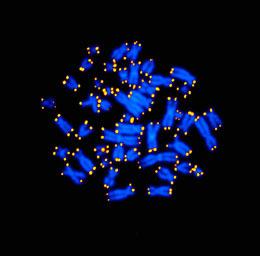
Telomeres: Peter Lansdorp/Visuals Unlimited/Corbis
Premature ageing can be reversed by reactivating an enzyme that protects the tips of chromosomes, a study in mice suggests.
Mice engineered to lack the enzyme, called telomerase, become prematurely decrepit. But they bounced back to health when the enzyme was replaced. The finding, published online today in Nature, hints that some disorders characterized by early ageing could be treated by boosting telomerase activity.
It also offers the possibility that normal human ageing could be slowed by reawakening the enzyme in cells where it has stopped working, says Ronald DePinho, a cancer geneticist at the Dana-Farber Cancer Institute and Harvard Medical School in Boston, Massachusetts, who led the new study. “This has implications for thinking about telomerase as a serious anti-ageing intervention.”
After its discovery in the 1980s, telomerase gained a reputation as a fountain of youth. Chromosomes have caps of repetitive DNA called telomeres at their ends. Every time cells divide, their telomeres shorten, which eventually prompts them to stop dividing and die. Telomerase prevents this decline in some kinds of cells, including stem cells, by lengthening telomeres, and the hope was that activating the enzyme could slow cellular ageing.
Two decades on, researchers are realizing that telomerase’s role in ageing is far more nuanced than first thought. Some studies have uncovered an association between short telomeres and early death, whereas others have failed to back up this link. People with rare diseases characterized by shortened telomeres or telomerase mutations seem to age prematurely, although some tissues are more affected than others.
When mice are engineered to lack telomerase completely, their telomeres progressively shorten over several generations. These animals age much faster than normal mice — they are barely fertile and suffer from age-related conditions such as osteoporosis, diabetes and neurodegeneration. They also die young. “If you look at all those data together, you walk away with the idea that the loss of telomerase could be a very important instigator of the ageing process,” says DePinho.
To find out if these dramatic effects are reversible, DePinho’s team engineered mice such that the inactivated telomerase could be switched back on by feeding the mice a chemical called 4-OHT. The researchers allowed the mice to grow to adulthood without the enzyme, then reactivated it for a month. They assessed the health of the mice another month later.
Shrivelled testes grew back to normal and the animals regained their fertility. Other organs, such as the spleen, liver and intestines, recuperated from their degenerated state. The one-month pulse of telomerase also reversed effects of ageing in the brain. Mice with restored telomerase activity had noticeably larger brains than animals still lacking the enzyme, and neural progenitor cells, which produce new neurons and supporting brain cells, started working again.
The downside is that telomerase is often mutated in human cancers, and seems to help existing tumours grow faster. “Telomere rejuvenation is potentially very dangerous unless you make sure that it does not stimulate cancer,” says David Harrison, who researches ageing at the Jackson Laboratory in Bar Harbor, Maine.
Harrison also questions whether mice lacking telomerase are a good model for human ageing. “They are not studying normal ageing, but ageing in mice made grossly abnormal,” he says.


 The k2p blog