Posts Tagged ‘Causality’

Home truths 1: Science & Philosophy

July 26, 2024

I find it ridiculous that the general assumption is that we know all about gravity. The reality is that we have no idea about why it exists or how the force of gravitation works. We can calculate the effects of gravity essentially still using Newton’s laws together with Einstein’s tweaks. But we have not the faintest idea about how one mass attracts another or why it should. How does the sun communicate with the planets and tell them what force applies  – if it does. A fundamental particle called the graviton is the proposed solution but we have never found one and it lives in the land of the Jumblies. We do not even have any idea what mass is. Physics even has massless particles (the gluon, the photon and the imaginary graviton) but only the God of Physics knows what massless, matter-less stuff such particles may contain. The reality is that science is strictly limited. It is limited by its fundamental assumptions and its boundary conditions. It cannot address matters outside of these conditions.

We put down motion at a distance to forces such as gravitational or electromagnetic. But we really have no idea how these forces are mediated. Probably by Mysterious Quantum Wave Functions which collapse conveniently when needed. But who knows why they exist? And let us be clear. Particles do not exist in two places at the same time. Never. And any physics which says so lives in the land of the Jumblies.

I am just trying to clear my mind by writing down my (current) home truths. I have chosen to arrange my “core beliefs” in three categories as 3 separate posts.

  1. Science & Philosophy
  2. Behaviour
  3. Society & Politics

I start with Science and Philosophy. The list below could have been much longer but I stopped when I started getting bored.


Home truths 1: Science & Philosophy

  1. We have no clue as to the question which existence is the answer to.
  2. We only have circular definitions for truth but what does exist (we assume) is true.
  3. The human mind is finite. There are things that are known, things that are knowable but unknown and there are things that cannot be known (the unknowable).
  4. Infinity, by definition, is a label – in language – for that which cannot be comprehended.
  5. Boundless, endless, timeless and infinite, just like before the beginning and after the end, are labels for the incomprehensible, no matter what the pretense.
  6. The human capability for language is genetic and unmatched by any other species on earth.
  7. The capability for language is discovered but all languages are invented.
  8. Once the concept of oneness – identity / one(1) – is defined, all other numbers of every kind are fixed. Once one (1) exists every other number of every kind automatically follows. Note that zero comes after 1 and derives from 1 – 1.
  9. One and all the numbers derived therefrom are concepts and do not exist explicitly in nature.
  10. All numbers are unreal and abstract.
  11. The process of counting and all of what is now called number theory are also derived from, and fixed by, the concept of one.
  12. Mathematics describes abstract relationships and abstract patterns connecting abstract concepts and does this using a number of invented languages. It is not a science.
  13. The practice of mathematics is art rather than science.
  14. Language is what gives humans the ability to describe the unreal, the past, the future and to lie.
  15. All languages are silent about the truth value of what is being described by language.
  16. Nonsense language is the perfectly correct use of language but where the content is nonsense.
  17. To create nonsense language or nonsense mathematics (in the manner of Edward Lear or Srinivasa Ramanujam) needs very great skill and great proficiency in the language.
  18. Mathematical equations are just propositions, as any sentence in any language, and are silent about the truth value of the content.
  19. Writing a mathematical equation provides no proof of that equation.
  20. Time is unidirectional and a brute fact of our universe. Negative time is not possible in our universe.
  21. The flow of time and existence emerge together.
  22. Mathematical equations for theories having negative time are merely nonsense mathematics (correct by the rules of mathematics but having nonsense as content).
  23. Physics and other scientific theories which do not explicitly exclude the possibility of negative time are incomplete or false.
  24. Scientific theories which are silent or are unable to exclude the possibility of negative time do not imply any support for the possibility of negative time.
  25. No logic system (or science) can ever prove the fundamental assumptions it is itself based upon.
  26. Science assumes that existence, the flow of time, causality, life and consciousness are all self-evident. Therefore science cannot address, let alone explain, any of them.
  27. Anything truly random (without cause) is inexplicable. Random is part of what we cannot know (or else it is Divine).
  28. Every scientific discipline assumes that cause precedes effect but ignores the unavoidable first cause problem.
  29. The Cosmic Big Bang theory cannot explain why there had to be a Big Bang.
  30. Matter forever or matter from nothing are equally inexplicable and unsatisfactory.
  31. Mass “is the amount of matter in matter” which means we have no clue as to what mass is.
  32. We do not know why there are as many “fundamental” particles as there are (or seem to be).
  33. We do not know why the fine structure constant is exactly the number that it is (or why the speed of light is what it is).
  34. Something from nothing cannot be explained by any Science nor by any theology or belief in a God.
  35. Time without beginning cannot be explained by any Science nor by any theology or belief in a God.
  36. A global zero made up of an arbitrary  local “+ dark energy” and balanced by a local “- gravitation energy” proves nothing.
  37. The concept of nothingness is beyond the finite human mind. (Zero derives from 1 and is not a description of nothingness).
  38. Why the universe (including its dimensions, matter, energy and all other properties) is compelled to exist is unknown. (This is an alternative formulation of home truth 1.1)
  39. There is no known explanation for the spark of life.
  40. Consciousness is a mystery without explanation.
  41. Though we can calculate its effects, nobody has the faintest inkling of how gravity is mediated or how it works.
  42. Nobody has a clue as to how large the universe (and not just the observable universe) is (or how big the Big Bang was).
Without the magic of cause and effect there is no science

March 4, 2019

Causality is existential for all the natural sciences and especially for physics.

Causality is magic. It is magic because why it should be so is inexplicable.

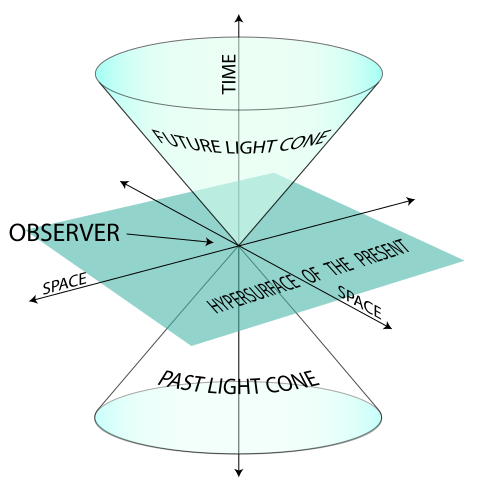
The most fundamental, enabling assumption for all the natural sciences is that identical causes lead to identical effects. The corollary that non-identical events are proof that the causes were not identical is also unquestioned – and unquestionable – for the scientific method. (However it is permitted that different causes may produce effects which are identical). Modern physics and relativity constrain causality. Cause and effect is restricted to the past and future light cones for any event. But this, in itself, implies a region (undefinable) where causality does not apply and does not even try to address why the magic that is causality exists.

Wikipedia

Causality means that an effect cannot occur from a cause that is not in the back (past) light cone of that event. Similarly, a cause cannot have an effect outside its front (future) light cone.

In special and general relativity, a light cone is the path that a flash of light, emanating from a single event (localized to a single point in space and a single moment in time) and traveling in all directions, would take through spacetime.

Being a fundamental assumption, it is not possible for the sciences and the scientific method to address why the assumption of causality exists. The First Cause problem is declared to be uninteresting to science just because it cannot be addressed. Allowing the problem would place all of science within a paradox. If everything has to have a cause then there must be a First Cause. If some things do not need to have a cause then there can be no certainty that anything is the cause of anything else.

The First Cause problem is what actually unifies science and philosophy and theology and religions. None have – or can have – an answer. They just use different labels for the undeniable magic. It has been debated since ancient times but I like the way Bertrand Russel expresses it.

Bertrand Russel- Why I am not a Christian

Perhaps the simplest and easiest to understand is the argument of the First Cause. (It is maintained that everything we see in this world has a cause, and as you go back in the chain of causes further and further you must come to a First Cause, and to that First Cause you give the name of God). That argument, I suppose, does not carry very much weight nowadays, because, in the first place, cause is not quite what it used to be. The philosophers and the men of science have got going on cause, and it has not anything like the vitality it used to have; but, apart from that, you can see that the argument that there must be a First Cause is one that cannot have any validity. I may say that when I was a young man and was debating these questions very seriously in my mind, I for a long time accepted the argument of the First Cause, until one day, at the age of eighteen, I read John Stuart Mill’s Autobiography, and I there found this sentence: ‘My father taught me that the question, “Who made me?” cannot be answered, since it immediately suggests the further question, “Who made God?” ’ That very simple sentence showed me, as I still think, the fallacy in the argument of the First Cause. If everything must have a cause, then God must have a cause. If there can be anything without a cause, it may just as well be the world as God, so that there cannot be any validity in that argument. It is exactly of the same nature as the Hindu’s view, that the world rested upon an elephant and the elephant rested upon a tortoise; and when they said, ‘How about the tortoise?’ the Indian said, ‘Suppose we change the subject.’ The argument is really no better than that. There is no reason why the world could not have come into being without a cause; nor, on the other hand, is there any reason why it should not have always existed. There is no reason to suppose that the world had a beginning at all. The idea that things must have a beginning is really due to the poverty of our imagination. Therefore, perhaps, I need not waste any more time upon the argument about the First Cause.

Russel is wise not to debate it further because penetrating the wall of the unknowable is a futile exercise. It is in the realm of magic.

Leibnitz’s formulation of the Principle of Sufficient Reason is only a formal description of Causality and defines the limits of empiricism and the scientific method. It cannot, however, penetrate the First Cause Problem.

Principle of Sufficient Reason

The Principle of Sufficient Reason stipulates that everything must have a reason, cause, or ground.

This is often formulated as:

  • For every entity X, if X exists, then there is a sufficient explanation for why X exists.
  • For every event E, if E occurs, then there is a sufficient explanation for why E occurs.
  • For every proposition P, if P is true, then there is a sufficient explanation for why P is true.

This is a stipulation, a statement of an assumption. But it is no explanation.

The conclusions I draw are that:

  1. Science is limited to where causality occurs.
  2. Physics admits causality is constrained by past and future light cones.
  3. Physics therefore admits that what lies outside the past and future light cones is unknowable.
  4. Causality is magic.
  5. All science depends upon magic.


The flow of time precedes causality

April 26, 2018

All origins, all beginnings presuppose the existence of a flow of time. Our imagination, our language and our thought are incapable of conceiving the non-existence of a beginning. We cannot conceive of anything in the world where a non-beginning is not also a non-existence. If it exists it must have had a beginning. There is no branch of science or field of study or area of thought which is not based on causality. We perceive the world around us through the eyes of causality. We perceive what is and look for what caused what is. We do not question that what is must have had a cause. We do not question either that what will be, will be caused by and follow what is. But causality pre-supposes the existence of a flow of time.

But there is no philosophy or theology or science which can explain

  1. what time is, and
  2. what causes time to flow

One could say that it is the existence of the flow of time which brings about causality. Causality is itself caused by time.

“Perhaps the simplest and easiest to understand is the argument of the First Cause. (It is maintained that everything we see in this world has a cause, and as you go back in the chain of causes further and further you must come to a First Cause, and to that First Cause you give the name of God). That argument, I suppose, does not carry very much weight nowadays, because, in the first place, cause is not quite what it used to be. The philosophers and the men of science have got going on cause, and it has not anything like the vitality it used to have; but, apart from that, you can see that the argument that there must be a First Cause is one that cannot have any validity. I may say that when I was a young man and was debating these questions very seriously in my mind, I for a long time accepted the argument of the First Cause, until one day, at the age of eighteen, I read John Stuart Mill’s Autobiography, and I there found this sentence: ‘My father taught me that the question, “Who made me?” cannot be answered, since it immediately suggests the further question, “Who made God?” ’ That very simple sentence showed me, as I still think, the fallacy in the argument of the First Cause. If everything must have a cause, then God must have a cause. If there can be anything without a cause, it may just as well be the world as God, so that there cannot be any validity in that argument. It is exactly of the same nature as the Hindu’s view, that the world rested upon an elephant and the elephant rested upon a tortoise; and when they said, ‘How about the tortoise?’ the Indian said, ‘Suppose we change the subject.’ The argument is really no better than that. There is no reason why the world could not have come into being without a cause; nor, on the other hand, is there any reason why it should not have always existed. There is no reason to suppose that the world had a beginning at all. The idea that things must have a beginning is really due to the poverty of our imagination. Therefore, perhaps, I need not waste any more time upon the argument about the First Cause.”  Bertrand Russel – 1927

Time, or space-time nowadays, is sometimes considered as a river. The analogy with fluid flow does not help greatly and only raises further questions. Fluids flow (over time and space) as a causal consequence of forces and energies which are not in balance and which seek balance. Fluids flow from a higher pressure to a lower (in a gas pipeline), from a higher level of potential energy to a lower (in a river) or by being physically forced from one location to another (in a pump or a compressor). In the fluid analogy it is particles of the the fluid which are transported over space and time.

If the flow of time is a river then what exactly is being transported? What then is the imbalance, and in what property or state which causes the transportation of the magical thing called time? Rather than addressing the First Cause, perhaps we should be addressing the First Questions.

What is time? and Why does it flow?

The existence of time precedes beginnings. The flow of time precedes causality. The problem of course is that without time, beginning and precede are undefined.


Idle thoughts: Disciplines, sciences and pseudosciences

November 4, 2012

There is virtually nothing in the physical universe around us that is not worthy of study. Most study begins with observations. We can term any such area of study where observations are made and knowledge accumulated as being a “discipline”. The social “sciences”, environmentalism and even astrology and palmistry could be considered disciplines.

But when does a discipline become a science?

(more…)