Posts Tagged ‘Cholera’

Haiti: The UN cholera tragedy continues…..

December 26, 2010

Port-au-Prince, Haiti (CNN) — At least 45 people, most of them voodoo priests, have been lynched in Haiti since the beginning of the cholera epidemic by angry mobs blaming them for the spread of the disease, officials said.

“People who practice voodoo have nothing to do with the cholera epidemic,” said Max Beauvoir, the head of a voodoo organization in the Caribbean country.

Beauvoir said Thursday that he has appealed to authorities to help before the situation gets worse.

Some of the victims were killed with machetes, others were burned alive by mobs that added tires and gasoline to stoke the fires. The cholera outbreak started in October.

Forty of the victims were found in a southwest area of Haiti called Grand Anse, said Moise Fritz Evens, a communications ministry official.

The victims have been targeted because of “misinformation” that had been circulating in the community that voodoo practitioners were spreading cholera by using witchcraft, according to communications Minister Marie-Laurence Lassegue.

“It was necessary to increase awareness of the disease and educate the population countrywide instead of getting into a religious war that has no ending,” Lassegue said.

The killings add to ongoing woes that have hit the island after the devastating earthquake in January. About 220,000 people were killed in the earthquake, and countless others left homeless. A cholera outbreak after the earthquake has killed more than 2,000 people, health officials said.

Before the current outbreak introduced by UN troops, Haiti had not seen cholera for over 100 years.

https://ktwop.wordpress.com/2010/11/19/un-cholera-and-protests-against-un-reach-port-au-prince/
UN to “investigate” its introduction of cholera to Haiti

December 17, 2010

More than a month after the outbreak , the United Nations secretary-general plans to call for an independent commission to study whether U.N. peacekeepers caused a cholera outbreak that has killed more than 2,400 people in Haiti, an official said on Wednesday.

http://www.thehindu.com/health/policy-and-issues/article956037.ece?homepage=true

U.N. officials initially dismissed speculation about the involvement of peacekeepers. The announcement indicates that concern about the epidemic’s origin has now reached the highest levels of the global organization.

“We are urging and we are calling for what we could call an international panel,” U.N. peacekeeping chief Alain Le Roy said at a news conference at U.N. headquarters in New York. “We are in discussions with (the U.N. World Health Organization) to find the best experts to be in a panel to be completely independent.”

Le Roy said details about the commission would be announced Friday by Secretary-General Ban Ki-moon. He said cholera experts and other scientists will have full access to U.N. data and the suspected military base.

“They will make their report to make sure the truth will be known,” Le Roy said.

Soon after the cholera outbreak became evident in October, Haitians began questioning whether it started at a U.N. base in Meille, outside the central plateau town of Mirebalais and upriver from where hundreds were falling ill. Speculation pointed to recently arrived peacekeepers from Nepal, a South Asia nation where cholera is endemic.

U.N. officials rejected any idea the base was involved, saying its sanitation was air-tight.

WHO and the U.S. Centres for Disease Control and Prevention said at the time that it was unlikely the origin would ever be known, and that pinning it down was not a priority.

Then the Associated Press found not only sanitation problems at the base, but that the U.N. mission was quietly taking samples from behind the post to test for cholera.

When the CDC determined the strain in Haiti matched one in South Asia, cholera and global health experts said there was now enough circumstantial evidence implicating the likely unwitting Nepalese soldiers to warrant an aggressive investigation.

The experts have also said there are important scientific reasons to trace the origin of the outbreak, including learning how the disease spreads, how it can best be combated and what danger countries around Haiti could face in the coming months and years.

Many think the U.N. mission’s reticence to seriously address the allegations in public helped fuel anti-peacekeeper riots that broke out across the country last month.

This outbreak, which experts estimate could affect more than 600,000 people in impoverished Haiti, involves the first confirmed cases of cholera in Haiti since WHO records began in the mid-20th century. Suspected outbreaks of a different strain of cholera might have occurred in Haiti more than a century ago.

The current outbreak has spread to the neighbouring Dominican Republic and isolated cases have been found in the United States.

French epidemiologist Renaud Piarroux argues that “no other hypothesis” from the Nepalese being the origin could explain his findings that cases of the diarrheal disease first appeared near the U.N. base in Haiti’s rural centre, far from shipping ports and the area affected by the Jan. 12 earthquake.

Haiti response inadequate and UN Head of Mission seems incompetent

November 20, 2010

The UN after having introduced cholera to Haiti – which will now remain for many decades – is providing an “inadequate response” according to Medecins Sans Frontieres (MSF) says the BBC.

MSF said that despite the huge aid agency presence in Haiti, urgent needs were not being met. MSF’s chief in Haiti, Stefano Zannini, said the charity had treated more than 16,500 people but that there had been “no real and efficient response from other organisations. This is alarming in the sense that we haven’t reached the peak yet, that might take some time, and so the number of patients might still go up while we still don’t see actions on behalf of other people,” he said.

In a statement, Mr Zannini said more help was urgently needed to treat the sick and implement preventative measures. “There is no time left for meetings and debate – the time for action is now,” he said. Cholera was previously unknown in Haiti, so MSF said much work had to be done to reassure the population, particularly of the low risk and positive benefits of having treatment centres close to areas where people live.

Haiti - Insecurity : The alarmist statements of Edmond Mulet !

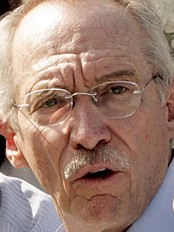
Edmond Mulet: image haitilibre.com

But the need for this reassurance to the local population is apparently not something understood by Edmond Mulet, the head of MINUSTAH (the United Nations Stabilization Mission in Haiti). He seems to be mainly engaged in justifying the UN deficiencies by blaming the lack of action on “the violent protests by people who blame peacekeepers for the spread of the disease (who) were wasting time and costing lives”.

But local Haitians are incensed by the alarmist posturing of the UN head of mission Edmond Mulet who is accused of not taking action. He is busy blaming everybody else and seems to be incompetent at basic public relations.

Judging by the response to his statements in haitilibre.com he is providing little reassurance and only succeeding to alienate the local population. They write

The alarmist statements of Edmond Mulet !

The perpetrators of these “criminals and irresponsible” acts said Mr. Mulet, “prevent the delivery of medical and sanitary assistance to the thousands of patients recently hit by the cholera epidemic, thus condemning to an unquestionable death.”

It is time to stop speaking and start acting Mr. Mulet before it is too late and that violence will spread throughout the country. 12,000 men strong, very well equipped and (with) armored vehicles, what awaits Minustah to release these roads and to restore the order in the zones concerned ? If Minustah’s mission is to maintain peace, she must first begin by eliminating the causes of these disorders, not with dramatic speeches.

If M. Mulet can only respond to the fear of people by blaming them instead of addressing their fear and anger then his competence is in question.

UN cholera and protests against UN reach Port-au-Prince

November 19, 2010
Map of Haiti

Haiti: image via Wikipedia

With its official population of 1 million and its estimated population of perhaps 3.5 million with many in refugee camps, Port-au-Prince is particularly susceptible to a cholera epidemic. The hope of containing the outbreak of UN cholera and preventing it from getting established in the capital are fading as more cases appear. Yesterday the protests against the UN also spread to the capital. So far 3 protesters and over 1100 cholera victims have been killed, directly or indirectly, by the UN. The number of infected is officially said to be over 18,000 but in reality may be as many as 100,000.

The BBC reports:

Protests linked to the outbreak of cholera in Haiti have spread to parts of the capital, Port-au-Prince.

Police fired tear gas as demonstrators set up barricades and threw rocks at United Nations vehicles. On Monday, clashes between residents and UN troops in the north had left two people dead. Some Haitians blame UN peacekeepers from Nepal for bringing cholera to the country – a claim denied by the UN. Sporadic gunfire could be heard on Thursday as protesters took to the streets of Port-au-Prince, which was devastated by a massive earthquake in January.

In its latest update, the Atlanta-based Centers for Disease Control (CDC) said the course of the disease was “difficult to predict” as it was the first cholera outbreak in Haiti for more than a century.  “The Haitian population has no pre-existing immunity to cholera, and environmental conditions in Haiti are favourable for its continued spread,” it said. The CDC said about 1.3m Haitians remained in camps following the earthquake and the camps’ “ability to provide centrally treated drinking water, adequate sanitation, handwashing facilities, and health care varies”. Just 17% of Haitians had access to adequate sanitation before the quake, the CDC said, adding that the situation had considerably worsened since then. US health experts say Haiti is vulnerable to further outbreaks.

It is thought that the cholera originated from septic tanks at a base for UN peacekeepers from Nepal. While the UN denies this and undercounts the number of cases in a totally misguided public relations exercise, the Swedish sources (Ambassador Claes Hammar and Svenska Dagbladet) are adamant about the UN being the source. Over 80% of people who carry the bacteria show no symptoms and since cholera is endemic in Nepal it is very likely that the troops from Nepal exhibited no symptoms but it is apparent that the UN did not test them to ensure that they were not carriers.

Elections in Haiti are due on November 28th and the UN’s communications “experts” seem to be incompetent. Spinning the truth to under-play the extent of the disease and and to deny responsibility is a fundamental PR mistake.

UN cholera spreads from Haiti to Dominican Republic

November 17, 2010
Map of Haiti

Haiti: image via Wikipedia

After diplomats confirmed yesterday that the cholera outbreak in Haiti had been brought in by UN personnel from Nepal, cases have also been detected in the neighbouring Dominican Republic.

While the UN is still denying that its troops from Nepal have introduced the disease, it seems that they are carrying out some mis-judged PR exercise in the face of the following:

  1. the cholera strain found in Haiti is that which is endemic in Nepal,
  2. the UN military camp has had cases,
  3. Haiti has not seen cases of cholera for over 100 years until this outbreak, and
  4. the disease has broken out even in areas which were not affected by the earthquake on 12th January.

It would be quite wrong to blame the poor Nepalese soldiers who face endemic cholera at home but it is certainly an indictment of UN systems and processes that over 1000 have died in Haiti which has not seen cholera for over 100 years.

The BBC reports:

The Dominican Republic has detected its first case of cholera, following the outbreak of the disease in neighbouring Haiti last month.

The patient is a Haitian migrant who had recently returned from his homeland, the health minister said.

The Dominican authorities had stepped up border controls and health checks to try to stop cholera from spreading from Haiti. More than 1,000 Haitians have died of the disease.

Dominican health minister Bautista Rojas said the patient, a 32-year-old Haitian construction worker, was being treated in isolation in the eastern town of Higuey.

Like Haiti, the Dominican Republic had not had a confirmed case of cholera in more than a century until this year.

In Haiti, the government says 1,034 people have died and the disease is still spreading rapidly. The epidemic has provoked fear and anger in Haiti. The country was already struggling to recover from a devastating earthquake in January which killed about 230,000 people in and around the capital Port-au-Prince and shattered its already poor infrastructure. On Monday two people died during violent protests against UN peacekeepers, whom some Haitians accuse of bringing cholera into Haiti. At least one of the men was shot dead by the UN troops.

The UN has said there is no evidence to support allegations that cholera was brought into Haiti by peacekeepers from Nepal, where the disease in endemic.