Posts Tagged ‘consciousness’

Is the Principle of Least Resistance the Zeroth Law of Being?

June 22, 2025

The underlying compulsion

Is thrift, parsimony, a sort of minimalism, part of the fabric of the universe?

Occam’s razor (known also as the principle of parsimony) is the principle that when presented with alternative explanations for the same phenomenon, the explanation that requires the fewest assumptions should be selected. While Occam’s razor is about how to think and describe phenomena, I am suggesting that parsimony of action, the path of least resistance is deeply embedded in causality and in all of existence.

Why is there something rather than nothing? Why does the universe exist? The answer is all around us. Because it is easier to be than not to be. Because at some level, in some dimension, in some domain of action and for some determining parameter, there is a greater resistance or opposition to not being than to being. Why does an apple fall from a tree? Because there is, in the prevailing circumstances, more resistance to it not falling than in falling. At one level this seems – and is – trivial. It is self-evident. It is what our common-sense tells us. It is what our reason tells us. And it is true.

It also tells us something else. If we are to investigate the root causes of any event, any happening, we must investigate the path by which it happened and what was the resistance or cost that was minimised. I am, in fact, suggesting that causality requires that the path of sequential actions is – in some domain and in some dimension – a thrifty path.

A plant grows in my garden. It buds in the spring and by winter it is dead. It has no progeny to appear next year. Why, in this vast universe, did it appear only to vanish, without having any noticeable impact on any other creature, god, or atheist? Some might say it was chance, others that it was the silent hand of a larger purpose. But I suspect the answer is simpler but more fundamental. The plant grew because it was “easier”, by some definition for the universe, that it grow than that it not grow. If it had any other option, then that must have been, by some measure, more expensive, more difficult.

In our search for final explanations – why the stars shine, why matter clumps, why life breathes – we often overlook a red thread running through them all. Wherever we look, things tend to happen by the easiest possible route available to them. Rivers meander following easier paths and they always flow downhill, not uphill. Heat flows from warm to cold because flowing the other way needs effort and work (refrigerator). When complexity happens it must be that in some measure, in some domain, staying simple faces more resistance than becoming complex. How else would physics become chemistry and form atoms and molecules? Why else would chemistry become biochemistry with long complex molecules? Something must have been easier for biology and life to be created than to not come into being. The bottom line is that if it was easier for us not to be, then we would not be here. Even quantum particles, we are told, “explore” every possible path but interfere in such a way that the most probable path is the one of least “action”. This underlying parsimony – this preference for least resistance – might well deserve to be raised to a status older than any law of thermodynamics or relativity. It might be our first clue as to how “being” itself unfurls. But is this parsimony really a universal doctrine or just a mirage of our imperfect perception? And if so, how far does it reach?

We can only elucidate with examples. And, of course, our examples are limited to just that slice of the universe that we can imperfectly perceive with all our limitations. Water finds the lowest point (where lowest means closest to the dominant gravitational object in the vicinity). Light bends when it moves from air into glass or water, following the path that takes the least time. Time itself flows because it is easier that it does than it does not. A cat, given the choice between a patch of bare floor and a soft cushion, unfailingly selects the softer path. It may seem far-fetched, but it could be that the behaviour of the cat and the ray of light are not just related, they are constrained to be what they are. Both are obeying the same hidden directive to do what costs the least effort, to follow a path of actions presenting the least resistance; where the minimisation of effort could be time, or energy, or discomfort, or hunger, or something else.

In physics, this underlying compulsion has been proposed from time to time. The Principle of Least Action, in physics, states that a system’s trajectory between two points in spacetime is the one that minimizes a quantity called the “action”. Action, in this context, is a quantity that combines energy, momentum, distance, and time. Essentially, the universe tends towards the path of least resistance and least change. Newton hinted at it; Lagrange and Hamilton built it into the bones of mechanics. Feynman has a lecture on it. The principle suggests that nature tends to favor paths that are somehow “efficient” or require minimal effort, given the constraints of the system. A falling apple, a planet orbiting the Sun, a thrown stone: each follows the path which, when summed over time, minimizes an abstract quantity called “action”. In a sense, nature does not just roll downhill; it picks its way to roll “most economically”, even if the actual route curves and loops under competing forces. Why should such a principle apply? Perhaps the universe has no effort to waste – however it may define “effort” – and perhaps it is required to be thrifty.

The path to life can be no exception

Generally the path of least resistance fits with our sense of what is reasonable (heat flow, fluid flow, electric current, …) but one glaring example is counter-intuitive. The chain from simple atoms to molecules to complex molecules to living cells to consciousness seems to be one of increasing complexity and increasing difficulty of being. One might think that while water and light behave so obligingly, living things defy the common-sensical notion that simple is cheap and complex is expensive. Does a rainforest  – with its exuberant tangle of vines, insects, poisons, and parasites  – look like a low-cost arrangement? Isn’t life an extremely expensive way just to define and find a path to death and decay?

Living systems, after all, locally do reduce entropy, they do build up order. A cell constructs a complicated molecule, seemingly climbing uphill against the universal tendency for things to spread out and decay. But it does so at the expense of free energy in its environment. The total “cost”, when you add up the cell plus its surroundings, still moves towards a cheaper arrangement overall and is manifested as a more uniform distribution of energy, more heat deposited at its lowest temperature possible. Life is the achieving of local order paid for by a cost reckoned as global dissipation. Fine, but one might still question as to why atoms should clump into molecules and molecules into a cell. Could it ever be “cheaper” than leaving them separate and loose? Shouldn’t complex order be a more costly state than simple disorder? In a purely static sense, yes. But real molecules collide, bounce, and react. Some combinations, under certain conditions, lock together because once formed they are stable, meaning it costs “more” to break them apart than to keep them together. Add some external driver – say a source of energy, or a catalyst mineral surface, or a ray of sunlight – and what might have stayed separate instead finds an easier path to forming chains, membranes, and eventually a primitive cell. Over time, any accessible path that is easier than another will inevitably be traversed.

Chemistry drifts into biochemistry not by defying ease, but by riding the easiest local, available pathway. It is compulsion rather than choice. Action is triggered by the availability of the pathway and that is always local. Evolution then – by trial and error – makes the rough first arrangement into a working organism. Not a perfectly efficient or excellent organism in some cosmic sense, but always that which is good enough and the easiest achievable in that existential niche, at that time. One must not expect “least resistance” to provide a  perfection which is not being sought. A panda’s thumb is famously clumsy – but given the panda’s available ancestral parts, it was easier to improvise a thumb out of a wrist bone than to grow an entirely new digit. Nature cuts corners when it is cheaper than starting over.

Perhaps the reason why the spark of life and the twitch of consciousness evade explanation is that we have not yet found – if at all we are cognitively capable of finding – the effort that is being minimised and in which domain it exists. We don’t know what currency the universe uses and how this effort is measured. Perhaps this is a clue as to how we should do science or philosophy at the very edges of knowledge. Look for what the surroundings would see as parsimony, look for the path that was followed and what was minimised. Look for the questions to which the subject being investigated is the answer. To understand what life is, or time or space, or any of the great mysteries we need to look for the questions which they are the answers to.

Quantum Strangeness: The Many Paths at Once

Even where physics seems most counter-intuitive, the pattern peeks through. In quantum mechanics, Richard Feynman’s path integral picture shows a particle “trying out” every possible trajectory. In the end, the most likely path is not a single shortest route but the one where constructive interference reinforces paths close to the classical least-action line. It also seems to me – and I am no quantum physicist – that a particle may similarly tunnel through a barrier, apparently ignoring the classical impossibility. Yet this too follows from the same probability wave. The path of “least resistance” here is not some forbidden motion but an amplitude that does not drop entirely to zero. What is classically impossible becomes possible at a cost which is a low but finite probability. Quantum theory does not invalidate or deny the principle. It generalizes it to allow for multiple pathways, weighting each by its cost in whatever language of probability amplitudes that the universe deals with.

It is tempting to try and stretch the principle to explain everything, including why there is something rather than nothing. Some cosmologists claim the universe arose from “quantum nothingness”, with positive energy in matter perfectly balanced by negative energy in gravity. On paper, the sum is zero and therefore, so it is claimed, no law was broken by conjuring a universe from an empty hat. But this is cheating. The arithmetic works only within an existing framework. After all quantum fields, spacetime, and conservation laws are all “something”. To define negative gravitational energy, you need a gravitational field and a geometry on which to write your equations. Subtracting something from itself leaves a defined absence, not true nothingness.

In considering true nothingness – the ultimate, absolute void (uav) – we must begin by asserting that removing something from itself cannot create this void. Subtracting a thing from itself creates an absence of that thing alone. Subtracting everything from itself may work but our finite minds can never encompass everything. In any case the least resistance principle means that from a void the mathematical trick of creating something here and a negative something there and claiming that zero has not been violated is false (as some have suggested with positive energy and negative gravity energy). That is very close to chicanery. To create something from nothing demands a path of least resistance be available compared to continuing as nothing. To conjure something from nothing needs not only a path to the something, but also a path to the not-something. Thrift must apply to the summation of these paths otherwise the net initial zero would prevail and continue.

The absolute void, the utter absence of anything, no space, no time, no law, is incomprehensible. From here we cannot observe any path, let alone one of lower resistance, to existence. Perhaps the principle of least resistance reaches even into the absolute zero of the non-being of everything. But that is beyond human cognition to grasp.

Bottom up not top down

Does nature always find the easiest, global path? Perhaps no, if excellence is being sought. But yes, if good enough is good enough. And thrift demands that nature go no further than good enough. Perfect fits come about by elimination of the bad fits not by a search for excellence. Local constraints can trap a system in a “good enough” state. Diamonds are a textbook example. They are not the lowest-energy form of carbon at the Earth’s surface, graphite is. Graphite has a higher entropy than diamond. But turning diamond into graphite needs an improbable, expensive chain of atomic rearrangements. So diamonds persist for eons because staying diamond is the path of least immediate, local resistance. But diamonds will have found a pathway to graphite before the death of the universe. The universe – and humans – act locally. What is global follows as a consequence of the aggregation, the integral, of the local good enough paths.

Similarly, evolution does not look for, and does not find, the perfect creature but only the one that survives well enough. A bird might have a crooked beak or inefficient wings, but if the cost of evolving a perfect version is too high or requires impossible mutations, the imperfect design holds. A local stability and a local expense to disturb that stability removes a more distant economy from sight.

Thus, the principle is best to be stated humbly. Nature slides to the lowest, stable, accessible valley in the landscape it can actually access, not necessarily the deepest valley available.

A Zeroth Law or just a cognitive mirage

What I have tried to articulate here is an intuition. I intuit that nature, when presented with alternatives is required to be thrifty, to not waste what it cannot spare. This applies for whatever the universe takes to be the appropriate currency – whether energy, time, entropy, or information. In every domain where humans have been able to peek behind the curtain, the same shadow of a bias shimmers. The possible happens, the costliest is avoided, and the impossible stays impossible because the resistance is infinite. In fact the shadow even looks back at us if we pretend to observe from outside and try and lift the curtain of why the universe is. It must apply to every creation story. Because it was cheaper to create the universe than to continue with nothingness.

It may not qualify as a law. It is not a single equation but a principle of principles. It does not guarantee simplicity or beauty or excellence. Nature is perfectly happy with messy compromises provided they are good enough and the process the cheapest available. It cannot take us meaningfully to where human cognition cannot go, but within the realm of what we perceive as being, it might well be the ground from which more specific laws sprout. Newtons Laws of motion, Einstein’s relativity, Maxwell’s equations and even the Schrödinger equation, I postulate, are all expressions of the universe being parsimonious.

We can, at least, try to define it: Any natural process in our universe proceeds along an accessible path that, given its constraints, offers the least resistance compared to other possible paths that are accessible.

Is it a law governing existence? Maybe. Just as the little plant in my garden sprouted because the circumstances made it the easiest, quietest, cheapest path for the peculiar combination of seeds, soil, sunlight, and moisture that came together by chance. And in that small answer, perhaps, lies a hint for all the rest. That chance was without apparent cause. But, that particular chance occurred because it was easier for the universe – not for me or the plant – that it did so than that it did not. But it it is one of those things human cognition can never know.

Knowledge, Truth, and Reality: Attributes of Consciousness in an Anti-Realist Framework

April 22, 2025

This follows on from my earlier post about knowledge.

This essay argues that knowledge, truth, and reality are attributes of consciousness, requiring a purposeful, self-aware mind to transform raw data into meaning. Countering realist and Cartesian assumptions, this post adopts an anti-realist framework which emphasizes consciousness’s role, urging epistemic humility and responsible engagement with constructed realities.


Introduction

Consider our famous tree which falls in a forest. The trivial question is whether there is a sound when there is no one to hear? But let us ask instead what is experienced by an intelligent observer who just happens to be around. This question opens up the nature of knowledge, truth, and reality, revealing their dependence on a conscious mind. I argue that these are attributes of consciousness, created when a self-aware, purposeful mind defines and interprets phenomena. Existence—the brute fact of all things being—may stand alone, like air pressure vibrations in a forest, but reality, truth, and knowledge require an observer to define specific things, such as a tree’s fall. Realists claim the universe exists and is real intrinsically, conflating existence with reality, but this begs, “Known by who?”—exposing the need for a conscious knower. Knowledge arises only when consciousness contextualizes defined phenomena, truth appears as consciousness judges their certainty, and reality takes shape as meaning is constructed, all within the mind. The grey amorphous splodge of everything which is in the universe may encompass all existence, but it defines no things; only observers carve out realities. This anti-realist perspective rejects absolute truth and philosophical objectivity, emphasizing diverse perspectives—humans understanding the sun scientifically, crows sensing it instinctively—each defining distinct realities, limited by the unknowable. Through definitions, epistemic limits, and implications, this essay explores how consciousness shapes understanding. Knowledge abides only in a consciousness which has a need to define what is known. The tree-falling analogy anchors this, showing existence to be diffuse and undefined until a mind makes it real, urging us to see knowledge, truth, and reality as products of consciousness.

Definitions

What does it mean to know, to judge true, or to call something real? These terms hinge on a critical and crucial distinction between existence – the universe’s raw, undefined splodge – and the reality, knowledge, and truth, which can only be carved out of existence by a conscious mind.

  • Existence is the brute fact of all things being—particles, waves, space, vibrations, stars, trees, winds, crows—swirling amorphously as the universe’s grey background, unnamed, undefined and needing no observer.
  • Data are discrete slices of existence, like air pressure vibrations in a forest, raw and shapeless until a mind touches them.
  • Information emerges when senses and interpreting brains select and shape data into patterns, such as sound waves rippling through an ear.
  • Knowledge is born when a conscious mind defines these patterns, naming them with certainty: “A tree fell.”
  • Cognition—perception, memory, reasoning—builds the bridge from data to information.
  • Consciousness is cognition with self-awareness, the spark that defines things and weaves knowledge.
  • Purpose is the drive, whether deliberate study or survival’s instinct, pushing a mind to define and learn.
  • Truth is a judgment, a mind declaring a defined thing certain, like “a tree fell is true,” meaningless without someone to say it.
  • Objectivity is minds agreeing, as in science’s shared truths, not a reality beyond them—else, “Intrinsic to what?”
  • Reality is meaning carved from existence, a defined thing like a forest event, not a universal fact.

This anti-realist view clarifies how knowledge, truth, and reality can only spring from a mind which contemplates and tries to define the bits and pieces of existence’s diffuse mass. The brute fact of all that is, just is and does not need to name or identify its own bits and pieces or make judgements about them. Realists conflate existence with reality, but pressure vibrations in the air do not sing until a conscious observer judges them to be a sensation called sound.

The Limits of Knowing: Known, Knowable, and Unknowable

Picture the universe as a vast, amorphous, undefined sea of existence. What can we know from it? Knowledge splits into three realms: the known, the knowable, and the unknowable. The known holds what we’ve defined—gravity’s pull, a tree’s fall—crafted by observation. The knowable waits to be defined, like distant stars or hidden creatures, reachable with better tools or sharper minds. The unknowable is existence undefined—quantum flickers, the universe’s deep nature—forever beyond our grasp. This divide shows knowledge and truth need a mind to carve specific things from existence’s splodge. Realists proclaim a universe real in itself, but “Known by who?, Real to who?” Defining the sun reveals this: humans name it a star, blazing with fusion; crows sense a warm light, guiding flight. Each reality is partial, missing existence’s undefined depths, like quantum secrets. The unknowable allows no mind to be able to capture all, shattering realism’s dream of one true reality. Knowledge lives in what we define, shaped by consciousness, not floating in existence. A tree’s vibrations are just there until an observer calls them a sound or a fall, crafting a reality. This anti-realist lens, seeing reality as it is defined, not as a given, leads us to explore how consciousness transforms bits of existence into knowledge.

From Data to Knowledge: The Conscious Process

Consider again our tree, crashing in the forest. What does an intelligent observer experience? Vibrations ripple through the air—existence’s brute fact, undefined and silent. These are data, raw scraps of the universe’s meaningless, lonely splodge. The eye perceives nothing but an ear catches them, cognition spins them into information—sound waves with rhythm and pitch. Then consciousness, purposeful and self-aware, defines them: “A cracking sound”, “A tree fell.” This is knowledge, born when a mind carves a specific thing from existence. Realists insist the fall is real in itself, but that cannot be. “What is a tree?, What is air? Known by who?” Vibrations aren’t a tree’s fall until defined—else, “Intrinsic to what?” A human observer might name it a forest event, mapping its cause; a crow, hearing danger, defines it as a threat. Each reality springs from defining selected bits and pieces of existence, both enlightened and limited by senses and constrained by the unknowable, like the molecular dance triggered by the tree which fell. What the human selects of the data available and what the crow selects are different. Knowledge isn’t in the universe’s raw being but in a mind’s act of definition. Animals or AI might process information, but only a conscious mind, driven by purpose—curiosity or survival—defines knowledge as humans do. No book or computer ever contained knowledge. A crow’s instinct doesn’t name the fall; AI’s outputs don’t reflect knowledge. Only consciousness, shaping existence into defined things, creates meaning, setting the stage for judgments of truth value.

Knowledge and Truth: A Mind-Dependent Relationship

What makes a belief knowledge, and what makes it true? Observe that belief – no matter how enhanced (justified, true, etc.) – can never achieve a truth value of 1. That requires it no longer be a belief. Knowledge is a belief held with a subjective confidence, defined and justified, like “The sun rises” seen daily. Truth is the mind’s judgment that a defined thing aligns with reality—but reality itself is carved from existence by consciousness. To call “a tree fell” true, an observer hears vibrations (existence), defines them as sound, and judges the event’s certainty. Realists claim truth lives in the universe, saying “the sun is real” or “gravity is true.” But “sun” or “gravity” are defined things, needing a mind—“Intrinsic to what?” Consciousness can deal with partial truths and almost certainties. Claiming “existence is true” is a tautology; existence just is, undefined. Humans define the sun as a star, fusing atoms; crows, as a light, guiding paths. Both truths are real, yet partial, blind to existence’s undefined depths, like quantum waves. “Known by who?” Truth applies to things that a mind names, not existence’s splodge. Truth falters, too: geocentrism once reigned, toppled by heliocentrism’s evidence. This shows consciousness, purposeful and fluid, redefining truths as knowledge shifts. Anti-realism sees truth as subjective, sometimes shared through science’s agreed definitions, but never absolute. Existence’s undefined vastness limits all truths—no mind defines it all. Knowledge and truth, born from defining bits of existence, are consciousness’s craft, driven by purpose, as we’ll see next.

Purpose in the Generation of Knowledge

Why do we know? Purpose lights the spark. Whether chasing curiosity or surviving danger, purpose drives a mind to define existence’s grey splodge. Picture our tree’s fall: an observer, keen to understand, hears vibrations and defines them as “a tree fell,” forging knowledge and truth. Without purpose, existence stays undefined. Realists claim gravity’s pull is knowledge itself, but “Known by who?” Gravity is another  indistinguishable part of existence until a mind defines it as a force or as the curvature of spacetime. Saying “existence is real” is empty—existence doesn’t define things. Purpose shapes what we carve: humans define a forest to study its life; crows, a fall as danger to flee. Each knowledge, each reality, is a slice of existence, limited by the undefinable, like unseen molecules. A book holds data, but only a purposeful reader defines its words as knowledge. Crows sense light, but without human-like purpose, they don’t define it as a star. AI crunches numbers, lacking the self-aware drive to name things. Realist intrinsic reality crumbles—“Intrinsic to what?”—as existence needs a mind to become real. Purpose makes knowledge, truth, and reality conscious acts, defining the universe’s raw being, a theme echoed in how perspectives shape reality.

Perspectives on Reality: The Role of Perception

Is reality one, or many? It depends on the mind defining it. The sun burns in existence’s splodge, undefined. Humans, through science, give it a boundary, define it as a star, fusing hydrogen; crows, through instinct, see a light, guiding their flight. Each carves a reality—knowledge and truth—from existence, yet each misses the undefinable, like quantum flickers. Realists insist the sun is real in itself, but “Intrinsic to what?” The sun isn’t a “star” without a mind to first carve it out of existence and name it—“Known by who?” The sound of our tree’s fall is just air pressure vibrations until defined: by humans as a forest event, by crows as danger. These realities, though valid, are partial, shaped by perception’s lens and existence’s hidden depths. The universe holds the splodge of existence but defines no things; minds do that. Even science’s objectivity is minds agreeing on defined truths, not a truth beyond them. But a subjective untruth even if shared 8 billion times remains a subjective untruth. Realist claims of a real universe blur existence with reality, ignoring that things need defining. No perspective holds all—humans, crows, or others—because the undefinable bits of existence will always escape us. Some existence is unknowable. Reality is consciousness’s craft, a mosaic of defined things, not a universal slab. This anti-realist view, seeing reality as what we define, faces challenges we’ll tackle next.

Counterarguments: Where Does Knowledge Reside?

Could knowledge live outside a mind—in the universe, nature, books, or AI? Realists say yes, claiming gravity’s law is knowledge, real in itself. But gravity is existence’s hum, undefined until a mind calls it a force or spacetime—“Known by who?” Saying “existence is real” is a tautology, blurring brute fact with defined reality—“Intrinsic to what?” Descartes’ Cogito, ergo sum stumbles here, its loop (I exist, so I exist) assuming a self, like realism’s assumed reality, defining nothing. Trees grow, crows fly by light, but their “knowledge” is instinct, not defined belief. Crows sense the sun but don’t name it a star, lacking human purpose. Books store words, yet only a reader defines their meaning. AI processes data, programmed but not purposeful, outputting results, not knowledge. These claims mistake existence or information for knowledge, ignoring the mind’s role in defining things. Science’s truths, though shared, are minds defining existence, not existence defining itself. Our tree’s vibrations are existence’s pulse, undefined until an observer names them a sound or a fall. Realists conflate existence’s being with reality’s meaning, but only consciousness, purposefully carving things from the universe’s splodge, creates knowledge, truth, and reality, as we’ll reflect on next.

Implications and Reflections

What happens if knowledge, truth, and reality are consciousness’s creations? We must tread humbly. Truths shift—geocentrism gave way to heliocentrism—as minds redefine the bits and pieces of existence. Undefined existence, the unknowable, looms beyond, like quantum shadows, reminding us no truth is final. Realists’ intrinsic reality—“Intrinsic to what?”—ignores this, conflating existence’s splodge with defined things. Humans define ecosystems, crows dangers, each reality a fragment, urging care in the truths we craft. Descartes’ Cogito’s tautology, looping on existence, fades beside this view of reality as defined, not given. Anti-realism sparks curiosity, urging us to define the knowable while bowing to the undefinable. Science’s shared truths are precious, yet human, not universal. For non-specialists, this reveals knowledge as our act of naming existence—trees, stars, laws—not a cosmic gift. Philosophically, it dances with idealism and constructivism, spurning realism’s blend of existence and reality. Existence may hum unheard, but without a mind to define it, it is silent. This calls us to question, redefine, and own the realities we shape, as we’ll now conclude.

Conclusion

Our tree falls, vibrations pulsing in existence’s grey splodge. Is it real? Only if a mind defines it. Knowledge, truth, and reality are consciousness’s gifts, carved from the universe’s raw being. An observer names vibrations a forest event, crafting reality; crows sense danger, defining another. Realists call the universe real, blending existence with meaning—“Known by who?” Existence just is; things, however, need to be first imagined and then defined by a mind. Humans weave scientific truths, crows instinctual ones, each partial, constrained by undefinable existence. Purpose fuels this, setting conscious minds apart. Truths evolve—fallible, human—rejecting absolute reality. Saying “existence is real” or leaning on Descartes’ Cogito’s loop dodges the truth: only defined things are real or true. The universe holds existence, not things, until we name them. This anti-realist view demands the humility imposed by the unknowable—our truths are ours—and imposes responsibility, as defined realities shape our world. We can study and explore what we can define, and question what we cannot. Consciousness is our tool to extract meaning and comprehension from the grey cosmic background of existence and to assess the quality – truth, reality – of the knowledge we have created.


The Great Mysteries: Known, Knowable, and Unknowable Foundations of Philosophy

April 16, 2025

The Great Mysteries: Known, Knowable, and Unknowable Foundations of Philosophy

Humanity’s pursuit of understanding is shaped by enduring questions – the Great Mysteries of existence, time, space, causality, life, consciousness, matter, energy, fields, infinity, purpose, nothingness, and free will. These enigmas, debated from ancient myths to modern laboratories, persist because of the inescapable limits of our cognition and perception. Our brains, with their finite 86 billion neurons, grapple with a universe of unfathomable complexity. Our senses – sight, hearing, touch – perceive only a sliver of reality, blind to ultraviolet light, infrasound, or phenomena beyond our evolutionary design. We cannot know what senses we lack, what dimensions or forces remain invisible to our biology. The universe, spanning an observable 93 billion light-years and 13.8 billion years, appears boundless, hiding truths beyond our reach. Together, these constraints – finite brain, limited senses, unknown missing senses, and an apparently boundless universe – render the unknowable a fundamental fact, not a mere obstacle but a cornerstone of philosophical inquiry.

Knowing itself is subjective, an attribute of consciousness, not a separate mystery. To know – the sky is blue, 2+2=4 – requires a conscious mind to perceive, interpret, and understand. How we know we know is contentious, as reflection on knowledge (am I certain?) loops back to consciousness’s mystery, fraught with doubt and debate. This ties knowing to the unknowable: if consciousness limits what and how we know, some truths remain beyond us. Philosophy’s task is to acknowledge this, setting initial and boundary conditions – assumptions – for endeavors like science or ethics. The unknowable is the philosophy of philosophy, preventing us from chasing mirages or clutching at straws. The mysteries intertwine – existence needs time’s flow, space grounds physical being, causality falters at its first cause, consciousness shapes knowing – luring us with connections that reveal little. We classify knowledge as known (grasped), knowable (graspable), and unknowable (ungraspable), rooted in consciousness’s limits. Ignoring this, philosophers and physicists pursue futile absolutes, misled by the mysteries’ web. This essay explores these enigmas, their links, and the necessity of grounding philosophy in the unknowable.

I. The Tripartite Classification of Knowledge

Knowledge, an expression of consciousness, divides into known, knowable, and unknowable, a framework that reveals the Great Mysteries’ nature. The known includes verified truths – facts like gravity’s pull or DNA’s structure – established through observation and reason. These are humanity’s achievements, from Euclid’s axioms to quantum theory. The knowable encompasses questions within potential reach, given new tools or paradigms. The origin of life or dark energy’s nature may yield to inquiry, though they challenge us now. The unknowable marks where our finite nature – biological, sensory, existential – sets impassable limits.

The unknowable stems from our constraints. Our brains struggle with infinite regress or absolute absence, bound by their finite capacity. Our senses capture visible light, not gamma rays; audible sound, not cosmic vibrations. We lack senses for extra dimensions or unseen forces, ignorant of what we miss. The universe, vast and expanding, hides realms beyond our cosmic horizon or before the Big Bang’s earliest moments (~10^-43 seconds). This reality – finite cognition, limited perception, unknown sensory gaps, boundless cosmos – makes it inevitable that some truths are inaccessible to us. We are embedded in time, space, and existence, unable to view them externally. Philosophy’s task is to recognize these limits, setting assumptions that ground endeavors. Ignoring the unknowable risks mirages – false promises of answers where none exist – leaving us clutching at straws instead of building knowledge.

II. The Great Mysteries: A Catalog of the Unknowable

The Great Mysteries resist resolution, their unknowability shaping the assumptions we must make. Below, I outline each, situating them in the tripartite framework, then explore their interconnected web, which lures yet confounds us.

Existence: Why Is There Something Rather Than Nothing?

Existence’s origin, from Leibniz to Heidegger, remains a foundational enigma. The known includes observable reality – stars, particles, laws – but why anything exists is unclear. Reason tells us that existence must be because it is compelled to be so, but what those compulsions might be defies our comprehension. There must have been some prior condition which made it “easier” for there to be existence than not. The knowable might include quantum fluctuations sparking the Big Bang, yet these assume causality and time. The unknowable is the ultimate “why,” demanding a perspective outside existence, impossible for us. Metaphysicians chasing a final cause risk mirages, assuming an answer lies within reach, when philosophy must set existence as an unprovable starting point.

Time: What Is Its True Nature?

Time governs not only life, but the existence of anything. Yet its essence eludes us. We observe some of its effects – clocks, seasons – and the knowable includes relativity’s spacetime or quantum time’s emergence. But is time linear, cyclic, or illusory? Its subjective “flow” defies capture. To know time, we’d need to transcend it, beyond temporal beings. Ancient eternal gods and block-time models falter, pursuing clarity where philosophy must assume time’s presence, not its essence. The unidirectional arrow of time just is. Brute fact which neither allows nor permits any further penetration.

Space: What Is Its Fundamental Reality?

Space, reality’s stage, seems familiar but confounds. We know its measures – distances, volumes – and the knowable includes curved spacetime or extra dimensions. But what space is – substance, relation, emergent – remains unknowable. Why three dimensions, enabling physical existence (stars, bodies), not two or four? We cannot exit space to see its nature, and Planck-scale probes (~10^-35 meters) elude us. Cosmologies from Aristotle to multiverses assume space’s knowability, risking straw-clutching when philosophy must posit space as a given.

Causality: Does Every Effect Have a Cause?

Causality drives science, yet its scope is unproven. We know cause-effect patterns – stones fall, reactions occur – and the knowable might clarify quantum indeterminacy. But is causality universal or constructed? The first cause – what sparked existence – remains sidestepped, with science starting a little after the Big Bang and philosophy offering untestable gods or regresses. To know causality’s reach, we’d need to observe all events, which is impossible. Thinkers like Hume assume its solvability, ignoring that philosophy must treat causality as an assumption, not a truth.

Life: What Sparks Its Emergence?

Life’s mechanisms – DNA, evolution – are known, and abiogenesis may be knowable via synthetic biology. We search for where the spark of life may have first struck but we don’t know what the spark consists of. Why matter becomes “alive,” or life’s purpose, is unknowable. And as long as we don’t know, those who wish to can speculate about souls. Animists saw spirits, biologists study chemistry, yet both chase a threshold beyond perception. Assuming life’s knowability risks mirages; philosophy grounds biology by positing life as an empirical phenomenon, not explaining its essence.

Consciousness: Why Do We Experience?

Consciousness, where knowing resides, is our core mystery. We know neural correlates; the knowable includes mapping them. But why processes yield experience – the hard problem – is unknowable, as consciousness cannot access others’ qualia or exit itself. How we know we know – certainty, doubt – is contentious, from Plato’s beliefs to Gettier’s challenges, tying knowing’s subjectivity to consciousness’s limits. Seeking universal theories risks mirages; philosophy assumes consciousness as given.

Matter, Energy, Fields: What Are They Fundamentally?

Matter, energy, and fields are known via models—atoms, quanta, waves. Every model uses initial and boundary conditions which, themselves, can not be addressed. The knowable includes quantum gravity. But their essence—what they are—may be unknowable. What is the stuff of the fundamental particles. Are fields real or fictions? Atomists to string theorists chase answers, but Planck-scale realities defy us. Assuming a final ontology risks mirages; philosophy sets these as frameworks, not truths.

Infinity: Can We Grasp the Boundless?

Infinity, the uncountable, defies intuition. It is a placeholder for the incomprehensible. We know mathematical infinities (Cantor’s sets) and use them; the knowable might clarify physical infinity (space’s extent). But infinity’s reality or role is unknowable—our finite minds falter at boundlessness, paradoxes (Zeno’s) persist. Mathematicians seeking proofs assume too much; philosophy posits infinity as a tool, not a fact.

Purpose: Does Existence Have Meaning?

Purpose shapes ethics and religion, yet is unproven. We know human meanings (values); the knowable might include evolutionary drives. But cosmic purpose – existence’s “for” – is unknowable, needing intent we cannot access. Existentialists and theologians project meaning, risking straws; philosophy assumes purpose as human, not universal. What compelled the Big Bang? or the existence of the universe? Was that some deeper Law of Nature? A Law of the Super-Nature?

Nothingness: What Is Absolute Absence?

Nothingness probes “nothing.” We know quantum vacuums fluctuate; the knowable might explore pre-Big Bang states. But true nothingness – absence of all – is unknowable, as we exist in “something.” To have something the framework of existence must be present and if then something is removed do we get to nothingness or are we left with the space of existence? With numbers we cannot derive zero except by subtracting one from one. But without something how do we even conceptualise nothing? Can nothingness only be defined by first having something? Parmenides and physicists assume answers, but philosophy must posit somethingness as our starting point.

Free Will: Are We Truly Free?

Free will grounds morality, yet is unclear. We know brain processes; the knowable includes mapping agency. But freedom versus determinism is unknowable – we cannot isolate uncaused acts or escape causality. Augustine to Dennett chase clarity, but philosophy assumes will as a practical condition, not a truth.

Perplexing Connections: A Web of Mirages

The mysteries intertwine, with knowing, as consciousness’s attribute, weaving through their links luring us toward insight yet leading nowhere. Existence and time are inseparable – being requires change which in turn needs time to flow. But what is the time and what does it flow through? Physical existence demands three-dimensional space – real things (quarks, trees) occupy it, unlike abstractions – yet why three dimensions, not two or four, baffles us. Causality binds these, an empirical fact – events follow causes – but the first cause, existence’s spark, is dodged, leaving a void.

  • Existence and Time: Existence implies dynamism; a timeless “something” feels unreal. Heraclitus tied being to flux, physics links time to entropy. But why existence exists loops to when it began, and time’s flow loops to existence’s cause. Our finite brains grasp sequences, not sources; senses see motion, not time’s essence; the boundless universe hides time’s start, if any. Philosophers like Kant (time as intuition) chase answers, but the link reveals only our limits, demanding we assume both as givens.
  • Space and Existence: Physical things require 3D space – a stone needs place, a star volume. Two dimensions lack depth for matter, four defy perception (a 4D “shadow” needs unimaginable light). Why 3D? Our embeddedness in space blocks an external view, senses miss other dimensions, and the cosmos may conceal alternatives. Descartes (space as extension) assumes knowability, but philosophy must posit 3D space as a condition, not explain it.
  • Causality’s Role: Causality stitches existence, time, space—events unfold in spacetime, caused by priors. Yet, the first cause – what began it? – is sidestepped. Science can only go back to a little after the Big Bang, philosophy offers gods or regresses, neither testable. Our observations halt at Planck scales, logic breaks at uncaused causes. Russell (“universe just is”) assumes closure, but causality’s origin remains an assumption, not a truth. Referring to a brute fact is the sure sign of having reached the unknowable.
  • Consciousness and Knowing: Knowing is consciousness’s act – perceiving, understanding, reflecting. How we know we know – certainty’s test – is debated, as consciousness doubts itself (Gettier, skeptics). This links all mysteries: existence’s why, time’s flow, space’s form depend on conscious knowing, subjective and limited, making their truths elusive.

These connections form a circular web – knowing needs consciousness, existence needs time, time needs space, space needs causality, causality needs existence – each leaning on others without a base we can reach. They tantalize, suggesting unity, but lead to mirages, as our finite minds cannot break the loop, our senses see only 3D, temporal projections, and the universe hides broader contexts. Ignoring this, thinkers pursue the web’s threads, clutching at straws when philosophy’s role is to set boundaries, not chase illusions.

III. The Futility of Overreaching

The Great Mysteries, interwoven, persist as unknowable, yet many refuse to see this. Philosophers debate existence or space’s nature, assuming logic captures them, blind to unprovable foundations. Neuroscientists claim consciousness will yield to scans, ignoring qualia’s gap. Physicists seek a Theory of Everything, presuming space, causality, matter have final forms, despite unreachable scales. The mysteries’ web fuels this folly—links like existence-time or causality-space suggest a solvable puzzle. But chasing these leads to mirages, as circularity traps us—time explains existence, space grounds causality, none stand alone.

This stems from assuming all is knowable. Science’s successes—vaccines, satellites—imply every question yields. Yet, the unknowable is philosophy’s guardrail. Without it, endeavors falter, like metaphysicians seeking existence’s cause or physicists probing causality’s origin, grasping at straws. Ancient skeptics like Pyrrho saw uncertainty’s value, grounding thought in limits, while modern thinkers often reject it, misled by the web’s false promise.

IV. Grounding Philosophy in the Unknowable

Acknowledging the unknowable is philosophy’s practical task, setting assumptions for science, ethics, art. It prevents chasing mirages, ensuring endeavors rest on firm ground:

  • Science: Assume space’s 3D frame, time’s flow, causality’s patterns, pursuing testable models (spacetime’s curve, life’s origin), not essences (space’s being, first causes).
  • Philosophy: Posit consciousness, free will as conditions for ethics, not truths to prove, avoiding loops to existence or causality.
  • Culture: Embrace mysteries in art, myth, as ancients did, using their web – time’s flow, space’s stage –  to inspire, not solve.

For example, DNA’s structure (known) and abiogenesis (knowable) advance biology, while life’s purpose is assumed, not chased. Space’s measures aid cosmology, its 3D necessity a starting point, not an answer.

V. Conclusion

The Great Mysteries – existence, time, space, causality, life, consciousness, matter, energy, fields, infinity, purpose, nothingness, free will – endure because our finite brains, limited senses, unknown missing senses, and boundless universe make the unknowable a fact. Their web – existence flowing with time, space enabling reality, causality faltering at its origin – lures but leads to mirages, circular and unresolvable. Ignoring this, philosophers and physicists chase straws, misled by false clarity. The unknowable is philosophy’s foundation, setting assumptions that ground endeavors. By embracing it, we avoid futile quests, building on the known and knowable while marveling at the mysteries’ depth, our place within their vast, unanswerable weave.


Related:

Knowledge is not finite and some of it is unknowable

https://www.forbes.com/sites/startswithabang/2016/01/17/physicists-must-accept-that-some-things-are-unknowable/#6d2c5834ae1a

https://ktwop.com/2018/08/21/when-the-waves-of-determinism-break-against-the-rocks-of-the-unknowable/

https://ktwop.com/2017/10/17/the-liar-paradox-can-be-resolved-by-the-unknowable/

Physics cannot deal with nothingness


Home truths 1: Science & Philosophy

July 26, 2024

I find it ridiculous that the general assumption is that we know all about gravity. The reality is that we have no idea about why it exists or how the force of gravitation works. We can calculate the effects of gravity essentially still using Newton’s laws together with Einstein’s tweaks. But we have not the faintest idea about how one mass attracts another or why it should. How does the sun communicate with the planets and tell them what force applies  – if it does. A fundamental particle called the graviton is the proposed solution but we have never found one and it lives in the land of the Jumblies. We do not even have any idea what mass is. Physics even has massless particles (the gluon, the photon and the imaginary graviton) but only the God of Physics knows what massless, matter-less stuff such particles may contain. The reality is that science is strictly limited. It is limited by its fundamental assumptions and its boundary conditions. It cannot address matters outside of these conditions.

We put down motion at a distance to forces such as gravitational or electromagnetic. But we really have no idea how these forces are mediated. Probably by Mysterious Quantum Wave Functions which collapse conveniently when needed. But who knows why they exist? And let us be clear. Particles do not exist in two places at the same time. Never. And any physics which says so lives in the land of the Jumblies.

I am just trying to clear my mind by writing down my (current) home truths. I have chosen to arrange my “core beliefs” in three categories as 3 separate posts.

  1. Science & Philosophy
  2. Behaviour
  3. Society & Politics

I start with Science and Philosophy. The list below could have been much longer but I stopped when I started getting bored.


Home truths 1: Science & Philosophy

  1. We have no clue as to the question which existence is the answer to.
  2. We only have circular definitions for truth but what does exist (we assume) is true.
  3. The human mind is finite. There are things that are known, things that are knowable but unknown and there are things that cannot be known (the unknowable).
  4. Infinity, by definition, is a label – in language – for that which cannot be comprehended.
  5. Boundless, endless, timeless and infinite, just like before the beginning and after the end, are labels for the incomprehensible, no matter what the pretense.
  6. The human capability for language is genetic and unmatched by any other species on earth.
  7. The capability for language is discovered but all languages are invented.
  8. Once the concept of oneness – identity / one(1) – is defined, all other numbers of every kind are fixed. Once one (1) exists every other number of every kind automatically follows. Note that zero comes after 1 and derives from 1 – 1.
  9. One and all the numbers derived therefrom are concepts and do not exist explicitly in nature.
  10. All numbers are unreal and abstract.
  11. The process of counting and all of what is now called number theory are also derived from, and fixed by, the concept of one.
  12. Mathematics describes abstract relationships and abstract patterns connecting abstract concepts and does this using a number of invented languages. It is not a science.
  13. The practice of mathematics is art rather than science.
  14. Language is what gives humans the ability to describe the unreal, the past, the future and to lie.
  15. All languages are silent about the truth value of what is being described by language.
  16. Nonsense language is the perfectly correct use of language but where the content is nonsense.
  17. To create nonsense language or nonsense mathematics (in the manner of Edward Lear or Srinivasa Ramanujam) needs very great skill and great proficiency in the language.
  18. Mathematical equations are just propositions, as any sentence in any language, and are silent about the truth value of the content.
  19. Writing a mathematical equation provides no proof of that equation.
  20. Time is unidirectional and a brute fact of our universe. Negative time is not possible in our universe.
  21. The flow of time and existence emerge together.
  22. Mathematical equations for theories having negative time are merely nonsense mathematics (correct by the rules of mathematics but having nonsense as content).
  23. Physics and other scientific theories which do not explicitly exclude the possibility of negative time are incomplete or false.
  24. Scientific theories which are silent or are unable to exclude the possibility of negative time do not imply any support for the possibility of negative time.
  25. No logic system (or science) can ever prove the fundamental assumptions it is itself based upon.
  26. Science assumes that existence, the flow of time, causality, life and consciousness are all self-evident. Therefore science cannot address, let alone explain, any of them.
  27. Anything truly random (without cause) is inexplicable. Random is part of what we cannot know (or else it is Divine).
  28. Every scientific discipline assumes that cause precedes effect but ignores the unavoidable first cause problem.
  29. The Cosmic Big Bang theory cannot explain why there had to be a Big Bang.
  30. Matter forever or matter from nothing are equally inexplicable and unsatisfactory.
  31. Mass “is the amount of matter in matter” which means we have no clue as to what mass is.
  32. We do not know why there are as many “fundamental” particles as there are (or seem to be).
  33. We do not know why the fine structure constant is exactly the number that it is (or why the speed of light is what it is).
  34. Something from nothing cannot be explained by any Science nor by any theology or belief in a God.
  35. Time without beginning cannot be explained by any Science nor by any theology or belief in a God.
  36. A global zero made up of an arbitrary  local “+ dark energy” and balanced by a local “- gravitation energy” proves nothing.
  37. The concept of nothingness is beyond the finite human mind. (Zero derives from 1 and is not a description of nothingness).
  38. Why the universe (including its dimensions, matter, energy and all other properties) is compelled to exist is unknown. (This is an alternative formulation of home truth 1.1)
  39. There is no known explanation for the spark of life.
  40. Consciousness is a mystery without explanation.
  41. Though we can calculate its effects, nobody has the faintest inkling of how gravity is mediated or how it works.
  42. Nobody has a clue as to how large the universe (and not just the observable universe) is (or how big the Big Bang was).

Purpose is a consequence only of individual consciousness

February 16, 2019

There seems to be a revival of the 70s concept of Gaia (Mother Earth). The concept, in a haze of hallucinogenic visions, endowed the Earth with consciousness and purpose. It made a new God of the Earth’s biosphere and attained a form of cult status – especially among the mindless and the great unwashed. It seems the millennials too are searching for meaning and purpose and some have revived some of the virtuous and self-righteous cults of 40 -50 years ago.

It brings back the classic dilemma of group versus individual. There can often be conflict between a “group purpose” and an individual. Invoking the “common good” is often used to suppress the individual. Democracy is all about suppressing the minority. Is a group purpose (perceived by who? defined by who?) superior to that of an individual? This is just another manifestation of the same kind of conflict interface which appears between local/global, national/international, bilateral/multilateral and centralised/distributed.

A few months ago I observed:

No Higher Purpose

Consider the characteristics of purpose.

  1. Purpose is not confined only to conscious minds or only to all living things. Purpose, as an objective or a direction, can be attributed to anything. But the attribution and its articulation seems confined to the existence of a conscious mind.
  2. Having (or being attributed with) purpose implies the flow of time. It implies a current state and actions to reach some other desired state at a later time. A purpose can not and does not address a past state.
  3. A purpose as an objective may describe a future state outside the space of perceived causality (and therefore of an imaginary state). But observe that even an imaginary future state can provide a real direction for current actions.
  4. A consciousness does not need to have a purpose and all its actions may be merely reactive. It also follows that if a conscious mind perceives no desired direction (no purpose), then its actions are reactive and merely respond to the prevailing imbalances it experiences.
  5. When more than one conscious mind is involved, individual purposes and the actions they engender, are additive and combine as vectors giving a “net” purpose.

The purpose of purposes is to give direction to actions. If an individual perceives no “higher” group purpose, that individual’s actions are then directed by that individual’s own purposes (or lack of purpose). Even where a group purpose is discernible, it can only be effected by the actions of individuals who subordinate their own purposes to that of the group. “Higher” purpose is irrelevant unless – and until – it is adopted by the entity carrying out the action. A “higher” purpose is ineffective except as disseminated and adopted by the actors.

Ultimately there is no higher purpose than that set or adopted by an individual for himself or herself.

When a group purpose suppresses or overrules an individual purpose, a feedback loop from the individual to the group (registering protest or dissent) is possible. A pseudo group consciousness comes into play (even if that can only be effected through other individuals).

But no form of group consciousness can be ascribed in any way to any species or to life in general or to Evolution or to the Earth or to the Sun.

Ultimately there is no higher purpose than that set or adopted by an individual for himself or herself.

And Mother Earth does not care what humans do or don’t do.


No sentience without sapience

June 26, 2014

There was a great deal of publicity last week but I am not very convinced that the computer program Eugene Goostman actually passed the Turing test. But whether it did or not, I got to wondering how to distinguish sapience from sentience.

I find that I tend to use “sapience” to imply the capability for thought while I take “sentience” to be a quality of consciousness of self. Which of course leaves rather diffuse and undefined what precisely “thought” involves and what “consciousness of self” consists of. But is sapience linked to sentience? Can one have one without the other? Or does the quality of being conscious only become possible once thought exists?

Rene Descartes’ Cogito ergo sum (I think therefore I am) should perhaps be modified to be Cogito ergo, ego ut sit (I think therefore I may be). “I think therefore I am” requires a pre-conception of individuality, of the “I”. To be aware of the “I”, to be conscious of oneself and to be able to articulate that consciousness would suggest that thought is already present before consciousness of self can come into play. Clearly my computer “thinks” in a fashion, as do many animals – in their fashion. But while some minimum capability for thought may be necessary for consciousness, it is also clearly not sufficient. A certain level of sapience may be necessary for sentience but sapience does not necessarily lead to sentience. Some other attribute or quality is required for a thinking entity to be said to have the level of consciousness necessary for sentience.

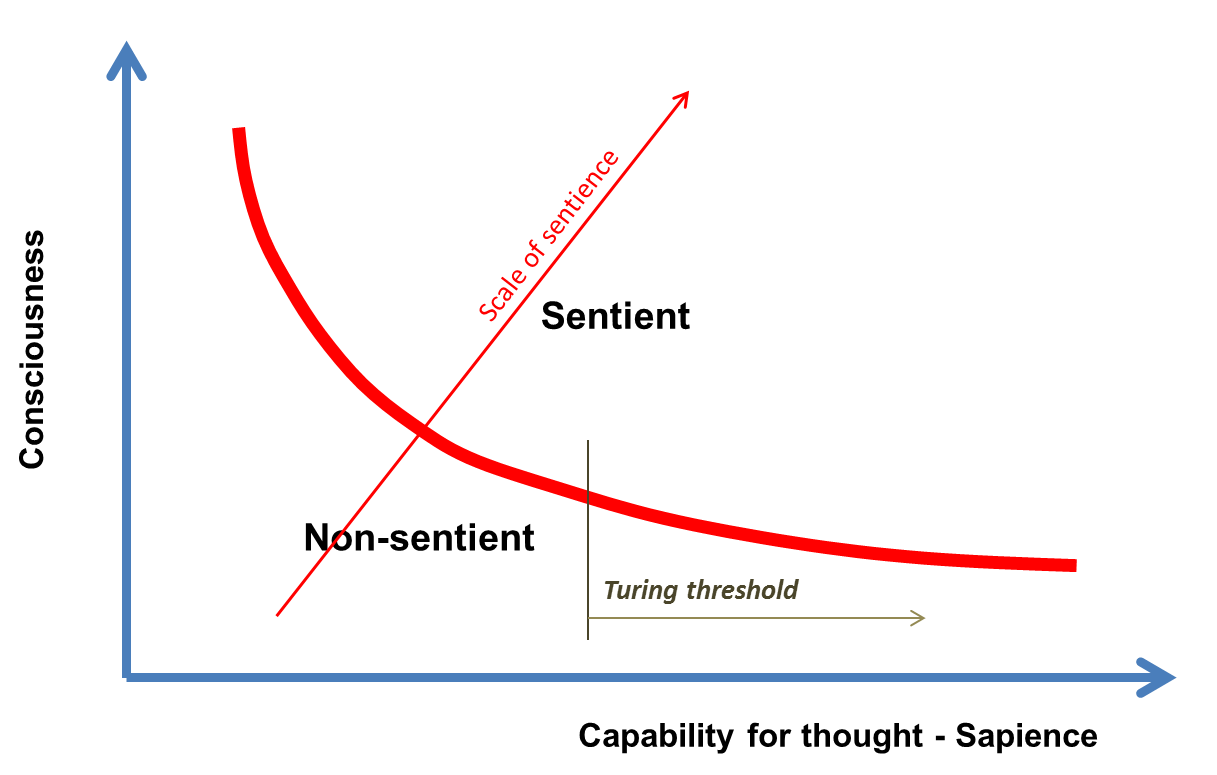
The Turing test is, I think, a test of reaching a particular level of sapience but it is not a test of sentience. But I also think that there is a scale of sapience. All  “artifical intelligences” show varying levels of applying “thought” and could be said to be sapient to some degree. Sapience would seem therefore to be on a continuous scale. Many animals and birds also exhibit some level of thought and clearly exhibit different degrees of sapience. But chimpanzees and gorillas and dolphins and even elephants seem to recognise themselves in a mirror while monkeys do not. They would seem to have different levels of self-consciousness and – it would seem – different levels of sentience. I take gorillas and chimpanzees and maybe elephants to be sentient – just – but not dogs or cats. Is there then a scale of sentience which is constrained (or enabled) by, and depends upon, an entity’s position on a scale of sapience?  I suspect that whatever it is I intuitively consider to be sentient depends upon a combination of sapience and the level of consciousness of self of an entity.

Therefore my tentative definitions / conclusions become

  1. Entities may be “alive” or “inert”.
  2. Only some entities are sapient to any significant degree but sapience is independent of being alive.
  3. There is no sentience without sapience.
  4. Only some “living”, sapient entities are sentient.
  5. Sentience is a composite quality and – I propose – depends on the level of sapience and the level of consciousness exhibited by an entity.


sapience and sentience

sapience and sentience