Posts Tagged ‘evolution of senses’

All the senses we do not have

December 12, 2025

This started as an Appendix to an essay I am writing. However it has grown to stand as a post in its own right. It will now be a citation rather than an Appendix in the essay which I hope to complete soon. “Gods are a matter of epistemology rather than theology”. Cognition, including human cognition, emerges from the interactions between a brain, the senses it has access to and the body they are all housed in. A cognition’s view of the world is as much enabled by its available senses as it is blinkered by the same senses. Senses available to any species are unique to that species’ physiology and the brain which interprests the signals generated. The signals from a spider’s eyes or from a dog’s nose are meaningles and cannot be interpreted by a human brain. Furthermore even within a species each individual cognition has unique features. The experiences of a cognition may be similar to that of another individual of the same species but cannot be truly shared. We have no examples of telepathy in any species. My qualia of experiencing red or pain cannot be shared by any other human – but may be similar to the experiences of others. However a spider’s qualia of experiencing the same red with its eight eyes is something else again.


Introduction

Evolution has no aims, plans, or intended outcomes. It is simply the cumulative result of differential survival and reproduction. Traits persist when organisms carrying them leave more descendants than those without them. Sometimes that happens because a trait spares its bearer from an early death; sometimes it happens because the trait leads to more mating opportunities, or because it helps relatives survive, or simply because there is no better alternative available in the genetic lottery.

The popular idea that evolution “selects” for superior or well-designed features is mostly rhetoric. Natural selection does not favour excellence; it favours whatever works well enough under the conditions at hand. What results in any organism, including humans, is not an optimal design but a set of compromises shaped by history, constraint, and chance. When people speak of evolutionary perfection or elegant fit, they are mistaking local adequacy for intentional design. These traits succeeded because, in a given environment, they did not lose in the competition to leave offspring.

The senses that living organisms possess are no different. Each sensory system that exists today is not the best possible way to perceive the world, but merely one that proved sufficient, in a particular lineage and habitat, to avoid being outcompeted. Evolution leaves us only what has survived, with those traits that were good enough for the conditions of the moment. It contains no foresight, no preparation for what comes next, and any sense of direction we read into it is something we impose after the fact.


Senses Animals Have That Humans Do Not

While humans rely primarily on the five traditional senses (sight, hearing, smell, taste, and touch), plus others like balance (equilibrioception), pain (nociception), and body awareness (proprioception), the living things on earth have evolved many “extra” senses that we do not possess.

  • Magnetoception (Magnetic Field Sense): The ability to detect the Earth’s magnetic field and use it for orientation and navigation. This is found in a wide variety of animals, including migratory birds, sea turtles, sharks, and even honey bees. They use this as an internal compass for long-distance travel.
  • Electroreception (Electric Field Sense): The capacity to sense weak electrical fields generated by other living creatures’ muscle contractions and heartbeats. Sharks and rays use specialized organs called the ampullae of Lorenzini for hunting in murky water, and the platypus uses electroreception in its bill.
  • Infrared (IR) Sensing/Vision (Thermoreception): The ability to sense heat radiation, allowing an animal to “see” the body heat of warm-blooded prey, even in complete darkness. Pit vipers (like rattlesnakes) and pythons have specialized pit organs that detect infrared radiation.
  • Echolocation: A biological sonar system used by bats, dolphins, and toothed whales to navigate and hunt. They emit high-frequency sound pulses and listen to the echoes to create a detailed mental map of their environment.
  • Ultraviolet (UV) Vision: The ability to see light in the ultraviolet spectrum, which is invisible to most humans. Many insects (like bees), birds, and fish use UV vision for finding nectar, recognizing mates, or spotting prey.
  • Polarized Light Detection: The ability to perceive the polarization patterns of light. This is used by many insects (for navigation using the sky) and mantis shrimp (which have the most complex eyes known, seeing forms of polarized light we cannot comprehend) for navigation and communication.
  • Seismic/Vibrational Sensitivity: The ability to detect subtle vibrations traveling through the ground or water over great distances. Elephants use their feet to sense ground tremors, and many snakes and insects use this to detect predators or prey.
  • Ultrasonic and Infrasonic Hearing: Many animals can hear frequencies far outside the human range of 20 Hz to 20,000 Hz. Bats and moths use ultrasound (above 20,000 Hz), while elephants and some whales communicate using infrasound (below 20 Hz).

Senses: Could there be more?

Our current understanding of sensory biology is itself limited by our own human perception. We tend to define a sense based on some physical parameter that can be and is converted into a signal that can then be interpreted by a specialised brain which has evolved together with the sensory organs. If there is some parameter or subtle information in our surroundings that no living thing known to us has evolved to be able to detect, or one that is so subtle and complex that it doesn’t clearly map to a known physical stimulus, we would not even recognize it as a “sense” at all.

  • Subtle Chemical Gradients: While we have smell, some organisms (like bacteria or fungi) may sense complex, long-range chemical fields in ways that defy our simple notions of “smell” or “taste.”
  • Quantum Senses: Some research suggests that the magnetic sense in birds may rely on quantum entanglement within specific proteins. If true, this hints at perception mechanisms on a quantum scale that are difficult for us to even conceptualize fully.
  • Predictive or Internal Senses: Plants, which react to light, gravity, touch, and chemical signals, display complex “behavior” without a nervous system. While we classify these as existing senses, their internal “awareness” of time, nutrient deficiency, or potential nearby threats might constitute forms of interoception or time-perception that function in a fundamentally different way than any human feeling.

Our “awareness” of a sense is often based on the technology we invent to imitate it (like a magnetic compass for magnetoception). It is highly likely that life on Earth has evolved to be able to detect some environmental information in ways that remain outside the scope of our imagination or our measurement tools. We can speculate on senses that could exist in principle but which have no value on earth and therefore have never evolved. Let us take a “sense” to be a structured mapping from external regularities into neural states. Many regularities exist which life-forms on Earth have apparently had no motive or incentive to detect or track.

  • Neutrino detection. Neutrinos pass through a light-year of lead without stopping. Biological tissue could never detect them reliably. Could it be of value to some alien cognition. What would such detection change in a world view?
  • Sense of gravitational gradients at fine spatial scales. Gravity is too weak at the biological scale. A living creature would need to be built of very dense matter to reliably distinguish micro-variations in gravitational fields. But we cannot see any value of this to any conceivable form of life.
  • Hyperspectral gamma-ray “vision”. Gamma rays obliterate earthly biological tissue. A system to detect them without dying would require materials and chemistry alien to Earth. The energy levels are simply incompatible with organic molecules.
  • Direct dark-matter detection. Dark matter barely interacts with baryonic matter. Evolution cannot select traits for a signal that never reaches biology. But could there be alien biology and alien cognition which made use of such detection. Who knows?
  • Time-structure sensing at quantum-coherence timescales. A species that can detect changes occurring over femtoseconds or attoseconds is conceptually possible, but organic molecules are far too slow and thermally noisy. Evolution selects for what biochemistry can sustainbut we cannot know what we cannot know.
  • Sensing vacuum fluctuations (zero-point energy). We are almost entering into nonsense territory but then my nonsense may be basic knowledge to an unimaginable alien.
  • Direct perception of spacetime curvature (not gravity but curvature gradients). Living tissue cannot detect curvature directly. Only masses and accelerations reveal it.

Our reality is that as our knowledge grows so does the perimeter to the unknown grow. We can never know all the senses we do not have.

Sensory and evolutionary deficiencies

August 18, 2014

What shapes our bodies? We can only sense what our shapes permit but are our shapes a result of the survival advantages of what we can sense? Certainly there is much of the physical world that we cannot sense directly – but which we can sense by the instruments we have crafted.There may be many things we don’t even know about which are outside the range of our senses and our instruments (lumped together as extra-sensory things and the source of much speculation and much fraud). Our view of the world and of physical reality is totally dependent upon our senses and what we can perceive directly or through our instruments. Even what we can imagine is limited (a la Rumsfeld) to areas that we know we don’t know. But we cannot even conceive of – let alone imagine – what we don’t know we don’t know.

But why are the ranges of what can be detected by our senses limited to what they are? As hunter-gatherers surely it would have been of survival advantage to see in the dark at least as well as the big cats that were our predators. We must – before agriculture – have had the ability to track our prey. Did humans have a more acute sense of smell then, in the distant past? Did we once use smell as a communication tool as some animals apparently do? Has our sense of smell deteriorated as we have developed as an agrarian society. We can feel minute changes of heat flow on our skins but we cannot “see” thermal images with our eyes. Is there no survival advantage in seeing further into the ultra-violet or the infra-red? Why is our ability to hear high frequency sounds so much inferior even to animals we have domesticated?

There is also a fundamental difference between our ability to perceive some sensory inputs and our ability to generate such sensory signals. We can make as well as detect sounds. We can see certain wave-lengths of reflected radiation but we are not luminescent. Our olfactory sense can detect some trace chemicals but we cannot generate smells at will. Taste buds taste but cannot generate tastes.

It is now thought that humans have many more than just the five traditional “Aristotelian” senses of sight, hearing, touch, taste and smell. Nowadays some recognise pressure, itch, balance, thermoception, proprioception, pain, magnetoception and perhaps even chronoception (the ability to discern passage of time) as being human senses. We can even perhaps sense the force of gravity. If our inherent senses were powerful enough and varied enough, we would not need any instruments. What we cannot detect because our senses are limited could well be called sensory deficiencies, but whether these are evolutionary deficiencies or not depends upon whether the lack of capability could have provided some survival advantage.We can measure brain waves in a fashion with our instruments but we don’t always know what they mean. The existence of an instrument to measure something is itself evidence of a sensory deficiency. But what an instrument can measure we can also imagine some organ may be able to sense.

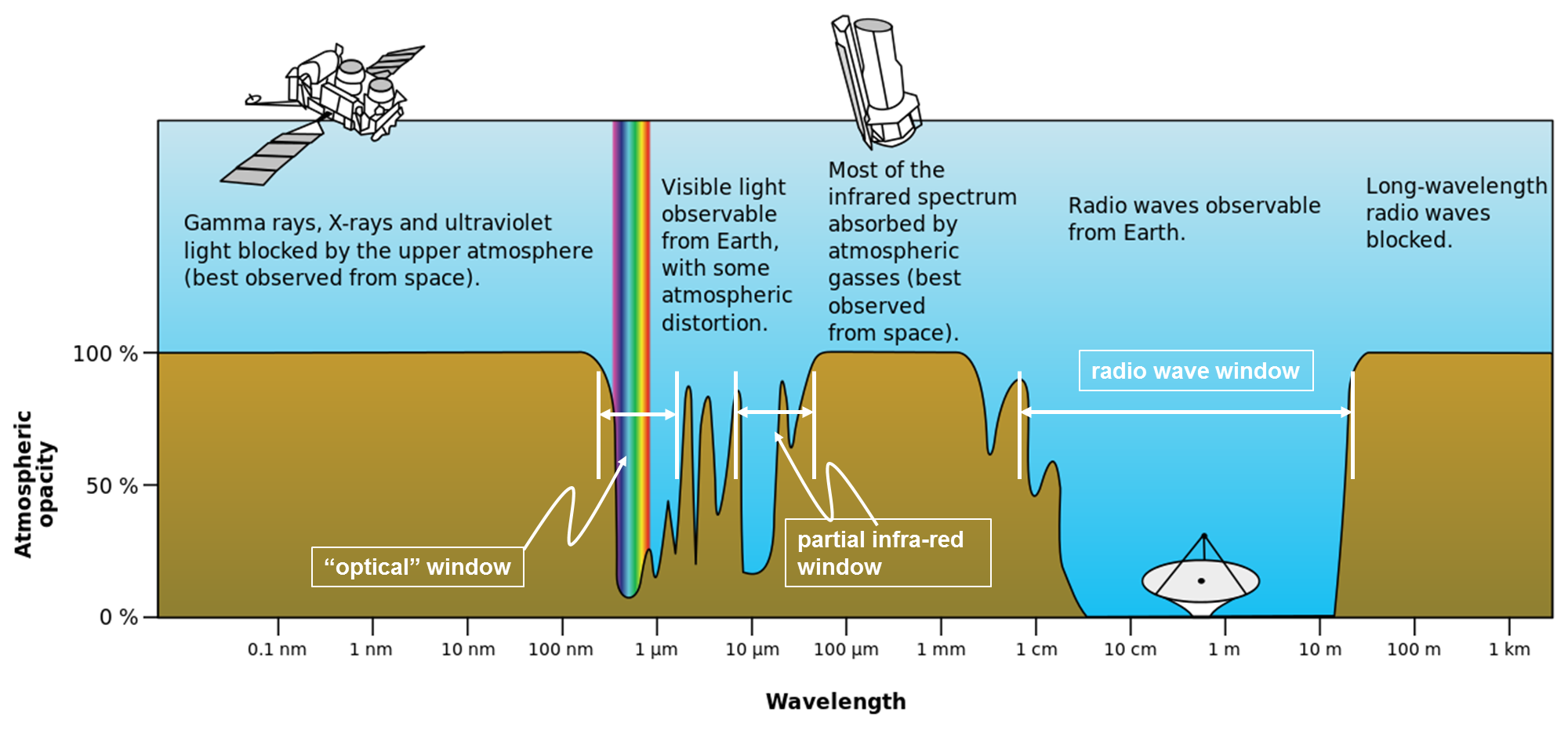
There are some who point to the evolution of the eye as some kind of proof of Intelligent Design. But it is actually the reverse. Human eyes actually see a very small part of the spectrum available to be discerned. Compared to what it could be, vision is a key area of sensory deficiency. Electromagnetic radiation exists in the range from gamma rays having a wavelength of 0.1 Angstrom (10−11 m  corresponding to a wavelength of 1019 Hz) all the way up to long wave radiation with a wave length of about 1,000 m and a frequency of 100,000 Hz. Within this range we find radio waves (wavelength 50 cm – 10 m), microwaves and radar (between 1cm – 10 cm wavelengths), infra-red (between 1 μm and 1 mm), “visible light” (between 360 nm to 720 nm), ultra-violet (20 nm to 100 nm) and X-rays (0.2 nm to 1 nm). The gases in the Earth’s atmosphere prevents much of the electromagnetic radiation from reaching the surface. But the atmosphere is virtually transparent in 3 main bands

  1. an “optical window” including the visible spectrum along with the near uv and near ir regions,
  2. a partial infra-red window, and
  3. a radio wave window
emr windows - based on wikimedia

emr windows – based on wikimedia

There is some reason therefore for life on earth to develop senses which take advantage of these windows to detect the electromagnetic radiation that passes through the atmosphere and bombards the earth. Yet no animal can detect all radiation just in the “optical window”. Some of the infra-red radiation can be detected as warmth on the skin. Bats can both see and emit along the radar bands but not at longer radio wave-lengths. Humans are virtually blind in the top two windows.

daffodil in visible and UV light image Dr. Mccarthy

daffodil in visible and UV light image Dr. Mccarthy

http://drmccarthysciencehgms.blogspot.se/2010/01/how-do-insects-see-flowers.html

Even within the optical window, the range of wave-lengths that are “visible” to humans is much narrower than the range visible to all animal-life. Pollinating creatures (bees and butterflies), for example, see well into the ultra-violet. The colours and patterns on flowers look quite different in ultra-violet light. They appear like landing lights to guide the pollinator “home”.While the picture on the right above is exclusively in uv light, an extended range of human visibility would lead to “seeing” some combination of the two pictures above. And so it would be if we could see further into the infra-red as well. We would need non-existent – but imaginable organs, to sense radiation within the other two windows.

Whether or not an extended range of vision could have helped humans better to survive, it is apparent that human vision is – compared to what is possible in the animal world – deficient. Compared to what is there to be “seen”, we see only a tiny fraction. It is highly unlikely that having an extended range of vision would have been a disadvantage in the survival stakes. It may not have provided a critical advantage but it still remains a sensory and an evolutionary deficiency!

Humans also lack the organs which allow bats to be radar receivers and emitters. A deficiency. We lack the organs that allow sharks to detect electric currents or birds to detect and navigate along magnetic lines of force. Our olfactory senses are far inferior to that of most animals. Dogs may be able to smell cancer cells but we can’t. Our hearing of high frequency sounds is also much inferior to that of most animals. All deficiencies. Humans do very well with low frequency sounds and perhaps only elephants and the largest of whales can generate and hear lower pitched sounds than humans can. We do not have the senses to even discern what some of our instruments measure.

For every human sense, and comparing only with the range exhibited by other life on Earth, our range of detection is deficient. There is no instance where the range of a human sense represents the entire range available within the animal world. Clearly, with a greater sensory range, humans could be much more capable – inherently – of discerning the world around them than they actually are.

Evolution of course is not about excellence. It is not even about the survival of the fittest. It is just the result of the demise of the unfit and therefore represents the minimum required to survive. Evolution is not about being “best” but only about being “good enough”. Evolution therefore sorts out individuals with sensory deficiencies when they are debilitating and prevent survival but evolution does not – except by accident – lead to an increase in a sensory range.

Natural de-selection which has dominated evolution so far is essentially without direction and is not a “selection for excellence”. Now as artificial selection comes into play, it becomes possible for humans – for the first time ever – to consider the direction to be taken for the development of future humans. This is the stuff of Frankenstein and Dr. Moreau and other evil genetic manipulators. Nevertheless I wonder which senses I would want/desire to be improved or enhanced or even created. (Though I would prefer that the deterioration of senses with age be addressed first).

Vision: I would quite like to have a much better night vision sensitivity together with some further range into the infra-red (but perhaps not much further into the uv range). I exclude Superman like X-ray vision as being too far removed from the optical window. To be able to “light-up” whatever I was looking at – say within 1 m – would require some new organ of luminescence which may be asking for too much.

Sound: A slightly larger range of hearing into the high frequency bands is, I think, to be desired. At least so I can hear what a dog hears. This would change human music and musical instruments quite drastically. I don’t think I want a more acute hearing sense (we are surrounded by enough noise as it is) but I would like to be able to hear a greater range of sounds than I can produce.

Magnetoception: It would have been a boon for explorers 500 years ago if they had had an innate sense of magnetic north. As we go out away from earth, humans will be exploring again and being able to discern lines of magnetic force without relying on instruments could well come in useful.

I have no great desire for enhancing the sense of touch or of smell. They are fine as they are and I see no clear benefits in their enhancement. But a new organ of extra-sensory perception (esp) to pick up the brain waves of others could be very handy. In its simplest form it would just detect when somebody was lying or some kind of “empathy” level being broadcast. But in its most evolved form it could be what is so beloved of science fiction writers. An organ that allowed mind-to-mind contact would lead to a profound paradigm shift in communication between humans which would rival the introduction of speech and language.