China’s lunar probe Chang’e 2 completed its mission orbiting the moon three months ago and has now reached Lagrange (liberation) Point L2.
It has now reached a point in space where neither the moon nor the earth’s gravity will affect the probe. This point is called L2. It’s the farthest a Chinese spacecraft has ever been.
Chang’e 2’s primary mission was to orbit the moon at only 100 kilometers from the surface, taking high resolution photos. After completing this, scientists decided that there was enough fuel to continue with the second part of the mission. But sending the probe from the moon was unprecedented. Similar missions has previously left directly from Earth, so keeping the satellite on course was a technological challenge.
Zhou Jianliang, Deputy Chief Designer, Measure & Control System of Chang’e 2, said, “The satellite faced various disruptions on its journey, which could have led it off course. We had planned four readjustments to keep it on track. But we only need(ed) to do it once since the first adjustment proved so accurate.”
China’s ambitious three-stage moon mission is steadily advancing. The next phase will be the launch of Chang’e-3 in 2013. The probe’s mission is to land on the moon together with a moon rover. In the third phase, the rover should land on the moon and return to Earth with lunar soil and stones for scientists to study. The Chang’e program was named after the legendary Chinese goddess who flew to the moon. With the progress in technology and experience from the Chang’e mission, sending a Chinese astronaut to the moon is now clearly feasible.
The Italian-French mathematician Joseph-Louis Lagrange discovered five special points in the vicinity of two orbiting masses where a third, smaller mass can orbit at a fixed distance from the larger masses. More precisely, the Lagrange Points mark positions where the gravitational pull of the two large masses precisely equals the centripetal force required to rotate with them. Those with a mathematical flair can follow this link to a derivation of Lagrange’s result (168K PDF file, 8 pages).
Of the five Lagrange points, three are unstable and two are stable. The unstable Lagrange points – labeled L1, L2 and L3 – lie along the line connecting the two large masses. The stable Lagrange points – labeled L4 and L5 – form the apex of two equilateral triangles that have the large masses at their vertices.
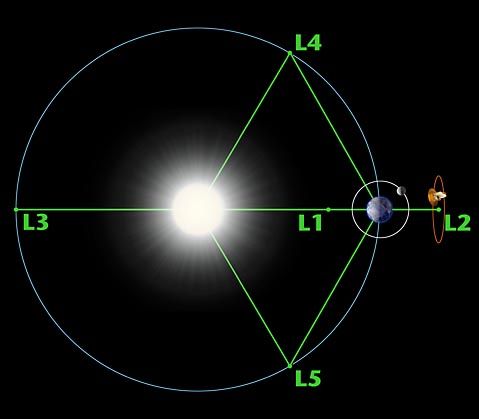
Lagrange Points of the Earth-Sun system (not drawn to scale!): NASA
The easiest way to see how Lagrange made his discovery is to adopt a frame of reference that rotates with the system. The forces exerted on a body at rest in this frame can be derived from an effective potential in much the same way that wind speeds can be inferred from a weather map. The forces are strongest when the contours of the effective potential are closest together and weakest when the contours are far apart. In the contour plot below we see that L4 and L5 correspond to hilltops and L1, L2 and L3 correspond to saddles (i.e. points where the potential is curving up in one direction and down in the other).
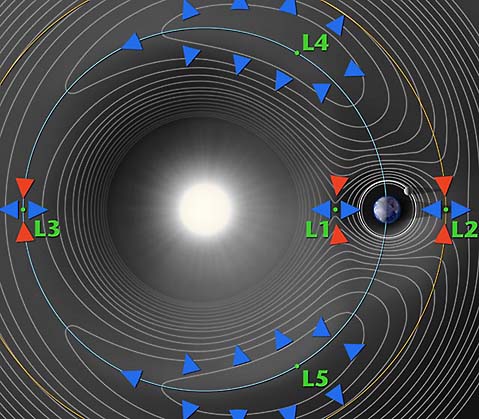
A contour plot of the effective potential (not drawn to scale!): NASA


 The k2p blog