Posts Tagged ‘Extrasolar planet’

“Where no man has gone before” – 50 new exoplanets discovered

September 12, 2011

Fifty New Exoplanets Discovered by HARPS

Astronomers using ESO’s world-leading exoplanet hunter HARPS have today announced a rich haul of more than 50 new exoplanets, including 16 super-Earths, one of which orbits at the edge of the habitable zone of its star. By studying the properties of all the HARPS planets found so far, the team has found that about 40% of stars similar to the Sun have at least one planet lighter than Saturn.

The HARPS spectrograph on the 3.6-metre telescope at ESO’s La Silla Observatory in Chile is the world’s most successful planet finder. The HARPS team, led by Michel Mayor (University of Geneva, Switzerland), today announced the discovery of more than 50 new exoplanets orbiting nearby stars, including sixteen super-Earths. This is the largest number of such planets ever announced at one time. The new findings are being presented at a conference on Extreme Solar Systems where 350 exoplanet experts are meeting in Wyoming, USA.

The harvest of discoveries from HARPS has exceeded all expectations and includes an exceptionally rich population of super-Earths and Neptune-type planets hosted by stars very similar to our Sun. And even better — the new results show that the pace of discovery is accelerating,” says Mayor.

In the eight years since it started surveying stars like the Sun using the radial velocity technique HARPS has been used to discover more than 150 new planets. About two thirds of all the known exoplanets with masses less than that of Neptune were discovered by HARPS. These exceptional results are the fruit of several hundred nights of HARPS observations.

Working with HARPS observations of 376 Sun-like stars, astronomers have now also much improved the estimate of how likely it is that a star like the Sun is host to low-mass planets (as opposed to gaseous giants). They find that about 40% of such stars have at least one planet less massive than Saturn. The majority of exoplanets of Neptune mass or less appear to be in systems with multiple planets.

Read the full European Southern Observatory Press Release
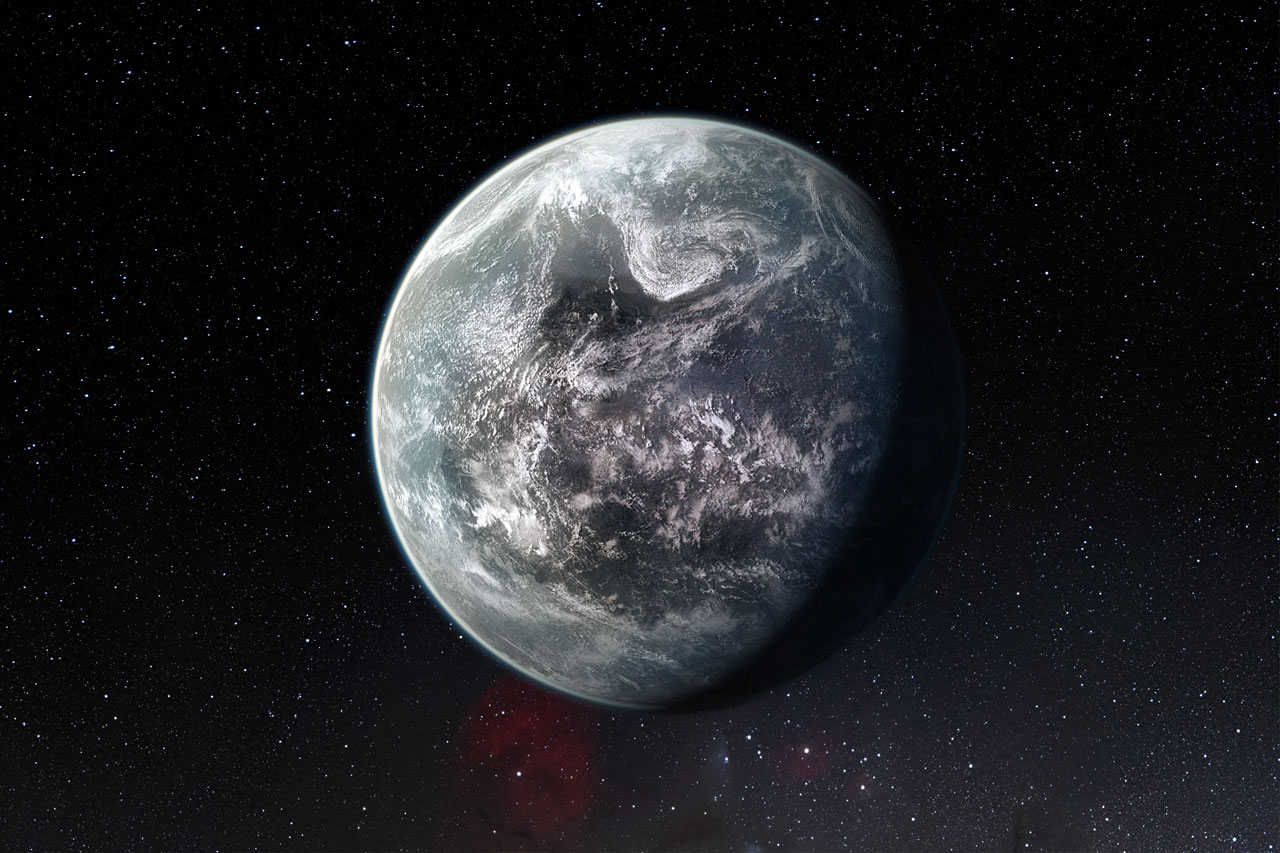
Artists’s impression of one of more than 50 new exoplanets found by HARPS: the rocky super-Earth HD 85512 b: image ESO

“Gliese 581g”: Habitable planet found?

September 30, 2010
Habitable zone-he

Image via Wikipedia: Habitable zone

From just a week ago “Two researchers have used the pace of past exoplanet finds to predict that the first habitable Earth-like planet could turn up in May 2011″.

A pessimistic forecast perhaps because astronomers may have found the most Earth-like alien planet to date, and it’s located only a short distance away, cosmically speaking. The team says that the planet’s proximity to its sun, coupled with the ease with which it was detected, suggests that the galaxy could be teeming with habitable worlds.

Science reports that:

Gliese 581g looks like a game-changer. Detected from the minuscule amount of gravitational influence it exerts on its star, the planet lives a mere 20 light-years away in the constellation Libra. Gliese 581g is the sixth world discovered around its sun—and the fourth most distant. Yet its orbit brings it closer to its parent star than Mercury is to our sun. Still, it’s squarely within the habitable zone, because the planet’s star, which is a type known as a red dwarf, contains only about 30% of the sun’s mass and shines with only about 1% of its brightness, the researchers will report in an upcoming issue of the Astrophysical Journal.

Read the article:

http://news.sciencemag.org/sciencenow/2010/09/astronomers-find-most-earth-like.html

Habitable planet to be discovered in May 2011?

September 22, 2010

The only thing certain about forecasts is that they are more often wrong than right – and I exclude forecasts made entirely on known science or “laws” of nature where the level of uncertainty is insignificant (e.g. the sun will rise tomorrow). Nevertheless “Future History” which is a study of how forecasts evolve and how accurate they have been is a most powerful tool when making judgements about directions to follow and actions to be taken. In management “Future History” methodology is, I think, one of the most powerful tools for the development of corporate strategies and action plans.

The New Scientist reports that :

“Two researchers have used the pace of past exoplanet finds to predict that the first habitable Earth-like planet could turn up in May 2011”.

In 1965, Intel co-founder Gordon Moore observed that the number of transistors that fit on a chip doubles about once every two years – a trend now known as Moore’s law. Samuel Arbesman of Harvard Medical School in Boston wants to see if scientometrics – the statistical study of science itself – can similarly be used to not only study past progress but also to make predictions.

He and Greg Laughlin of the University of California, Santa Cruz, are testing the idea with exoplanets. Over the past 15 years or so, the pace of planet discoveries has been accelerating, with some 490 planets now known. “It is actually somewhat similar to Moore’s law of exponential growth,” Arbesman says.

To predict when astronomers might find the first planet similar in size to Earth that also orbits far enough from its star to boast liquid water, the team scoured the discovery records of 370 exoplanets.

They focused on two basic properties needed for habitability: a planet’s mass and its surface temperature. They used these two factors to assign each planet a ‘habitability metric’ ranging from 0 to 1, where 0 was uninhabitable and 1 is close to Earth’s twin.

A rough estimate of each planet’s habitability was then plotted against the date of its discovery. Using different subsets of the 370 planets, the researchers made curves from the individual points and extrapolated the curves to find when a planet would be found with a habitability of 1. They then analysed the range of discovery dates to determine which would be most probable.

Habitable planets: http://t2.gstatic.com/images

Their calculations suggest there is a 50 per cent chance that the first habitable exo-Earth will be found by May 2011, a 75 per cent chance it will be found by 2020, and a 95 per cent chance it will be found by 2264.

In fact, exoplanet researchers have made forecasts of the future informally, plotting the mass of planets against the date of discovery to see how the field is progressing. “We’ve done that for many years at conferences,” says Eric Ford of the University of Florida in Gainesville. “The new aspect of this paper is putting an uncertainty on those predictions and unfortunately the uncertainty is quite large.”

One source of uncertainty is how factors like changes in funding and the development of new techniques and technology can alter the pace of discovery. “Like the stock market, past returns are no guarantee of future performance,” Ford says.

“There are always these complex factors of how science is actually done,” Arbesman agrees. But he says the forecasting technique could still prove useful, even if these factors are not accounted for directly. In part, that is because new technologies tend to take a while to ramp up, so they may not lead to sharp jumps in the number of discoveries made.

Previously, Arbesman has quantified how the ease of discovering new mammalian species, chemical elements, and asteroids affects the rate of their discovery. New species and asteroids are more difficult to find the smaller they are, and indeed larger ones are found first. For chemical elements, the opposite is true, since the bigger they are, the rarer and more unstable they tend to be.