Posts Tagged ‘Germany’

Tactical voting in the German polls today?

September 22, 2013

Talking to some of my German friends over the last few days, I get the impression that there could be some tactical voting today.

German polls

German polls

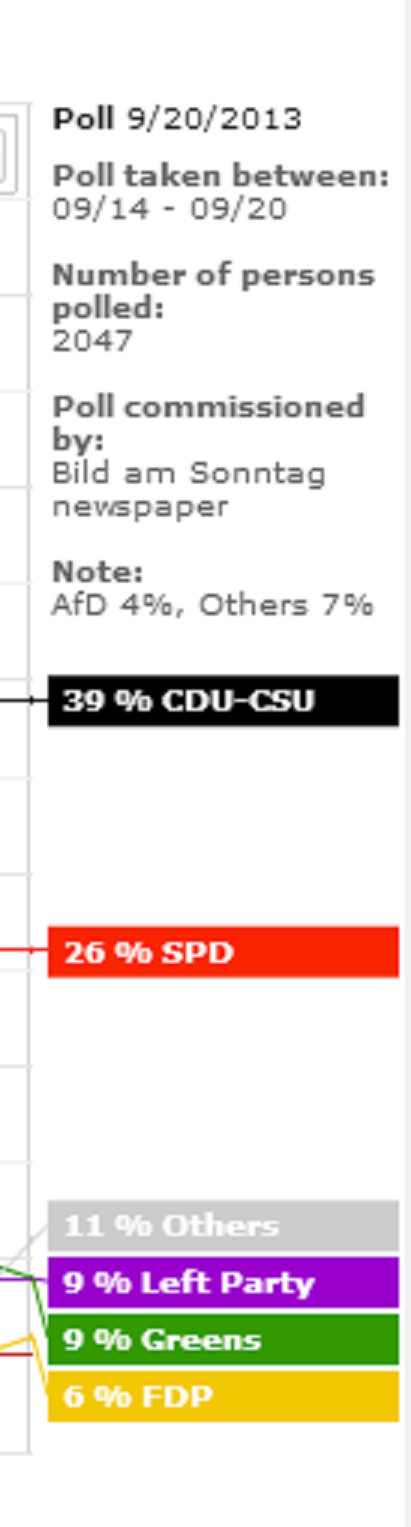
The latest polls (via der Spiegel) give Angela Merkel’s CDU-CSU 39% but their coalition partners the FDP are running close to the 5% barrier. The Green vote has come down to around 9% and the recent ballyhoo about their pro-vegetarianism, anti-car and pro-paedophilia positions could hurt them further. The dawning realisation that they have been most responsible for the very high cost of electricity that Germans are burdened with has probably been the underlying reason for their steady decline in the last few months. The far Left are also around 9% and their votes are probably solid especially in Eastern Germany where die-hard communists are still hankering for the “good old days”.

The anti-Euro AfD are running below the 5% barrier and it has been politically incorrect to show any support for them. They could spring a surprise and creep over 5% and that would lead to interesting times – especially if their success is allied with a weakening of the Greens. Paradoxically some of their far-right support could be enhanced by some support from the very far Left.

To get any kind of a comfortable right-of-centre coalition Angela Merkel needs the FDP. For the FDP to fall below 5% could lead to some unnecessary pressures. A Grand Coalition with the SDP is something to be avoided. And this leads to the possibility that some CDU-CSU voters will cast their primary vote for their CDU-CSU candidate but will give their second vote to the FDP party. While no single FDP candidate will be advantaged in winning their own seats, this tactical approach could ensure that the FDP gets close to 7 or 8%. The seats they win as a party could then be close to the number won by the Greens and could provide the cushion that Angela Merkel could be quite thankful for. Talking to my friends (2 CDU supporters and one SDP) I got the impression that

  1. in very strong CDU-CSU constituencies some of the second “party” vote could well go to the FDP, and
  2. in strong SDP constituencies, CDU-CSU voters could cast both their votes for the FDP.

Well, the results will be known in about 12 hours and Angela Merkel’s performance is almost a foregone conclusion. She will be returned for the 3rd time. It is the performance of the Greens, the FDP and the AfD which adds some spice and interest to an otherwise rather low key and almost “boring” election. But it is the very mundane nature of the election which – I think – reflects the mood in Germany and is Angela Merkel’s greatest advantage. She makes common sense and being “boring” virtues devoutly to be sought.

Germans no longer being taken in by Green propaganda

September 10, 2013

The German elections are less than 2 weeks away and the only real question is what Angela Merkel’s win will look like. Whatever the result she will not find it necessary to pay too much attention to the Greens. The German Green party peaked in support a few weeks after the 2011 earthquake, tsunami and Fukushima nuclear plant accident. They reached the height of 28% support for a few days in April 2011 and entertained hopes of becoming Germany’s 3rd party. But the euro zone financial crises have ccontinued since then. The German Energiewende is turning out to be an expensive catastrophe. More coal is being burnt today than before. Heavily subsidised solar and wind energy are destabilising the grid and not pulling their weight. German electricity prices are driving industries – and jobs – out of the country. Profligate Green policies adopted under Green pressure are being seen to be the reason. They are a problem rather than a solution to any existing problem.The Greens are currently polling at about 10% support. A long drop from the heady days of 2011.

As Der Spiegel puts it:

German consumers already pay the highest electricity prices in Europe. But because the government is failing to get the costs of its new energy policy under control, rising prices are already on the horizon. Electricity is becoming a luxury good in Germany … 

…. The political world is wedged between the green-energy lobby, masquerading as saviors of the world, and the established electric utilities, with their dire warnings of chaotic supply problems and job losses.

Even well-informed citizens can no longer keep track of all the additional costs being imposed on them. According to government sources, the surcharge to finance the power grids will increase by 0.2 to 0.4 cents per kilowatt hour next year. On top of that, consumers pay a host of taxes, surcharges and fees that would make any consumer’s head spin.

It is beginning to sink in with the German electorate that “feel good” politics of the Greens which achieves little and costs the earth is not sustainable. The electorate is beginning to resent being told what to do, how to live, what to eat and how to drive. To attack meat-eating and the driving of cars as the Greens have done seems particularly inept.

Reuters: 

Greens dream of power fading as German election nears

….. Like other Germans once attracted to the world’s most successful pro-environment party, Suska is now turned off by the Greens — and his defection helps explain a sudden drop in support before Germany’s September 22 election.

“The Greens have this ‘ecological dictatorship’ feeling about them now,” says Suska, 45. “I used to always vote Greens. But not anymore. No one likes to be told what to do. It feels like the Greens are going to make everything more expensive.”

Support for the Greens, which traces its roots to the peace movement of the 1970s, hit a high of 23 percent in 2011 after the Fukushima disaster in Japan boosted the appeal of its anti-nuclear message. Within weeks of the tragedy, the Greens stunned Chancellor Angela Merkel by winning control of the state of Baden-Wuerttemberg, long a conservative stronghold.

As recently as July, the party was polling a robust 15 percent, well above its 2009 result of 10.7 percent.

But over the past two months, the Greens have seen their support crumble to 10 percent, a four-year low. The collapse, in the most crucial phase of the campaign, appears to have doomed what faint hopes the party had of returning to power with the Social Democrats (SPD), with whom it ruled from 1998 to 2005.

… Much of the party’s fall in popularity can be traced to a series of self-inflicted wounds.

One big problem is the lin… gering suspicion the Greens want to tell people what to do: drive more slowly, take the bus, turn off lights, turn down the heat, ban large livestock farming.

Their light-hearted idea for a “Veggie Day”, where Germans would skip meat once a week, has been mocked in the media and by other parties. The rival Free Democrats (FDP) went so far as to organize a barbecue to annoy the Greens.

Proposals to cut city speed limits and put an upper limit on motorways have also alienated some supporters.

“Germans don’t have a sense of humor when it comes to cars and meat,” said Yvonne Seiler, a secretary and Greens backer.

Gero Neugebauer, a political scientist at Berlin’s Free University, said: “The Greens scare away a lot of voters and their ideas just don’t excite people anymore. People don’t understand their message.”

Der Spiegel again:

…. with the vote two-and-a-half weeks away, the picture is not nearly as rosy. A poll released Thursday found that just 10 percent of Germans intend to vote for the Greens on Sept. 22. It is the lowest survey result for the once popular party since way back in 2009.

…… One of the party’s central proposals in the current campaign, for example, has been that of raising taxes on high earners and introducing a 1.5 percent tax on assets of over €1 million as a way of increasing social justice. To be sure, many of the party’s core voters support such a proposal, despite being in the upper tax brackets themselves. But it seems poorly designed should the Greens be interested in getting their new supporters to actually cast a ballot for the party on Sept. 22. Other proposals have likewise fared poorly.

Specifically, the Greens have proposed the introduction of one vegetarian day each week in workplace cafeterias across the country. “A veggie day would be a great opportunity to see how we can nourish ourselves without meat and sausage,” senior Green politician Renate Künast told the tabloid Bild on Monday.
German helicopter probes US consulate in Frankfurt for spy station

September 10, 2013

The US NSA’s wide-spread surveillance of friends and foes alike revealed by the Snowden documents is creating an atmosphere of distrust. South American countries are not pleased after the revelations that leading politicians have had their e-mails intercepted and hacked by the NSA. Of course many of the intelligence agencies in European countries have been complicit in the indiscriminate surveillance. Now it seems that the NSA have also probably been helping US companies by spying on their rivals such as Petrobras, SWIFT and other foreign firms.

In Sweden you haven’t really arrived if you aren’t important enough to have had your e-mail intercepted!

But suspicions are now running very high about all US installations.

The Local:

A German police helicopter has flown low over the US Consulate in Frankfurt looking for a secret listening station, prompting a call from the American ambassador to Germany’s foreign ministry.

The helicopter circled low over America’s consulate in Frankfurt on August 28th on the orders of Chancellor Angela Merkel’s chief of staff Ronald Pofalla, magazine Focus reported on Monday.

Pofalla had declared the NSA spying scandal – sparked by whistleblower Edward Snowden’s revelations of a mass surveillance programme – over. 

But the helicopter flight, whose mission was to gather evidence of the supposed spying station – hints at the German government’s lack of trust in its ally’s spying activities on German soil. The helicopter slowly flew twice over the consulate at a height of 60 metres to photograph the site, Focus reported. 

Probably the only safe course is now for any country and for any company with US competitors to assume that they are being spied upon and to assume that every US government installation abroad is involved in the surveillance.

How long can Germany bear the cost of their Greens?

September 4, 2013

Less than 3 weeks to go for the German elections and the polls put Angela Merkel at 39% with the Social Democrats at 23%, the Greens at 11% and the Far Left at 10%. But polls have been wrong in German elections and sometimes spectacularly wrong:

Reuters:

Eight years ago Angela Merkel stared gloomily at the election results with disbelief when her party crashed to 35.2 percent of the German vote, seven points below the opinion poll forecast.

Her poll lead melted away again on election day four years later, though her conservatives stayed in power despite their worst result since 1949. Indeed her Christian Democrats (CDU) and their Bavarian sister party, the Christian Social Union (CSU), have fallen short of forecasts in the last six elections.

They are leading again as the September 22 vote comes round, but that humbling record explains why Merkel is not letting up, with 56 campaign stops in the month before voters give their verdict.

The chancellor warns in her speeches that supporters will have a “rude awakening” if they place too much faith in polls.

Once highly accurate, voter surveys in Germany have become a less reliable barometer as party allegiances weaken, voter turnout falls, differences between parties disappear and small newcomers crowd the ballot sheet.

The success of the Greens and their profligate policies have been mainly due to the German electorate looking desperately for a “feel-good” factor. My 3 years living in Germany – in the heart of the “old” Eastern Germany – only convinced me that the normally very pragmatic Germans were extremely apprehensive and tentative about touting their undoubted economic successes. They feared to take too much pride in their achievements since it brushed perilously close to Nationalism and all the dark ghosts that evoked. The Green Party – I think – filled this need for somehow “feeling good” about their own achievements in a benign way while avoiding any of the sinister negatives associated with “national pride”.

But this has been an expensive experiment – in money and in jobs. How much longer the Green bubble will continue remains to be seen. It is fundamentally unsustainable and all over Europe it is beginning to penetrate that the cost of “feeling good” for no benefits is a luxury. But German common sense, pragmatism and realism will eventually prevail as the costs of “feeling good” become increasingly obvious.

The Local:

Higher renewable energy subsidies due to be introduced in October will add an extra €40 onto the annual energy bill for a three person household, wrote Der Spiegel magazine in a report published on Monday. 
The cost of supporting German producers of renewable energy is, under German law, passed on to the consumer. The cost per kilowatt hour of green energy is simply added onto their bills. 
Set every October for the following year, this year the cost is set to jump 20 percent from 5.3 cents per kilowatt hour to 6.5 cents, wrote the magazine. 
Perversely, the price hike is necessary because the electricity market is actually being flooded with cheap electricity, wrote the magazine. 
Germany’s green energy producers have been guaranteed fixed rates feed-in-tariffs for 20 years, while recently the electricity stock market price has fallen to its lowest value in years. 
This has led to a widening gap between the falling prices grid operators are able to sell electricity for on the market, and the fixed guaranteed prices they have to pay out to producers of renewable energy. The result is that consumers have to make up the difference.

And consumers can only take so much. My expectation that common sense will prevail is – to no small part – also dependent upon the Greens propensity for being silly. Many of the Greens’ policies are silly without initially being seen to be silly. But calls – by some Green leaders – for a ban on driving cars on weekends and by other Greens for the legalising of incest go beyond silly and enter the realms of “stupid”. It is beginning to dawn on the electorate that the Greens may be a luxury – in money, jobs and in ideas – that Germany can ill afford.

NoTricksZone:

German daily Die Welt writes that one of the leaders of Germany’s influential Green Party is now calling for a ban of car driving in Germany on weekends.

Die Welt writes:

Green parliamentary group leader Fritz Kuhn wants cars of German drivers to be idle on weekends. […] With a driving ban a clear signal against climate change would be made. According to estimates by Kuhn, the citizens would quickly notice, “that you can also get along without cars”.

Fritz Kuhn, the mayor of Stuttgart, cites a ban used in Northern Italy in 150 cities last Sunday in order to fight air pollution. People can use their bicycles or go by foot.

By now readers may be thinking that the German Greens want to ban everything. Though it seems to be that way, this is not true.

There are some things they want to legalize: incest for example. According to FOCUS magazine here:

The incest ruling by the European Court of Justice for Human Rights (EGMR) against a 34-year old man from Leipzig has led to controversial reactions. Green Party politician Hans-Christian Ströbele reacted the most sharply. He wants to permit sex between siblings and other close relatives, and is requesting doing away with the incest laws. It is an isolated relic of another time when adultery was punishable, which we also have done away with,’ Ströbele told news network N24. Paragraph 173 no longer matches ‘in this time of enlightened opinion on marriage and family. It must be abolished’.”

Reality Check – Climate does not much care for Acts of Parliament

March 24, 2013

Two interesting articles today and perhaps they presage the return of some sanity to the ludicrous, Canute-like attempts to try and control climate. The first is in Die Welt (which is usually a most politically correct adherent of global warming dogma) about the nonsense that the Greens have wrought in German policy (by Sebastian Lüning and Fritz Vahrenholt reported by P. Gosselin). The second is a leader in the Telegraph calling for the repeal of the Climate Change Act in the UK.

NoTricksZone: Germany’s Energiewende [energy transition over to renewables] is being watched closely in foreign countries. Already bets are being made on whether the expensive experiment is going to work. Meanwhile increasing numbers of international experts are expressing serious doubts. In the March 20th print edition of German national daily Die Welt, Daniel Wetzel reports on a survey by the World Energy Council in an article titled “The Energiewende is an international flop”. An online version of the report is now available and bears the watered down title: “Other countries disdaining the Energiewende”:

Worldwide doubt about the success of the German Energiewende is growing. International experts are sure that the German economy is weakening. This is the finding of a survey from the World Energy Council. […] A rapid short-term shutdown of nuclear power plants along with unlimited subsidies for renewable energies: In Germany this has been viewed as the silver bullet for energy policy since the Fukushima accident. However in Europe and globally, there’s hardly a nation that views the German ‘Energiewende”’ as worth copying. These are the findings of the German section of the World Energy Council in 23 member countries, made exclusively available to Die Welt. […] The rising doubt is possibly related to the unexpectedly rapidly rising electricity prices in Germany, which are having a dissuasive effect. Stotz believes: ‘Obviously one has to be able to afford an energy transition.’ (Read more at Welt Online).

In a commentary appearing at Die Welt titled, “Germany, the odd one out”, Daniel Wetzel pleads for more prudence, and rejects climate alarmism as the most important argument for an Energiewende:

Also the necessity to rapidly end the use of fossil fuels no longer appears as urgent as it was just a few years ago. Indeed, in the meantime, fear of climate change appears to have evaporated worldwide. Global warming has been taking a break for over 10 years, and politicians in many countries appear as if they would rather await a good explanation for this phenomenon before again making the fight against climate change a high priority. Quite apart from this: one other large industrial country has just succeeded in reducing its per capita CO2 emissions to levels of the early 1960s. The best in the class when it comes to climate politics is the USA. Thanks to fracking technology in natural gas drilling, they have been able to switch off dirty coal power plants.”

“The Tory part of the Coalition is beginning to recognise some painful truths, but it is time for the Coalition to tear up its energy policy before the lights go out” says The Telegraph:

……  Because of a misguided faith in green energy, we have left ourselves far too dependent on foreign gas supplies, largely provided by Russian and Middle Eastern producers. Only 45 per cent of our gas consumption comes from domestic sources. All it takes is a spell of bad weather, and the closure of a gas pipeline from Belgium, to leave us dangerously exposed, and to send gas prices soaring. Talk of rationing may be exaggerated, but our energy policy is failing to deal with Britain’s fundamental incapacity to produce our own power.

…… It is time for the Coalition to tear up its energy policy before the lights really do go out. The first priority must be to repeal the Climate Change Act of 2008, with its brutal, punishing targets: ………  But green technology – in its current incarnation, anyway – is just too inefficient and expensive to meet our energy needs. In some of the worst weather for more than 30 years, green power still only provides a tiny fraction of our energy needs. Solar power is of limited use in our cold, dark, northern climate. And wind power isn’t much better – cold weather doesn’t necessarily mean windy weather. 

…….. He will know that American gas prices have plummeted, thanks to the US embracing the shale gas revolution. ………. Our energy problems have been deepened by the greener-than-green Liberal Democrats, with their seeming stranglehold on the Cabinet post of Energy Secretary. ………….

There is some good news, however. As we report today, government sources have said that wind power subsidies are to be cut again. This is a move in the right direction and we very much welcome it. It is to be hoped that there will be more such announcements, and concrete actions, from a government that has neglected a fundamental duty – to keep the lights on, energy affordable and our houses warm.

Stealing by the state from depositors in Cyprus is a dangerous precedent for all weak banks in the Euro zone

March 23, 2013

A one off tax is not a regular tax but just confiscation. When done by a State it is Grand Theft. It is some kind of nationalisation where some selected private assets are appropriated. Whatever it is called, it is just plain stealing from bank depositors. When banks are weak or badly managed it is the owners of the bank who should be held both responsible and accountable. But to blatantly and arbitrarily just “confiscate” a part of some of the depositors holdings  is a dangerous precedent.

If this is what happens in Cyprus and seemingly with the acquiescence –  if not the encouragement – of the Euro zone then it bodes ill for all depositors in weak Euro zone banks or banks in weak Euro zone countries. Cyprus can set a precedent of what is acceptable behaviour in the Euro zone. Certainly the banks and the owners will like this. After all it shifts risk from the bank’s equity to the bank’s depositors. And for profligate countries it provides a cover for stealing the money of large depositors.

For depositors having more than €100,000 in Cyprus it is already too late. Robbery by the State has been sanctioned by the European Union including Germany. Rationalising such a move by saying it is to get at black Russian money is disingenuous. If this is acceptable in Cyprus today then it may well be acceptable for banks – and not just the State – to confiscate their customer’s savings whenever an “emergency” arises.

For those with substantial deposits  – and not just over €100,000 – in Greece or Spain or Italy or Ireland it is probably high time to get out.

Reality Check: add renewables subtract nuclear = more coal (and more gas)

August 20, 2012

Reality of course is that coal, gas, hydro and nuclear are the cheapest sources of electricity generation and will be with us for some time to come. And there is no need – for the sake of idiotic scenarios of nuclear holocaust and nonsense theories about AGW – to move away from them.

Bloomberg:

Chancellor Angela Merkel’s government says RWE AG (RWE)s new power plant that can supply 3.4 million homes aids her plan to exit nuclear energy and switch to cleaner forms of generation. It’s fired with coal.

(more…)

Wind power beginning to lose its gloss in Germany

August 18, 2012

The cost of wind power is beginning to bite in Germany. Two articles  in Der Spiegel and in Financial Times Deutschland puncturing the virtuous bubble that surrounds wind power in Germany:

Der Spiegel:

Grid Instability Has Industry Scrambling for Solutions

(more…)

Renewable Energy Law has weakened the German electricity grid

May 13, 2012

The Renewable Energy Law was introduced 12 years ago in Germany. It prioritises the use of “green energy”. What was thought to be a way of helping the introduction of new technology and fulfilling a political agenda has backfired and has led to a severe weakness of the electricity grid and the second-highest electricty price in Europe.

The Law leads to large conventional coal and gas plants leaving the grid far too early  and these are the only plants which can guarantee a stable supply of power. This in turn has led to many of these plants being decommissioned prematurely since they were being forced to operate at uneconomic levels of loading. They are then no longer available to compensate when the wind does not blow or at night or on cloudy days as wind and solar power generation fluctuate wildly.

The hidden costs of renewable power are now being revealed and an entirely new market for “balancing power” has appeared. The “balancing power” – nearly always gas-fired  – is just to compensate for the inherent unreliability of wind and solar.  For every 100 MW of renewable capacity added around 70 MW of (mainly) gas-based balancing capacity has to be added to ensure a stable and steady supply of power. With subsidies and “balancing” costs added to the direct cost of building wind or solar plants, the actual costs of renewable power have been exorbitant and have contributed significantly to the increase of electricity prices to the consumer. Germany now has the second highest consumer electricity price in Europe (second only to Denmark with its profligate use of subsidised wind turbines)

The German Federal Network Agency has issued a report warning of the dangers during the coming winter. Daniel Wetzel of Die Welt writes (translation from GWPF – Philip Mueller):

Last winter, on several occasions, Germany escaped only just large-scale power outages. Next winter the risk of large blackouts is even greater. The culprit for the looming crisis is the single most important instrument of German energy policy: the “Renewable Energy Law.”

(more…)

Plagiarism one-upmanship – return your doctorate before you are found out

April 29, 2012

German politicians and plagiarised dissertations are reaching new heights. You can now get political credit for returning your doctorate awarded for a plagiarised dissertation provided you do it before you are found out.

Copy Shake and Paste has this story:

Florian Graf, CDU photo:dpa

There’s a bizarre case brewing in Berlin, Germany. A local politician, Florian Graf, chief of the CDU party group in the city-state governing council, announced Friday afternoon that he was returning his doctorate to the University of Potsdam.

His announcement (here his text) was a very strange tale. It seems that he had submitted his thesis and delivered the copies to the library, but requested that they not be on loan because he was publishing an article and the journal wanted to be the first publisher. And then he got the piece of paper saying he had a doctorate and has been using it ever since, even though he does not have the thesis published.

And now he’s come to realize, as he said to the Bild-Zeitung, that he is sure that he did not follow quoting conventions and asks for everyone’s forgiveness. And his fellow party members are rushing to hug him and say: ohhhh, that’s bad, we’re so sorry, you are such a nice guy. He’s requested a vote of confidence for Thursday (Tuesday is a holiday in Germany, and most of the country will take Monday off as well).