Posts Tagged ‘Germany’
February 11, 2012
zu Guttenberg is back and has friends in high places. Baron Cut and Paste rides again.
This might be considered ironic but being the European commission I put it down to plain stupidity. To have a plagiarist who was brought down by net activism but who then bought his way out of criminal prosecution (by paying €20,000) as a special advisor on net activism illustrates the stupidity and the corruption at the centre of the European Commission.
Stupid is as stupid does.
From TechDirt:
European Commission Vice-President Neelie Kroes has invited Karl-Theodor zu Guttenberg, a former Federal Minister of Defence, and of Economics and Technology, in Germany, to advise on how to provide ongoing support to Internet users, bloggers and cyber-activists living under authoritarian regimes. This appointment forms a key element of a new “No Disconnect Strategy” to uphold the EU’s commitment to ensure human rights and fundamental freedoms are respected both online and off-line, and that internet and other information and communication technology (ICT) can remain a driver of political freedom, democratic development and economic growth.
Of course, that’s rather rich coming from a region where France already allows disconnections as punishments (HADOPI), and where the UK has legislation in place that will allow it to do the same (Digital Economy Act). But it turns out that the ironies are even deeper.
The reason that Karl-Theodor zu Guttenberg — once seen as a likely successor to Germany’s current Chancellor, Angela Merkel — is no longer the Federal Minister of Defence, and of Economics and Technology, is that he resigned when it emerged that he had plagiarized significant parts of his doctorate.
After initial denials, Guttenberg was forced to admit the extent of his plagiarism thanks largely to a crowdsourced wiki called GutenPlag (original German) offering “collaborative documentation of plagiarism”, which went through his thesis searching for passages taken from elsewhere without acknowledgement. In total, it claims to have found “1218 plagiarized fragments from 135 sources, on 371 out of 393 pages (94.4%), in 10421 plagiarized lines (63.8%).” There’s even an interactive, color-coded visualization of what happened where.
A petition against this stupidity can be found here: zu Guttenberg must leave the European Commission
Tags:corruption, European Commission, European Union, Germany, Karl-Theodor zu Guttenberg, Neelie Kroes, Plagiarism
Posted in Corruption, Ethics, European Union, Germany | Comments Off on Plagiarist zu Guttenberg invited to join the European Commission
January 20, 2012

The dark side of solar energy: Der Spiegel graphic
The price for the headlong rush to renewable energy in Germany driven largely by a rampant Green party now has to be paid. Subsidies have exceeded 100 billion € but nothing of that has reached the consumer. But some developers and some entrepreneurs have made some not so small fortunes.
Der Spiegel is not known for daring to challenge political correctness and has been one of the staunch supporters of the global warming orthodoxy. But even Der Spiegel is apalled:
The costs of subsidizing solar electricity have exceeded the 100-billion-euro mark in Germany, but poor results are jeopardizing the country’s transition to renewable energy. The government is struggling to come up with a new concept to promote the inefficient technology in the future.
(more…)
Tags:Germany, Renewable Energy Law, solar energy subsidy, Solar panel, Subsidy
Posted in Alarmism, Climate, Renewable Energy | Comments Off on The dark side of the sun in Germany
November 20, 2011
Karl-Theodor zu Guttenberg is serving his self-imposed 2 year exile on the other side of the Atlantic. But he is beginning the process of his own rehabilitation in the public eye. He seems to have subtly changed his look – probably part of a determined effort to create a new “cleaner” image.
Deutsche Welle:

Guttenberg's developed a new look, sans glasses and hair gel: Deutsche Welle
Germany’s disgraced former Defense Minister Karl-Theodor zu Guttenberg has returned to the political stage, albeit far away in Canada. After the dodgy doctorate debacle, is this the first sign of a comeback? …
Guttenberg, sporting a new look at the Halifax International Security Forum in Canada, was referred to as “the honorable Karl-Theodor zu Guttenberg, distinguished statesman, Center for Strategic and International Studies (CSIS)” when introduced to the audience of some 300 people. Guttenberg moved to the US with his family in the summer, and works at CSIS, a think tank based in Washington.
….. Guttenberg’s doctoral title has since been revoked by the University of Bayreuth, and he may yet face trial on charges of violations of copyright law in writing his thesis. The former defense minister did not speak to journalists on the sidelines of the forum.
Tags:Canada, Center for Strategic and International Studies, Germany, Karl-Theodor zu Guttenberg, PhD thesis plagiarism, Plagiarism, retracted doctorate, United States, zu Googleberg
Posted in Academic misconduct, Ethics, Germany, Politics | 5 Comments »
November 8, 2011
The Russian gas pipeline bypassing all transit countries to Germany by being routed under the Baltic Sea goes live today.
RT: After 13 years of planning and two years of construction, the Nord Stream pipeline will deliver its first supplies of Russian gas to an estimated 26 million homes in the EU on Tuesday.
(more…)
Tags:Baltic Sea, Dmitry Medvedev, European Union, Gazprom, Germany, Nord Stream, Russia, Vladimir Putin
Posted in Business, Energy, Gas, Germany, Russia | Comments Off on Nord Stream gas goes on-line today
October 26, 2011
It seems like an exercise of common sense:
The Local – Germany’s highest civil court has set out a process by which web hosts can avoid liability for libellous blog posts, in a decision which Google described as striking a blow for freedom of expression and information in the internet.
… The Federal Court of Justice …. also set out a process which web hosts should follow to avoid any liability.
Someone who believes a blog entry violates the law must inform the hosting company – but allegations of illegality must be “concrete” enough that they can be affirmed “without detailed legal and factual review,” the court ruled.
The allegations must be passed onto the blogger who must respond within a reasonable period – or the blog can simply be deleted. If the blogger decides to defend their entry, the complainant must prove that it is illegal, and if this cannot be done, the entry must remain.
But as regards anonymity this requires that the identity of the blog poster must be known to the host.
Tags:Blog posts, Federal Court of Justice, Freedom of speech, Germany, Google, liability for blog posts
Posted in Behaviour, Germany, Media | Comments Off on German Federal Court sets out rules for site liability for blog posts
July 6, 2011
A key problem with subsidising “renewable energy” is that the economics become so distorted that developers/owners focus first on maximising the extraction of subsidies and not on the long-term operation of the plant or the production of power. As soon as payback is achieved the focus is on generating revenues while minimising expenditure on operation and maintenance (O & M). Inevitably such plants are abandoned as soon as the O & M costs approach the level of revenues. Whereas conventional power plants (coal, gas, hydro and nuclear) have a design life of 30 – 40 years and often carry out maintenance to extend this lifetime, subsidised “renewable energy” plants have a lifetime of less than 10 years and often even less.
For example grants for construction and high tariffs were used for many years to encourage sugar producers in India and Brazil and other countries to build power plants burning bagasse (the waste matter left after crushing sugar-cane to extract juice). But the consequence was that sugar producers could generate more revenue by producing power rather than sugar – especially when the sugar price was low. Sugar producers built power plants which were larger than they needed themselves and based solely on the level of grant that could be extracted. Access to the grid was guaranteed. But again many of these plants were abandoned as soon as the O & M costs became too onerous. Effectively the developers had recovered all the investment (which was mainly grant money anyway) and more from the allowed 16 – 20% rate of return (which in practice was more like about 30-50% ) of the supposed investment. As plants were “cashed out” and abandoned, the grid just had to absorb the disturbances – which were not negligible.
The subsidies in Europe for wind and solar power are encouraging the same behaviour. In Germany the almost profligate subsidy regime has encouraged the implementation of less than serious power projects by less than serious developers. The game has been the extraction of subsidies not of generating power. In Germany wind turbine and photo-voltaic solar cell plants popped up everywhere. Farmers and shop-keepers and schools all have became power generators. Grid stability has been weakened to cope with the plethora of small plants cutting in and out of the grid. The obscenely high feed-in tariffs in Spain have encouraged solar plants to burn more gas than permitted and pass off the power generated as being “renewable power” at the high tariff. But as the subsidy regime weakens and tariffs reduce and grants are scaled down, the likelihood of these plants being abandoned is increasing. Certainly there is no incentive to spend any money on maintenance.
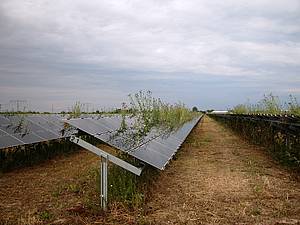
P. Gosselin at NoTricksZone has this about a pv solar plant (2.7 MW) after less than 2 years:
Weed-Covered, Neglected Solar Park: 20 Acres, $11 Million, Only One And Half Years Old!

Over the next few years we shall see many more solar and wind power plants in Europe where money will not be spent on maintenance unless it is absolutely necessary for the generation of short-term (subsidised and inflated) revenues. Long-term maintenance will just not happen. And when the O & M costs become too onerous the plants will simply be abandoned. No doubt bankruptcies will be arranged when the plants are cashed-out such that there is no recourse to the developers/owners for any remaining liabilities.
Subsidies just don’t work for their intended purpose in power generation – but they are short-term gold mines for some developers.
Tags:counter-productive subsidies, Electricity generation, Energy, Germany, Renewable energy, Solar power, wind power
Posted in Energy, Politics, Renewable Energy | Comments Off on Renewable Energy follies: Subsidies discourage maintenance
July 5, 2011
The number of German politicians who have plagiarised for their doctorates grows. After zu Guttenberg, the story of Sylvana Koch-Mehrin and Jorgo Chatzimarkakis is building up into another dirty little tale.
EU politicians are less than impressive. The level of corruption and scams along with the level of arrogance of the EU politicians in Brussels is almost legendary. From my experiences I am fairly certain that the level of political corruption in Europe is significantly higher than for example in India – but far more sophisticated and difficult to find.
The distinct impression is of pigs feeding in a trough.

Pigs feeding from the EU trough
From Professor Debora Weber-Wulff’s blog:
Sylvana Koch-Mehrin had her doctorate rescinded by the University of Heidelberg for containing over 30% plagiarism in May 2011, and now in June she has been named EU commissioner for research, Spiegel Online reports.
This means that she is in the committee that determines research policy for the EU. She had been an alternate for the committee, her fellow FDP politician, Jorgo Chatzimarkakis (his dissertation is currently at 71% plagiarism, but he is contesting the plans of the University in Bonn to rescind his doctorate as well) had the main seat. They have now changed places.
What does this say about research in Germany? What message does this give to the general populace about the importance of research? Plagiarists determining research policy? If today was April 1 I would have considered this an April Fool’s joke, but it is unfortunately true.
Poor Germany, all of your good researchers do not deserve this.
Update: A petition has been started requesting that she step down immediately. It is online in English, German, and French. If you feel so inclined, please sign. There are already almost 2000 signatures – on day 1 of the petition.
I just signed this petition and I am signer #8325.
Tags:EU Commisioner of research, European Union, Germany, Jorgo Chatzimarkakis, Plagiarism, Sylvana Koch-Mehrin
Posted in Behaviour, Corruption, European Union, Germany, Politics, Scientific Fraud | Comments Off on Plagiarist with a recently rescinded PhD appointed EU Commissioner for Research
May 9, 2011
No doubt the value of the Euro which is being held back by the economically weak countries helps but it does not explain the strength of the recovery in Germany led by exports. It is not surprising that there are many Germans who are troubled by the burden placed on the European currency by Greece, Portugal and Ireland and begin to yearn for the return of the Deutschmark. There is a real fear among German savers that the achievements will be diluted by the weaker countries which in turn will destroy the value of their savings. The growth rate in Germany is second only to Sweden in Europe but the sheer size of the German economy makes it the real motor in Europe.
There is also an attempt by the German media to create a narrative that it is not unthinkable for a country to leave (or be pushed out from) the Euro. Last Friday’s media rumours about Greece leaving the Euro generally started in Germany. Even though the rumours were hastily denied by everybody, just the fact of bringing it up makes it less unthinkable.

Returning to the Deutschmark?
BBC:
German exports surged in March to their highest level since records began, as the growing global economy lifted demand for its products and services. The country’s exports for the month totalled 98.3bn euros ($142bn; £87bn), 7.3% higher than February.
Its imports also reached an all-time high, up 3.1% to 79.4bn euros. Both imports and exports are the most since data started to be collected in 1950.
Germany is the world’s second-largest exporter.
Only China exports more than the European nation, and the latest monthly figure for German exports was much higher than market expectations.
“Germany is on the verge of a ‘golden decade’,” said Christian Schulz of Berenberg Bank. Fellow analyst, Carsten Brzeski at ING, said the German economy was now “cruising along smoothly”.
The latest German export figures provide yet more evidence of a “two speed” eurozone, with the German and French economies continuing to grow strongly, while others, such as Greece and Portugal are struggling against a backdrop of high national debt levels.
Tags:Deurschmark, Germany, Greece, Portugal, Two-speed Euro
Posted in Economy, Germany, Global economy | 2 Comments »
March 27, 2011
Apparently Libyan oil is still flowing while bombs are falling .
But who is getting the money for the oil?
And is oil the only reason why the West and Nato are supporting the rebels in Libya but not those opposing the oppresive regime in Bahrain?
Der Spiegel:
Are countries involved in the international operation in Libya hypocritical? That, it would seem, is the belief of German Development Minister Dirk Niebel, who criticized participants for continuing to draw oil from Libya. The comments show just how wide the gap between Berlin and its NATO allies has become. …
On Thursday evening, Dirk Niebel a member of Merkel’s junior coalition partners, the Free Democrats (FDP), accused the United Nations-backed military alliance currently operating in Libya of hypocrisy.
“It is notable that exactly those countries which are blithely dropping bombs in Libya are still drawing oil from Libya,” he said.
Niebel also said that Germany was “not consulted” by France prior to the start of the campaign in Libya and added that European Union foreign affairs chief Catherine Ashton’s coordination of the EU position on Libya had been “suboptimal.”
Niebel’s comments came on the heels of a demand by Merkel, made during the ongoing European Union summit in Brussels, for a complete oil embargo against Libya. The international community, she said, “must clearly show that we will not do business with anyone who wages war against his own people.” …..
And the implied accusation that oil interests are one motivation behind the Libya mission is not likely to be well received in Western capitals. …
Meanwhile, on Thursday, an agreement was reached among NATO member states that the trans-Atlantic alliance would take control of the no-fly zone over Libya.
Towns, tribes and oil fields of Libya.
Tags:Dirk Niebel, Germany, Libya, Libyan oil, Muammar al-Gaddafi, NATO
Posted in Germany, Libya, North Africa, Politics | 1 Comment »
March 1, 2011
The power of the internet and we should not forget that of the shoes!!
zu Googleberg has bowed to the inevitable and has resigned.

German Defense Minister Karl-Theodor zu Guttenberg has announced his resignation after weeks of criticism over plagiarizing parts of his Ph.D. thesis. ….The University of Bayreuth had already stripped Guttenberg of his law doctorate last week. Guttenberg apologized to the German parliament, and said he had made “grave errors” in his thesis, but insisted he did not intentionally copy it.
Pressure mounted on him to resign, after at least 17,000 academics signed an open letter to the German chancellor on Monday (over 20,000 according to the Updated ticker of Germans signing the open letter here), in which they said the plagiarism scandal made a “mockery” of the academic profession.
In recent days Education Minister Annette Schavan had called Guttenberg’s actions shameful, and parliamentary speaker Norbert Lammert said they were “a nail in the coffin for confidence in democracy.”
Tags:Angela Merkel, Bayreuth University, burnt toast, Germany, Guttenberg plagiarism, Karl-Theodor zu Guttenberg, zu Googleberg
Posted in Corruption, Ethics, Fraud, Germany, Politics | 2 Comments »



 The k2p blog