Posts Tagged ‘Google Search’

In spite of Google apology, Modi still prominent in “Top 10 criminals” image search

June 4, 2015

It seems the Google search algorithms are all too easily subverted. I suspect that Google itself carries out “subversion” to put its favoured documents or images higher up in the list of “hits”.

BBCInternet giant Google has apologised after Indian PM Narendra Modi’s photos started appearing in the image search results for “Top 10 criminals”. 

“We apologise for any confusion or misunderstanding this has caused,” a Google statement said. Mr Modi figures prominently in the search alongside images of terrorists, murderers and dictators. Other world leaders on the list include former US president George Bush and Libya’s Muammar Gaddafi. 

Other prominent Indians who come up in the search include Delhi Chief Minister Arvind Kejriwal, lawyer Ram Jethmalani, fugitive underworld don Dawood Ibrahim and Bollywood actor Sanjay Dutt who is serving a jail term in connection with deadly blasts in Mumbai in 1993. “These results trouble us and are not reflective of the opinions of Google,” the company said in its statement released on Wednesday night.

But a search just now (screenshot below) shows that Google have not been able to correct their algorithms. In a Google image search for “top 10 criminals”, Narendra Modi appears 8 times among the first 40 images and more often than anyone else, even Osama bin Laden. I gave up counting after that but his image keeps cropping up. George Bush and Bill Gates are there as well. But I couldn’t find Tony Blair.
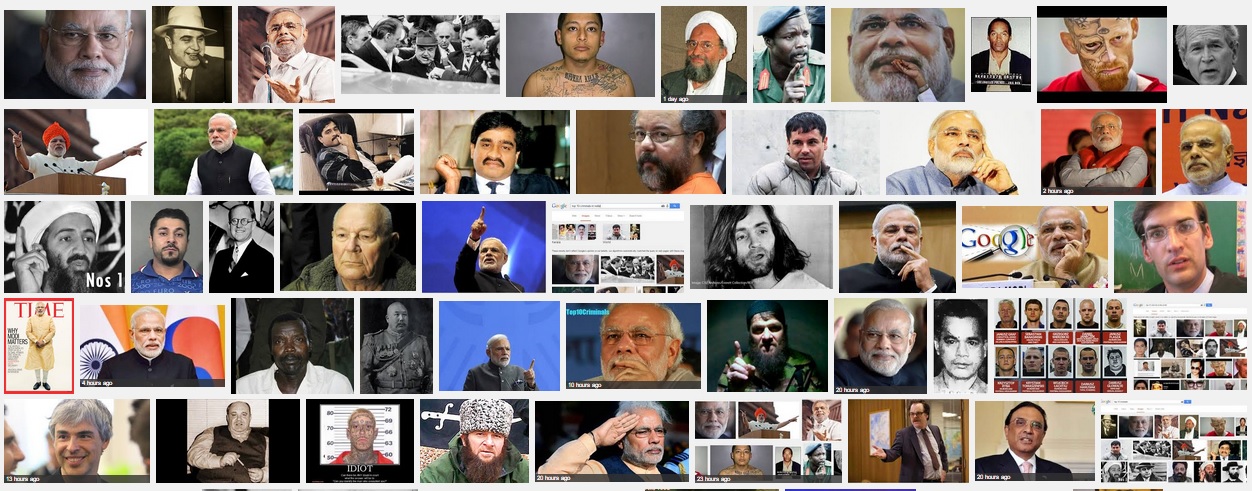
Modi as

Modi as “top 10 criminal” on google

The internet firm said the result was due to a British daily which had published an image of Mr Modi with erroneous metadata.

Really?

For 8 images out of 40?

It is pretty obvious that the results of a Google search do not represent a listing by popularity or importance. In fact the first 4 or 5 entries after the ads are often subverted. And switching from “News” to “web” to “images” or back again can very easily confuse the Google algorithms.

In any event it is best to assume that a Google search gives a list of mainly relevant results. The list is neither comprehensive nor objective. The ranking of hits on the list of is no real relevance since it can be so easily subverted and sometimes, it seems, the subversion is by Google itself. The first 4 or 5 “hits” after the obvious ads – for some searches – also seem to be sponsored in some way. Almost as if Google has overt and covert ads.

Google funded study implies that Google Trends is a valid and rigorous behavioural indicator

January 8, 2014

I find that this disclaimer at the end of this study effectively invalidates the method of the study and its results.

This project was supported by a Google.org grant from 2012, although Google.org played no role in designing or conducting this study.

The results of the study (that more people searched for health issues on Google during the recession) are trivial and – with the best will in the world – of little value except for providing a plug for Google Search and Google Trends. Of course a Google Trend means something but to imply – as this study does – that a Google Trend for selected search items  is a rigorous and valid representation of a human behavioural pattern is more than a little fanciful.

Benjamin M. Althouse et al, Population Health Concerns During the United States’ Great Recession, Am J Prev Med 2014;46(2):166–170

Press Release: 

The group examined Americans’ Google search patterns and discovered that during the recent Great Recession, people searched considerably more frequently for information about health ailments. The kinds of problems indicated by the queries weren’t life threatening, but they could keep someone in the bed a few days, like ulcers, headaches, and back pain. 

In total, the team found there were more than 200 million excess queries of this kind during the Great Recession than expected.

“While it’s impossible to uncover the motives for increased searches, they likely indicate a person being ill, and ill enough to seek out online information or remedies,” Ayers said. The same group previously published a report showing that queries for anxiety and depression also increased substantially during the Great Recession.

The authors themselves write:

google search

Without first a study on whether the usage of Google search is actually representative of any part of the population, and whether a trend in such usage permits conclusions regarding the motives for such usage, this study is little more than an advertisement for Google Search and Google Trends.

Just as with Facebook surveys and profound conclusions, I am not at all sure that this “study” can even be considered science  – let alone good science. It is published  – believe it or not – in a journal of preventive medicine,  but it has little to do with medicine and more to do with PR and  Google’s image.