Posts Tagged ‘Haiti’

Haiti cholera death toll revised up to 2,000, elections this weekend

November 25, 2010

The UN has has released revised information about the cholera outbreak in Haiti. What they are reporting now is what others were reporting already last week:

http://www.un.org/apps/news/story.asp?NewsID=36853&Cr=haiti&Cr1=

A baby and other patients suffering from acute diarrhoea lie on the floor of St. Nicholas Hospital in Haiti: photo UN

The number of reported cases of cholera in Haiti is now approaching 50,000, but health experts have cautioned that the figure could be higher because data on the epidemic has not been received from some rural communities, a United Nations relief official said today. Nigel Fisher, the UN Humanitarian Coordinator for Haiti, said that epidemiologists in the Pan-American Health Organization (PAHO) – the regional arm of the World Health Organization (WHO) – estimate that the number of cases could be as high as 70,000.

The experts have said that the disease might have claimed as many as 2,000 people, with some fatalities in remote areas going unreported. Speaking via a video link from the capital, Port-au-Prince, Mr. Fisher told a news conference in New York that PAHO epidemiologists have also revised their projections of the spread of the disease and now anticipate that cases could rise to 200,000 over the next three months. The experts had earlier estimated that the number of cases could rise to that figure in six months.

“This epidemic is moving faster,” Mr. Fisher said.

Meanwhile, general elections will proceed on Sunday as planned, despite the cholera outbreak and the recent streets protests in the country, Edmond Mulet, the Special Representative of the Secretary-General and head of the UN Stabilization Mission in Haiti (MINUSTAH), told the same press briefing.

Operational Biosurveillance had reported similar figures last week and now says:

  • In some areas of Haiti, we have confirmation that in-patient statistics are under-reported by as much as 400%. In many areas of Haiti, we are documenting outbreaks that are not being accounted for in the official statistics.  We therefore estimate the upper bound of estimated total (subclinical and clinically apparent) case counts to be nearly 375,000.
  • It is likely the elections will facilitate the spread of the epidemic due to population mixing.

Time to postpone Haitian elections?: UN cholera “unusual, swift and severe”

November 21, 2010

ff

Upplopp i Port-au-Prince under fredagen.

Protests in Port-au-Prince on Friday 19th November: image Svenska Dagbladet

The cholera in Haiti has spread to the prison in Port-au-Prince. Of the 2000 prisoners over 30 have shown signs of infection and 13 have died. The official death toll in Haiti is now over 1200 and the official number of those infected is over 20,000. The actual number infected is probably approaching 100,000.

AFP reports that:

Haiti is facing an “unusual” cholera epidemic that could be more severe than figures suggest, according to a French cholera expert who is advising Haitian health authorities. And determining who is to blame for bringing the disease here won’t help solve the crisis, he added.

The outbreak, which threatens to overwhelm Haiti as it struggles to recover from January’s cataclysmic earthquake, has left nearly 1,200 dead and prompted riots in several cities including the capital as citizens accuse the United Nations of importing the cholera.

But Doctor Gerard Chevallier, who is advising Haiti’s Health Ministry, warned that the country needs to focus on trying to halt the spread of the disease detected in Haiti one month ago.

“The mechanics of the epidemic are unusual, swift and severe,” Chevallier told AFP in an interview. “The whole country is not affected, but the epidemic will spread.” Chevallier noted that in such epidemics, especially in impoverished nations like Haiti, the toll is “under-assessed” and almost always higher than the official figure. “Reports are imperfect. There are areas where people die and nobody knows,” Chevallier said. “Two thirds of the territory is accessible only on foot.”

Chevallier is working with a French team seeking to provide Haitian authorities with tools that allow for a more complete and reliable picture of the epidemic.

To merely ignore or deny the cause of the outbreak because containing it is now the highest priority does not address the emotions in the local population which are running very high. In the local population fear is exacerbated by anger that the UN which is virtually running the country is not owning upto its responsibilities.  After a hundred years without cholera Haiti is now condemned to many decades of having the disease and the UN cannot continue in denial.

It is not the fault of the Nepalese troops who were the carriers of the disease but it is a terrible indictment of sloppy UN processes which allowed them into the country without testing and without adequate precautions.

It is time for the elections due to be held on 28th November to be postponed. Trying to pack people into polling booths while the epidemic is raging seems to be the height of stupidity. AFP also reports that four Haitian presidential candidates have called for postponing elections set for Nov 28 as the country struggles with a cholera epidemic that has claimed nearly 1,200 lives amid protests targeting UN peacekeepers.


Haiti response inadequate and UN Head of Mission seems incompetent

November 20, 2010

The UN after having introduced cholera to Haiti – which will now remain for many decades – is providing an “inadequate response” according to Medecins Sans Frontieres (MSF) says the BBC.

MSF said that despite the huge aid agency presence in Haiti, urgent needs were not being met. MSF’s chief in Haiti, Stefano Zannini, said the charity had treated more than 16,500 people but that there had been “no real and efficient response from other organisations. This is alarming in the sense that we haven’t reached the peak yet, that might take some time, and so the number of patients might still go up while we still don’t see actions on behalf of other people,” he said.

In a statement, Mr Zannini said more help was urgently needed to treat the sick and implement preventative measures. “There is no time left for meetings and debate – the time for action is now,” he said. Cholera was previously unknown in Haiti, so MSF said much work had to be done to reassure the population, particularly of the low risk and positive benefits of having treatment centres close to areas where people live.

Haiti - Insecurity : The alarmist statements of Edmond Mulet !

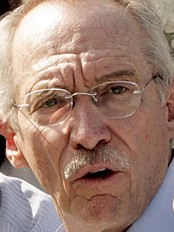
Edmond Mulet: image haitilibre.com

But the need for this reassurance to the local population is apparently not something understood by Edmond Mulet, the head of MINUSTAH (the United Nations Stabilization Mission in Haiti). He seems to be mainly engaged in justifying the UN deficiencies by blaming the lack of action on “the violent protests by people who blame peacekeepers for the spread of the disease (who) were wasting time and costing lives”.

But local Haitians are incensed by the alarmist posturing of the UN head of mission Edmond Mulet who is accused of not taking action. He is busy blaming everybody else and seems to be incompetent at basic public relations.

Judging by the response to his statements in haitilibre.com he is providing little reassurance and only succeeding to alienate the local population. They write

The alarmist statements of Edmond Mulet !

The perpetrators of these “criminals and irresponsible” acts said Mr. Mulet, “prevent the delivery of medical and sanitary assistance to the thousands of patients recently hit by the cholera epidemic, thus condemning to an unquestionable death.”

It is time to stop speaking and start acting Mr. Mulet before it is too late and that violence will spread throughout the country. 12,000 men strong, very well equipped and (with) armored vehicles, what awaits Minustah to release these roads and to restore the order in the zones concerned ? If Minustah’s mission is to maintain peace, she must first begin by eliminating the causes of these disorders, not with dramatic speeches.

If M. Mulet can only respond to the fear of people by blaming them instead of addressing their fear and anger then his competence is in question.

UN cholera and protests against UN reach Port-au-Prince

November 19, 2010
Map of Haiti

Haiti: image via Wikipedia

With its official population of 1 million and its estimated population of perhaps 3.5 million with many in refugee camps, Port-au-Prince is particularly susceptible to a cholera epidemic. The hope of containing the outbreak of UN cholera and preventing it from getting established in the capital are fading as more cases appear. Yesterday the protests against the UN also spread to the capital. So far 3 protesters and over 1100 cholera victims have been killed, directly or indirectly, by the UN. The number of infected is officially said to be over 18,000 but in reality may be as many as 100,000.

The BBC reports:

Protests linked to the outbreak of cholera in Haiti have spread to parts of the capital, Port-au-Prince.

Police fired tear gas as demonstrators set up barricades and threw rocks at United Nations vehicles. On Monday, clashes between residents and UN troops in the north had left two people dead. Some Haitians blame UN peacekeepers from Nepal for bringing cholera to the country – a claim denied by the UN. Sporadic gunfire could be heard on Thursday as protesters took to the streets of Port-au-Prince, which was devastated by a massive earthquake in January.

In its latest update, the Atlanta-based Centers for Disease Control (CDC) said the course of the disease was “difficult to predict” as it was the first cholera outbreak in Haiti for more than a century.  “The Haitian population has no pre-existing immunity to cholera, and environmental conditions in Haiti are favourable for its continued spread,” it said. The CDC said about 1.3m Haitians remained in camps following the earthquake and the camps’ “ability to provide centrally treated drinking water, adequate sanitation, handwashing facilities, and health care varies”. Just 17% of Haitians had access to adequate sanitation before the quake, the CDC said, adding that the situation had considerably worsened since then. US health experts say Haiti is vulnerable to further outbreaks.

It is thought that the cholera originated from septic tanks at a base for UN peacekeepers from Nepal. While the UN denies this and undercounts the number of cases in a totally misguided public relations exercise, the Swedish sources (Ambassador Claes Hammar and Svenska Dagbladet) are adamant about the UN being the source. Over 80% of people who carry the bacteria show no symptoms and since cholera is endemic in Nepal it is very likely that the troops from Nepal exhibited no symptoms but it is apparent that the UN did not test them to ensure that they were not carriers.

Elections in Haiti are due on November 28th and the UN’s communications “experts” seem to be incompetent. Spinning the truth to under-play the extent of the disease and and to deny responsibility is a fundamental PR mistake.

Case of UN cholera reaches Florida from Haiti while UN “spins” information

November 18, 2010

UPDATE from Operational Biosurveillance:

Current official stats are more than 18,382 cases and 1,110 fatalities.  This includes more than 1,800 cases in Port au Prince with over 30 fatalities.

  • Conservative estimates therefore suggest 75,000 cases of cholera in Haiti to-date, the majority of which were subclinical.
  • In some areas of Haiti, we have confirmation that in-patient statistics are under-reported by as much as 400%. In many areas of Haiti, we are documenting outbreaks that are not being accounted for in the official statistics.  We therefore estimate the upper bound of estimated case counts to be 250,000.
  • We are now pursuing answers to the question of uptake by indigenous zooplankton and spread along oceanic currents that pass west of the Gonave Gulf, which is where the Artibonite River discharges, north and west along the northern Cuban coastline and north to the waters east of Florida.
  • Tomorrow is Vertieres Day, where we may see some degree of population mixing, particularly in the north.  It is unclear at this time to what degree the recent violence will affect observance of the holiday.  Holidays are opportunities to spread disease further as populations intermingle.

As noted by HEAS one week ago and yesterday officially acknowledged, cholera is in the  Dominican Republic.  We expect to see medical clinic inundations inside DR in the near future.

As expected, Florida has reported a case of cholera in a returned traveler.  There will be more cases in the United States; we believe it likely more cases are inside the US unreported.  Implications for the United States are neglible.

The cholera introduced into Haiti by the UN has spread not only into the Dominican Republic but also to Florida through a traveller from Haiti. Diplomats have confirmed that the disease has come with UN troops from Nepal where the disease is endemic. It is unlikely to spread in the US since the propagation of cholera is through water or food that is contaminated by the bacterium Vibrio cholerae.  For an epidemic, the source is often the feces of infected people. The New York Times reports:

The first known case of cholera in the United States linked to the outbreak in Haiti was confirmed Wednesday by health officials who said a southwest Florida woman contracted the disease while visiting family in a region at the heart of Haiti’s epidemic.

The Florida Department of Health was investigating several suspected cases of the disease elsewhere in the state. They were not believed to be connected to the verified patient, who sought treatment this month at a hospital emergency room in Collier County. The woman spent five days in hospital after developing diarrhea and dehydration, classic symptoms of cholera, following her return from Haiti, where she had spent time in the Artibonite region. She is expected to recover fully.

“We are lucky in the state of Florida, and the U.S. generally, to have a very sound infrastructure for our food, water and sewage,” said Rob Hayes, spokesman for the Florida Department of Health. “With that in place, and with our aggressive public health practices, we are not concerned about this being a significant public health threat.”

The situation is more dangerous in the Dominican Republic where conditions are more conducive to the spread of the disease. In Haiti official reports give over 1100 deaths and over 18,000 infected.

There are reports that the actual number of cases may be being grossly under-reported.

On November 14, Operational Biosurveillance said it confirmed statistics of up to 400% undercounting.

“We now have nearly 60k cases shedding pathogen into the environment. We believe the true statistic to be closer to more than 100k based on the degree of under-reporting. It is extremely difficult to estimate the true scale of this epidemic now. (It’s) grossly uncontrolled, uncontained, (and) has exceeded public health capacity to investigate and assess every site reported and every sample received.”

It seems that political considerations are now leading to all information being subject to political “spin”.

  1. For reasons of not upsetting the Nepalese Government and to defuse the local anger, the UN officially denies that the cholera originated with the troops from that country.
  2. With elections due in Haiti in just two weeks all information about the cause of the outbreak and the extent of the spread is being down-played to avoid further exploitation by some politicians and further riots.

Haiti – till now – had been free of cholera for over a hundred years. No doubt the priority now must be to treat those infected and contain the spread of the disease. But UN processes are clearly wanting and the sooner they come out of “denial” and address their own methods and processes the better.

UN cholera spreads from Haiti to Dominican Republic

November 17, 2010
Map of Haiti

Haiti: image via Wikipedia

After diplomats confirmed yesterday that the cholera outbreak in Haiti had been brought in by UN personnel from Nepal, cases have also been detected in the neighbouring Dominican Republic.

While the UN is still denying that its troops from Nepal have introduced the disease, it seems that they are carrying out some mis-judged PR exercise in the face of the following:

  1. the cholera strain found in Haiti is that which is endemic in Nepal,
  2. the UN military camp has had cases,
  3. Haiti has not seen cases of cholera for over 100 years until this outbreak, and
  4. the disease has broken out even in areas which were not affected by the earthquake on 12th January.

It would be quite wrong to blame the poor Nepalese soldiers who face endemic cholera at home but it is certainly an indictment of UN systems and processes that over 1000 have died in Haiti which has not seen cholera for over 100 years.

The BBC reports:

The Dominican Republic has detected its first case of cholera, following the outbreak of the disease in neighbouring Haiti last month.

The patient is a Haitian migrant who had recently returned from his homeland, the health minister said.

The Dominican authorities had stepped up border controls and health checks to try to stop cholera from spreading from Haiti. More than 1,000 Haitians have died of the disease.

Dominican health minister Bautista Rojas said the patient, a 32-year-old Haitian construction worker, was being treated in isolation in the eastern town of Higuey.

Like Haiti, the Dominican Republic had not had a confirmed case of cholera in more than a century until this year.

In Haiti, the government says 1,034 people have died and the disease is still spreading rapidly. The epidemic has provoked fear and anger in Haiti. The country was already struggling to recover from a devastating earthquake in January which killed about 230,000 people in and around the capital Port-au-Prince and shattered its already poor infrastructure. On Monday two people died during violent protests against UN peacekeepers, whom some Haitians accuse of bringing cholera into Haiti. At least one of the men was shot dead by the UN troops.

The UN has said there is no evidence to support allegations that cholera was brought into Haiti by peacekeepers from Nepal, where the disease in endemic.

Cholera in Haiti introduced by UN Nepalese troops confirms Swedish Ambassador

November 16, 2010
A man, apparently turning on a water pipe, is ...

"Turning on the cholera": Image via Wikipedia

It would seem that the cholera tap in Haiti was “turned” on by UN troops.

Translated freely from Svenska Dagbladet:

Violent riots have erupted in Haiti after rumors of the cholera infection
having originated from the Nepalese UN staff – something which the UN denied. But now, the Swedish Ambassador Claes Hammar has confirmed that the rumor is true. ” I’ve had it confirmed by a diplomatic source that the cholera comes from Nepa ” he told Svenska Dagbladet.

Since the earthquake on 12 January, cholera has taken hold in the extreme poor living conditions in Haiti. The epidemic broke out in October and since then more than 900 people have died and 15 000 are believed to be infected.

Violent riots broke out yesterday in the cities of Cap Haitien, Hinche and Milot, when hundreds of people attacked the UN mission, MINUSTAH. The riots began after a rumor that previously infected Nepalese UN personnel took cholera to the island. The UN has always denied the rumors.

But now Claes Hammar, Sweden’s ambassador to the country has confirmed for Svenska Dagbladet that the information is correct. Two weeks ago he visited Haiti. “Yes, unfortunately it is so. It has been shown that the cholera is from Nepal. This is obviously a strain of the disease that is prevalent in Nepal and now it seems that to have ended up in Haiti. I have received the information from a diplomatic source. It is 100 percent accurate. We have taken samples and traced the infection to Nepal”.

Meanwhile, the U.S. Centers for Disease Control and Prevention, found that the cholera epidemic in Haiti came from South Asia, but it had not identified any specific country. Cholera has never previously been detected in Haiti.

The cholera began to spread in areas that were not affected by the earthquake and only after the Nepalese forces arrived. The UN has also accepted that health problems exist at the UN base, but says that the soldiers are not behind the cholera outbreak.

“It is of course very sad that this has happened. But one should not forget the disease spreads because of poor hygiene. The UN is making great efforts to combat the outbreak “, said Claes Hammar.

The violence that erupted yesterday in Haiti occurred just two weeks before presidential and parliamentary elections due on November 28. Svenska Dagbladet can also reveal that, according to an internal UN report it is the notorious rebel leader Guy Philippe, wanted by U.S. authorities for drug smuggling, who is behind the riots.  He is thought to have started the riots across Haiti by sending out many text messages in which he asked the locals to attack the UN force. The UN headquarters in Cap Haitien was attacked by hundreds of people who threw stones and bottles.

The violence escalated later in the day, when several police stations were attacked and burned down. A hospital in the town of Milot was attacked by hundreds of people protesting that the hospital was accepting cholera patients. At the same time the Nepalese UN troops were subjected to stone throwing by a large crowd in the town of Hinche. The soldiers responded with tear gas. Local people also opened fire on UN troops in Cap Haitien who were forced to shoot back in self defense, according to a statement from the UN.
Two Haitians have died and dozens were injured in the disturbances. Seven of the United Nations force were injured.