
Sarmatian (Amazon) warriior woman (image from RealmsofGold)
It is thought that the predecessors of the ancient warrior-women of the Sauromatian culture of central Asia dating from the 6th to the 4th century B.C. could have been the inspiration for the Amazons of Homer’s Iliad. The Iliad possibly dates from the 8th or the 7th century B.C and describes
a race of fierce women who mated with vanquished male foes and kept only the female children they bore, were believed to occupy the area around the Black Sea. Amazon women also crop up in Greek myths. One of the labors of Hercules, for example, required him to acquire the girdle of the Amazon queen, Hippolyte.
… The works of the Greek historian Herodotus, written around the 5th century B.C., describe a group of female warriors who lost to the Greeks at the battle of Thermodon. Herodotus’ Amazons were taken prisoner and put on ships, but overwhelmed and killed the Greek crew. Unable to sail themselves, the women drifted to the shores of the Black Sea, to the territory of the Scythians, a nomadic culture of Iranian descent. The women, Herodotus says, intermarried with the Scythian men, and convinced their new husbands to move northeast across the flat grassy plains, high mountains, and searing deserts of the Russian steppes, where the group eventually evolved into the Sauromatian culture.
The Sauromatians were succeeded by the Sarmatians from around the 4th century B.C. who were also nomadic and fierce warriors who held their warrior-women – now evolving into “noble” women – in high regard:
The culture, which had been expanding its territory, soon shifts its focus. “They become raiders and traders, with forays to the west to interface with the Romans, and they relocate to cities and to areas along large trade routes,” …… “Their wealth increases. We see that in their burial items. We see strong, powerful women, but their role changes. We find burials of women that still retain cultic artifacts, indicating that they were a priestess of some sort, but there is much more gold and more secular ornamentation — more golden cups, more golden jewelry, elaborate things — and less weaponry. This type of evolution is a normal manifestation of culture.”
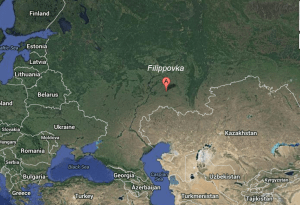
Filippovka “Tsar Tumulus” mounds (Google Maps)
The Sarmatians held sway for about 900 years until about 400 AD when they were overrun by barbarians from the West. Now a completely intact tomb of a Sarmatian noble woman dating from about 2500 years ago has been found at the “Tsar Tumulus” mounds near Filippovka in Southern Russia reports RiaNovosti.
MOSCOW, August 6 (RIA Novosti) – Archaeologists have found the intact burial chamber of a noble woman from a powerful tribe that roamed the Eurasian steppes 2,500 years ago in southern Russia, an official said Tuesday.
The Sarmatians were a group of Persian-speaking tribes that controlled what is now parts of southern Russia, Ukraine and Central Asia from around 500 BC until 400 AD. They were often mentioned by ancient Greek historians and left luxurious tombs with exquisite golden and bronze artifacts that were often looted by gravediggers.
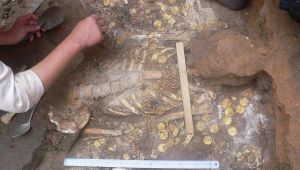
sarmatian trasures (image from en.ria.ru)
But the burial site found near the the village of Filippovka in the Orenburg region has not been robbed – and contained a giant bronze kettle, jewelry, a silver mirror and what appears to be containers for cosmetics, said history professor Gulnara Obydennova who heads the Institute of History and Legal Education in the city of Ufa.
“The find is really sensational also because the burial vault was intact – the objects and jewelry in it were found the way they had been placed by the ancient nomads,” she told RIA Novosti.
The vault – located 4 meters (13 feet) underground – was found in the “Tsar Tumulus,” a group of two dozen mounds where hundreds of golden and silver figurines of deer, griffins and camels, vessels and weapons have been found since the 1980s.
The woman’s skeleton was still covered with jewelry and decorations, and her left hand held a silver mirror with an ornamented golden handle, Obydennova said.
The descendants of the Sarmatians include Ossetians, an ethnic group living in the Caucasus region, who speak a language related to Persian.
From Realmsof Gold:
Accomplished horse-breeders and horsemen, Sarmatians were nomadic Indo-European tribes closely related to the Scythians. The Roman historian Ammianus Marcellinus describes Sarmatian tribesmen as “tall and handsome, their hair inclines to blond; by the ferocity of their gaze they inspire dread. They delight in danger and warfare.”
A fascinating feature of Sarmatian society was the high status accorded to women. Sarmatian warrior queens were renowned in antiquity. Herodotus affirmed that the Sarmatians were descendants of the Amazons and Scythians, whose women “frequently hunted on horseback with their husbands; in war taking the field; and wore the very same dress as the men.” The Sarmatian tradition had it that “no girl should wed till she had killed a man in battle.” In ancient kurgans, sumptuous female burials often included swords and arrowheads together with elegant jewelry inlaid with dazzling gems in the Hellenistic style. Eastern campaigns of Alexander the Great (356-323 BC) spread Greek influences throughout his huge empire and exposed local artisans to new styles. The composite style that emerged is known as Hellenistic.
The Sarmatians were overrun by the invasions of the Goths and Huns in the 3rd and 4th centuries AD. –


 The k2p blog