Posts Tagged ‘IPCC’
November 23, 2011
I am not quite sure who put this together but its appearance within about 24 hours of the original data dump on a Russian server is pretty impressive.
Climategate 2 | FOIA 2011 Searchable Database
ReadMe:
This website is provided as a research resource for mining the recently leaked climate communications. Every effort has been made to redact personal contact information such as email addresses and telephone numbers. The redaction algorithms are currently tuned to be quite stringent, and they will inadvertantly obfuscate other details as well. We will continue to tune the software to improve the quality of the results.
This database was assembled in a very short space of time, and at present only provides the most rudimentary tools for exploring this vast trove of material. We will be improving the quality of the search tools and adding further metadata to the database over the course of the next few weeks.
The investigative capabilities of the on-line community when engaged is quite formidable (as I have remarked on earlier).
Tags:Climategate, Climategate 2.0 emails, Climatic Research Unit email controversy, FOIA, global warming, IPCC
Posted in Climate, Fraud, Media | Comments Off on Searchable data base for Climategate 2 emails already online
November 22, 2011
Update 2100 CET: This has finally reached the Nature News Blog and the bits they quote are telling – especially in the light of the IPCC having to acknowledge that for the next few decades the global warming signal may be much smaller than the signals due to natural climate variation.
“I find myself in the strange position of being very skeptical of the quality of all present [climate] reconstructions,” one researcher is quoted as having allegedly remarked.
Another remark reads: “What if climate change appears to be just mainly a multidecadal natural fluctuation? They’ll kill us probably.”
Indeed!
===================================
The Global Warming Climate Change scam.
When it reads like a scam, talks like a scam and sings like a scam — it is most definitely a scam!
From the Air Vent:
It happened again.I woke up to find a link from FOIA.org on a thread. Thousands of emails unlocked with 220,000 more hidden behind a password. Despite the smaller size of the Air Vent due to my lack of time, there were twenty five downloads before I saw it once. As before, there are some very nice quotes and clarifications from the consensus. Below is a guest post in the form of a readme file from the FOIA.org group. – Jeff
/// FOIA 2011 — Background and Context ///
“Over 2.5 billion people live on less than $2 a day.”
“Every day nearly 16.000 children die from hunger and related causes.”
“One dollar can save a life” — the opposite must also be true.
“Poverty is a death sentence.”
“Nations must invest $37 trillion in energy technologies by 2030 to stabilize
greenhouse gas emissions at sustainable levels.”
Today’s decisions should be based on all the information we can get, not on
hiding the decline.
This archive contains some 5.000 emails picked from keyword searches. A few
remarks and redactions are marked with triple brackets.
The rest, some 220.000, are encrypted for various reasons. We are not planning
to publicly release the passphrase.
We could not read every one, but tried to cover the most relevant topics such
as…
(more…)
Tags:academic misconduct, climate change, Climategate 2.0, email-release, FOIA.org, global warming, IPCC, Scientific misconduct
Posted in Academic misconduct, Alarmism, Climate, scientific misconduct | 3 Comments »
August 26, 2011
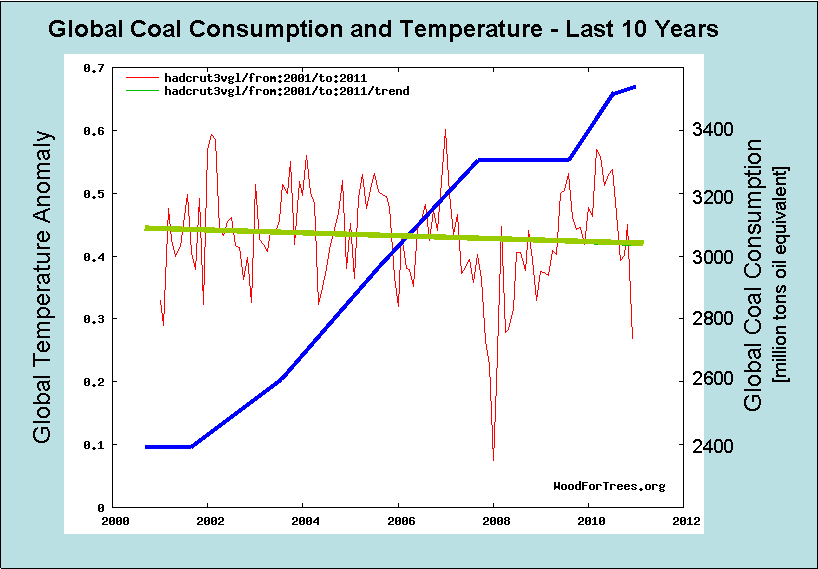
There is a clear disconnect between global coal consumption (and therefore carbon dioxide emissions) and global temperatures.
Of course we must take into account that these are only real data over the last 10 years and are not generated by computer models and have not been validated by the IPCC!!
Quote of the week at WUWT 22nd May 2011
“People underestimate the power of models. Observational evidence is not very useful,” adding, “Our approach is not entirely empirical.” John Mitchell, principal research scientist at the UK Met Office
P Gosselin at NoTricksZone has the “heretical” story:
Global Coal Consumption Jumps Almost 50% – Yet Global Temps Drop!
A recently released BP report here shows that global coal consumption has risen over the last 10 years by almost 50%. So wouldn’t you think that all those millions of tons of emitted CO2 (food for plants) as a result would drive the global temperatures up? Have temperatures risen along with all that extra coal burning?
No they haven’t. In fact they’ve dropped slightly over the same period. So go figure!
In the above chart the blue line shows global coal consumption, data taken here, Review of World Energy. According to the report, India and China alone are responsible for 90% of the world’s coal consumption increase, while renewable energy in the 2 countries plays nary a role. According to BP figures, global CO2 emissions rose 5.8% in the year 2010. ……..
Read source report
Tags:carbon dioxide emissions, climate, Coal, coal consumption, coal consumption disconnected from global temperature, Energy, Fossil fuel, global temperature, IPCC, John Mitchell
Posted in Alarmism, Climate, Energy | Comments Off on Coal consumption increases almost 50% in 10 years and has no impact on global temperature
June 30, 2011
The Nature editorial published today will be unwelcome criticism for the IPCC from a normally very friendly quarter. “Shot with its own gun” is the headline and the editorial chastises Pachauri and the IPCC for failing “to make clear when this new conflict-of-interest policy will come into effect and whom it will cover. It needs to do so — and fast”.
Allowing Greenpeace to ‘dictate’ the IPCC’s renewable-energy report was particularly inept and as one Nature reader puts it “The IPCC has become a Centre of Criticism”. But the fundamental problem with the IPCC is of course that it has become an advocacy group with a pre-determined agenda where scientific evidence has been replaced by dubious results from scenarios. Claiming that model results of a chaotic and imperfectly understood system are “settled science” is the travesty.
But criticism coming from Nature is friendly fire indeed.
Nature 474, 541 (30 June 2011) doi:10.1038/474541a
In the past two years, the IPCC has displayed a talent for manoeuvring itself into embarrassing situations, making itself an easy target for critics and climate sceptics.
The problems began in late 2009, when it was reported that the IPCC’s fourth assessment report, published two years earlier, mistakenly claimed that all Himalayan glaciers could melt by 2035. The subsequent fallout seriously damaged the IPCC’s credibility, and was exacerbated by the inept attempts of the group’s chairman, Rajendra Pachauri, to contain the crisis. A subsequent review of the organization’s governance and policies saw it commit to a number of wide-ranging reforms.
This month, the IPCC is in the crosshairs again. The revelation that a Greenpeace energy analyst helped to write a key chapter in the IPCC’s Special Report on Renewable Energy Sources and Climate Change Mitigation, released last month, sparked widespread criticism across the blogosphere. Compared with the glacier faux pas, the latest incident is trivial. But it should remind the IPCC that its recently reworked policies and procedures need to be implemented, visibly and quickly.
In response to the glacier blunder, the IPCC pledged greater caution in the processes it uses to select scientific experts and to evaluate grey literature, and to make sure that (unpaid) work for the panel does not clash with interests arising from the professional affiliations of its staff and contributing authors (see Nature473, 261; 2011). But it has failed to make clear when this new conflict-of-interest policy will come into effect and whom it will cover. It needs to do so — and fast.
This is the only way that the organization can counter recurring claims that it is less policy-neutral than its mandate from the United Nations obliges it to be. In particular, it needs to make clear the position for the working groups on climate-change impacts and adaptation (the science group adopted a rigid conflict-of-interest policy last year). Pachauri is on record as saying that the new conflict-of-interest policy will not apply retrospectively to the hundreds of authors already selected for the IPCC’s fifth assessment report, due in 2014. This is unacceptable. He should make it a priority to ensure that the rules cover everyone involved — including himself. …
The IPCC’s vulnerability to such attacks should also prompt it to reconsider how it frames its findings. Journalists and critics alike gravitate towards extreme claims. So when the IPCC’s press material for the May report prominently pushed the idea that renewables could provide “close to 80%” of the world’s energy needs by 2050, it was no surprise that it was this figure that made headlines — and made waves. The IPCC would have saved itself a lot of trouble and some unwarranted criticism had it made the origins of this scenario explicit.
Now with the natural death of the Kyoto Protocol and with a few decades of cooling in front of us it is time for the IPCC to be disbanded.
Tags:global warming, IPCC, Nature criticism, Rajendra K. Pachauri, Renewable energy
Posted in Alarmism, Climate, Science, Scientific Fraud | Comments Off on Nature editorial chastises IPCC for conflict of interest policy
June 16, 2011
There seems to be an incestuous relationship between the IPCC and a number of advocacy groups with the parties lobbying for each other. In the latest episode the IPCC has become the vehicle for publishing conclusions from a Greenpeace advocacy report on renewables:
The Independent:
Climate change panel in hot water again over ‘biased’ energy report
The world’s foremost authority on climate change used a Greenpeace campaigner to help write one of its key reports, which critics say made misleading claims about renewable energy, The Independent has learnt.
The Intergovernmental Panel on Climate Change (IPCC), set up by the UN in 1988 to advise governments on the science behind global warming, issued a report last month suggesting renewable sources could provide 77 per cent of the world’s energy supply by 2050. But in supporting documents released this week, it emerged that the claim was based on a real-terms decline in worldwide energy consumption over the next 40 years – and that the lead author of the section concerned was an employee of Greenpeace. Not only that, but the modelling scenario used was the most optimistic of the 164 investigated by the IPCC.
Critics said the decision to highlight the 77 per cent figure showed a bias within the IPCC against promoting potentially carbon-neutral energies such as nuclear fuel. One climate change sceptic said it showed the body was not truly independent and relied too heavily on green groups for its evidence.
Yesterday, after the full report was released, the sceptical climate change blog Climate Audit reported that the 77 per cent figure had been derived from a joint study by Sven Teske, a climate change expert employed by Greenpeace, which opposes the use of nuclear power to cut carbon emissions.
Last night, the IPCC said it had been made clear that the 77 per cent figure was only one of the estimates made from the models and that Mr Teske was just one of 120 researchers who had worked on the report. John Sauven, executive director of Greenpeace UK, said: “Exxon, Chevron and the French nuclear operator EDF also contribute to the IPCC, so to paint this expert UN body as a wing of Greenpeace is preposterous.” But Mark Lynas, a climate change writer in favour of using nuclear and renewables to combat global warming, said: “It is stretching credibility for the IPCC to suggest that a richer world with two billion more people will use less energy in 2050. Campaigners should not be employed as lead authors in IPCC reports.”
The IPCC must urgently review its policies for hiring lead authors – and I would have thought that not only should biased ‘grey literature’ be rejected, but campaigners from NGOs should not be allowed to join the lead author group and thereby review their own work. There is even a commercial conflict of interest here given that the renewables industry stands to be the main beneficiary of any change in government policies based on the IPCC report’s conclusions. Had it been an oil industry intervention which led the IPCC to a particular conclusion, Greenpeace et al would have course have been screaming blue murder.
Climate Audit: IPCC WG3 and the Greenpeace Karaoke
The basis for this claim is a Greenpeace scenario. The Lead Author of the IPCC assessment of the Greenpeace scenario was the same Greenpeace employee who had prepared the Greenpeace scenarios, the introduction to which was written by IPCC chair Pachauri.
The public and policy-makers are starving for independent and authoritative analysis of precisely how much weight can be placed on renewables in the energy future. It expects more from IPCC WG3 than a karaoke version of Greenpeace scenario.
It is totally unacceptable that IPCC should have had a Greenpeace employee as a Lead Author of the critical Chapter 10, that the Greenpeace employee, as an IPCC Lead Author, should (like Michael Mann and Keith Briffa in comparable situations) have been responsible for assessing his own work and that, with such inadequate and non-independent ‘due diligence’, IPCC should have featured the Greenpeace scenario in its press release on renewables.
Everyone in IPCC WG3 should be terminated and, if the institution is to continue, it should be re-structured from scratch.
Tags:advocacy groups, Climate Audit, Greenpeace, IPCC, IPCC Fourth Assessment Report, Mark Lynas
Posted in Alarmism, Climate, Corruption, UN | 1 Comment »
January 24, 2011

Glacial lakes, Bhutan: Image via Wikipedia
Reuters reports:
(Reuters) – Some Himalayan glaciers are advancing despite an overall retreat, according to a study on Sunday that is a step toward understanding how climate change affects vital river flows from China to India.
“Our study shows there is no uniform response of Himalayan glaciers to climate change and highlights the importance of debris cover,” scientists at universities in Germany and the United States wrote in the study of 286 glaciers.
The findings underscore that experts in the U.N.’s Intergovernmental Panel on Climate Change (IPCC) were wrong to say in a 2007 report that Himalayan glaciers could vanish by 2035 in a headlong thaw. The panel corrected the error in 2010.
The report said that 58 percent of glaciers examined in the westerly Karakoram range of the Himalayas were stable or advancing, perhaps because they were influenced by cool westerly winds than the monsoon from the Indian Ocean.
Science News says:
Glaciers largely stable in one range of Himalayas
Dirk Scherler of the University of Potsdam, Germany, and his colleagues report in the January 23 Nature Geoscience. ……. but in Karakoram, 58 percent of studied glaciers were stable or slowly expanding up to 12 meters per year…..
The new findings are consistent with what Kenneth Hewitt of Wilfrid Laurier University in Waterloo, Ontario, has observed, and point to the fact “that the picture of climate change effects in high Asia is much more complicated than most people realize.”
Indeed, for much of the past century Karakoram’s glaciers were in retreat. A 2005 paper by Hewitt described a turnaround that commenced only in the late 1990s. In the new study, Scherler’s team looked for factors that might affect the responsiveness of Himalayan glaciers to regional warming. A rocky blanket quickly emerged as a major one.
D. Scherler, B. Bookhagen and M.R. Strecker. Spatially variable response of Himalayan glaciers to climate change affected by debris cover. Nature Geoscience (in press, online January 23, 2011). DOI: 10.1038/NGEO1068.
Tags:Glacier advance, glacier retreat, Himalayan glaciers, IPCC
Posted in Alarmism, Climate, Geosciences, India | Comments Off on New study confirms Himalayan glaciers will not disappear any time soon
January 6, 2011
Most homes in Delhi have no insulation and no central heating. Double glazing is almost unheard of. No doubt Pachauri’s home in the prestigious Golf Links area of Delhi is an exception. Current Delhi temperatures are running some 45°C lower than maximum summer temperatures. And from my week in Delhi during December 2010 I can testify that it is a mind and body numbing experience when temperatures inside the home are less than 10°C.
The claims that global warming is responsible and Pachauri’s IPCC must seem like bad jokes.
http://www.bbc.co.uk/news/world-south-asia-12125207
A continuing cold snap has forced authorities in the Indian capital to keep schools closed till Sunday. Delhi has been badly hit by the cold, along with Indian-administered Kashmir, and the states of Haryana, Punjab and Uttar Pradesh.
Temperatures have been hovering around 4°C after dipping to 3.7°C on Tuesday morning, the city’s lowest this winter. The death toll in the cold snap that has disrupted life across northern India has reportedly risen to 47.
http://www.ndtv.com/article/india/north-india-in-the-grip-of-intense-cold-wave-77387
The cold wave intensified further in Kashmir division, including Ladakh region, as the minimum temperature across the state dipped several degrees further, with Leh town freezing at -23 °C.
Leh recorded the coldest temperature in Kashmir division at -23 °C, which was 2.8 degrees lower than the minimum temperature recorded on Tuesday. The maximum temperature recorded in Leh was three degrees below the freezing point. In Srinagar city, the minimum temperature dipped by 1.3 deg C to settle at -5.4 °C. Kargil town witnessed an extremely cold night as the minimum temperature remained -18 °C for the second consecutive night. In Kashmir Valley, the tourist resort of Pahalgam recorded a temperature of – 11.6 °C which was nearly four degrees lower compared to Tuesday’s minimum of -7.7 °C.
http://www.thehindu.com/news/states/other-states/article1032332.ece

Daily wage labourers on their way to work braving the cold and windy conditions in New Delhi even as the minimum temperature dropped below 3.4°C the season's lowest, on 04, January 2011. Photo: V.V.Krishnan
Tags:Delhi winter, global warming, India cold wave, IPCC, Pachauri
Posted in India, Weather, Winter | Comments Off on Northern India shivers: Schools closed in Delhi till Sunday
December 5, 2010
The Cancun jamboree enters it’s second week with efforts being made to reduce expectations even further. It is clear that any extension of Kyoto will be deferred till next year – again- and the pressure is now to get sufficient at Cancun next week to be able pronounce a success.
But the mood of the world has changed. Politicians lag the world by a few months and it is apparent that there are vry few who are leaders.
From the Hindu:
With Japan’s forthright statement on Monday and reluctance on the part of the other countries such as Russia, Canada and Australia to commit to a second phase, the entire negotiation is fraught with uncertainty.
To add to this the ALBA or the Bolivarian Alliance for the Peoples of Our America, which comprise nations of the South America and the Caribbean, has upped the ante by demanding a firm commitment from developed nations to the second phase of the Kyoto protocol, putting pressure on the main polluters. Matters were worsened by rumours of a secret text floated at the conference, which was strenuously denied by Christiana Figueres, Executive Secretary of the United Nations Framework Convention on Climate Change (UNFCCC), on Thursday. The secret text, according to a statement released by NGOs says the presidency of the conference of parties, Mexico, has convened an exclusive small group of countries aimed at agreeing on a text on the most sensitive topic, the mitigation efforts of developed and developing countries.
Ms. Figueres, Executive Secretary of the United Nations Framework Convention on Climate Change (UNFCCC), briefing the press, denied there was any secret Mexican text. Japan was clear about its position for a long time and it comes as no surprise that it had made a statement on its position, she reiterated. “The challenge of Cancun is how to formulate the broad array of proposals from developed countries under the UNFCCC framework,” she said. Even the position of the ALBA countries was known and there was no news there. Their position was 180 degrees opposite to Japan. “I don’t think it will be possible to guarantee a second commitment to the Kyoto Protocol. And it could be addressed later, but not at Cancun,” she said.
Expectations are being walked back.
Tags:Alarmism, Cancún, IPCC, Kyoto, Kyoto Protocol, United Nations Framework Convention on Climate Change
Posted in Alarmism, Climate, Environment, UN | Comments Off on Cancun won’t because it can’t
December 2, 2010
Jun Arima, an official in the government’s economics trade and industry department, in an open session at Cancun bluntly stated that “Japan will not inscribe its target under the Kyoto protocol on any conditions or under any circumstances.”

Kyoto stop
The Guardian is concerned which is a good sign in itself:
The brief statement…. was the strongest yet made against the protocol by one of the largest emitters of greenhouse gases.
“For Japan to come out with a statement like that at the beginning of the talks is significant,” said one British official. “The forthrightness of the statement took people by surprise.”
If it proves to be a new, formal position rather than a negotiating tactic, it could provoke a walk-out by some developing countries and threaten a breakdown in the talks. Last night diplomats were urgently trying to clarify the position. The move provoked alarm among the G77, the grouping of developing countries who regard the Kyoto protocol as the world’s only binding agreement on climate change cuts. Japan gave no reasons for making its brief statement on the second day of the talks, but diplomats said last night that it represented a hardening of its line. “Japan has stated before that it wants only one legal instrument and that it would be unfair to continue the protocol,” said one official who did not wish to be named.
Bloomberg writes:
China and Brazil led developing nations in saying Japan’s refusal to help extend the Kyoto Protocol to curb greenhouse gas emissions may halt work on a global accord to combat global warming.
A total of 37 developed countries, including Japan, ratified the Kyoto Protocol in 1997, agreeing to set limits on fossil fuel emissions. The Kyoto accord expires in December 2012 and with no other agreement to replace it, delegates at the United Nation climate talks in Cancun, Mexico, say extending the protocol is crucial.
“The Kyoto Protocol is the very basis of the framework to address climate change through international cooperation,” China’s envoy, Su Wei told reporters in Cancun. “If the pillar is collapsed, you can guess the consequences.”
Tags:Cancún, climate change, IPCC, Japan, Kyoto Protocol, United Nation
Posted in Alarmism, Climate, Environment, UN | Comments Off on Some good news from Cancun: Japan refuses to extend Kyoto protocol



 The k2p blog