Posts Tagged ‘ISIS’

G20 meets in Turkey today – but will Saudi and Turkish (and EU) support for ISIS be confronted?

November 15, 2015

The agenda of the G20 meeting starting in Turkey today will be dominated by Paris – and so it should.

The G20 is made up of 19 countries and the EU: Argentina, Australia, Brazil, Canada, China, France, Germany, India, Indonesia, Italy, Japan, Mexico, Russia, Saudi Arabia, South Africa, South Korea, Turkey, the United Kingdom, the United States of America and the European Union.

129 people died in Paris on Friday night and another 90 are still in critical condition. At least two of the terrorists had posed as refugees passing through Turkey and Greece just about a month ago. One more has now been identified as a known, 29 year old, “radicalised” French citizen.

The G20 is intended primarily as an economic forum, but Paris and Syria and ISIS can be expected to dominate. But I am not sure that any discussions about ISIS will be open enough or sufficiently meaningful in addressing root causes. To do that the agenda would have to include,

  1. the tacit support for ISIS from Turkey and Saudi Arabia, and
  2. the funding and growth of ISIS caused by the EU and US support of anti-Assad  rebels, and
  3. the misguided “multiculturalism” in the EU which – among other things – allows Saudi funded, radicalising mosques and madrassas all across Europe, and
  4. the EU “soft” policies which have now probably allowed at least hundreds of terrorists to be sneaked into Europe as “refugees”.

Both Saudi Arabia and Turkey are members of the G20, but their support for ISIS, not officially perhaps, but indirectly and by inaction and by default, will not, I think, be confronted directly. Turkey is a Nato member and is “protected” from criticism of its excesses. Criticism of Saudi Arabia is always muted from those countries dependent on oil imports or defence exports.

A great deal of ISIS financing is from private Saudi sources but surely not without the knowledge of the Saudi authorities. The official Saudi support is ostensibly for groups of Sunni rebels who are opposed to Assad and who are also said to be opposed – sometimes very mildly – to ISIS. Moreover some of these groups are no more than conduits to ISIS and al Qaida. Saudi Arabia’s primary aim seems to be to support anti-Shia groups and opposition to ISIS is only secondary. If ISIS was the only Sunni group available to oppose the Shia forces then Saudi Arabia would make sure they were supported.

Prince Bandar bin Sultan, once the powerful Saudi ambassador in Washington and head of Saudi intelligence until a few months ago, had a revealing and ominous conversation with the head of the British Secret Intelligence Service, MI6, Sir Richard Dearlove. Prince Bandar told him: “The time is not far off in the Middle East, Richard, when it will be literally ‘God help the Shia’. More than a billion Sunnis have simply had enough of them.”

Saudi Arabia, Qatar and the other Sunni Gulf States, all want the Shia to be wiped off the face of the Earth and if that means supporting the murderous psychopaths of ISIS – well, the end justifies the means.

In the case of Turkey, it is also an overwhelming desire to prevent any Kurdish state which rules their actions. Turkish hatred of a Kurdistan is on a par with the Saudi hatred of the Shia. They are also against terrorism, provided that the Kurds are first defined as terrorists. And ISIS, as an enemy of their Kurdish enemies, is often their friend. Turkey sees Kurdish successes in Northern Iraq and parts of Syria as ominous and are quite happy to bomb Kurds in or close to Turkey, even if it helps ISIS to gain territory.

Greater Kurdistan dreams map from Jon Davis via Quora

Greater Kurdistan dreams map from Jon Davis via Quora

Turkey will not take actions against ISIS if there is any chance that Kurds may gain an advantage.

I don’t expect the G20 meeting to get more than empty statements from Turkey and Saudi Arabia. Obama will order a few more air strikes. The EU is now a dithering and fractured entity. In fact the EU is now part of the problem and European countries (France, UK, Germany …) will need to act independently to oppose and attack the growth of ISIS. The G20 meeting in Antalya will get no commitments

  1. from Turkey to attack ISIS even if it helps the Kurds, or
  2. from Saudi Arabia to shut off all private funding for ISIS, or
  3. even to withdraw official Saudi support from Sunni groups who “leak” funds to ISIS, or
  4. from the EU to stop the funding from the Middle East of radicalising mosques and madrassas in Europe, or
  5. from the EU to winnow out the terrorists and criminals from among the influx of “refugees”

Sunni Muslims across the world need to pay more than lip-service to opposing the barbarism of ISIS. The Shia are already opposed to all things Sunni. But far too many Sunnis – by inaction – allow their own fanatics to prosper. They allow their fanatic imams to continue preaching their brand of hatred. They turn a blind eye to their radicalised sons and daughters. They too harbour dreams of the establishment of a new Islamic (Sunni, of course) Caliphate and have secret sympathies for the objectives of those “fighting” or murdering for this dream.

I am afraid that Sunnis anywhere (and for me that means all over Europe and the Middle East, Africa and even India, Bangladesh, Malaysia and Indonesia) who do not declare themselves – by word and action – to be against the Islamic Caliphate must be taken to be supporters of, and sympathisers with, ISIS.
Mayhem in Paris – and I wonder which Muslims are celebrating?

November 14, 2015

The mayhem in Paris is not over yet. So far 40 dead are reported and 100 have been taken hostage.

So tell me again that the religion of Islam and its high priests bear no responsibility.

Or that any peaceful side of Islam has not been obliterated by its barbaric manifestations.

Or that this is probably the barbarism of just a few Sunni fanatics and should not tarnish all Muslims.

Or that there are not Madrassa-brainwashed Muslim youths across Europe who are not secretly celebrating.

Or that no money from Saudi Arabia was involved either in the brainwashing or in the barbarism.

Or that it is not misguided multiculturalism which has provided the space for their isolation and their radicalisation.

And I wonder how many hundreds if not thousands of killers have been sneaked into Europe among the – no doubt – real refugees and asylum seekers?

Someday humans societies will grow up and all organised religions and their brainwashing of children will be obsolete. But not for a very, very long time.

Is the US now tacitly accepting the Russian strategy?

October 9, 2015

The US has abandoned its fiasco of a $500 million program for the training of “moderate rebels” who could then have provided the physical presence in Syria for getting rid of ISIS (and Assad). So while the rhetoric against the Russian line continues, it seems apparent that the US is not prepared to work directly for the removal of Assad any more. They seem to have reluctantly accepted that Assad need to stay for some indefinite transition period. But that is precisely the path that the Russians are trying to follow. So even if the US has not exactly thrown the “moderate rebels” under a bus, it seems that they are not going to go very far out of their way to support them with more than some arms and some money.

The US may not have completely abdicated, but seems to be taking a political back seat. Regime change is on hold. They may well content themselves – like any good back-seat driver – with criticising the competence of, and the direction being taken by, the Russian driver.

There is a risk now that Saudi Arabia, and the Gulf states will start throwing large sums of money into Syria. Ostensibly it will be for Sunni rebel groups, but much will end up with ISIS and other extreme groups. Iraq of course has joined Iran, Hezbollah and the Assad regime in the Russian coalition.

BBC:

The US is to end its efforts to train new Syrian rebel forces and says it will shift to providing equipment and weapons to existing forces.

Its $500m (£326m) programme was heavily criticised after it emerged that US-trained rebels had handed vehicles and ammunition over to extremists. ……. 

Quoting an anonymous US Department of Defense source, the New York Times reported that the US would no longer recruit Syrian rebels to go through its training programmes in Jordan, Qatar, Saudi Arabia or the United Arab Emirates.

Instead, it would establish a smaller training centre in Turkey, where “enablers” – mostly leaders of opposition groups – would be taught operational manoeuvres like how to call in airstrikes, the newspaper said. 

The failure of the programme underscores the wider problem of the inability to create large and effective moderate forces on the ground. It will also have wider repercussions since the programme helped to coordinate support activities between the Americans, the Gulf states, Turkey, and Jordan. The risk now is that those countries may push on with more separate initiatives backing individual client groups.

The end-game is not certain but the Russian end-game is the only one around.

US/Nato lack of strategy being shown up by the Russians

October 8, 2015

The US started its regime change efforts in Syria 4 years ago, in 2011,  with the financing, training and encouragement of selected “moderate rebels”. They have no doubt weakened Assad but have also been instrumental in creating ISIS.

The US and Nato have been taking great pains to avoid providing any support to Assad’s regime, and only providing support to their favoured “moderate rebel” groups. Even though it has always been the fanatic groups who have muscled the “moderate rebels” out of the way whenever they have achieved any gains. US and Nato have had no clear strategy. They have attempted regime change with no idea of what is to come afterwards. They have not been able to even contemplate any plausible end-game scenario, because the “moderate rebels” they support are too fractured and diverse in themselves to form any clear alternative to the regime.

By contrast, the Russians have an end-game in view though it is not clear if that can be achieved. But it does at least provide a clear direction and a focus which is lacking in the US/Nato approach.

  1. rendering ISIS and al-Nusra and Al Qaida and other fanatics impotent, even if it means supporting Assad,
  2. a managed withdrawal of Assad, with the regime still in place but without leaving any power vacuum
  3. a political settlement between the regime (sans Assad) and the other “moderate rebels”

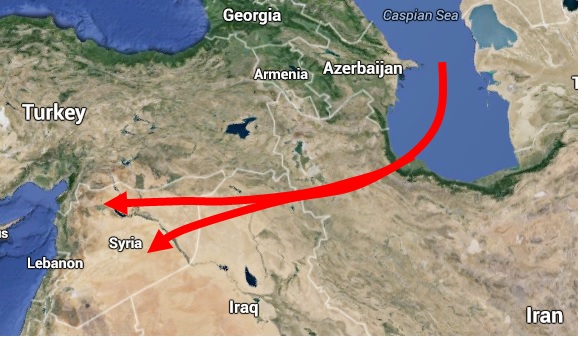
Needless to say, the US and NATO are not amused, though they have no alternatives to suggest when they criticise the Russian cruise-missile strikes from the Caspian Sea. These missiles flew over Iran and Iraq and the strikes were clearly coordinated with them.

4 Russian warships launch 26 missiles against ISIS from Caspian Sea

4 Russian warships launch 26 missiles against ISIS from Caspian Sea

RT:

“Four missile ships launched 26 cruise missiles at 11 targets. According to objective control data, all the targets were destroyed. No civilian objects sustained damage.”

Frigate Dagestan image shipspotting.com

The missiles flew some 1,500 km before reaching their targets. …. Four warships of the Caspian fleet were involved in the missile attacks, the Gepard-class frigate Dagestan and the Buyan-M-class corvettes Grad Sviyazhsk, Uglich and Veliky Ustyug. They fired cruise missiles from the Kalibr NK (Klub) VLS launchers. The missiles used are capable of hitting a target within 3 meters at a range of up to 2,500 km.

Nato countries and the US are highly indignant at these attacks and the Russian violations of Turkish air space, which I suspect, were deliberate and were meant to test limits even if they had no hostile intent.

Nato defence ministers are promising to support Turkey and the Baltic States as if they were directly being threatened by Russia. But that, I think, is because they have no strategy of their own. The US also does not like the Russian strategy but has none of its own.

BBC:

A US-led coalition has been carrying out air strikes against IS in both Syria and Iraq for months. But Western countries support rebels who have been fighting to oust Mr Assad since 2011. ….

But US Defence Secretary Ash Carter said coalition forces fighting IS in Syria would not co-operate with Russia. “We believe Russia has the wrong strategy,” he said. “They continue to hit targets that are not IS.”

Protesting too much, I think.

The problem for the US is that the boots on the ground to defeat ISIS are not going to come from their pet “moderate rebels”. They can only come from the Assad regime, Hezbollah, Iran and Iraq (along with a thousand or two Russian “advisors”).


Whose boots will prevail in Syria?

October 5, 2015

It does not require rocket science to see that ISIS will only, can only, be defeated finally by boots on the ground.

The US and its partners assumed that “moderate rebels” in Syria would provide the boots on the ground to take over, once they had managed to get rid of Assad. But the assumption that the “moderate rebels” formed any sort of cohesive group which could bring stability has proven to be grossly wrong. They are so splintered and fractured and cover such a wide range of objectives that they can only ensure instability. The further assumption that the rag-tag being supplied with weapons and money to effect regime change, did not also include radical and fanatic Sunnis and Wahabis has been at best, incompetent, and at worst, disastrous. The Russians are, it seems, making a different calculation.

Any scenario which pictures the defeat of ISIS will require that their followers are left with no physical or political space to occupy and control. And that is going to require that their space is then occupied by someone else. Air attacks by the US led coalition or by Russia can only prepare the way, but without a real physical presence the effects of such air attacks can only be temporary. Without filling up the space with some form of political stability, any political vacuum will always provide room for the fanatics.

Of a Syrian population of about 23 million, 9 million are displaced and are refugees within Syria or abroad. Around 3 million are estimated to have left Syria. Around 75% of the Syrian population were Sunni muslims, 12% were Alawites (a secretive branch of Shia Muslims) and about 8% were Christians. Assad is of course an Alawite. As Shias the regime is supported by the Hezbollah from Lebanon and from Iran’s Shia (90% of Iran’s population are Shia and about 9% are Sunni). If Assad were to step down, but was replaced by another Alawite, then the Alawites, many of the Christians and even some of the moderate Sunnis, could probably live with a regime which provided stability. The fly in the ointment is financial support for the various Sunni and Wahabi rebel groups in Syria (including the hard-line terrorist groups such as Al Qaida, al-Nusra and ISIS) which comes mainly from Saudi Arabia and the Gulf States. US support for rebel groups in Syria has, under Saudi influence, often supported the Sunni line. ISIS cannot be politically suffocated as long as its external financing continues.

Even with a defeated ISIS, sympathisers will still remain. But they will not be in control. A “defeat” can only mean that they no longer have any control over any settlements within which they might still exist, and that they have no safe havens within which to hole-up. That cannot happen unless control over all geographical areas effectively lies with some body – or bodies – that reject the fundamental claims of the Islamic State.

The mutual hatred between ISIS and Shia Muslims is a key factor. No Sunni rebel group fighting against Assad is not without some sympathy for ISIS. This virtually disqualifies any of the current rebel groups being supported by the US coalition, from being capable of supplying the political control needed to squeeze out ISIS. Certainly the US and its coalition partners are not going to supply the physical presence on the ground. The Russians are not going to send in troops beyond military advisors to Assad either.

So who does that leave? Whose boots on the ground are going to prevail?

The Russian calculation seems to be that the regime (later without Assad) together with Hezbollah, Iraqi Shias and some Iranian presence will be sufficient to defeat ISIS and squeeze them out. It is not impossible, but the Saudis will not take kindly to that. That would be seen as an unacceptable blow to the Sunni ego.

And then whether such an end-game is allowed to stand will depend upon whether the US is prepared to satisfy the Saudis by challenging the Russians (and the Iranians and Hezbollah) in their support of the Assad regime. I suspect that the Russians are calculating that Obama will only keep shifting his red line rather than actually cross it. As long as the Russians keep the eventual stepping down of Assad as being inherent in their plans, Obama will, reluctantly, go along.

It seems a highly dangerous path to this end-game where the regime (without Assad) but with help from Hezbollah and Shias from Iraq and Iran supply the boots on the ground to get rid of ISIS. But at least it is an end-game which is not impossible. And it seems to be the only one available. The US and their European partners seem not to have thought very far beyond the removal of Assad.


Obama’s ISIS strategy revealed – follow behind Russia (and Iran)

September 29, 2015

A vacuum in leadership will be one way in which Barack Obama’s 2 terms are remembered. But in Syria and concerning ISIS, US “strategy” has been of avoidance, if not quite of denial, of the issues.

And the vacuum provides Putin (and therefore Iran and even Assad) the chance to set the agenda. Of course a strategy implies having a picture of what is to be achieved and the available paths to lead to achieving that picture. I suspect Obama and Kerry are not even very clear of the end-scenario to be targeted.

Since 9/11, the entire US Middle East “policy” (if it could be called a policy) has been of short-term actions without any clear picture of what is to be achieved subsequently. From removing the Taliban (temporarily) from power in Afghanistan, to the removal of Saddam Hussein without a vision of a subsequent Iraq, support of a “democratic” Muslim Brotherhood in Egypt followed by support to the Egyptian army, and the removal of Gaddafi which helped create and arm ISIS and now the attempt to remove Assad without an end-game, US policy, I think, has consisted of ad hoc actions without any coherent, underlying strategy.

NYT:

For the second time this month, Russia moved to expand its political and military influence in the Syria conflict and left the United States scrambling, this time by reaching an understanding, announced on Sunday, with Iraq, Syria and Iran to share intelligence about the Islamic State.

Like Russia’s earlier move to bolster the government of President Bashar al-Assad by deploying warplanes and tanks to a base near Latakia, Syria, the intelligence-sharing arrangement was sealed without notice to the United States. American officials knew that a group of Russian military officers were in Baghdad, but they were clearly surprised when the Iraqi military’s Joint Operations Command announced the intelligence sharing accord on Sunday.

It was another sign that President Vladimir V. Putin of Russia was moving ahead with a sharply different tack from that of the Obama administration in battling the Islamic State, also known as ISIS or ISIL, by assembling a rival coalition that includes Iran and the Syrian government. ……….

Russia’s moves are raising difficult questions for the Obama administration, which remains deeply conflicted about American military involvement in the Syria conflict. Ensuring that the Russian military and the United States-led coalition, which is carrying out airstrikes against the Islamic State, “deconflict” and avoid running into each other is only part of the problem: The Obama administration and the Kremlin do not appear to agree even on the main reason for the conflict.

American officials, who have long cast Mr. Assad as the primary source of instability in Syria, assert that the Syrian leader’s brutal crackdown provided an opening for jihadist groups and that the crisis cannot be resolved until a political transition is negotiated that requires him to leave power. But Russian officials see the Syrian government as a bulwark against further gains by groups like Islamic State and Nusra Front and sometimes suggest that the defeat of the Islamic State should come before a negotiated solution for the Syrian conflict. ……..

Just as with the Taliban, a short-term military win is of little value if the political climate still leaves them with physical space to move in and ideological air to breathe. ISIS will not disappear until they are

  1. defeated first militarily,
  2. and are given no physical space to occupy,
  3. and a political climate exists which gives them no air to breathe.

But then, what do I know?

Obama still has no strategy for ISIS

September 17, 2015

Last year Barack Obama admitted he had no strategy, “yet”, for ISIS. By the latest admissions, he still doesn’t. He is pouring money into “fighting ISIS” but it would seem that there are many expensive but ineffective actions ongoing – but there are few signs of any coherent, comprehensive strategy with any real goals.

The latest example of money down the drain, with nothing to show for it, is revealed by the testimony of Gen. Lloyd Austin to the Senate Armed Services Committee. The $500 million program to train 5,400 Syrian fighters against ISIS started off by training and sending 54 well-armed fighters. Only 4 or 5 remain. The others have been captured or killed by Al Qaida or ISIS or have abandoned the fight.

CBS NewsOnly four or five U.S-trained Syrian fighters remain on the battlefield against militants with the Islamic State of Iraq and Syria, the top U.S. commander in the Middle East acknowledged Wednesday in the face of withering criticism from senators who dismissed the training program as a “total failure” and demanded a change of strategy. Gen. Lloyd Austin told the Senate Armed Services Committee that the U.S. is looking at better ways to deploy the Syrian forces, but he agreed that the U.S. will not reach its goal of training 5,000 in the near term. ….. 

The first group of 54 U.S.-trained Syrian fighters was sent into Syria in late July. But a Syrian affiliate of al Qaeda attacked the group, killing several of the fighters and taking others hostage. A number of the remaining fighters fled. Officially called the New Syrian Force, the contingent was trained by the U.S. military at a base in Turkey and sent across the border into Northern Syria, ……..

The committee’s chairman, Republican Sen. John McCain, called the U.S. strategy against ISIS a debacle. He said assessments by Austin and the Pentagon that the U.S. strategy is working is “divorced from reality.” And other senators focused directly on the stumbling training effort that takes months to identify and screen Syrian rebels for the program and has lagged far behind original goals. “We have to acknowledge this is a total failure,” said Sen. Jeff Sessions, R-Ala., said about the training. “I wish it weren’t so, but that’s the fact.”

Congress has approved $500 million to train Syrian fighters. Officials have said fewer than 200 are going through training now.

Last week we heard how Obama and Kerry missed the opportunity in 2012 to work with Russia to arrange for Assad to step aside in an orderly transfer of power. Was it just ego that stopped that? Was it the wishful thinking that the support being given to the splintered Syrian rebels by the US and the Europeans, would lead to a complete defeat of Assad.

I certainly have the perception that the US (and their European partners) have been more than a little incompetent in their efforts at regime change – whether in Iraq or Libya or Syria or even the Ukraine. Like it or not, it is the lack of a coherent strategy and the incompetence of  implementation of ad hoc actions, which has provided the space for ISIS to flourish. While Saddam and Gaddafi and Assad were in place, many were throttled, but so was ISIS.

Obama deals with imaginary threats while “in denial” about ISIS

May 25, 2015

I would have said that Barack Obama is not just “in denial” but living in a bubble of his own making. If one needed an example to illustrate a “clear and present” danger, there couldn’t be one better than the advance of ISIS and the lack of resistance from the Iraqi Army. It is the danger of advancing barbarism and the lack of resistance from the “civilised” world represented by the US and its allies. The risk now is greater than that imagined to be posed by Saddam Hussain’s imaginary WMD. It is greater than the risk posed by Gaddafi in Libya.

And instead Obama is blathering on about the imaginary immediacy of the imaginary risk of imaginary global warming. “An immediate risk to our national security ….and we need to act now” he proclaims. He stopped just short of ordering air strikes against global warming.

The Guardian:

Senator John McCain on Sunday attacked the president for citing climate change as a threat to national security, suggesting that the Obama administration’s focus on environmental issues was detracting from the fight against Islamic State militants in Iraq and Syria.

The comments by the Senate armed services committee chairman were part of a rotating blame game over the Memorial Day weekend about who is responsible for recent gains by Isis fighters, who last week took control of the ancient Syrian city of Palmyra and the Iraqi city of Ramadi.

“There is no strategy, and anybody who says there is, I’d like to hear what it is,” McCain said, appearing on CBS News. “Because it certainly isn’t apparent. Right now we are seeing these horrible reports, in Palmyra, they’re executing people and leaving their bodies in the streets.

“Meanwhile the president of the United States is saying that the biggest problem we have is climate change.”

In a commencement address at the US Coast Guard Academy last week, President Barack Obama said climate change posed an “immediate risk”.

“I’m here today to say that climate change constitutes a serious threat to global security,” Obama said. “An immediate risk to our national security. And make no mistake, it will impact how our military defends our country. And so we need to act, and we need to act now.”

Bolton was just as blunt, accusing the White House of being in denial.

Washington Examiner:

White House officials are “in denial” about the threat posed by Islamic State fighters in the Middle East, former U.S. Ambassador to the United Nations John Bolton said Sunday.

“They just simply will not acknowledge that ISIS is a threat,” Bolton told Fox News Sunday’s Chris Wallace. “I think they’re blinded by their own ideology.”

Bolton said countries in the region, such as Turkey and Saudi Arabia, “need American leadership” to fight the rising extremist movement that has swallowed up cities in Iraq in recent weeks.

“Are we really saying we are going to put American security in the hands of the Saudi defense ministry?” Bolton said.

And the spin doctors are out again to divert attention from the lack of US strategy and instead to blame the Iraqis. The Iraqis are now nothing more than what has been created by the US. If they lack the will to fight it is because the US “divide and rule” policy has sapped their will to fight. And the artificially created Iraq, without the Shia element will always be incomplete. But to bring the Shia into a position of strength – and thereby favour Iran – is ideologically impossible for Obama. He is stuck with his religious commitment to Saudi Arabia. Maybe that will change when the nuclear deal with Iran has to be struck.

On Sunday the US defense secretary, Ash Carter, blamed the fall of Ramadi, in Anbar province west of Baghdad, not on a lack of American commitment but on Iraqi forces, who he said lack the “will to fight”.

“What apparently happened is the Iraqi forces just showed no will to fight,” Carter told CNN. “They were not outnumbered. In fact, they vastly outnumbered the opposing force. That says to me, and I think to most of us, that we have an issue with the will of the Iraqis to fight [Isis] and defend themselves.”

The simple conclusion I come to is that merely stating that he has a strategy does not mean that Obama actually has any strategy. His actions (or lack of action) actually demonstrate that he does not.

Stockholm city to provide priority for social services for returning ISIS murderers

May 22, 2015

Even if one didn’t want to accept the case for capital punishment the least that could be contemplated for ISIS murderers would be a chemical castration and incarceration for ever, with an exit only via an assisted suicide. Neither the world nor the human race have any benefit from any ISIS murderers continuing to exist or to have any off-spring. I do have some qualms with capital punishment but these all vanish when confronted by barbarous murderers such as these. Not for “revenge” but because they have nothing positive to contribute and neither do their genetic offspring. They are a contaminating virus which kills the sapience in homo sapiens.

But the Red/Green/Pink (Social Democrats + Environmental party + Feminist party) majority in the Social Services Committee of Stockholm city have now approved and adopted a sanctimonious and monstrous strategy for rewarding any ISIS terrorists of Swedish nationality (and there are many) who return. They and their families are to get adequate support by getting a priority for handouts, housing and jobs.

The same committee, in its wisdom, also provides financial support to Swedish Muslim organisations such as the Islamic Association of Sweden which just happens to be the Swedish “branch” of the Muslim Brotherhood.

It is sanctimonious do-gooding gone mad.

The world may someday be destroyed by an asteroid impact or a super-volcano, but the greater risk is that the human race will degenerate into something barbarous because of the behaviour of naive, sanctimonious, well-meaning, self-righteous, politically-correct do-gooders.

Metro:

When the red-green-pink majority of Stockholm’s social services committee on Tuesday adopted a new strategy to counter violent extremism the criticism was not long in coming. The strategy, which proposes that people who want to leave extremist groups or return from fighting abroad should be helped with sustenance, employment and housing, is being attacked for providing the “cream” for criminals, and because it does not give any concrete proposals on how people should de-radicalised-

“I think that is extremely naive and completely lacking any realization that that under Swedish law these people are serious criminals. They have committed genocide, and it is one of the worst crimes one can commit. They should be prosecuted and put in prison” says Lotta Edholm (FP), opposition member of the City Council of Stockholm to Metro.

The City of Stockholm has a system for social preference, where people with strong medical or social needs can be given priority in the housing queue. According to Lotta Edholm, the new strategy will lead to, for example, the returning ISIS murderers getting priority in Stockholm’s housing queue.

“The strategy contains a lot of fuzz and the majority probably mean well. But if this strategy means anything it must mean that these IS-murderers should get a social priority. It’s so stupid”, says Lotta Edholm.

Stupid is an understatement.

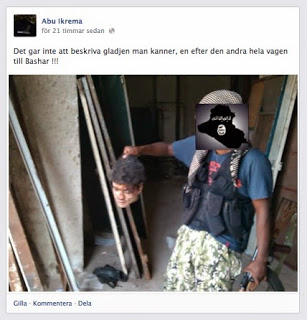
Per Gudmundson on his blog has this picture uploaded by a barbarian, “Abu Ikrema”,  from Stockholm who writes ” It is impossible to describe the joy one feels….”

The new social strategy will apply to people like him.

Iran to the rescue as Obama’s moribund ISIS “strategy” stalls

May 19, 2015

Back in September last year, Barack Obama first admitted he had no strategy “yet” for ISIS and then announced his “hands-off” air-strike strategy

“Our objective is clear: We will degrade, and ultimately destroy, ISIL through a comprehensive and sustained counterterrorism strategy,”

But what his strategy has achieved so far is an ISIS which hunkers down during air-strikes and then rolls over new strategic targets whenever the opposition is the Iraqi army or other Sunni opponents. Resistance and attrition only occurs when ISIS faces Assad or Iran-backed Shiite groups. If and when ISIS is stopped it may be enabled by US led air-strikes, but it will actually be achieved only by Iranian-supported boots on the ground. ISIS will not be stopped by a Sunni force. And that does not make Saudi Arabia very happy. I have a hypothesis that Barack Obama’s strategies both in domestic and foreign policy are driven primarily by the avoiding of his fears. In Iraq and Syria his strategy plays into Iran’s hands.

Foreign Policy: To date, the Obama administration’s claims of progress in the campaign against the Islamic State (IS) have been accompanied by qualifications and caveats. In January, the Pentagon claimed to have killed 6,000 IS fighters since the September start of “Operation Inherent Resolve,” a statistic that became less impressive when later that month it was reported that roughly 5,000 foreign fighters had joined IS since October. At the Munich Security Conference in February, Secretary of State John Kerry claimed the anti-IS coalition had “taken out half” of the terrorist pseudo-state’s senior leadership, a boast that was subsequently discredited as inexact at best. In early April — a month before the Islamic State captured Ramadi — Vice President Joe Biden declared: “ISIL’s momentum in Iraq has halted, and in many places, has been flat-out reversed. Thousands of ISIL fighters have been removed from the battlefield. Their ability to mass and maneuver has been greatly degraded. Leaders have been eliminated.” Add to this the analytical disputes over the Pentagon’s claim that the Islamic State has lost 25 percent of its territory since the start of Operation Inherent Resolve, and it is easy to see why skeptics believe the current strategy is insufficient to achieve the president’s stated goals of degrading and defeating the terrorist proto-state.

Now Ramadi has fallen to ISIS after it was abandoned without resistance by Iraqi Sunni forces. The US has been sending very confused messages with, on the one hand, increased air sorties against Ramadi while, on the other, sending diplomats (including John Kerry) to spin the story that Ramadi was not very important anyway. In the meanwhile Iran, through its Shiite Prime Minister, has called in the Shiite militia to retake Ramadi. The Shiite militias will now probably succeed in retaking Ramadi – as ISIS melts away to open another front, somewhere else, against the Iraqi Army.

Reuters:

Thousands of Shi’ite militiamen on Monday prepared to fight Islamic State insurgents who seized the Iraqi provincial capital Ramadi at the weekend in the biggest defeat for government forces in nearly a year.

A column of 3,000 Shi’ite militia fighters assembled at a military base near Ramadi, preparing to take on Islamic State militants advancing in armored vehicles from the captured city northwest of Baghdad, witnesses and a military officer said.

The decision by Prime Minister Haider al-Abadi, who is a Shi’ite, to send in the militias to try to retake the predominantly Sunni city could add to sectarian hostility in one of the most violent parts of Iraq.

Washington, which is leading a campaign of air strikes to roll back Islamic State advances and struggling to rebuild Baghdad’s shattered army, played down the significance of the loss of Ramadi, the capital of the vast western Anbar province.

U.S. Secretary of State John Kerry said it was a “target of opportunity,” that could be retaken in a matter of days, and U.S. officials insisted there would be no change in strategy despite a failure to make major advances against Islamic State.

Warplanes in the U.S.-led coalition had conducted 19 strikes near Ramadi over the past 72 hours at the request of the Iraqi security forces, a coalition spokesman said.

The Shi’ite militia, known as Hashid Shaabi or Popular Mobilization, “reached the Habbaniya base and are now on standby,” said the head of the Anbar provincial council, Sabah Karhout.

It may only be a temporary alliance between the US and Iran for retaking Ramadi, but it will only reinforce my view that Iranian strategy is a relatively low-cost, proxy strategy which has succeeded in absorbing and diverting Obama’s strategy to its own advantage.