Posts Tagged ‘Italy’

Scientific negligence goes on trial for manslaughter in Italy

September 20, 2011

“Scientists” today enjoy a general reputation for being unbiased, objective, incorruptible and dauntless seekers after truth. With this reputation they also have little liability for their pronouncements or for the integrity or the quality of their work. This is not sustainable as the politicisation of science is increasingly unavoidable and temptations for scientific misconduct grow. To try and de-politicise science is impractical. More emphasis can be placed on developing ethical standards which should reduce the incidence of misconduct. But I think the key is to ensure that scientists carry some liability for what they do and that they do it honestly. A scientist is no less a professional than a lawyer or an engineer or a physician or an architect. They do have some liability for the quality of what they do. Incompetence, negligence or dishonesty carry penalties for other professions and scientists can not and should not be exempt.

Of course the scientific community is up in arms about the seismologists being tried for manslaughter in Italy, but they do need to be held accountable for their negligence or incompetence – if demonstrated. Wearing a white coat and calling oneself a “scientist” should not provide automatic immunity from accountability and liability.

Scientific American:  By Nicola Nosengo

Six Italian seismologists and one government official will be tried for the manslaughter of those who died in the earthquake that struck the city of L’Aquila on 6 April 2009. The seven were on a committee that had been tasked with assessing the risk associated with recent increases in seismic activity in the area. Following a committee meeting just a week before the quake, some members of the group assured the public that they were in no danger. 

In the aftermath of the quake, which killed 309 people, many citizens said that these reassurances were the reason they did not take precautionary measures, such as leaving their homes. As a consequence, the public prosecutor of L’Aquila pressed manslaughter charges against all the participants in the meeting, on the grounds that they had falsely reassured the public. After several delays, the public prosecutor Fabio Picuti and the defendants’ lawyers appeared this week before Giuseppe Gargarella, the judge for preliminary hearings, who had to decide whether to dismiss the case or proceed with a trial.

During the hearing, the prosecutor called the committee’s risk assessment “superficial and generic”, resulting in “incomplete, imprecise and contradictory public information”. Responding to the thousands of scientists who had signed a letter of support for the defendants, the prosecutor acknowledged that the committee members had no way of predicting the earthquake, but he accused them of translating their scientific uncertainty into an overly optimistic message. More specifically, the accusation focuses on a statement made at a press conference on 31 March 2009 by Bernardo De Bernardinis, who was then deputy technical head of Italy’s Civil Protection Agency and is now president of the Institute for Environmental Protection and Research in Rome. “The scientific community tells me there is no danger,” he said, “because there is an ongoing discharge of energy. The situation looks favorable”. ….

 At the end of the hearing, the judge decided that the trial will begin on 20 September. …

The earthquake was surely not predictable and poor building standards surely contributed to the deaths but whether the scientists exhibited incompetence or negligence is a valid question. And if they did they need to be held accountable even if not perhaps for manslaughter.
Bunga bunga Berlusconi sinks to new depths with Gaddafi

February 22, 2011

As Gaddafi threatens more bloodshed and seems to be increasingly removed from reality, the eastern part of Libya including Benghazi is clearly no longer under his control. He does not seem to be on his way to Venezuela but is looking to his special relationship with Berlusconi.

ABC News reports that bunga bunga Berlusconi is now providing further support to his friend Gaddafi by telephone:

Italian Premier Silvio Berlusconi has spoken by telephone with Libyan leader Moammar Gadhafi amid a bloody crackdown by Libyan forces on anti-government protesters.

A one-sentence statement from Berlusconi’s office late Tuesday said the phone call took place in the afternoon. It gave no details.

Berlusconi has called Gadhafi his “friend” and has entertained the Libyan leader several times in Rome.

With Italy’s Eni, the main foreign operator in Libya taking home a full one-third of the north African nation’s oil production, it is no surprise that a succession of Italian governments have sought a cozy relationship with Libyan leader Moammar Gadhafi — none less than the extravagant embrace by current Premier Silvio Berlusconi.


Berlusconi won’t “disturb” Gaddafi – as one Dirty Old Man supports another

February 21, 2011

As the brush fire of revolution against dictators spreads in North Africa and the Middle East, Bunga bunga Berlusconi ( 75 years old) announced that he will not “disturb” his soul-brother Gaddafi (69 years) in his time of trial. They are of course both senior members of the Association of Dirty Old Leaders.

Reuters reports:

Opposition lawmakers criticised Italian Prime Minister Silvio Berlusconi for failing to condemn violence in Libya and saying he did not want to “disturb” Libyan leader Muammar Gaddafi during the revolt in his country.

Berlusconi’s government, which has aggressively courted Libyan petrodollars and rolled out the red carpet during Gaddafi’s multiple visits to Italy, has said little on Libya’s crackdown on protesters that has killed more than 170 people.

Pressed by reporters on whether he had spoken to Gaddafi since the uprising began, Berlusconi said on Saturday: “No, I haven’t been in contact with him. The situation is still in flux and so I will not allow myself to disturb anyone.”

The comment stirred outrage among the leftist opposition, which has long accused Berlusconi of turning a blind eye to Gaddafi’s human rights record and pandering to the Libyan leader for the sake of lucrative contracts and investment in Italy, which is Libya’s former colonial ruler.

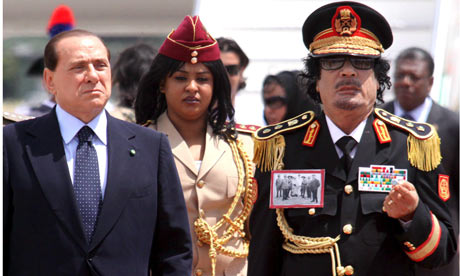
In this photograph from June 2009 where Berlusconi is welcoming Gaddafi accompanied by a rather plump member of his all-woman bodyguard, it is not clear why Gaddafi finds it necessary to wear cardboard medals and an old photograph on his chest. It is probably something only Bunga bunga will know.

Silvio Berlusconi welcomes Muammar Gaddafi at Rome Ciampino airport

Italian Premier Silvio Berlusconi welcomes Libyan leader Muammar Gaddafi at Rome's Ciampinio airport, Italy, on 10 June 2009. Photograph: ALESSANDRO DI MEO/EPA

As the Guardian put it when Gaddafi visited Italy in 2009:

The highlight of Gaddafi’s trip to Rome is a meeting, personally requested by the Libyan leader, with 700 women from the worlds of “politics, industry and culture”. So Berlusconi got down his Bumper Catalogue of Hot Stuff, got rid of any that were over 25, discarded those with a loud voice or body hair, and whittled down the rest by ballot until he got to 1,000, whereupon the disappointed remainder that didn’t get to meet Muammar were given a senior post in his cabinet or a mini-break in his fancy villa with the pools and the elephants.

Before we start thinking this is just a pact of weirdness between two profoundly weird men, it is not the first time Gaddafi has extended the hand of friendship to the ladies of Europa (I do not mean the convenience store chain; I am romanticising the continent, trying to get into the mind of the mighty dictator). Two years ago in Paris, he met 1,000 French women. His message was clear: he wanted to “save European women”.

Gaddafi and his nurse: image EPA

Of course in addition to his bodyguards Wikileaks has told us that he also has his own voluptuous Ukrainian nurse(s).

Diplomats in Tripoli described how the Libyan leader appeared to be reliant on Galyna Kolotnytska, without whom he reportedly “cannot travel”.

In a despatch to the US Secretary of State, Hillary Clinton, sent in September 2009, embassy officials painted an intimate portrait of Col Gaddafi’s many fears and “eccentricities”.

The secret memo, which was headed “A glimpse into Libyan leader Gaddafi’s eccentricities”, said he “appears to rely” on his senior nurse, and less than in the past on his “legendary” band of women bodyguards who used to accompany him everywhere.


Cold Fusion: Another fraud or a breakthrough?

January 22, 2011

In March 1989, Stanley Pons and Martin Fleishmann claimed to have achieved cold fusion at room temperature but their experiment could not be reproduced.

File:Igloo.jpg

Cold fusion lab (igloo) under construction : image wikipedia

While cold fusion is considered highly improbable, it is not impossible and there remains a nagging suspicion (hope?) that some “miracle”, perpetual machine may suddenly appear in the most unlikely place and perhaps even outside main-stream science.

Physorg reports on another claim this time from Bologna, Italy:

Despite the intense skepticism, a small community of scientists is still investigating near-room-temperature fusion reactions. The latest news occurred last week, when Italian scientists Andrea Rossi and Sergio Focardi of the University of Bologna announced that they developed a cold fusiondevice capable of producing 12,400 W of heat power with an input of just 400 W. Last Friday, the scientists held a private invitation press conference in Bologna, attended by about 50 people, where they demonstrated what they claim is a nickel-hydrogen fusion reactor
. Further, the scientists say that the reactor is well beyond the research phase; they plan to start shipping commercial devices within the next three months and start mass production by the end of 2011.

Rossi and Focardi say that, when the atomic nuclei of nickel and hydrogen are fused in their reactor, the reaction produces copper and a large amount of energy. The reactor uses less than 1 gram of hydrogen and starts with about 1,000 W of electricity, which is reduced to 400 W after a few minutes. Every minute, the reaction can convert 292 grams of 20°C water into dry steam at about 101°C. Since raising the temperature of water by 80°C and converting it to steam requires about 12,400 W of power, the experiment provides a power gain of 12,400/400 = 31. As for costs, the scientists estimate that electricity can be generated at a cost of less than 1 cent/kWh, which is significantly less than coal or natural gas plants……….

…… Rossi and Focardi’s paper on the nuclear reactor has been rejected by peer-reviewed journals, but the scientists aren’t discouraged. They published their paper in the Journal of Nuclear Physics, an online journal founded and run by themselves, which is obviously cause for a great deal of skepticism. They say their paper was rejected because they lack a theory for how the reaction works. According to a press release in Google translate, the scientists say they cannot explain how the cold fusion is triggered, “but the presence of copper and the release of energy are witnesses.”

http://www.physorg.com/news/2011-01-italian-scientists-cold-fusion-video.html

But not everybody is dismissing this latest claim.

Steven Krivit of the New Energy Times describes why he believes that the Rossi and Focardi LENR device is probably real and is an advancement on the Piantelli process.

But there seems to be a vested interest here and I remain unconvinced.

Especially since they claim that they cannot fully explain what happens but are going to be producing “commercial units” anyway it sounds like a scam. They will probably sell some units to the gullible  before they disappear from view.

Just another fraud.

Solid demand for bond issues by Spain, Portugal and Italy boost Euro

January 13, 2011
The euro sign; logotype and handwritten.

Image via Wikipedia

The countries are considered among those dragging down the Eurozone but strong demand for Portugese bonds on Wednesday was followed by solid demand for those issued by Spain and Italy today. Earlier this week both Japan and China had pledged to buy the bonds in Europe. Both countries have large cash reserves and are probably attracted by the higher yields but are also making a political statement in supporting the Eurozone. China is on a charm offensive and wishes to be seen to be reaching out to Greece and Portugal.

BBC:

Spain has raised 3bn euros ($3.9bn; £2.5bn) in an auction of five-year government bonds. The average yield on the bonds was 4.542%, which was nearly one percentage point higher than the rate reached in the last auction in November. However, analysts had feared the yield would be even higher.

The debt sale, which follows a similar auction by Portugal on Wednesday, is soothing fears over the eurozone’s ability to service its debts. Michael Lister, strategist at West LB in Dusseldorf, said: “The figures look really good, it’s the perfect sequel to the Portugal auction yesterday.”

Wall Street Journal:

The Hong Kong dollar rose against the U.S. dollar Thursday as a successful bond auction in Portugal helped ease concerns about the euro zone’s debt problems, encouraging investors to shift funds from the U.S. currency to riskier assets.

Traders said gains in the local stock market will continue to boost demand for the Hong Kong dollar. They said they expect the U.S. dollar to trade between HK$7.7720 and HK$7.7780 Friday.

“Portugal’s bond auction temporarily eased concerns over European debt. Also, the U.S. dollar isn’t likely rise sharply ahead of (Chinese) President Hu Jintao’s visit to the U.S. next week,” said a senior trader at a Chinese bank. Hu plans to meet U.S. President Barack Obama in Washington on Jan. 19.

The Portuguese government sold EUR1.25 billion worth of bonds in an auction overnight, offering good news to investors worried an unsuccessful bond sale could signal tougher austerity measures in parts of the euro zone.

Financial Times:

Spain and Italy on Thursday followed Portugal by holding successful bond auctions, providing a glimmer of optimism in the eurozone debt crisis. Italy sold €6bn of five-year and 15-year debt while Spain issued €3bn in five-year bonds, but both countries were forced to pay higher interest rates than in previous auctions.

The three successful auctions this week from peripheral eurozone countries provide a small amount of breathing room in the crisis. But the elevated yields paid by all of them and their high funding needs mean that investors are still waiting for decisive action from European policymakers.

Italy sold €3bn of 15-year bonds at a yield of 5.06 per cent, up from 4.81 per cent at a previous auction in November. Likewise, the yield on €3bn of five-year debt rose from 3.24 per cent two months ago to 3.67 per cent. Both auctions were fully covered. Spain paid almost a percentage point more than it did in November with a five-year yield of 4.54 per cent.