Posts Tagged ‘Japan Aerospace Exploration Agency’

JAXA to go fishing for space debris

February 13, 2011

Space junk: image discovery.com

http://www.jaxa.jp/projects/engineering/research/index_e.html

From the Telegraph

The Japan Aerospace Exploration Agency (JAXA) and Nitto Seimo Co aim to tackle the increasingly hazardous problem of rubbish in orbit around the Earth damaging space shuttles and satellites once and for all.

Last year, a US report concluded that space was so littered with debris that a collision between satellites could set off an “uncontrolled chain reaction” capable of destroying the communications network on Earth. It is estimated there are 370,000 pieces of space junk.

The Japanese plan will see a satellite attached to a thin metal net spanning several kilometres launched into space. The net is then detached, and begins to orbit earth, sweeping up space waste in its path.

During its rubbish collecting journey, the net will become charged with electricity and eventually be drawn back towards earth by magnetic fields – before both the net and its contents burn upon entering the atmosphere.

It is likely the nets will target the orbital paths of space shuttles which are constantly monitored for debris.

It is thought that the net will remain in orbit for several weeks, collecting enough rubbish to make the trip financially worthwhile, before sending another net into space.

Inspired by a basic fishing net concept, the super-strong space nets have been the subject of extensive research by Nitto Seimo for the past six years and consist of three layered metal threads, each measuring 1mm diameter and intertwined with fibres as thin as human hair.

The company, which became famous for inventing the world’s first machine to make strong knotless fishing nets in 1925, is aiming for the fuel-free system to be completed within two years.


Hayabusa particles are extra-terrestrial

November 16, 2010

The particles found in Hayabusa have now been confirmed to be extra-terrestrial from the asteroid 25143 Itokawa.

Nikkei News reports:

Capsule from the Hayabusa probe contained particles from the Itokawa asteroid (Kyodo)

The Japan Aerospace Exploration Agency said Tuesday it has confirmed that the particles retrieved from the Hayabusa unmanned space probe after its seven-year space trip are from the asteroid Itokawa.

JAXA says the roughly 1,500 particles it analyzed using electron microscopes are totally different from substances found on Earth. The particles measure only about 10 micrometers in diameter.

The Hayabusa probe is the first exploratory spacecraft to land on a celestial body other than the Moon and then return to Earth.

Hayabusa particles could be extraterrestrial

October 10, 2010

I posted earlier on the return of the ion engine powered Hayabusa.

Hayabusa started its journey in 2003 and met up with the asteroid Itokawa in 2005. The plan was to fire small metal projectiles at the asteroid to generate small pea size samples of the asteroid. This plan failed when the projectile firing device failed to function. After a long journey the spacecraft returned to Earth in June this year.

The sample capsule released by the Hayabusa asteroid probe. (Mainichi)

The sample capsule released by the Hayabusa asteroid probe. (Mainichi)


Though the inner capsule had no mm sized particles as hoped, some dust was found in the sealed container. Until recently, many of the fine particles found in the capsule had been believed to be aluminum powder or dust that had slipped into the capsule on Earth during manufacturing or Hayabusa’s launch reports the Mainichi Daily News.

However, the research team collected some 100 particles that are smaller than 0.001 millimeters in size from the inner cylinder of the capsule, called the “sample catcher,” and concluded some of them may be cosmic materials. The particles, which are invisible to the human eye, were collected by remote control using a special Teflon spatula — about 6 millimeters long and 3 millimeters wide — and examined with an electron microscope. Japan Aerospace Exploration Agency (JAXA) plans to further analyze the samples by splitting each particle and examining their crystal structure at Spring 8, a large-scale synchrotron radiation facility in Hyogo Prefecture, starting next month to determine where they are from. The procedure may also provide new information on the birth of the solar system.

“We cannot yet tell (whether the particles are from Itokawa) from their external features, but we have found many particles and there is a chance (that they are extraterrestrial),” said Munetaka Ueno, a researcher at JAXA’s Institute of Space and Astronautical Science.

Today Mainichi reports that:

Rocky particles (circled) are seen on the tip of a spatula used to scrape materials off of the sample capsule. (Photo courtesy of JAXA).

Rocky particles (circled) are seen on the tip of a spatula used to scrape materials off of the sample capsule. (Photo courtesy of JAXA).

The particles in a sample capsule released by the Hayabusa asteroid probe on its return to Earth were largely rocky materials, researchers have announced. At a lecture of the Japanese Society for Planetary Sciences in Nagoya on Oct. 8, a team of researchers released electron micrographs of the particles that were retrieved from the capsule, reporting that most of them were rocky.

According to the research team, including experts from the Japan Aerospace Exploration Agency (JAXA), they have detected at least 100 particles from the capsule, with most of them measuring less than 0.001 millimeters in size.

Since the rocky particles are diverse in composition, researchers will further inspect them at SPring-8, a large synchrotron radiation facility in Sayo, Hyogo Prefecture, to determine if they are terrestrial or from the asteroid Itokawa.

Michibiki navigation satellite in position over Japan

September 30, 2010

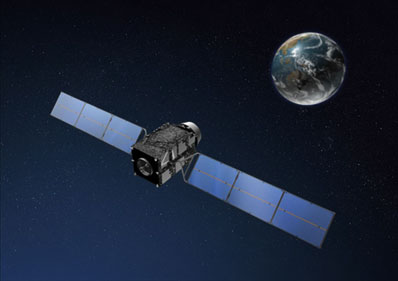
Japan’s first navigation satellite has arrived on station more than 20,000 miles over Asia to improve positioning coverage in mountainous terrain and urban centers.

Artist's concept of the Michibiki satellite. Credit: JAXA

MICHIBIKI injected into the quasi-zenith orbit with its center longitude of about 135 degrees.

The First Quasi-Zenith Satellite MICHIBIKI, which was launched by the H-IIA Launch Vehicle No. 18 on Sept. 11 (JST,) has been maneuvered to shift its orbit from the drift orbit to the quasi-zenith orbit starting on the 21st. The satellite is now confirmed to be inserted into the quasi-zenith orbit over Japan with its center longitude of about 135 degrees through the final orbit control performed at 6:28 a.m. on Sept. 27. The MICHIBIKI was launched from the Tanegashima Space Center at 8:17 p.m. on September 11, 2010 (JST.)

Yoshinobu Launch Complex

Yoshinobu Launch Complex at the Tanegashima Space Center: JAXA

JAXA’s press release is here:

http://www.jaxa.jp/press/2010/09/20100927_michibiki_e.html