Posts Tagged ‘Japan’

Divabot – debut for the all singing, all dancing robot

November 8, 2010

(PhysOrg.com) — A singing, dancing humanoid recently joined a live group of dancers to perform.

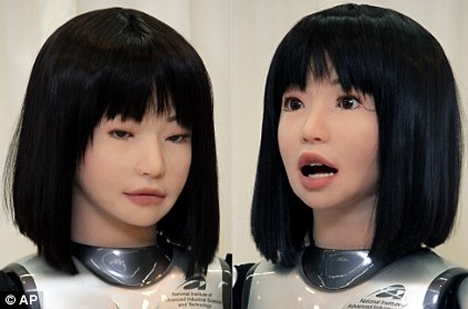
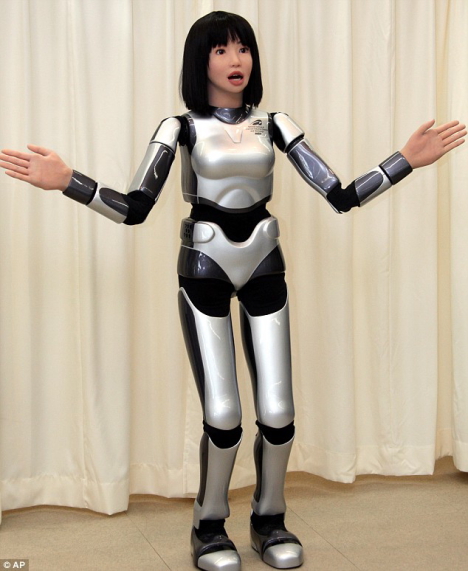
Developed by the country’s biggest public research organization, Japan’s National Institute of Advanced Industrial Science and Technology (AIST), the new variant of HRP-4, the female robot HRP-4C deemed “Divabot,” has a realistic face, movable features and even mimics human-sounding breaths.

Diva-bot’s intricate software creates complicated movements such as jumping, dancing and even balancing. Using a mouse, those with zero robotic expertise are meant to find Diva-bot easily operable, which may or may not be a good thing considering how complex the robot is.Comparable to the software commonly used in CG character animation, Diva-bot’s positioning can be controlled by clicking on the different parts and dragging them to the desired position, creating a sequence of key poses that the software generates, making the robot move.

http://pinktentacle.com/2009/03/video-hrp-4c-fashion-model-robot/


The HRP-4C, a walking, talking humanoid fashion model fembot developed by Japan’s National Institute of Advanced Industrial Science and Technology (AIST), is ready for the runway.

Video here.

With 30 motors in her body, the 158-centimeter (62-in) tall, 43-kilogram (95-lb) HRP-4C can walk around and strike a range of poses.

The black-haired robot also has 8 motors in her face, allowing her to wow the crowds with expressions of simple emotions like anger and surprise.


HRP-4C fashion model robot --

Anger // Surprise: HRP-4C


Nuclear renaissance: Vietnam gets nuclear reactors from Russia and Japan, Japan gets access to rare earths

November 1, 2010

Now Vietnam is going nuclear with its first 2 plants coming from Russia and the next 2 from Japan. Unexploited rare earth deposits in Vietnam are receiving a great deal of attention from countries hit by the Chinese monopoly on rare earth supplies.

Chosun Ilbo reports

Russian President Dmitry Medvedev and his Vietnamese counterpart Nguyen Minh Triet have called for increased trade and investment between their two countries. The two leaders met Sunday in Hanoi to seal a nuclear plant construction agreement and other bilateral deals. Under the $5 billion agreement, Russia will build Vietnam’s first nuclear power plant. Construction is expected to start in 2014.

Asahi Shimbun reports on a deal where Japan  gets access to the rare earth resources in Vietnam in exchange for two 1000 MW nuclear reactors worth 14.4 billion $ to the Japanese nuclear construction industry.

The nuclear reactor construction agreement, worth an estimated 1 trillion yen ($14.4 billion), gives the green light for Japanese companies to build nuclear facilities in an emerging nation’s fledgling nuclear industry for the first time.

The two reactors will be built in the southeastern province of Ninh Thuan and are scheduled to start operations in 2021. They will have a combined output of 2 gigawatts. Vietnam plans to build 14 nuclear reactors by 2030. Construction deals for four reactors in Ninh Thuan province have so far been agreed upon, including the two to be awarded to Japan. Russia won the rights to build two reactors in December last year.

Japan, which has been trying to use infrastructure exports as a springboard for its flagging economy, began bidding for the nuclear reactor project earlier this year. In August, a delegation of Japanese business leaders led by Japan’s industry minister visited Vietnam to lobby officials. They offered financial assistance and training for Vietnamese people.

Visiting Prime Minister Naoto Kan and Vietnamese Premier Nguyen Tan Dung also agreed on joint development of deposits in Vietnam of rare earth elements, part of a Japanese drive to reduce its reliance on China for supplies of the vital raw materials, which have been obstructed following a diplomatic dispute with Beijing.

A joint team of Japanese and Vietnamese businesses is currently applying for rare earth mining rights. The Japan Oil, Gas and Metals National Corp. discovered rare earth veins in the northern Lai Chau province about 10 years ago. Toyota Tsusho Corp., Sojitz Corp., and an arm of a Vietnamese public corporation have been preparing plans for joint development.

The underground reserves are believed to be capable of yielding 3,000 tons of rare earths a year, about 10 percent of Japan’s current annual requirement.

The Japanese government has offered to provide expertise and training in surveying, excavation, and processing the rare earth metals to Vietnam. Japan is also likely to dip into official development assistance to help the country build infrastructure such as roads and water supply near the mines. In a separate project, Sumitomo Corp. is looking into mining rare earths in Yen Bai province in the north of Vietnam.

Japan’s mighty whale mountain – to be consumed by school children

September 20, 2010
The flukes of a sperm whale as it dives into t...

Sperm whale flukes

It has become an annual ritual between Sea Shepherd and Japanese whalers, a ritual that only gets stronger, louder, and more dangerous over the years.  The Japanese claim that their whaling program is for research purposes.  However, whale meat ends up on the shelves of almost every counter in Japan, leading many activist groups to believe that it is a cover-up.

It is a series of cat and mouse games between the two sides, more often than not resulting in violence and even injuries.  Earlier that day before the collision occurred, Sea Shepherd activists threw stink bombs at the ships and dropped ropes in an effort to snarl their propellers. In the past, they have lobbed missiles including paint and rancid butter. The Japanese whalers have responded with water cannon, flash grenades (usually used for crowd control), and military-grade acoustic weaponry.

But how effective are Sea Shepherd’s tactics?  It is a question that has no answer.  Many media sources criticize Sea Shepherd for their violent demeanor.  Perhaps one of the most well known activist groups, Greenpeace, has openly pointed out that Sea Shepherd’s tactics are “morally wrong” and counter-productive as violent means only harden the Japanese public opinion and ensures whaling continues.

The Japan Times reports:

Stocks of frozen whale meat in Japan have reached 4,000 tons. That means there are about 40 million portions of whale meat being expensively stored under refrigeration ready for eating. But not enough people eat kujira (whale), and far from dwindling, Japan’s whale mountain is growing. It’s just not popular enough as a food. The Institute of Cetacean Research (ICR) — a branch of the government’s Fisheries Agency that outsources and oversees Japan’s whaling operations — urgently needs to reduce the size of the mountain. It wants Japan to eat more whale, and it has targeted school children as important consumers.

Whale meat for schools

Whale meat has been eaten for centuries in Japan, even millennia, but it was not consumed on a large scale until after World War II. Post 1945, as the country was being rebuilt, whale meat became an important source of protein. The children who ate it in their school lunches back then are now the venerable policymakers in the ICR and in government. The first potential problem with whale meat concerns its possible contamination with mercury.

A study conducted by Tetsuya Endo at the Health Sciences University of Hokkaido, and Koichi Haraguchi at the Daiichi College of Pharmaceutical Sciences in Fukuoka, investigated methyl mercury levels in whale meat on sale in Taiji, and in hair samples taken from 50 residents of the town. They found methyl mercury levels of 5.9 micrograms per gram in the red meat. For comparison, the United States Food and Drug Administration sets an “action level” of 1 microgram. In the U.S., any food with more than 1 microgram of methyl mercury is not allowed to be sold or consumed.

In residents who often ate whale meat, on average their hair contained 24.6 micrograms of mercury per gram. The figure from residents who do not consume whale meat was 4.3 micrograms, and in the Japanese population as a whole the figure is about 2 micrograms. The study was published earlier this year in Marine Pollution Bulletin.

n the September 2010 issue of the journal Current Problems in Pediatric and Adolescent Health Care, a group of public health researchers made an extensive review of the evidence for the effect of mercury exposure on children’s health. “Mercury,” the team write, “is a highly toxic element; there is no known safe level of exposure. Ideally, neither children nor adults should have any mercury in their bodies because it provides no physiological benefit.” ( DOI reference  is: 10.1016/j.cppeds.2010.07.002.).

In a paper to come in October 2010’s issue of Environmental Research (DOI: 10.1016/jenvres.2010.07.001) researchers based at Tohoku University conducted a “birth cohort” study on almost 500 mothers-to-be, and the children they gave birth to. They looked at the amount of seafood consumed by the women, the amount of mercury in the women’s hair, and then they measured the child’s behavior at age 3 days using the standard Neonatal Behavioral Assessment Scale.

They found that the greater the amount of mercury in the mother’s hair, the worse the child performed on the behavioral test. “In conclusion,” the team write, “our data suggest that prenatal exposure to methyl mercury adversely affects neonatal neurobehavioral function.”

This seems to be a not insignificant risk to subject school children to.
Snow among the cherry blossoms

April 18, 2010

A lovely picture of cherry blossoms in full bloom, people in kimonos, umbrellas unfurled and snow on the ground in Tokyo — from The Japan Times.

News photo

Snow in Tokyo today. It must be global warming!

April 17, 2010
Tokyo had snow today — the latest time of the year snowfall has been seen since 1969.
http://www.yomiuri.co.jp/dy/flashnews/