Posts Tagged ‘Magic’

Science ultimately needs magic to build upon

January 3, 2025

The purpose of the scientific method is to generate knowledge. “Science” describes the application of the method and the knowledge gained. The knowledge generated is always subjective and the process builds upon fundamental assumptions which make up the boundary conditions for the scientific method. These  assumptions can neither be explained or proved.


I find it useful to take knowledge as coming in 3 parts.

  1. known: This encompasses everything that we currently understand and can explain through observation, experimentation, and established theories. This is the realm of established scientific knowledge, historical facts, and everyday experiences.
  2. unknown but knowable: This is the domain of scientific inquiry. It includes phenomena that we don’t currently understand but that we believe can be investigated and explained through scientific methods. This is where scientific research operates, pushing the boundaries of our knowledge through observation, experimentation, and the development of new theories.
  3. unknown and unknowable: This is the realm that I associate with metaphysics, religion and theology. It encompasses questions about ultimate origins, the meaning of existence, the nature of consciousness, and other metaphysical questions that may not be amenable to scientific investigation.

Philosophy then plays the crucial role of exploring the boundaries between these domains, challenging the assumptions, and developing new ways of thinking about knowledge and reality.

I like this categorization of knowledge because

  • it provides a clear framework for distinguishing between different types of questions and approaches to understanding.
  • it acknowledges the limits of scientific inquiry and recognizes that there may be questions that science cannot answer, and
  • it allows for the coexistence of science, philosophy, religion, and other ways of knowing, each addressing different types of questions.

To claim any knowledge about the unknown or the unknowable leads inevitably to self-contradiction. Which is why the often used form “I don’t know what, but I know it isn’t that” is always self contradictory. It implies a constraint on the unknown, which is a contradiction in terms. If something is truly unknown, we surely cannot even say what it is not.

Given that the human brain is finite and that we cannot observe any bounds to our universe – in space or in time – it follows that there must be areas beyond the comprehension of human cognition. We invent labels to represent the “unknowable” (boundless, endless, infinite, timeless, supernatural, magic, countless, ….). These labels are attempts to conceptualize what is inherently beyond our conceptualization. They serve as placeholders for our lack of understanding. But it is the human condition that having confirmed that there are things we cannot know, we then proceed anyway to try and define what we cannot. We are pattern-seeking beings who strive to make sense of the world around us. Even when faced with the limits of our understanding, we try to create mental models, however inadequate they may be.

Human cognitive capability is limited not only by the brain’s physical size but also by the senses available to us. We know about some of the senses we lack (e.g., the ability to detect magnetic fields like some birds or to perceive ultraviolet light directly like some insects), but cannot know what we don’t know. We cannot even conceive of what other senses we might be missing. These are the “unknown unknowns,” and they represent a fundamental limit to our understanding of reality. Even our use of instruments to detect parameters we cannot sense directly must be interpreted by the senses we do have. We convert X-rays into images in the visible spectrum, or we represent radio waves as audible sounds. This conversion necessarily involves interpretation and introduces subjectivity. We also know that the signals generated by an animal’s eye probably cannot be understood by a human brain. The brain’s software needs to be tuned for the senses the brain has access to. The inherent limitations of human perception makes the subjective nature of our experience of reality unavoidable. The objectivity of all human observations is thus a mirage. Empiricism is necessarily subjective.

Scientific inquiry remains the most powerful tool humans have developed for understanding the world around us. With sophisticated instruments to extend our limited senses and by using conceptual tools such as mathematics and logic and reason we gain insights into aspects of reality that would otherwise be inaccessible to us. Never mind that logic and reason are not understood in themselves. But our experience of reality is always filtered through the lens of our limited and species-specific senses. We cannot therefore eliminate the inherent subjectivity of our observations and the limitations of our understanding. We cannot know what we cannot know.

I do not need to invoke gods when I say that “magic” exists, when I define “magic” as those things beyond human comprehension. This definition avoids superpower connotations and focuses on the limits of our current knowledge. In this sense, “magic” is a placeholder for the unknown. I observe that the process of science requires fundamental assumptions which are the boundary conditions within which science functions. These assumptions include:

  • Existence of an External Reality: Science assumes that there is an objective reality independent of our minds.
  • Existence of Matter, Energy, Space, and Time: These are the fundamental constituents of the physical universe as we understand it.
  • Causality: Science assumes that events have causes and that these causes can be investigated.
  • Uniformity of Natural Laws: Science assumes that the laws of nature are the same everywhere in the universe and throughout time.
  • The possibility of Observation and Measurement: Science depends on the assumption that we can observe and measure aspects of reality.
  • The biological and medical sciences observe and accept but cannot explain life and consciousness.

Science operates within a framework given by these fundamental assumptions which cannot be  explained. These incomprehensibilities are the “magic” that science builds upon. Science can address them obliquely but cannot question them directly without creating contradictions. If we were to question the existence of an external reality, for example, the entire scientific enterprise would become meaningless. Science can investigate their consequences and refine our understanding of what they are not, but cannot directly prove or disprove them. These assumptions are – at least currently – beyond human comprehension and explanation. Science builds upon this “magic” but cannot explain the “magic”.

Magic is often ridiculed because it is perceived as invoking beings with supernatural powers which in turn is taken to mean the intentional violation of some of the laws of nature. The core issue lies in the definitions of “magic” and  “supernatural.” I take supernatural to be “that which is beyond the laws of nature as we know them.” But we tend to dismiss the supernatural rather too glibly. If something is beyond comprehension it must mean that we cannot bring that event/happening to be within the laws of nature as we know them. And that must then allow the possibility of being due to the “supernatural”. If we do not know what compels existence or causality then we cannot either exclude a supernatural cause (outside the laws of nature as we know them). In fact the Big Bang theory and even quantum probabilities each need such “outside the laws of nature” elements. A black hole is supernatural. Singularities in black holes and the Big Bang represent points where our current understanding of physics breaks down. The laws of general relativity, which describe gravity, become undefined at singularities. In this sense, they are “beyond” our current laws of nature. A singularity where the laws of nature do not apply is “supernatural”. Dark energy and dark matter are essentially fudge factors and lie outside the laws of nature as we know them. We infer their existence from their gravitational effects on visible matter and the expansion of the universe, but we haven’t directly detected them. Collapsing quantum wave functions which function outside space and time are just as fantastical as Superman. All these represent holes in our understanding of the universe’s composition and dynamics. That understanding may or may not come in the future. And thus, in the now, they are supernatural.

Supernatural today may not be supernatural tomorrow. It is the old story of my technology is magic to someone else. Magic is always beyond the laws of nature as we know them. But what is magic today may remain magic tomorrow. We cannot set qualifications on what we do not know. What we do not know may or may not violate the known laws of nature. While we have a very successful theory of gravity (general relativity) that accurately predicts the motion of planets, we don’t fully understand the fundamental nature of gravity. We don’t know how it is mediated. In this sense, there is still an element of “magic” or mystery surrounding gravity. We can describe how it works, but not ultimately why. The bottom line is that we still do not know why the earth orbits the sun. We cannot guarantee that everything currently unexplained will eventually be explained by science. There might be phenomena that remain permanently beyond our comprehension, or there might be aspects of reality that are fundamentally inaccessible to scientific investigation. By definition, we cannot fully understand or categorize what we do not know. Trying to impose strict boundaries on the unknown is inherently problematic. We cannot assume that everything we currently don’t understand will necessarily conform to the laws of nature as we currently understand them. New discoveries might require us to revise or even abandon some of our current laws.

The pursuit of scientific knowledge is a journey into the unknown, and we will encounter phenomena that challenge our existing understanding. But we cannot question the foundational assumptions of science without invalidating the inquiry.

Science depends upon – and builds upon – magic.

Without the magic of cause and effect there is no science

March 4, 2019

Causality is existential for all the natural sciences and especially for physics.

Causality is magic. It is magic because why it should be so is inexplicable.

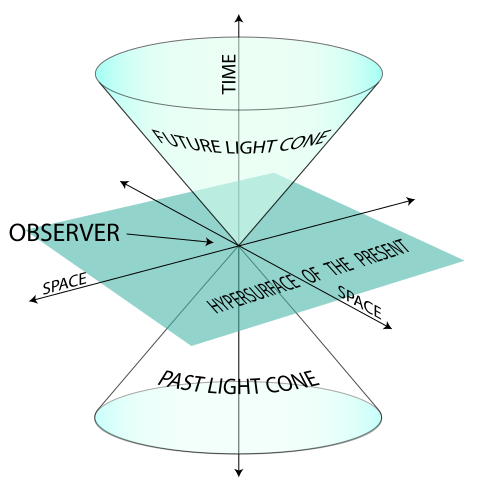
The most fundamental, enabling assumption for all the natural sciences is that identical causes lead to identical effects. The corollary that non-identical events are proof that the causes were not identical is also unquestioned – and unquestionable – for the scientific method. (However it is permitted that different causes may produce effects which are identical). Modern physics and relativity constrain causality. Cause and effect is restricted to the past and future light cones for any event. But this, in itself, implies a region (undefinable) where causality does not apply and does not even try to address why the magic that is causality exists.

Wikipedia

Causality means that an effect cannot occur from a cause that is not in the back (past) light cone of that event. Similarly, a cause cannot have an effect outside its front (future) light cone.

In special and general relativity, a light cone is the path that a flash of light, emanating from a single event (localized to a single point in space and a single moment in time) and traveling in all directions, would take through spacetime.

Being a fundamental assumption, it is not possible for the sciences and the scientific method to address why the assumption of causality exists. The First Cause problem is declared to be uninteresting to science just because it cannot be addressed. Allowing the problem would place all of science within a paradox. If everything has to have a cause then there must be a First Cause. If some things do not need to have a cause then there can be no certainty that anything is the cause of anything else.

The First Cause problem is what actually unifies science and philosophy and theology and religions. None have – or can have – an answer. They just use different labels for the undeniable magic. It has been debated since ancient times but I like the way Bertrand Russel expresses it.

Bertrand Russel- Why I am not a Christian

Perhaps the simplest and easiest to understand is the argument of the First Cause. (It is maintained that everything we see in this world has a cause, and as you go back in the chain of causes further and further you must come to a First Cause, and to that First Cause you give the name of God). That argument, I suppose, does not carry very much weight nowadays, because, in the first place, cause is not quite what it used to be. The philosophers and the men of science have got going on cause, and it has not anything like the vitality it used to have; but, apart from that, you can see that the argument that there must be a First Cause is one that cannot have any validity. I may say that when I was a young man and was debating these questions very seriously in my mind, I for a long time accepted the argument of the First Cause, until one day, at the age of eighteen, I read John Stuart Mill’s Autobiography, and I there found this sentence: ‘My father taught me that the question, “Who made me?” cannot be answered, since it immediately suggests the further question, “Who made God?” ’ That very simple sentence showed me, as I still think, the fallacy in the argument of the First Cause. If everything must have a cause, then God must have a cause. If there can be anything without a cause, it may just as well be the world as God, so that there cannot be any validity in that argument. It is exactly of the same nature as the Hindu’s view, that the world rested upon an elephant and the elephant rested upon a tortoise; and when they said, ‘How about the tortoise?’ the Indian said, ‘Suppose we change the subject.’ The argument is really no better than that. There is no reason why the world could not have come into being without a cause; nor, on the other hand, is there any reason why it should not have always existed. There is no reason to suppose that the world had a beginning at all. The idea that things must have a beginning is really due to the poverty of our imagination. Therefore, perhaps, I need not waste any more time upon the argument about the First Cause.

Russel is wise not to debate it further because penetrating the wall of the unknowable is a futile exercise. It is in the realm of magic.

Leibnitz’s formulation of the Principle of Sufficient Reason is only a formal description of Causality and defines the limits of empiricism and the scientific method. It cannot, however, penetrate the First Cause Problem.

Principle of Sufficient Reason

The Principle of Sufficient Reason stipulates that everything must have a reason, cause, or ground.

This is often formulated as:

  • For every entity X, if X exists, then there is a sufficient explanation for why X exists.
  • For every event E, if E occurs, then there is a sufficient explanation for why E occurs.
  • For every proposition P, if P is true, then there is a sufficient explanation for why P is true.

This is a stipulation, a statement of an assumption. But it is no explanation.

The conclusions I draw are that:

  1. Science is limited to where causality occurs.
  2. Physics admits causality is constrained by past and future light cones.
  3. Physics therefore admits that what lies outside the past and future light cones is unknowable.
  4. Causality is magic.
  5. All science depends upon magic.


Atheism cannot cope with the unknowable

July 8, 2018

I take atheism to be a “lack of belief in gods”.

A lack of belief does not lie in the realm of knowledge. Neither does it lie in the realm of the unknown. A lack of belief is silent about the state of knowledge about the subject in question. A lack of belief does not imply a state of knowledge. A lack of a belief is not in itself a logical negation of that belief. Many extend this and take atheism to be a denial of the existence of gods as professed as a belief by others. I suspect that most of my acquaintances who claim to be atheists use the latter definition when they present arguments to support their denial of the existence of gods to try and negate the beliefs of others. But a denial of some belief is then an attempt to shift something unknown into the realm of knowledge. It shifts the conversation from ” I don’t myself believe in X” to “I know that your belief in X is false”.

This shift from the realm of belief to the realm of knowledge, I think, is incorrect, illogical and invalid. We are inevitably drawn into epistemology. The known, the unknown and the unknowable. The known and the unknown are realms that are self-apparent. Science is the process at the interface of these regions which leads to the growth of the region of the known. All beliefs by definition lie in the region of the unknown. Any statement and its negation ( X and not-X) must both either lie in the region of knowledge, or both in the region of the unknown. It is not possible for one to live in the realm of knowledge and its negation to live in the region of the unknown. A belief in gods lies in the unknown. A lack of belief in gods (which is atheism) is not in itself a commentary on that belief. A denial of the belief in gods cannot then be anything other than belief and cannot shift into the realm of knowledge. A denial of a belief – which by definition lies in the unknown – is to claim knowledge of an unknown thing which is self-contradictory.

Known, Unknown and Unknowable

Is some part (and maybe the major part) of the unknown then unknowable? Some scientists – and some atheists – would claim that the unknowable does not exist; that everything – eventually – can be explained. But I think they delude themselves. This trifurcation into the known, the unknown and the unknowable does not address who the observer is or the time element. “To know” requires cognition. Cognition requires a brain. Known to whom? when? for how long? What is “known” depends upon the brains alive to know. Facts which were once part of knowledge may become unknown, though they may well remain facts. I observe that most of past events are now unknowable, though they were once known. What was once known, may have first passed into the region of the unknown (but was still knowable) and then with the further passage of time may have passed into the region of the unknowable. Most of the past events in my own life are already in the region of the unknowable. The most basic questions of science that we can formulate always lead us first into the unknown and then into the unknowable.  When the unknowable is reached we use labels. Gods, The Big Bang, Dark Energy, Dark Matter, …….. . But they are all just labels for Magic.

But more fundamentally, the Great Unknowable – throughout all of space and all of time – is time and its nature. What came before time, when “before” was undefined, is unknowable. At the most basic level, our causal universe and all its laws and all our logic rely upon the existence of an inexorable and inexplicable Time Magic. (I take all events which occur but which are inexplicable to be Magic. It is my label for that which lies in the region of the unknowable). Beliefs in Gods or the Big Bang also lie in the region of the unknowable.

Atheism is about belief and does not address the nature of knowledge or confront the unknowable. An atheist’s lack of belief in gods then lies in the realm of the unknown and perhaps in the realm of the unknowable (Magic). Even an atheist believes in Time Magic (whether he acknowledges it or not).


Even atheists and agnostics (and scientists) believe in Magic

April 3, 2018

I find religions unsatisfactory because they take the easy way out and answer all the fundamental questions by inventing the label of Gods and Divinity and Divine Properties. I find organised religions even less satisfactory since they try and indoctrinate and coerce others into their own invented beliefs. I find atheism and agnosticism unsatisfactory in that they are merely reactions which deny the isms of religion and beliefs in gods. To the question “Is there a god?”, atheism denies the existence of any deities while agnosticism merely claims not to know. A “No” or a ” I don’t know”.

Atheism only denies already existing beliefs and has no philosophy to offer in its own right. The only thought required is in constructing arguments to negate other existing beliefs. Agnosticism can be a little more thoughtful in that it claims a lack of knowledge or that such knowledge is unknowable. But as I have posted earlier, some things are unknowable and the answers to the fundamental questions are outside our ken. They are just Magic. All religions and theologians also believe in Magic though they use different labels.

For the atheist, what time is, or how the universe was created, or how life started all remain unaddressed. For the agnostic the answers to these questions lie in the field of the unknowable. But what is inexplicable, but always is, is just Magic. There is time magic and universe creation magic and spark of life magic. Just labels of course for the inexplicable. But time always flows – by magic – and the universe exists – by magic – and life exists – by magic.

God and The Big Bang are both just labels for Magic

Religion relies on the “inexplicable” to justify the invocation of Gods. God-magic. Atheism relies on the “power of reason” giving the lie to the existence of Gods.  But atheism is merely a rejection of one set of labels and explains nothing. Religions vest their Gods with sufficient attributes to explain away what cannot be explained. Atheism merely ignores the inexplicable or claims the inexplicable to be a consequence of random events. Theologians and physicists alike merely give labels to what they cannot explain – as if the label is in itself an explanation. Anything inexplicable is what Magic is. Of course, Magic itself is just a label. ………. The universe was created by a magical event and dances to magical tunes played by magical instruments. Life was magically created by other magical music within this universe. Atheists and priests and physicists and theologians all actually believe in Magic. God-magic is no different to Big-Bang-magic or origin-of-life-magic. A belief in a God is just as much a belief in Magic as a belief in the Big Bang is.

“Scientists” often disclaim any such beliefs but they fool themselves. All science relies on, and is built upon, foundations of Magic. Why time exists and why time flows is just Magic. Why space exists and space expands is also some other Magic. Scientists may not like the use of the label Magic, but

We can, through the process of science and reason, discover the laws applying to the universe we perceive but, at every step of increased knowledge, we find new “whys” we cannot address. We now believe there are four fundamental forces of nature (gravitation, electromagnetism, strong nuclear, weak nuclear) but have no idea why they should be just four and not five or a thousand. Depending on how you classify them there are 12 or 57 fundamental particles. Why 12 or why 57 is just as much magic as when the universe was considered to consist of just fire, earth, water and air. Gravity and electromagnetism are just as magical now as they ever were. You could as well have a gravity-god or space-time magic. “Why time” is the essence of magic. The Origin of Life is also just a label for a Creation Event. There are weird and wonderful theories about this, ranging from a random event in the primordial soup to extra-terrestrial intervention.

Like it or not, every atheist, agnostic, scientist, philosopher, pope or theologian believes in Magic.


God and The Big Bang are both just labels for Magic

January 22, 2018

The Universe was subject to a “Creation Event”. It was not, and then it was, (and if it always was it is even more troublesome). The Origin of Life is also a Creation Event. These two “creations” (of the universe and of life) are the great existential questions which require Magic.

Religion relies on the “inexplicable” to justify the invocation of Gods. God-magic. Atheism relies on the “power of reason” giving the lie to the existence of Gods.  But atheism is merely a rejection of one set of labels and explains nothing. Religions vest their Gods with sufficient attributes to explain away what cannot be explained. Atheism merely ignores the inexplicable or claims the inexplicable to be a consequence of random events. Theologians and physicists alike merely give labels to what they cannot explain – as if the label is in itself an explanation. Anything inexplicable is what Magic is. Of course, Magic itself is just a label. I take the view that the nature of humans is such that some things are unknowable. The Universe exists in dimensions we cannot access or even perceive. We can, through the process of science and reason, discover the laws applying to the universe we perceive but, at every step of increased knowledge, we find new “whys” we cannot address. We now believe there are four fundamental forces of nature (gravitation, electromagnetism, strong nuclear, weak nuclear) but have no idea why they should be just four and not five or a thousand. Depending on how you classify them there are 12 or 57 fundamental particles. Why 12 or why 57 is just as much magic as when the universe was considered to consist of just fire earth water and air. Gravity and electromagnetism are just as magical now as they ever were. You could as well have a gravity-god or space-time magic. “Why time” is the essence of magic. The Origin of Life is also just a label for a Creation Event. There are weird and wonderful theories about this, ranging from a random event in the primordial soup to extra-terrestrial intervention.

All religions and theologians – at best – indulge in lazy thinking. Creation Events are just assigned to an appropriately defined God. Gods are just labels generated to answer unanswerable questions. Physicists and biologists are not quite as intellectually lazy but still resort to labels to explain away inexplicable Magic. Physics and cosmology define their own Creation Event and call it the Big Bang. To resolve all the problems with the Big Bang theory, it is deemed a singularity where the laws of known physics did not apply. It is then stated to be the start of known time which neatly dismisses any need to consider what came before. We still have no idea of how life came to be, or can be, created from non-life. Theologians merely put it down to a convenient God.

Magic = inexplicable.

The universe was created by a magical event and dances to magical tunes played by magical instruments. Life was magically created by other magical music within this universe. Atheists and priests and physicists and theologians all actually believe in Magic. God-magic is no different to Big-Bang-magic or origin-of-life-magic. A belief in a God is just as much a belief in Magic as a belief in the Big Bang is.


Real Magic

December 26, 2017

Magic is perceived when

  1. an observation (an effect) has no perceivable cause, or
  2. an effect contrary to the laws of nature (as known) follows some cause.

“Magic tricks” and illusions create perceptions of either 1 or 2. This is not Real Magic. It is where the apparent magic lies in creating a perception which is contrary to reality.  A magician is then someone or some entity which causes effects, which are perceived – by others – as inexplicable and magic, but which would be no magic for the practitioner.

Real magic can thus never be practiced. It can only be perceived.

Hard sciences take the position that all observations are explainable even if the explanation is unknown at that time. All fields of learning – including the hard sciences and even philosophy and theology – perceive magic (observations with no perceivable cause, or effects contrary to the known laws of nature) but are extremely reluctant to admit to the concept of magic. There is a fear – in all fields of learning – to admit that some things may be unknowable. Physics and cosmology merely give labels to the inexplicable to disguise their perceptions of magic. Neither philosophers nor physicists can explain what time is or why it exists or why the arrow of time is unidirectional. The “Big Bang Singularity” is just a label as “Dark Energy” and “Dark Matter” are labels for postulated events or things that cannot be explained. “God” is also just a label used by theologians instead of admitting to the inexplicable. What scientists and theologians conveniently ignore is that a label is not in itself an explanation. The label “Big Bang” or the label “Allah” explain nothing if you add the prefix “Why”. The Why of waves and particles and quantum theory are all in the realm of magic. Why the physical constants of the universe are what they are is wondrous and magical. Why does the logic of mathematics work and why should π have the value it does? How could matter and anti-matter have been formed in the first place if they annihilate one another?

But Real Magic exists. Real Magic lies in that time exists and that the Universe exists (in that order). The concept of a flowing time is so ingrained that we cannot imagine the beginning of time without asking what came before time existed – even if “before” has then no meaning. That effect should follow cause is Real Magic. Why logic exists and why the Universe should follow any laws at all, is inexplicable and Real Magic.

Physics and religions have this in common. What they cannot explain, what they perceive as magic, they invent a label for.


A second now must be longer than a second was then

December 12, 2017

We cannot measure time. We have no idea why time is unidirectional.

We claim to measure time periods and the passage of time, though we have no idea what it is that is passing.

We impute time periods to the observation of changes. We assume that the changes being observed are stable and regular. We used to assume that the earth orbited the sun in a stable and regular manner with every completed orbit taking what we called a year. We now know that the orbit is neither stable nor regular and is no longer accurate enough for use as the standard measure of a time period. We used to assume that the earth’s rotation around its own axis was stable and regular but now know that this rotation is slowing and days are getting longer by about 2.3 milliseconds per century. Of course, to be able to say that, we need a “second” defined independently of a “day” defined by the rotation of the earth. The modern definition of a “second” is now based on the vibration of a caesium atom.

The second is the duration of 9 192 631 770 periods of the radiation corresponding to the transition between the two hyperfine levels of the ground state of the cesium 133 atom in its ground state at a temperature of 0 K.

This assumes that this radiation is stable and regular. We assume that the 9,192,631,770 periods taken to constitute a second are each identical to the other. (Why it should be so is of course magic). For all practical purposes and relative to the duration of the lifespan of the human species it may well be so. But over the long, long term it cannot be so.

The earth-moon-sun system, the solar system and even our galaxy are all losing energy. Even all vibrating atoms must be losing energy for any radiation to occur or for any vibration to take place. For the “radiation corresponding to the transition between the two hyperfine levels of the ground state of the cesium 133 atom in its ground state at a temperature of 0 K” to remain stable for ever requires an energy input which does not exist. Why any radiation should be regular is still a matter of magic.

What a “second” was at the Big Bang and before is unknown. But since then, it follows that “seconds” then were shorter than “seconds” are now. Every “second” now must be shorter than every “second” to come.

Of course what is even more magical is our fundamental assumption that the passage of time itself is stable and regular. We have no clue as to what laws of the universe require such stability or regularity and the why of any such laws is still in the realm of magic.


The magical speed of an inconstant time


Science (and the gods) rely equally on magic

July 3, 2017

The fundamental assumptions of science can be written in various ways but, for me, seem to boil down to four:

  1. The Universe exists
  2. Laws of nature (science) exist
  3. All phenomena are constrained to obey the laws of nature (science)
  4. The laws of nature (science) apply everywhere in the universe

The laws of nature are such that compliance with these laws is inbuilt. If there is any non-compliance it is not a law of nature. If compliance is all that we observe then it is a law of nature. But why the laws are what they are are usually beyond explanation.

Assumptions are not amenable to further question. You could apply an “if” to them or question “why” the assumption is true, but that is futile for there are no answers. They are just taken as self-evident and the starting point of rational thought. They are never, in themselves, self-explanatory except in the trivial form. (Assume that 1+1=2. Therefore 2+2=4 and that proves that 1+1=2).

I apply the word “magic” to all that is inexplicable. And all the fundamental laws of nature (science) are built on a foundation of inexplicable magic. How many fundamental particles exist and why? It’s magic. If the laws of science only apply after the Big Bang but don’t apply at the Big Bang singularity itself, what laws did? It’s magic. If the laws apply to a supernova but not inside a black hole, it’s magic. (Never mind that a black hole seems to be a part of the universe where the laws of science do not apply which violates the assumption that the universe is homogeneous and isotropic (Assumption 4 above). Why are there 4 – and only 4 – fundamental forces in nature? It’s magic. How did time begin? It’s magic. Can empty space exist without even the property of dimensions? It’s magic. Can time be a dimension and not have negative values? It’s magic. Dark energy and dark matter are merely labels invoking magic. All science which relies on fundamental assumptions is ultimately built upon and dependent upon a set of inexplicable, fundamental statements. They are just magic.

A fundamental flaw with the claim of physics, that all of history up to just after the Big Bang is explainable by the laws of science, must also mean that all of the future is also fixed and determined by the laws of science applied to conditions now. What will happen was therefore fixed for all time by the Big Bang itself. And that, too, is indistinguishable from magic.

Religions do not just rely on magic, they claim the magic for their gods. Modern, “with-it” religions, which try to be “compatible” with the latest knowledge discovered by science, merely claim that their God(s) pushed the button which caused the Big Bang. That my God is greater than your God is magic. That there is a life after death, or reincarnation, or rebirth or an ultimate state of grace is also just magic.

Shiva, Kali, Jesus, Allah, nirvana, dark energy, dark matter and the Big Bang singularity are all labels for different facets of magic.

Magic, by any other name, is just as inexplicable.


The speed of light may have been faster

May 4, 2017

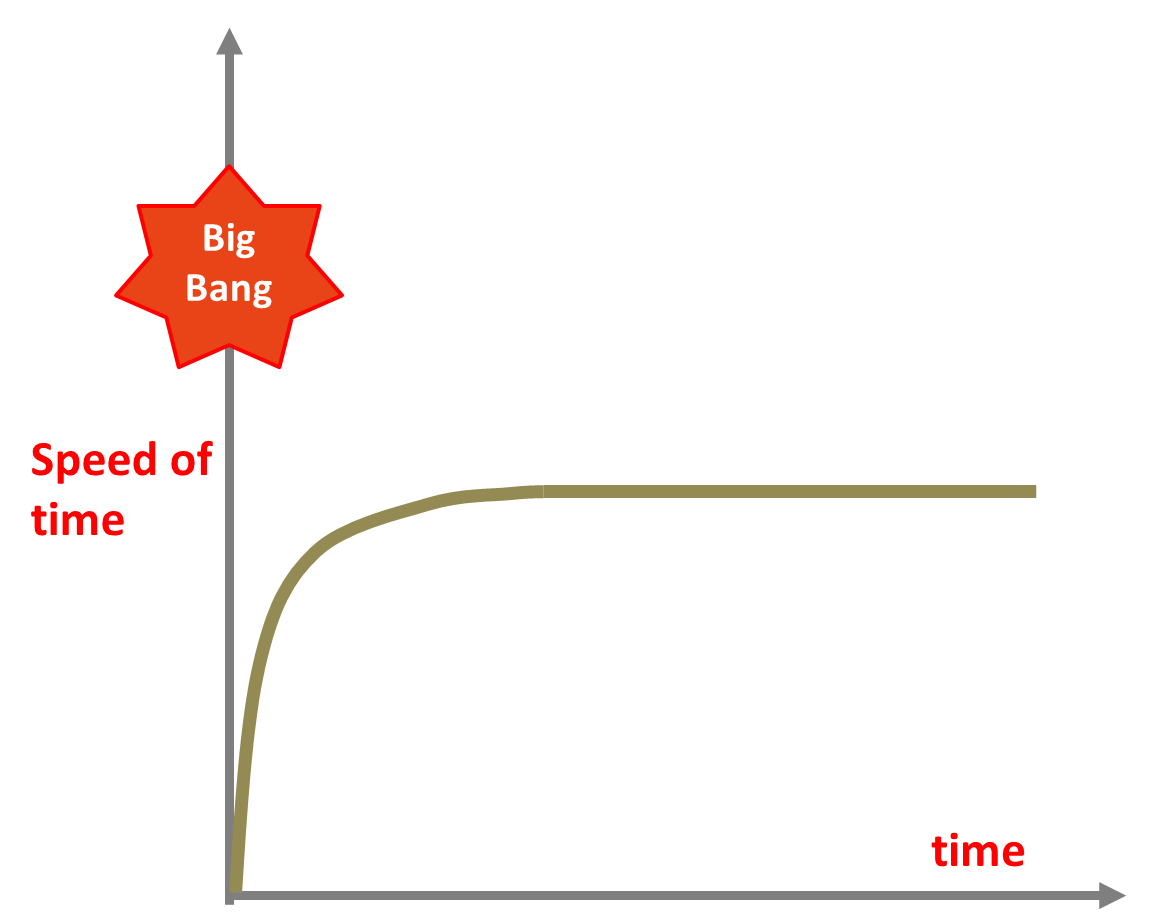
I have speculated before that the rate at which time dissipates may not be constant (The Magical Speed of an Inconstant time).

Now come suggestions that the speed of light may have been faster at the time of the Big Bang. That is perfectly consistent with the speed of time being slower at the time of the Big Bang.

In 2015, scientists at the Laser Interferometer Gravitational-Wave Observatory (LIGO) confirmed evidence of gravitational waves. These ripples in space-time, formed by the merger of two supermassive black holes, were exactly what Einstein had described with his theory of general relativity. But physicists studying the LIGO data found evidence of “echoes” that seem to contradict the predictions made by general relativity.

“Theoretical physicists Jahed Abedi, Hannah Dykaar, and Niayesh Afshordi, published a new paper explaining that the group believes they have detected the first evidence of gravitational effects not explained by general relativity in the data,” reported Inverse in the wake of the LIGO announcement. In this way, Einstein’s vindication could also prove his theory’s undoing. And this isn’t the only evidence that could disrupt the theory of relativity.

Physicists studying the early origins of the universe hypothesize that light has not always traveled at the same speed. This directly challenges special relativity.

“João Magueijo from Imperial College London and Niayesh Afshordi of the Perimeter Institute in Canada proposed a new experiment proving Einstein wrong and demonstrating that the speed of light actually isn’t a constant,” Inverse reported in November 2016. “The pair thinks light may have moved faster in the past, around the time of Big Bang, and that it’s actually slowed down since.”

They suspect that the lumpy density of the early universe caused light to behave differently. As the universe expanded and smoothed out, these lumpy areas disappeared. But there still may be some areas at the edge of the universe where the lumpiness persists, and in these areas, faster-than-light travel could be possible.

That’s why Einstein’s theory of relativity, which provides the foundation of most of modern physics, may soon be proven wrong as advanced technologies enable us to peer farther into the expanding universe than we ever have before: Once we finally peer into a black hole, we might find that Einstein was wrong about general relativity.


My speculations about time had to resort to magic:

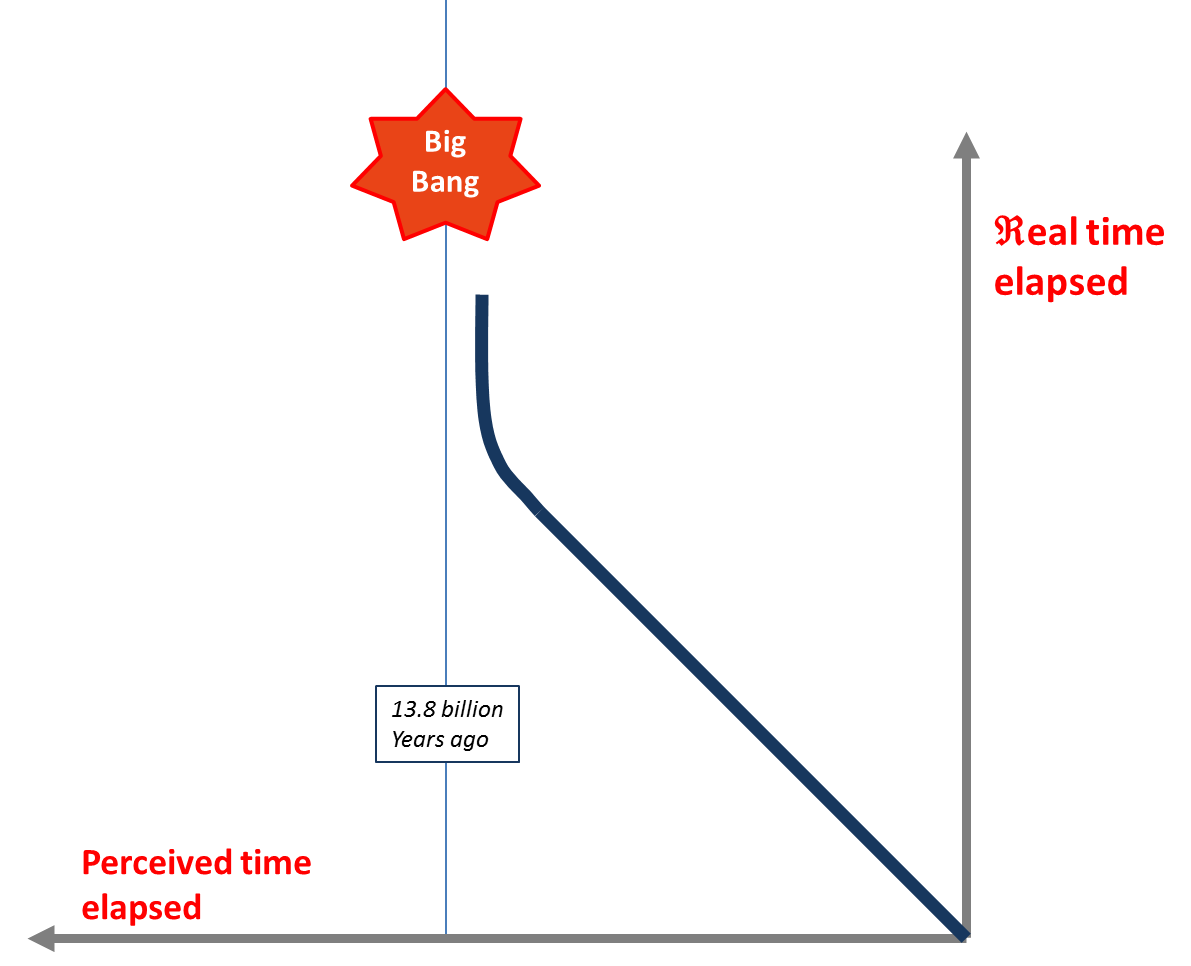
And so I distinguish between perceived time and eal time. eal time, of course is magical. It is only by definition that we take the passage of time to be constant. Of course this is just perceived time. And we perceive time only as a consequence of change. But eal time does not have to elapse at a constant rate.

The Big Bang does not, apparently, mathematically permit of a time older than 13.8 billion years. Magical eal time, of course, goes back to infinitely long ago. All can be resolved merely by accepting that ℜeal time elapsed at zero rate at the Big Bang and then gradually built up to the rate of elapse we are subject to now. ……

At the Big Bang, even change had to get started. All change, all motion, all vibrations, all oscillations and all radiation had to start from zero. The atoms and the elements had to come into being. Cesium had to have come much later. These cycles of these oscillations of even the very first atoms may be regular now. But they would all have had to start somewhere (somewhen) and start from zero. The speed of oscillation had to build up from nothing (implying an infinite period) to that applying today. Which means that close to the Big Bang as atoms were ratcheting up their oscillations, the period between cycles would have been longer, starting infinitely long and reducing rapidly (in apparent time) to what is observed today. Closer to the Big Bang, eal time, as opposed to apparent time, would have elapsed more slowly and the period between cycles of all radiation would have had to start from infinity. The very speed of time would have been slower.

At the Big Bang, the speed of eal time would have been zero. A perceived picosecond of elapsed time would actually have been after the elapse of many, many trillions of eal time years. The perceived age of the universe of 13.8 billion years of perceived time would have been infinitely long ago in eal time.

Ultimately physics is just magic.


Gravitational “constant” is not constant but varies periodically

February 1, 2016

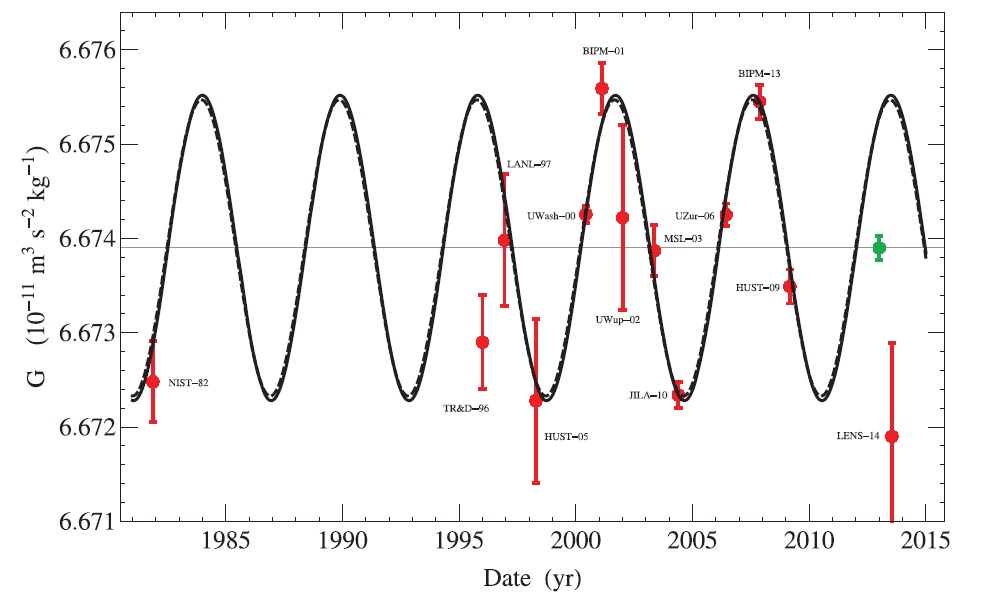
Newton’s gravitational constant, G, is surprisingly variable and varies periodically. The period is 5.899 +/- 0.062 years which is the same period by which the length of day varies and is also about half the 11 year solar cycle.

The reasons for this are unknown and speculations about currents in the earth’s core and magnetic effects abound.

The simplest explanation is that it is the same magic which causes gravity (and calling it space-time does not reduce its magical qualities) which also causes the solar cycle and is also the same magic which governs the movement of the earth around the sun and the corresponding length of day.

John D. Anderson, Gerald Schubert, Virginia Trimble, Michael R. Feldman, Measurements of Newton’s gravitational constant and the length of day, EPL 110 (2015) 10002, doi:10.1209/0295-5075/110/10002

Abstract:About a dozen measurements of Newton’s gravitational constant, G, since 1962 have yielded values that differ by far more than their reported random plus systematic errors. We find that these values for G are oscillatory in nature, with a period of P = 5.899 +/- 0.062 yr, an amplitude of (1.619 +/- 0.103) x 10^{-14} m^3 kg^{-1} s^{-2}, and mean-value crossings in 1994 and 1997. However, we do not suggest that G is actually varying by this much, this quickly, but instead that something in the measurement process varies. Of other recently reported results, to the best of our knowledge, the only measurement with the same period and phase is the Length of Day (LOD – defined as a frequency measurement such that a positive increase in LOD values means slower Earth rotation rates and therefore longer days). The aforementioned period is also about half of a solar activity cycle, but the correlation is far less convincing. The 5.9 year periodic signal in LOD has previously been interpreted as due to fluid core motions and inner-core coupling. We report the G/LOD correlation, whose statistical significance is 0.99764 assuming no difference in phase, without claiming to have any satisfactory explanation for it. Least unlikely, perhaps, are currents in the Earth’s fluid core that change both its moment of inertia (affecting LOD) and the circumstances in which the Earth-based experiments measure G. In this case, there might be correlations with terrestrial magnetic field measurements.

A set of 13 measurements of G exhibit a 5.9-year periodic oscillation (solid curve) that closely matches the 5.9-year oscillation in LOD measurements (dashed curve). The two outliers are a 2014 quantum measurement and a 1996 measurement known to suffer from drift. The green dot is an estimate of the mean value of G after the 5.9-year periodicity is removed. Credit: J. D. Anderson, et al. ©2015 EPLA

A set of 13 measurements of G exhibit a 5.9-year periodic oscillation (solid curve) that closely matches the 5.9-year oscillation in LOD measurements (dashed curve). The two outliers are a 2014 quantum measurement and a 1996 measurement known to suffer from drift. The green dot is an estimate of the mean value of G after the 5.9-year periodicity is removed. Credit: J. D. Anderson, et al. ©2015 EPLA

Physics is impossible without final recourse to various magics; Big Bang Magic, gravitational magic, weak force magic, strong force magic and electromagical magnetics. There is something very inelegant – bordering on ugly – when modern physics needs over 50 different “fundamental” particles and unknown, unseen, undetectable forms of dark matter and dark energy to make their models feasible.

If there is a fundamental particle then there can be only one and it is called the Ultimion.