The Times of India is not impressed by the report in The Lancet Infectious Diseases Journal which claims that “India also provides cosmetic surgery for Europeans and Americans, and it is likely the bacteria will spread worldwide.”
cartoon from indianmta.blogspot.com
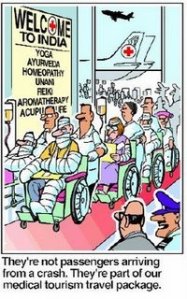
Scientists have tracked down a drug-resistant superbug that infects patients and causes multiple organ failure to Indian hospitals but doctors here see in it the germ of a move to damage the country’s booming medical tourism industry. While the study has the medical world turning its focus on infection control policies in Indian hospitals, the Indian Council of Medical Research has alleged a bias in the report and said it is an attempt to hurt medical tourism in the country that is taking away huge custom from hospitals in the West. “Such infections can flow in from any part of the world. It’s unfair to say it originated from India,” said ICMR director Dr VM Katoch. The superbug NDM-1 (New Delhi metallo-beta-lactamase) is named after the national capital, where a Swedish patient was reportedly infected after undergoing a surgery in 2008.
Senior doctors working in infection control said India lacks policies on antibiotics, infection control and registries for hospital-acquired infections. By the ICMR director’s own admission, India cannot scientifically fight back allegations of being the source of such superbugs, as the country does not have a registry of such hospital-acquired infections.
“Two in every five patients admitted to hospitals acquire infections. This extends the patient’s stay in the hospital, increases the expenses and causes side-effects,” said Dr Dilip Mathai, head of the department of internal medicine, Christian Medical College, Vellore.
The Lancet report is causing some alarm within the medical tourism fraternity in India and doctors are rushing to defend the business.
But doctors in India said there was little chance this bacteria would infect overseas “health tourism” visitors. “Most of these bacteria are mostly transmitted to ICU patients, those in ventilators or critically ill patients. Since overseas patients come for selective surgeries, chances of them getting these bugs are negligible,” said Dr Monica Mahajan, senior consultant at Delhi-based Max Healthcare. Dr Amit Verma, director of critical care medicine at Fortis said he did not anticipate any major impact to medical tourism in India. The sample size of the study was very small to arrive at a conclusion, he said, adding that the chances of the bacteria becoming a global epidemic was negligible due to the restricted transmission capability of the bacteria.
Somehow the glib statement that “Most of these bacteria are mostly transmitted to ICU patients, those in ventilators or critically ill patients. Since overseas patients come for selective surgeries, chances of them getting these bugs are negligible” does not inspire much confidence!

 The k2p blog