
Borobudur Temple: Image via Wikipedia
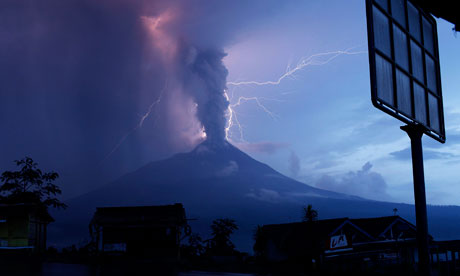
The death toll from recent eruptions at Indonesia’s Mount Merapi continues to rise as the volcano spewed hot ash clouds and gas on Sunday. At least 156 people have died since Merapi started erupting on October 26. Ash columns reached as high as 6 kilometers (3.7 miles), according to the Indonesian Volcanology and Geological Disaster Mitigation Agency.
The Borobudur temple lies about 45 km from Mount Merapi and is currently covered with ash which is being painstakingly cleared.
Employees of Borobudur temple on Sunday were working to keep the historic site from being damaged by the thick black ash that has fallen from nearby Mount Merapi’s eruption.
Karyono, a parking lot employee who has been working there since 1986, was taking the ash off the driveway and the parking lot. Using a small iron shovel, he and his 10 coworkers were squatting and painstakingly taking the ash away in buckets.Karyono said that he has been cleaning since Saturday and piling up the ashes to be dumped elsewhere.
While the cleanup operation continues, the famous temple is closed to visitors from Nov. 5 to 9.
Mount Merapi unleashed nearly 50 million cubic meters of gas, rocks and ash on Friday, its most powerful eruption in a century.
Up to 138 people have now died on Merapi’s slopes in the past ten days of eruptions and gas cloud ash emissions.
Authorities charged with conserving the temple say that
ash up to 3-centimetres deep has covered it and the acidity could erode the temple’s stones. They believe that if the ash it is not cleared away quickly it will accelerate the decay of the stones. The monument comprises six square platforms topped by three circular platforms, and is decorated with 2,672 relief panels and 504 Buddha statues. A main dome, located at the center of the top platform, is surrounded by 72 Buddha statues seated inside perforated stupa. The monument is both a shrine to the Lord Buddha and a place for Buddhist pilgrimage. The journey for pilgrims begins at the base of the monument and follows a path circumambulating the monument while ascending to the top through the three levels of Buddhist cosmology, namely Kāmadhātu (the world of desire), Rupadhatu (the world of forms) and Arupadhatu (the world of formlessness). During the journey the monument guides the pilgrims through a system of stairways and corridors with 1,460 narrative relief panels on the wall and the balustrades. Officials however confirm that over the next few days they will be conducting a technical evaluation for the cleaning process. The temple was again closed down for visitors temporarily after volcanic ash covered it following the Merapi volcano’s powerful eruptions on Friday. When the cleanup is completed visitors will be allowed to visit the site early next week – but they will still not be permitted to climb up to the temple.
Evidence suggests Borobudur was abandoned following the 14th-century decline of Buddhist and Hindu kingdoms in Java, and the Javanese conversion to Islam. Worldwide knowledge of its existence was sparked in 1814 by Sir Thomas Stamford Raffles, then the British ruler of Java, who was advised of its location by native Indonesians. Borobudur has since been preserved through several restorations. The largest restoration project was undertaken between 1975 and 1982 by the Indonesian government and UNESCO, following which the monument was listed as a UNESCO World Heritage Site. It is still used for pilgrimage; once a year Buddhists in Indonesia celebrate Vesak at the monument. Borobudur remains Indonesia’s single most visited tourist attraction.
Since Borobudur was built sometime in the 9th Century it has probably seen – and survived – over one hundred eruptions from Mount Merapi in the following 1200 years. Mount Merapi is Indonesia’s most active volcano and has certainly been erupting regularly at least since 8000 BC. Since 1548 written eruption records are available but earlier eruptions are inferred.

Mount Merapi as seen from Borobudur: image ghumakkar.com


 The k2p blog