Posts Tagged ‘“Peak” gas’

And now the UK reports a huge shale gas find – but WWF wants to ban it

September 22, 2011

“Peak-gas” moves further into the future as recoverable reserves of shale-gas are found in more countries. The coming gas glut is getting ever more real. Now the UK – which was thought to have little shale gas – has found reserves of about 5,700 billion cubic metres of shale gas in Lancashire. Poland -which was thought to be the richest in shale gas resources in Europe has recoverable reserves of about 5,400 billion cubic metres. Till now the British Geological Survey had thought the country possessed only about 150 billion cubic metres.

The map of the world’s shale gas reserves is changing rapidly as exploration for this previously ignored resource intensifies. The gas glut is going to provide relatively cheap options for the use of gas based electricity generation into the foreseeable future. In fact the increase in the cost of electricity which has been driven by the use of renewables and misplaced penalties for fossil fuel could finally be reversed. Needless to say the “environmental” industry – instead of welcoming the finding of new resources – is in a state of denial – and looking for every possible objection to the use of shale gas. The use of intermittent wind and solar power – apart from being so expensive when deployed – always needs back-up capacity and gas fired power generation is the only real option. The gas glut comes just in time for the recovery of the world economy which is now badly needed.

Wall Street Journal:  An area in northwest England may contain 200 trillion cubic feet of shale gas, putting it in the same league as some of the vast shale-gas plays that have transformed the U.S. energy industry. The figure for the area near Blackpool, released Wednesday by Cuadrilla Resources, a small oil-and-gas company with operations in England’s Bowland Shale, highlights the U.K.’s emerging position as a new frontier for unconventional gas exploration. But it inflamed environmental groups who say the technology used to extract shale gas is environmentally damaging.

The discovery of such vast resources—200 trillion cubic feet would be enough to meet U.K. gas demand for 64 years—comes at a time when the U.K.’s conventional gas fields are in steep decline and as it is becoming increasingly dependent on imports such as liquefied natural gas from Qatar and piped gas from Norway.

The response from the World Wildlife Fund was predictably alarmist.

In response to Cuadrilla’s announcement, the environmental group WWF called Wednesday for a moratorium on shale-gas production in the U.K. and said the country should be more focused on investing in renewables than increasing its reliance on fossil fuels. “The government should at the very least halt shale gas exploration in Britain until more research can be undertaken on both the climate-change impacts and contamination risks associated with shale gas,” said Jenny Banks, WWF-UK’s energy- and climate-change policy officer.

The coming gas glut: Shale gas gets going in Poland

September 19, 2011

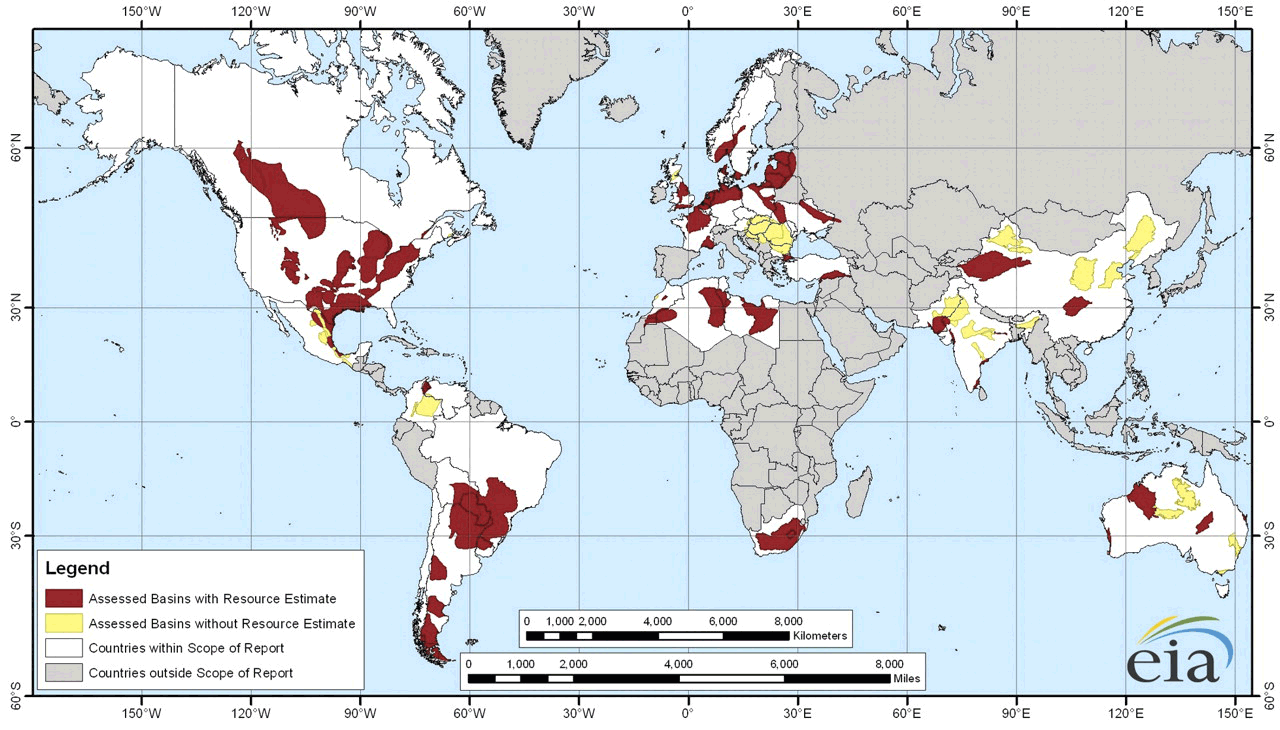
An estimate of the world’s recoverable shale gas reserves in 32 countries is as at least as much again as the world’s proven natural gas reserves as of 2010. This does not include large parts of Africa and Russia, the Middle East and SE Asia. It does not include known resources within the 32 countries but which have not yet been assessed. Fears of any kind of “peak” gas scenario being attained are rapidly disappearing into the future.

US EIA: The initial estimate of technically recoverable shale gas resources in the 32 countries examined is 5,760 trillion cubic feet. Adding the U.S. estimate of the shale gas technically recoverable resources of 862 trillion cubic feet results in a total shale resource base estimate of 6,622 trillion cubic feet for the United States and the other 32 countries assessed. To put this shale gas resource estimate in some perspective, world proven reserves of natural gas as of January 1, 2010 are about 6,609 trillion cubic feet, and world technically recoverable gas resources are roughly 16,000 trillion cubic feet, largely excluding shale gas. Thus, adding the identified shale gas resources to other gas resources increases total world technically recoverable gas resources by over 40 percent to 22,600 trillion cubic feet.

Outside of the US the recovery of shale gas is being planned in many countries. In Europe the rush to recover and use shale gas is being led by Poland which has been dependant upon its own coal and on Russian gas. The shale is not very deep down and is mainly in thinly populated areas. And now the recovery has started and commercial production should start within 10 – 20 months.

Shale gas is abundant in Poland: map via Wikipedia

Wall Street Journal: Shale gas is burning in Poland after gas firm PGNiG SA torched a flare on one of its rigs. Poland wants to become one of the major players in the European gas market within the next two decades, with the state-controlled natural gas firm starting commercial production in 2014.

PGNiG has begun technical production of natural gas from its shale gas concession in Lubocino, a village in northern Poland, and plans successive drilling as the company hopes to tap the country’s potentially vast unconventional hydrocarbon reserves.

Outside the U.S., Poland is the first country where companies are making a serious effort to develop shale gas, which Polish Prime Minister Donald Tusk has called the country’s “great chance,” as it could reduce Poland’s dependence on Russia for gas, create tens of thousands of jobs and fill state coffers.

PGNiG now plans to drill horizontally and conduct further fracturing procedures on this concession, which may be completed in 10-20 months and will enable commercial extraction. …….

Prime Minister Tusk Sunday said he was “moderately optimistic” commercial shale gas production would begin in 2014, which would by 2035 free it from its overreliance on Russia’s OAO Gazprom for natural gas supplies and allow it to be a major player in Europe’s gas.

“After years of dependence on our large neighbor, today we can say that my generation will see the day when we will be independent in the area of natural gas and we will be setting terms,” Mr. Tusk said. Poland’s domestically produced shale gas should be competitively priced compared to gas imported from Russia, a government official said earlier. Exploration in Poland won’t pose a danger to the environment, he added.

China and India have not yet even fully mapped all the shale gas reserves they have but plans for commercial gas production from the reserves already known to exist are being prepared. With the slow-down expected in building nuclear plant the gas “glut” comes just in time for the gas based power production that will be needed when the economic recovery is established. Moreover all intermittent, subsidised renewable energy (solar and wind) need capacity back-up and the only viable option is gas based power plants.

Bio-gas is out, shale gas is in and there is no “peak” gas in sight!

May 6, 2011

Shale gas is abundant and now beginning to undercut the price of other sources of natural gas. It is already cheaper than LNG transported around the world which requires both terminals for liquefaction and receiving stations for evaporation. Gas-fired power plants are relatively cheap and quick to build. In simple-cycle operation gas turbine based power plant provide the economic method of choice for emergency power and peak power. In combined cycle operation they provide the highest efficiency of all types of fossil fired electricity generation (around 60%). The ratio of gas price to coal price determines whether this can be cheaper than coal fired power generation.

Shale gas is abundant: map via Wikipedia

Total oil, gas and coal resources in the Earth’s crust are estimated at more than 570,000 exajoules. The world will use about 450 exajoules (billion billion joules) of fossil fuel energy this year.

Exajoule

The exajoule (EJ) is equal to 1018 joules. The 2011 Tōhoku earthquake and tsunami in Japan had 1.41 EJ of energy according to its 9.0 on the Richter magnitude scale. Energy in the United States used per year is roughly 94 EJ.

Matt Ridley:

Quantity is not really the point; price is. Most fossil fuels are impossibly hard to extract at a reasonable price. More than half the reserves consist of methane clathrates hydrated gas found mostly on the seabed near the margins of the continents in vast quantities. Nobody knows how to turn them into fuel except at huge cost, although the Japanese are on the case. So the question is not whether we run out of fossil fuels but whether we run out of cheap fossil fuels.

With oil, the answer may be “yes”. A huge amount of oil is still untapped, but most of it is under deep water or in oil sands and is costly to extract. But with gas, the answer is “no”. Most free methane is found in impermeable rocks such as shale, not in permeable “traps” whence it is easiest to extract. Shale gas was thought to be as inaccessible as clathrates, and when it began to be exploited in the 1990s it looked as if it would still come in at the top of the price range. Now technological improvements have brought the price down so far that it undercuts conventional gas. 

The “shale-gas shock” will have far-reaching consequences. It will make gas prices lower and less volatile relative to oil than ever before.

This will cause gas to take market share from coal, nuclear and renewables in electricity generation, and from oil in transport. London buses should follow Washington and Delhi in switching to gas both to save money and to produce less smog.

Shale gas is good news for America and China (which probably has even more of it than America), consumers (cheap fuel means higher standards of living) and farmers (fertiliser is made from gas). It is bad news for Russia and Iran (which hoped to corner the gas market in coming decades), for coal (until now the cheapest fuel for electricity) and for the nuclear and wind industries. The last two had expected to be rescued from dependence on subsidies by rising fossil fuel prices. They may now not be.

The losers are formidable enemies, so there is a movement, whose fans range from Gazprom to Greenpeace, to strangle the shale-gas industry at birth, by claiming that drilling for it contaminates water with carcinogenic and even radioactive chemicals. This turns out to be true only in the sense that coffee is carcinogenic, bananas radioactive and dihydrogen monoxide (water) a chemical.

The use of gas for power generation is perfectly sustainable into the foreseeable future. As the hysteria and alarmism around carbon dioxide causing global warming is debunked and begins to fade away the fashionable and unsustainable focus on bio-gas will also die away. The price of electricity production from gas will be the benchmark for judging whether wind and solar power make any sense. Without artificially imposed penalties on carbon or carbon taxes on fossil fuel, bio-gas can never be more than a marginal fuel of little significance. For bio-gas to have any significance catchment areas become so large that food production is adversely affected. The cost of production is relatively high. Without a carbon dioxide scare and the resulting subsidies, wind and solar power are still not able to compete against any form of fossil fuel power generation or hydro power or nuclear power.

But the success of technologies for the extraction of shale gas ensures availability of significant quantities for a long time to come. These quantities are so large that there is no “peak” in sight and all the alarmist “peak” gas scenarios are rendered meaningless.

Moving peaks: Peak gas will never come

Related: Europe told of potential shale gas bonanza