In November last year I posted about this paper which used economic factors to develop a model for Olympics medal results and then used the model to predict medals won at the Sochi Winter Olympics starting today. Today Price Waterhouse Coopers (PwC) have with great fanfare made their predictions for the winter Olympics. In their press release they make no mention of this earlier paper
W Andreff, Economic development as major determinant of Olympic medal wins: predicting performances of Russian and Chinese teams at Sochi Games, in Int. J. Economic Policy in Emerging Economies, 2013, 6, 314-340.
The PwC predictions are slightly different but remarkably similar to the results published by Andreff. They claim to have looked at the same factors as Andreff did. They make the same prediction of home advantage for Russia as Andreff did. I don’t have access to their full report but their press release makes absolutely no reference to the earlier paper and seeks to take credit for the analysis. If their report makes no acknowledgement of the work by Andreff then it does look very much like plagiarism by PwC. Even if their “econometric” model has been developed independently, it is still a plagiarism of ideas if an acknowledgement of Andreff’s analysis has not been made.
Andreff Result Predictions:
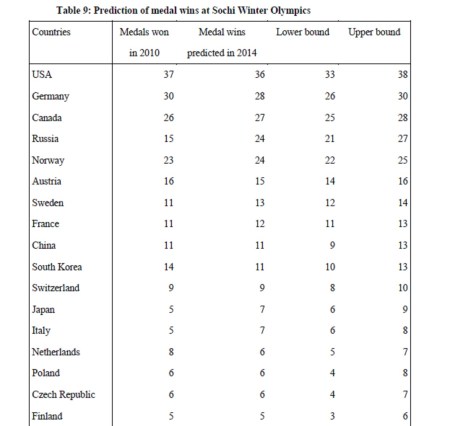
Medal predictions Sochi 2014 – M Andreff
PWC Medal Predictions

PWC sochi predictions
Press Release via ConsultantNews:
London, 31 Jan 2014As with the Summer Olympics, home advantage could play a key part in how the Winter Olympics medals are shared out next month – with hosts Russia looking set to capture a record haul.
But the hosts – along with close rivals Germany, Canada, Austria and Norway – will have their work cut out to catch the US team. Further down the table, after their London 2012 Olympics success, the GB team may have to settle for just a couple of medals. And unfortunately the cool Jamaican bobsled team don’t even make it into the running.
Once again, economists at PwC have used their skills to project the likely medal tally – this time for the Olympic Winter Games at Sochi starting on 7 February. Their analysis is based on econometric modelling, testing the historic correlation between a range of socio-economic metrics and historic medal success.
The modelling results show that the size of the economy is significant in determining success, with total GDP appearing as a significant variable. However, a large economy is not sufficient on its own for a strong performance. Climate is an important factor, with snow coverage and the number of ski resorts per head having a significant and positive impact on medal shares.
Larger, developed countries with the right climate dominate the top of the projected medals table; but Austria and Norway demonstrate that a smaller economy is not a barrier to success, with a greater estimated medal haul than countries such as China and France.
William Zimmern, PwC economist, said: “While this is a light-hearted analysis, it makes an important point of how organisations can use economic techniques to help make better business decisions. The purpose of our model is not to forecast medal totals with complete accuracy, but rather to increase the predictive power of medal projections over and above using historic medal results alone.
The model allows us to make better, more confident and more informed forecasts. Businesses can use similar techniques to do the same.”

Home advantage – PwC
We used regression analysis to produce the results in Table 1, employing a Tobit model to estimate medal share for the 28 countries which have won at least one medal in the last three Winter Olympics. The variables used were total GDP, ski resorts per head, level of snow coverage, medal shares in the previous two Winter Olympics, and dummies for countries with a “tradition” of winter sports and for host countries.
I have worked with PwC many times during my career. They are very effective but they are not slow in trying to take credit wherever they can – even if it is undeserved. And their ethics are generally as lacking as is endemic in their industry (audit/consultancy). A little bit of plagiarism by PwC – and not for the first time – would not be a great surprise.

 The k2p blog