Posts Tagged ‘Qantas’

Qantas grounds all A 380 flights following in flight failure of RR Trent 900

November 4, 2010

Reuters:

Qantas Airways suspended flights of its Airbus A380s on Thursday after one of the aircraft was forced to land in Singapore with engine trouble, one of the most serious incidents for the world’s largest passenger plane in its three years of commercial flight.

Qantas, which operates six A380s, said it was grounding the aircraft pending a full investigation. “We will suspend all A380 takeoffs until we are fully confident we have sufficient information about (flight) QF32,” Qantas Chief Executive Alan Joyce told reporters in Sydney.


Main Image

Indonesian police examine fallen debris from a Qantas jet collected from several areas on Batam island, an Indonesian territory near Singapore November 4, 2010. :Credit Reuters/Stringer


Singapore Airlines also uses Rolls Royce Trent 900 engines in its A 380s.

Related posts on Rolls Royce engine failures:

https://ktwop.wordpress.com/2010/11/04/qantas-a-380-suffers-in-flight-rr-trent-900-engine-failure/

https://ktwop.wordpress.com/2010/10/25/in-flight-failure-of-rb-211-524-engine/

https://ktwop.wordpress.com/2010/09/28/rolls-royce-trent-1000-fix-is-defined/

Qantas A 380 suffers in-flight RR Trent 900 engine failure

November 4, 2010

Updatedhttps://ktwop.wordpress.com/2010/11/04/qantas-grounds-all-a-380-flights-following-in-flight-failure-of-rr-trent-900/

Sydney Morning Herald

A Qantas A380 has been forced to return to Singapore’s Changi Airport after pilots were forced to shut down one of its four engines. QF32 was bound for Sydney with 443 passengers and 26 crew on board when the engine failed. “Qantas flight QF32 was en route from Singapore to Sydney, the number two engine has shut down, so as a precautionary measure we are taking it back to Singapore,” a Qantas spokeswoman said.


The wrecked engine after the plane landed in Singapore.

The wrecked engine after the plane landed in Singapore.Photo: AFP


Indonesian authorities said there had been some sort of explosion over the island of Batam, just south of Singapore. Elfhinta radio quoted a police officer in Batam, Eryana, saying parts of the plane had been found. “We are still collecting debris,” he said.

In a recent similar incident, an engine exploded on a Qantas flight to San Francisco on August 30, with debris tearing holes in the engine cover.

The Qantas A 380’s have 4 Rolls Royce Trent 900 engines.

The RR Trent 1000 destined for Boeing’s Dreamliner has had some problems during testing.

A month ago on 28th September, a Singapore Airlines A380 also suffered a failure of one of it’s 4 Trent 900 engines.

An engine problem on a Singapore Airlines A380 superjumbo airliner was a “non-event” in technical terms, the chief executive of the company that built it said yesterday. Singapore Airlines said the plane carrying 444 passengers from Paris to Singapore was forced to return to the French capital on Sunday when the as-yet unspecified problem was detected two and a half hours into the flight.

The A380 is the world’s largest passenger airliner and Singapore Airlines (SIA) is the first to take delivery of it, having ordered 19 with an option for six more. Speaking in Paris, Louis Gallois, chief executive of Airbus manufacturer EADS, called the incident “a complete non-event”.

“Engine failure on a four-engine aircraft does happen and nobody should think of it as a drama,” Gallois told journalists. “In technical terms, it is not an event.”

Background: (Wikipedia)

The A380 can be fitted with two types of engines: A380-841, A380-842 and A380-843F with Rolls-Royce Trent 900, and the A380-861 and A380-863F with Engine Alliance GP7000 turbofans. The Trent 900 is a derivative of the Trent 800, and the GP7000 has roots from the GE90 and PW4000. The Trent 900 core is a scaled version of the Trent 500, but incorporates the swept fan technology of the stillborn Trent 8104. The GP7200 has a GE90-derived core and PW4090-derived fan and low-pressure turbo-machinery. Only two of the four engines are fitted with thrust reversers.

In flight failure of RB 211-524 engine

October 25, 2010

WA Today reports:

Air safety investigators have found extensive turbine damage in the jet engine that exploded on a Qantas jumbo at 25,000 feet near San Francisco in August this year. Engine parts that were flung outwards tore not only a gaping hole on the far side of the engine cover but also peppered the near-side with holes, air safety investigators have revealed. As the engine vibrated, debris ejected through the engine hole hit the underside of the wing, puncturing the wing flaps, investigators have found.


A Qantas jet was forced to turn back to San Francisco after a hole was blown in the shell of the engine.

Flight QF74 failure of RB211-524 engine:Photo: Channel Ten


The findings are contained in a preliminary report by the Australian Transport Safety Bureau (ATSB) into the explosion on flight QF74, carrying 213 passengers and 18 crew, on August 30. The incident occurred 15 minutes after take-off.

The pilots shut down the engine, sought landing clearance, dumped fuel and landed safely at San Francisco, where the plane was met by fire crew, inspected and allowed to taxi to the terminal. This was an exceptionally rare event and the first time Qantas has experienced this type of engine failure,” a Qantas spokesman said.

All of the engine’s turbine blades had either fractured or broken away, investigators said. There was also damage of other engine internals including vanes, bearings, speed probes and a turbine shaft. Further testing of engine components will be undertaken by Rolls-Royce, overseen by UK air safety investigators. The Rolls-Royce RB211-524 engine was removed from the aircraft and taken to Hong Kong for examination. The investigation is continuing.


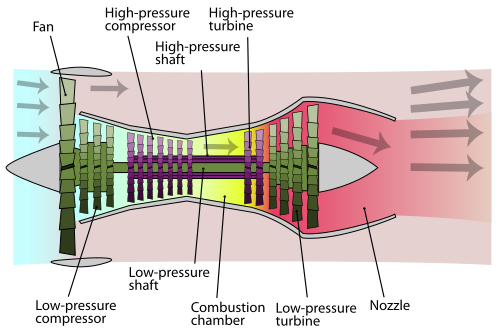
Turbofan engine operation: Wikimedia


RB 211-524: aircraftenginedesign.com


The RB 211 family is a high bypass turbofan engine originally designed for the Lockheed Tristar. The 211-524 engine was developed with increased thrust and efficiency for the Boeing 747-200 and further improvements led to the 211-524 G and 211-524H for the Boeing 747-400 and for the 767. The 211 family has led to the Trent engines and some features of the Trent could be retrofitted to create the 211-524G-T and the 211-524H-T. A newer version of the same family the 211-535 series is used in Boeing 727’s and 757’s.

An industrial version of the RB211 is used for power generation and another inter-cooled version is used in marine applications.

The Rolls Royce Trent 1000 engine designed for Boeing’s Dreamliner has had some initial testing setbacks which seem to be fixed but which has caused some of the delays to the Dreamliner.