Posts Tagged ‘Reto Dorta’

Update on the Dorta-Drinkel paper

August 20, 2013

To “close” the story on my previous posts (here and here), this post at the Chemistry blog brings a kind of “closure” though some more details will no doubt surface.

Prof Dorta has apparently responded recognising that his “just make up an elemental analysis..” comment was “inappropriate”. The Editor of Organometallics has also made a lengthy response – quite unusual for an Editor to be so forthcoming and to “step-up”:

….

Best wishes,

John Gladysz
(on whose desk “the buck stops” for everything, good and bad, at Organometallics)

He also leaves a comment at ChemBark (which itself is worthy of note as an interaction between the Editor of a Peer-reviewed Journal and a blog)

…..

Thus, with respect to the Dorta manuscript and Drinkel thesis, we will be focusing (apart from many other questions) on whether the reported procedures give solvated or unsolvated products (it cannot be both), and then whether the yields given are correct (we have done the calculations both ways, and also looked at the NMR spectra per the group handout).

Quite possibly there has been carelessness and there are clearly some mistakes, but – hopefully –  not much in the way of “underhand behaviour” or misconduct.

The full responses from Prof. Dorta and John Gladysz are over at the Chemistry blog.
Fallout from the Dorta – Drinkel paper

August 18, 2013

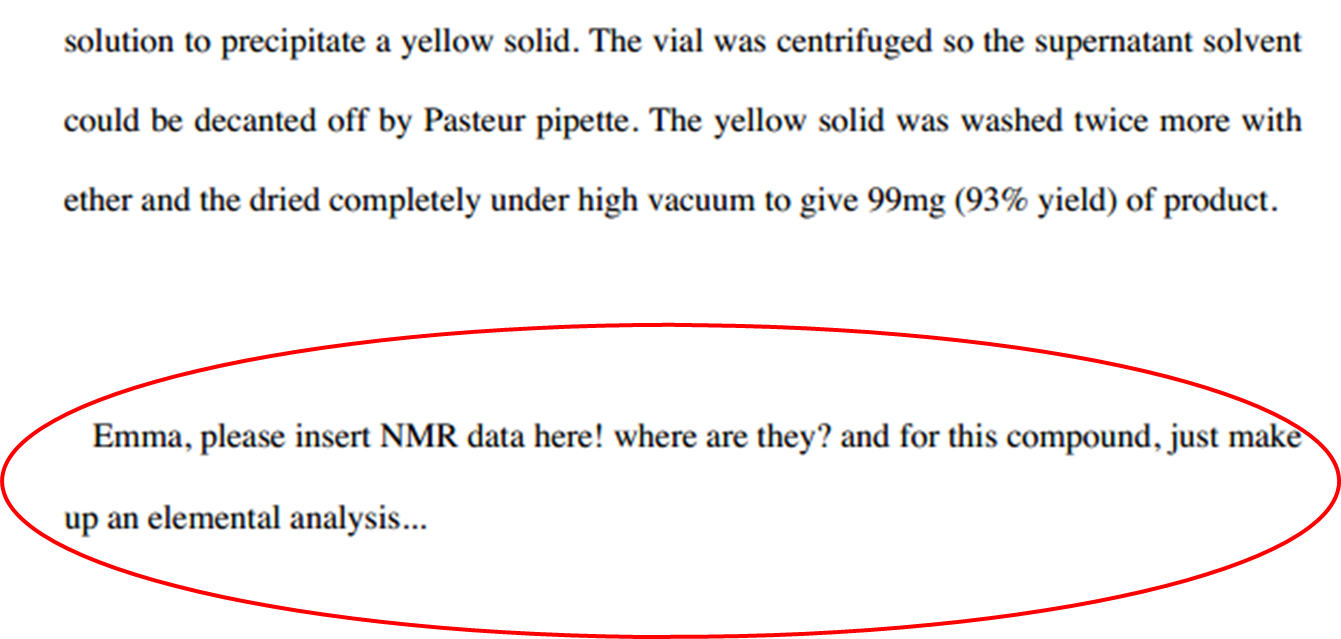
When publishing a paper based on her thesis, Professor Reto Dorta apparently “instructed” Emma Drinkel to “make up an elemental analysis” which – to her credit – she did not. But the “instruction” was inadvertently left in the supplemental information to the paper (which itself was rather sloppy editing and by her but his responsibility as the corresponding author).

Apparently since the news came out in ChemBark and RetractionWatch and other sites, Emma Drinkel’s reputation and career are severely threatened and the attention and “hounding” she has received has caused much distress. Quite probably much of the criticism is the usual anonymous abuse in the blogosphere and quite unjustified.

But what is missing as far as I am aware is any “explanation” from Prof. Reto Dorta who wrote the “instruction” and was the senior author and – presumably – her supervisor. Though it was a very long time ago since I was subject -academically – to the whims and the power of a supervisor, I know how difficult it is to resist a supervisor’s instructions. Was he in the habit of giving such “instructions” to his students?

Synthetic Remarks carries an admirable post entitled “In Defense of Emma with an email from Emma’s mother which does not need any commentary.

From: Mary-Anne Drinkel [mailto:xxxxa@xxxx.co.uk]
Sent: 15 August 2013 21:04
To: Fredrik von Kieseritzky ‘xxx@xxx.com’
Subject: Emma Drinkel – the Dorta Affair

Dear Dr Kieseritzky

I hope you don’t mind me contacting you, but I would just like to thank you for your comment on ChemBark. My name is Mary-Anne Drinkel, and I am mother of Emma. We are very proud of our daughter she has worked hard and conscientiously to earn her first class degree at Durham, her PhD at Zurich, and presently her Post doctorate work in Brazil- we know that fabricating data would be alien to her. I cannot believe that her good reputation, built up over these years can be destroyed in a week. I know nothing of the academic community, but the hostile and aggressive comments left on the blog sites are unbelievable. I don’t know if Reto Dorta was careless or has done a very bad thing, but I do know that Emma is the innocent party in this affair. How many PhD thesis could withstand the hostile scrutiny that Emma’s has been subjected to, with these bloggers determined to find evidence of wrongdoing – boasting about who broke the news first.

Emma’s husband has a new industry position in Switzerland, and they will be moving back to Europe very soon; this means Emma will be applying for jobs – she fears this affair will affect her chances, as she would be honest with prospective employers about her situation. They had decided to leave the academic world long before this episode because the competitiveness and political environment of university life was not for them. Emma is devastated that her good name at Durham and Zurich University will be forever tarnished by this affair.

My husband and I have felt so sad and so helpless as these events have developed – when I saw your comment that was sympathetic to Emma’s plight, it was the first bit of humanity I had witnessed in the whole affair, and I am grateful to you for that. Emma will get through this, she is resilient and has the support of her husband, family and friends – but we feel so angry that Emma has been subjected to this through no fault of her own.

Once again thank- you,

Best wishes,

Mary-Anne Drinkel

“Just make up an elemental analysis…..”

August 8, 2013

ChemBark has the details of this case where sloppy writing and/or editing shows up some not so ethical behaviour:

Just make up the data..

Just make up the data ……

This instruction apparently from the senior author to the first author was found inadvertently left in the Supplemental Information for this paper – which has been archived here in case it disappears: SI Emma E Drinkel et al.

What is particularly noteworthy is the casual nature of the instruction to “just make up the data…”. It would almost appear that faking data is a routine and regular procedure. Less shocking but a telling commentary on the review process is that such a statement made it all the way to publication.

Emma E. Drinkel, Linglin Wu, Anthony Linden and Reto Dorta, Synthesis, Structure and Catalytic Studies of Palladium and Platinum Bissulfoxide Complexes, Organometallics, Article ASAP, DOI: 10.1021/om4000067

The affiliations of the authors is given as  the University of Zurich, but the senior author, Professor Reto Dorta now seems to be at the University of Western Australia while Emma Drinkel is in Brazil at the Universidade Federal de Santa Catarina.

ChemBark:

A recently published ASAP article in the journal Organometallics is sure to raise some eyebrows in the chemical community. While the paper itself is a straightforward study of palladium and platinum bis-sulfoxide complexes, page 12 of the corresponding Supporting Information file contains what appears to be an editorial note that was inadvertently left in the published document:

Emma, please insert NMR data here! where are they? and for this compound, just make up an elemental analysis…

This statement goes beyond a simple embarrassing failure to properly edit the manuscript, as it appears the first author is being instructed to fabricate data. Elemental analyses would be very easy to fabricate, and long-time readers of this blog will recall how fake elemental analyses were pivotal to Bengu Sezen’s campaign of fraud in the work she published from 2002 to 2005 out of Dalibor Sames’ lab at Columbia.

The compound labeled 14 (an acac complex) in the main paper does not appear to correspond to compound 14 in the SI. In fact, the bridged-dichloride compound appears to be listed an as unlabeled intermediate in Scheme 5, which should raise more eyebrows. Did the authors unlist the compound in order to avoid having to provide robust characterization for it? ….

Related:

 Insert data here … Did researcher instruct co-author to make up results for chemistry paper?

When Authors Forget to Fake an Elemental Analysis