Posts Tagged ‘Russia’
June 23, 2011
Two days ago:
21st June: A Russian plane exploded into flames after crashing on a highway just short of its airport, killing 44 and leaving eight survivors fighting for their lives, officials said Tuesday.
The RusAir Tupolev 134 was trying to land at its destination of Petrozavodsk in the Karelia region of northwestern Russia in bad weather but failed to make the runway and instead hurtled onto a road 1.25 miles away.
The impact of the landing blasted parts of the plane and corpses of the passengers several hundred meters distant as the burning wreckage blazed in the night sky.
“The plane sustained a hard landing two kilometres from Petrozavodsk,” the emergencies ministry said in a statement on its website. “Forty-four people were killed and eight people injured.”

The wreckage of Tu-134 plane, belonging to the RusAir airline, is seen on a highway near the city of Petrozavodsk Tuesday, June 21, 2011. Photo AP
But today’s Haaretz reports that:
Nuclear experts killed in Russia plane crash helped design Iran facility.
The five Russian scientists were among 44 killed earlier this week; no official investigation of foul play has been opened, though Iranian nuclear experts have in the past been involved in similar accidents.
The five nuclear experts killed in a plane crash in northern Russia earlier this week had assisted in the design of an Iranian atomic facility, security sources in Russia said on Thursday.
The experts – who included lead designers Sergei Rizhov, Gennadi Benyok, Nicolai Tronov and Russia’s top nuclear technological experts, Andrei Tropinov – worked at Bushehr after the contract for the plant’s construction passed from the German Siemens company to Russian hands.
The five were employed at the Hydropress factory, a member of Russia’s state nuclear corporation, and one of the main companies to contract for the Bushehr construction.
While sabotage is not being mentioned officially as a reason for the crash it is not far away from the thoughts of the investigators.
Israeli covert activities have previously been blamed by the Iranian government for the death of two of their nuclear scientists.
Tags:Aviation accidents and incidents, Bushehr, conspiracy theory, Iran, Iran nuclear program, Russia
Posted in Aviation, Nuclear Power, Russia | 3 Comments »
February 15, 2011
Perhaps humanity as a whole has not come as far as we think from the days of Genghis Khan and the inquisitions of the Catholic Church and witch doctors and shamans.
Reuters reports:
Does the sun revolve around the Earth? One in every three Russians thinks so, a spokeswoman for state pollster VsTIOM said on Friday.
In a survey released this week, 32 percent of Russians believed the Earth was the center of the Solar system; 55 percent that all radioactivity is man-made; and 29 percent that the first humans lived when dinosaurs still roamed the Earth.
The study also found that women were more likely than men to believe the scientific fallacies.

image: crooksandliars.com
Tags:Russia, Solar System, Sun orbits earth
Posted in Russia, Trivia | Comments Off on One in three Russians believes the sun revolves around the earth!
January 30, 2011
Ria Novosti today:

MOSCOW, January 30 (RIA Novosti) 18:45 30/01/2011
The Russian icebreakers Krasin and Admiral Makarov have rescued the ice-trapped mother fishery ship Sodruzhestvo ending the month-long operation in the Sea of Okhotsk.
“The operation to rescue the Sodruzhestvo mother ship out of ice trap has been completed,” Russia’s Ministry of Transport said in a statement on Sunday.
The icebreakers resumed towing the vessel, stuck in the Sea of Okhotsk, toward clear waters on Wednesday. The rescue operation was earlier suspended due to poor weather conditions.
The Sodruzhestvo, Bereg Nadezhdy ship and the Professor Kizevetter research vessel, carrying altogether over 400 people, got stuck in two-meter-thick ice in the Sea of Okhotsk on December 31. Two other ships, the Mys Yelizavety and the Anton Gurin, became trapped a few days later.
The Admiral Makarov released the Professor Kizevetter and the Mys Yelizavety vessels from the ice trap, while the Anton Gurin managed to cope on its own. The Bereg Nadezhdy was successfully towed to clear water on January 24.
Tags:Icebreaker Admiral Makarov, Icebreaker Krasin, Russia, Sea of Okhotsk
Posted in Engineering, Environment, Russia, Technology, Weather | Comments Off on Okhotsk rescue over and icebreakers end operations
January 19, 2011
While the icebreakers had broken through the worst of the ice, the rescue is not yet over and my previous post was a little premature.
A report of the latest news is available here: http://eureferendum.blogspot.com/2011/01/its-not-over.html
I was not expecting to be writing about the Okhotsk Sea today, but in yesterday’s account there were warnings that the crisis was not quite over. And indeed that is the case, with Voice of Russia observing that the rescue operation “will not be over today”. Conditions appear to have deteriorated sharply and, last night, the four-ship convoy covered “no more than three miles”. A helicopter is out reconnoitring the ice situation today.

The convoy in the Sea of Okhotsk
Tags:Icebreaker, Okhotsk Sea, Rescue, Russia
Posted in Engineering, Environment, Russia, Technology | Comments Off on Sea Of Okhotsk rescue not quite over yet
January 14, 2011

Depths in Sea of Okhotsk: Image via Wikipedia
The suspended rescue operation of the trapped ships in the Sea of Okhotsk has restarted and is progressing slowly in deteriorating weather and increasing ice.
From Ria Novosti:07:45 14/01/2011
Russia’s Krasin and Admiral Makarov icebreakers continue to lead the Sodruzhestvo mother fishery ship through thick ice floe to clear waters, the Far Eastern Shipping Company said Friday.
The fishing ship with about 300 people on board has been stranded in heavy ice in the Sea of Okhotsk for two weeks. The Admiral Makarov and Krasin started towing the vessel on Wednesday afternoon, but towing ropes snapped soon after the start of the operation. The rescue resumed on Thursday morning.
“The convoy has covered 17 miles since the beginning of the rescue operation, and will reach the Bereg Nadezdy refrigerator ship after another eight miles,” spokeswoman Tatyana Kulikova said. “After the meeting with the refrigerator, they will face a very difficult stretch of ice floe before reaching clear waters.”
According to the rescue plan, the icebreakers will continue towing the Sodruzhestvo, while the Bereg Nadezhdy will attempt to sail on its own along the channel cut in the ice by Admiral Makarov and Krasin.
The weather conditions in the area continue to deteriorate rapidly. Strong winds, low visibility and shifting ice floes hamper the rescue effort, the spokeswoman said.
Photographs from the Sea of Okhotsk can be seen here:
http://en.rian.ru/photolents/20110111/162101793.html
and here:
http://english.ruvr.ru/photoalbum/39338590/39338722/index.html
Related: https://ktwop.wordpress.com/2011/01/03/unusually-thick-ice-traps-ships-in-the-sea-of-okhotsk/
https://ktwop.wordpress.com/2011/01/11/sea-of-okhotsk-rescue-update-tartar-straits-frozen-to-the-bottom/
Tags:Admiral Makarov, Krasin, Rescue, Russia, Sea of Okhotsk, Sodruzhestvo
Posted in Engineering, Environment, Russia, Technology | Comments Off on Sea of Okhotsk rescue operations restarted
January 10, 2011
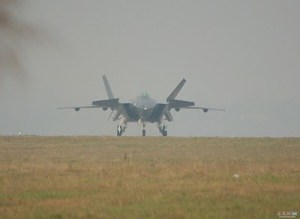
Both China and India are developing 5th Generation stealth fighters; China on its own and India as part of a joint development programme together with Russia.
From http://china-defense.blogspot.com/2010/12/latest-batch-of-j-20-photos.html
Rumours from China’s Chengdu Aerospace Corporation (CAC) and the adjoining Aircraft Plant No 132 suggest that a flight of a Chinese-developed fifth-generation fighter prototype would take place by the end of the year. Reportedly, two airframes (numbered 2001 and 2002) have been assembled at the 132 plant.
In August 2008 it was reported that 611 Institute was selected to be the main contractor for the development of the fifth-generation stealthy J-20, and that 601 Institute was the sub-contractor. It was rumored that 611 Institute has started to issue manufacturing drawings for constructing the first prototype, which is expected to fly by 2012, even though the full configuration one won’t fly until a few years later. The latest rumor suggested that a full-scale mock-up had been built at CAC.
From http://www.globalsecurity.org/military/world/china/j-xx.htm

Sukhoi PAK FA T50: image wikipedia
Russia and India are jointly developing the Sukhoi PAK FA / T-50 , which first flew in January 2010. In June 2001, India was offered ‘joint development and production’ of this new 5th generation fighter by Russia. Russia had been trying to sell this concept both to China and India for some time. It seems probable that China declined to participate in this project given a belief that Russia stood to gain more from Chinese participation than did China. That is, it would seem that China had determined that it could produce a superior product without Russian help. With the first flight of the Russian stealth fighter in 2010, an arguably superior Chinese steath fighter might be expected to take to the skies not too long thereafter.
Chinese combat aviation has made remarkable strides in recent years, moving from a collection of obsolete aircraft that would have provided a target-rich environment to potential adversaries. Today China flies hundreds of first rate aircraft, and even flies more Sukhoi Flankers [the aircraft the American F-22 was designed to counter] than does Russia. The Chinese stealth fighter has arrived right on schedule. Chinese military technology is generally rated about two decades behind that of the United States. while the advent of a Chinese counterpart to the F-22 fighter might be disconcerting, the first flight of the prototype American F-22 stealth fighter came on September 29, 1990.
New Delhi, December 21, 2010: India and Russia on Tuesday finalised a contract for the biggest defence programme in the country’s history — a $30-billion (Rs 1,35,000-crore) project involving the joint production of 200-250 fifth generation fighter aircraft (FGFA). The aircraft, being called the perspective multi-role fighter (PMF), will exploit the basic design of the Russian Sukhoi T-50 PAK-FA prototype, with modifications thrown in to meet the Indian Air Force’s “more stringent specifications”. The 30-tonne aircraft will be a swing-role fighter with stealth features for increased survivability, advanced avionics, smart weapons, top-end mission computers and 360-degree situational awareness. What will put the co-produced fighter in a different league is its ability to supercruise, i.e. sustain supersonic speeds in combat configuration without kicking in fuel-guzzling afterburners. Currently, the US Air Force’s F-22 Raptor is the only fighter in the world that can supercruise.
The contract for the joint design and development of the FGFA was signed between Hindustan Aeronautics Limited and two Russian firms, Sukhoi Design Bureau and Rosoboronexport. The fighter will be jointly marketed to international air forces. The first prototype flew its maiden sortie in January 2010 and has conducted more than 40 flights. The IAF hopes to induct it by 2018.
A joint statement issued by the ministry of external affairs said Prime Minister Manmohan Singh and Russian President Dmitry Medvedev agreed that the December 2009 pact covering bilateral military cooperation during the next decade would lead to a more substantive engagement cutting across joint research and development, manufacturing and marketing activities.

HAL Tejas: Image via Wikipedia
India today joined a select group of nations manufacturing warplanes with the home-grown Light Combat Aircraft ‘Tejas’ moving a step closer to its induction into the Indian Air Force after getting its Initial Operational Clearance (IOC) here.
27 years after the project was initiated, defence minister AK Antony handed over the IOC certificate to Air Chief Marshal PV Naik at the HAL airport in Bangalore.
“This is only the semi-finals”, Antony said, adding the LCA would enhance national security and build the country’s own fighter aircraft capabilities.
The aircraft, with an investment of over Rs 14,500 crore ($3.2 billion), has been developed by DRDO’s Aeronautical Development Agency after battling technology denial regimes and sanctions for nearly three decades. “After crossing a number of challenges and accomplishing a significant series of milestones including weapon delivery, in over 1500 sorties, the country is poised for a major turning point with the declaration of the IOC,” Antony said.
The IAF has plans to induct a total of around 200 planes of which orders for the initial 40 have already been placed by the IAF.
The aircraft, which costs between Rs 180 to 200 crore ($45 million) per piece, is presently powered by American GE-F 404 engine and the advanced GE-414 engines have been chosen for powering the LCA Mk II aircraft, which are likely to be developed by 2014.
Tags:5th generation fighters, Chengdu J-20, China, India, Lockheed Martin F-22 Raptor, Russia, stealth fighters, Sukhoi PAK FA / T-50
Posted in Aviation, China, Defense, India, Russia | 2 Comments »
January 2, 2011
Xinhua News:
MOHE, Heilongjiang, Jan. 2 (Xinhua) — Some 42,000 tonnes of crude oil had as of 5:48 a.m. Sunday flowed through an oil pipeline linking Russia’s far east and northeast China, 24 hours after the pipeline began operating, a spokesman for the Chinese operator of the pipeline said.

Pipelines and oil storage tanks of China and Russia crude oil pipeline in Mohe, northeast China's Heilongjiang Province, Jan. 1, 2011: (Xinhua/Wang Jianwei)
The pipeline, which originates in the Russian town of Skovorodino in the far-eastern Amur region, enters China at Mohe and terminates at northeast China’s Daqing City. A total of 1.32 million tonnes of oil is scheduled to be transported to China through the pipeline in January, said a spokesman for Pipeline Branch of Petro China Co., Ltd. (PBPC), the operator of the Chinese section of the pipeline.
The 1,000-km-long pipeline will transport 15 million tonnes of crude oil from Russia to China per year from 2011 until 2030, according to an agreement signed between the two countries. Some 72 kilometers of the pipeline is in Russia while 927 km of it is in China.
Tags:China, Daquing city, Russia, Russia China oil pipeline, Skovorodino
Posted in China, Energy, Oil, Russia | Comments Off on Russian oil pipeline to China in operation
December 28, 2010
An interesting defence by Japanese fishing firms that bribes paid to Russian officials and deposited in Cyprus bank accounts were properly booked as “expenditures” and therefore not to be taxed as profits!!
(And from my own experience I conclude that there is no Japanese businessman – or politician – who believes there is anything wrong or unethical in bribing officials – especially in other countries. The only wrong is in paying too much or being caught.)
The Japan Times has the story (but of course does not comment on the ethics involved):
KUSHIRO, Hokkaido (Kyodo) One of four fishery firms hit for back taxes for allegedly making illicit payments to Russian officials denied any impropriety Monday and said the payments were a necessary expense. “We booked the money in the expenditure category (in accounting). It was not illicit money,” said Munemoto Nakayama, who runs Kanai Gyoin Kushiro, Hokkaido. The president spoke with reporters following media reports Sunday that Kanai and three other fishery firms provided about ¥500 million to Russian officials in the three years to 2009 so they could fish in Russia’s exclusive economic zone beyond the limits set under a bilateral agreement with Japan.
Sources said the tax authorities discovered the firms made the payments using irregular accounting methods and concluded the act constituted income concealment, ordering them to pay about ¥200 million in back taxes and penalties. Nakayama confirmed, as claimed in fresh media reports Monday, that the four firms, in addition to having given the money to Russian officials aboard their ships, remitted part of the ¥500 million to bank accounts overseas, including in Cyprus. “We have been doing Russia-related business for over 10 years and have remitted money (overseas),” he said. He also revealed that his company had already filed a revised tax return in connection with the payments as demanded by tax authorities. The four firms admitted paying the Russians to look the other way when their fish catches exceeded the legal quota, the sources said.

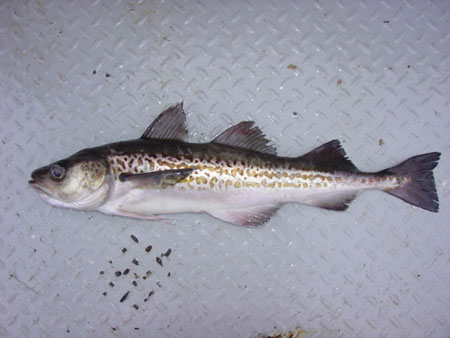
Walleye pollock: image wikimedia
Kanai, along with three other firms — Wakkanai Kaiyo in Wakkanai, Hokkaido, Kaiyo Gyogyo in Hachinohe, Aomori Prefecture, and Sato Gyogyo in Shiogama, Miyagi Prefecture — sends boats to Russia’s EEZ to catch walleye pollock. The annual catch quotas in Russia’s EEZ were set in the Russo-Japanese fisheries talks, and this year’s quota for walleye pollock was 10,925 tons, the Fisheries Agency said. Russian border security officials are usually present on Japanese boats to monitor their operations, the sources said. Investigative sources said they often hear of fishing companies paying the Russians and they appear to be wining and dining them as well.
Tags:Bribery and corruption, Bribing Russian officials, Japan, Japanese fishing firms, Russia
Posted in Behaviour, Business, Corruption, Ethics, Japan, Russia | Comments Off on Japanese fishing firms fight back taxes: “necessary” bribes to Russian officials paid into Cyprus banks
November 12, 2010

Natural gas pipelines from Russia to Europe: image via Wikipedia
“Peak gas” like “peak food” and “peak resources” and like all “peak scenarios” keeps getting postponed. The US is awash with shale gas and has started re-exporting LNG it had contracted for to Europe challenging the dominance of Russian supplies of natural gas.
Money control reports:
The United States may play a role this winter in loosening Russia’s grip on the European market for natural gas by shipping liquefied natural gas across the Atlantic. Awash with domestic shale gas and with little need to import extra fuel, the United States has started re-exporting LNG cargoes, which firms had previously imported under contract, to countries where gas prices are much higher.
Such shipments could contribute to a growing pool of cheaper LNG going to Russia’s biggest export market this winter. In the longer term, U.S. plans to build plants to liquefy shale gas could create another rival to Russian pipelines. The first re-export cargo from the United States to Britain — a key access point for LNG into northern Europe via an Interconnector pipeline to Belgium — is set to sail over the weekend. “It is a landmark shipment,” said Zach Allen at NATS LNG analysts in Raleigh North Carolina. “LNG has, through the Interconnector, played a major role in reducing intake of Russian gas into western Europe.”
U.S. shale gas has already forced many LNG producers that had hoped to supply the North American market to find alternative buyers, with many cargoes ending up in Europe and driving spot gas prices below the price of oil-indexed Russian gas.
US re-exports to Europe are the latest sign that increases in shale gas production have transformed the global gas market. The International Energy Agency said on Tuesday that a decade-long period of oversupply was likely to push oil-indexed gas sellers to accept lower prices.
In February, Russian gas export monopoly Gazprom postponed it’s Shtokman LNG project because the United States, its target market, did not need more imports. Major European pipeline gas supplier Statoil has been forced to find alternative markets for LNG it had hoped to send to the United States, often selling it into Europe. Qatar, the world’s largest producer and exporter of LNG, has also pushed into both Norwegian and Russian markets by making large deliveries of cheap LNG into Britain and Belgium. US LNG imports have fallen to contractual minimums as gas prices have sagged, forcing importers whose terminals are sitting idle to change strategy and re-export to make the most of higher prices overseas.
US gas at USD 4.1 per million British thermal units (mmbtu) was about USD 3.3/mmbtu below UK prices on Tuesday and just under half the price of Russian gas in Europe in October, according to International Monetary Fund data. About 20 billion cubic feet of gas has already been re-exported from the United States this year, with some sent to Asia, where buyers have paid nearly USD 10 per mmbtu, and some to Latin America and the Middle East.
More of those US loaded cargoes could head to Britain over coming months, given that winter price increases are sharper in northern Europe than in the United States and that imports by South American and Middle Eastern buyers are usually confined to summer.
“US exports to Europe will remain rather exotic, but they underline once again the big risks for Russia of focusing some of its future projects on US markets,” said Valery Nesterov, energy analyst at Moscow-based Troika Dialog brokerage.
Cheniere Energy, operator of the Sabine Pass import terminal in Louisiana, announced plans in June to build a liquefaction plant at the terminal. It said on Tuesday that US bank Morgan Stanley hoped to secure some of its export capacity. Pending approval, the plant would export US-produced shale gas to markets all over the globe from 2015. It would be the first US LNG export plant in 40 years — following the old Kenai facility which supplies Asia from Alaska — and would be well placed to supply Europe. “LNG supplies from the United States can help lower gas prices in Europe and Asia and ultimately help lift prices in the States,” said Mikhail Korchemkin from Pennsylvania-based East European Gas Analysis.
Tags:Europe, Gas price, Liquefied natural gas, LNG re-export, Russia, Shale gas, United States
Posted in Energy, European Union, International Trade, Investing, Technology, US | 2 Comments »
November 1, 2010
Now Vietnam is going nuclear with its first 2 plants coming from Russia and the next 2 from Japan. Unexploited rare earth deposits in Vietnam are receiving a great deal of attention from countries hit by the Chinese monopoly on rare earth supplies.
Chosun Ilbo reports
Russian President Dmitry Medvedev and his Vietnamese counterpart Nguyen Minh Triet have called for increased trade and investment between their two countries. The two leaders met Sunday in Hanoi to seal a nuclear plant construction agreement and other bilateral deals. Under the $5 billion agreement, Russia will build Vietnam’s first nuclear power plant. Construction is expected to start in 2014.
Asahi Shimbun reports on a deal where Japan gets access to the rare earth resources in Vietnam in exchange for two 1000 MW nuclear reactors worth 14.4 billion $ to the Japanese nuclear construction industry.
The nuclear reactor construction agreement, worth an estimated 1 trillion yen ($14.4 billion), gives the green light for Japanese companies to build nuclear facilities in an emerging nation’s fledgling nuclear industry for the first time.
The two reactors will be built in the southeastern province of Ninh Thuan and are scheduled to start operations in 2021. They will have a combined output of 2 gigawatts. Vietnam plans to build 14 nuclear reactors by 2030. Construction deals for four reactors in Ninh Thuan province have so far been agreed upon, including the two to be awarded to Japan. Russia won the rights to build two reactors in December last year.
Japan, which has been trying to use infrastructure exports as a springboard for its flagging economy, began bidding for the nuclear reactor project earlier this year. In August, a delegation of Japanese business leaders led by Japan’s industry minister visited Vietnam to lobby officials. They offered financial assistance and training for Vietnamese people.
Visiting Prime Minister Naoto Kan and Vietnamese Premier Nguyen Tan Dung also agreed on joint development of deposits in Vietnam of rare earth elements, part of a Japanese drive to reduce its reliance on China for supplies of the vital raw materials, which have been obstructed following a diplomatic dispute with Beijing.
A joint team of Japanese and Vietnamese businesses is currently applying for rare earth mining rights. The Japan Oil, Gas and Metals National Corp. discovered rare earth veins in the northern Lai Chau province about 10 years ago. Toyota Tsusho Corp., Sojitz Corp., and an arm of a Vietnamese public corporation have been preparing plans for joint development.
The underground reserves are believed to be capable of yielding 3,000 tons of rare earths a year, about 10 percent of Japan’s current annual requirement.
The Japanese government has offered to provide expertise and training in surveying, excavation, and processing the rare earth metals to Vietnam. Japan is also likely to dip into official development assistance to help the country build infrastructure such as roads and water supply near the mines. In a separate project, Sumitomo Corp. is looking into mining rare earths in Yen Bai province in the north of Vietnam.
Tags:Japan, Nuclear power, Nuclear renaissance, Rare earths, Russia, Vietnam
Posted in Business, Energy, Japan, Nuclear Power, Russia, Vietnam | Comments Off on Nuclear renaissance: Vietnam gets nuclear reactors from Russia and Japan, Japan gets access to rare earths






 The k2p blog