Posts Tagged ‘Saudi Arabia’

Gaddafi gains ground while protests spread to Saudi Arabia

March 11, 2011
Location of Benghazi within Libya.

Image via Wikipedia

The Gaddafi end-game gets murkier as he uses air power, regular troops and heavy artillery to retake towns controlled by the demonstrators. Zawaiyah and Ras Lanuf have been ruthlessly bombarded into submission. In the process many (at least 1000) Libyans have been killed by other Libyans. In the meantime NATO, the European Union, and the UN are dithering about the introduction of a no-fly zone across Libyan air space. It is conceivable that with no other forces coming into play Gaddafi could even try to retake Benghazi. In any event without US support such a no-fly zone would be difficult to implement. Any UN Security Council resolutions will be watered down since Russia and China have a fundamental aversion to the support of any group challenging authoritarian rule.

Gulf Arab states said the Gaddafi regime was illegitimate, and urged contact to be made with the rebels while President Barack Obama’s top intelligence adviser James Clapper predicted government forces would defeat the rebels.

Gaddafi has to go but the end-game for him and his family could be a long drawn-out affair. While France has recognised the rebel National Libyan Council as the legitimate government, other countries concerned that may well have to deal with Gaddafi for some time yet have not had the courage to follow suit. Berlusconi will see to it that any European consensus will be hard to come by.

But these hot and humid winds of change in North Africa and the Middle East represent a fundamental shift of political climate and are unlikely to be stopped. What is commonly known as the Sirocco is called Chom (hot) or arifi (thirsty) in North Africa and Simoom in Palestine, Jordan, Syria, and the desert of Arabia. In Libya it is called the Ghibli, in Egypt it is the Khamsin  and it is the Sharavin in Israel.

File:Persian Gulf Arab States english.PNG

map via Wikipedia

And the winds are now blowing towards the House of Saud. Yesterday (Thursday)

Saudi security forces fired on scores of protesters in the city of Qatif, according to two witnesses and an activist.

The protests took place one day ahead of a planned “Day of Rage” in the Middle Eastern country.

Defying a Saudi government ban on all kinds of public demonstrations, more than 100 people in the predominantly Shiite city in eastern Saudi Arabia urged authorities to release Shiite prisoners, the witnesses and activist said.

At some point, the witnesses said Saudi security forces shot to disperse the crowd. It was unknown if the forces fired rubber bullets or live ammunition. Those injured were taken to Qatif Central Hospital for treatment, the activist and witnesses said.

The Jerusalem Post writes:

The time after Friday prayers has proved to be crucial in popular uprisings that have brought down Tunisian and Egyptian rulers who once seemed invulnerable.

Gulf leaders are struggling to hold back an Internet-era generation of Arabs who appear less inclined to accept arguments appealing to religion and tradition to explain why ordinary citizens should be shut out of decision-making.

Saudi Arabia, the largest country in the Gulf, is home to Islam’s holiest sites – and is a long-time US ally that has ensured oil supplies for the West. More than 32,000 people have backed a Facebook call to hold two demonstrations in the country, the first of them Friday.

Riyadh has tried to counter the call with promises of money and other measures – including a pro-government Facebook page “against the revolution” with 23,000 supporters.

The protest movements hit populous Yemen a month ago, and spread to the Gulf states, where dynasties secured their rule in colonial times.

Bahrain – an island state, whose rulers look to Riyadh for support – has been the most vulnerable so far. This week, hardline Shi’ite groups formed an alliance to ditch the monarchy and turn Bahrain into a republic.

Saudi King Abdullah summons Bahraini King to receive his orders

February 24, 2011
King Abdullah bin Abdul Aziz. (2002 photo)

King Abdullah bin Abdul Aziz: Image via Wikipedia

That the King of Bahrain owes a sort of feudal allegiance to King Abdullah of Saudi Arabia is a reality on the ground. That the Saudis are most concerned about growing Iranian and Shi-ite ifluence  is also apparent. That Bahrain is “giving in” to demonstrators and – thereby – empowering the Shia majority is not a development that the Saudis like. That Bahrain may move from being an absolute monarchy towards a constitutional monarchy -or even worse- a parliamentary democracy is anathema in Saudi Arabia.

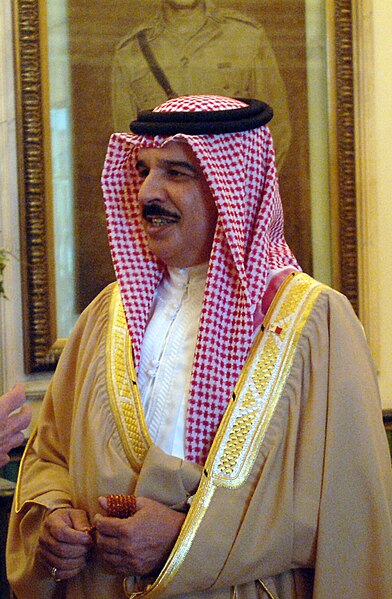
It is significant that the King of Bahrain, Shaikh Hamad bin Isa Al Khalifa, has rushed of to meet King Abdullah who has just returned after a long period abroad on medical grounds and can only be in response to a summons from his feudal lord. But Sheikh Hamad has a fine balancing act to perform. He must assuage the Saudi fears sufficiently to prevent an influx of a Saudi military presence into Bahrain while at the same time continuing the relaxation of his regulations to pacify his people. Saudi Arabia has instead decided to bribe its people rather than make any structural or political concessions and has announced $37 billion of financial benefits.

File:Hamad-Bin-Isa-Al-Khalifa.jpg

King Hamad-Bin-Isa-Al-Khalifa: image from Wikipedia

From the Washington Post:

MANAMA, BAHRAIN – On Wednesday morning, King Hamad bin Isa al-Khalifa boarded a plane to pay his respects to King Abdullah of neighboring Saudi Arabia, who had returned home after months abroad for medical treatments.

It was a trip that underscored the extent of Saudi Arabia’s sway over the teardrop-shaped island off its eastern shore, as well the prospect that the turbulence still whirling in tiny Bahrain could have outsize repercussions in its giant neighbor.

A day after tens of thousands of demonstrators turned out in Bahrain’s capital, the king is still under pressure from demonstrators who are demanding that he make democratic concessions or step aside. The Shiite-led protesters in Bahrain are demanding that the Sunni royal family grant them equal rights and an equal voice, and Saudi Arabia, home to Sunni Islam’s holiest sites, is worried that their campaign might give ideas to its own large Shiite minority. ……

……. “Saudi Arabia fears a constitutional monarchy in Bahrain,” said Kristin Smith Diwan, an assistant professor at American University who studies Islamic movements in the Persian Gulf region. “It’s about empowerment of the Shia and what that might mean for Shia in the eastern province” of Saudi Arabia, she said, in addition to fears about Iran’s influence, which she deemed largely unjustified.

“In this current crisis, none of the solutions look good for Saudi Arabia,” Diwan said. “A crackdown in Bahrain would be destabilizing. A reform itself would be destabilizing, unless Saudi Arabia was willing to make some reforms.”


Oil price drops as Mubarak steps down – will Saudi Arabia follow?

February 12, 2011

We are in for a period with very volatile oil prices as the Middle East enters the age of “people power”. It is quite unlikely that this wave of popular “revolt” will stop with Tunisia and Egypt. Yemen is already showing signs and Libya, Algeria, Morocco, Jordan and the Gulf States are all regimes with a potential for revolution. Saudi Arabia is the big one though for oil price.

But the events in Egypt with no clear political leader and with no retaliatory violence to deliberate provocation are both amazing and encouraging. There is a widespread political maturity that is quite fantastic after 30 years of authoritarian rule.

The Hindu reports:

Besides Egyptian President Hosni Mubarak’s stepping down, the rising dollar index and rally of U.S. stocks triggered oil selling and sent the price to a 10-week low. …

… Light, sweet crude for March delivery dropped 1.15 dollars to 85.58 dollars a barrel on the New York Mercantile Exchange, its lowest settlement since Nov. 30, 2010. The crude oil price went up and down following Egypt’s fears and joys. The commodity had experienced an approximately 6 percent price increase since the crisis began on Jan. 25. Much of that move pertained to the uncertainty surrounding the leadership of Egypt. Although Egypt is not a main oil producer, it controls the Suez Canal, which is an important transportation route for oil from the Middle East.


The short term consequences for oil price when (and it has to be “when” and not “if”) the Saudis finally dismantle the anachronistic regime they have cannot be predicted. But the long-term consequences will probably be a reduction of the base price.

The key is when. It is also amazing in this information and “spying” dominated world that the entire intelligence community had no inkling  of what was coming in Tunisia and Egypt. Information was probably available but clearly no one made the correct analysis or drew the right conclusions.

Saudi Arabia vulnerable to volcanoes

September 28, 2010

Saudi Arabia’s deserts are not usually associated with volcanic activity but Reuter’s reports that:

Fissures formed in western Saudi Arabia during the earthquake swarm

Magma has worked its way up to just under the surface in a remote region of northwest Saudi Arabia, causing a flurry of small to moderate quakes and threatening to form a new volcano, researchers said Sunday. A swarm of 30,000 quakes shook the region of Harrat Lunayyir from May to June last year and opened an 5-mile long rift, the U.S. Geological Survey team reported.

A wary Saudi government evacuated 40,000 residents at the time but has since let them move back home. But the residents should be ready to leave again if the ground starts to shake, the USGS team reported in the journal Nature Geoscience.

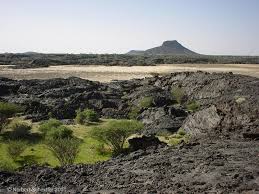
Harrat Lunayyir volcano is located in NW Saudi Arabia

“This finding indicates that the region is at risk from significant geohazards,” John Pallister of the USGS and colleagues at King Abdullah University of Science and Technology in Saudi Arabia and elsewhere wrote. The area is known for its lava fields, called harrat in Arabic, as well as small volcanic cones and volcanic ash called tephra. “The 2009 intrusive episode at Harrat Lunayyir, along with geomorphically young lava and tephra deposits are reminders that, although eruptions are not frequent, the harrat fields remain active and potentially hazardous,” they wrote.